What if a single burst pipe at 3 AM could cost you more in emergency call-out fees than your entire annual insurance premium? As trade costs continue to climb in 2026, many property owners are finding that the landlord home emergency cover cost is a small price to pay for avoiding the financial sting of independent contractors. You likely already know the frustration of handling tenant complaints during a weekend boiler failure or trying to decipher vague exclusions in a standard policy. It’s a stressful balancing act between protecting your investment and maintaining your margins, especially when the average household property claim has reached approximately £6,200 according to the Association of British Insurers.
This guide helps you understand current market pricing and how to secure reliable protection without overpaying for unnecessary extras. We’ll look at the value of fixed repair costs and how having a plan for rapid emergency repairs ensures you stay compliant with habitable property standards. Just Quote Me for a clear path through the complexities of rental protection. Whether you need to safeguard a single flat or a growing portfolio, we provide the clarity you need to move forward with confidence.
Get Your Free Business Insurance Quote now.
Request a Call back for free Expert advice.
Key Takeaways
Understand why priority access to vetted tradespeople is essential in 2026 to bypass widespread contractor shortages and long waiting lists.
Identify how property type and the age of your heating system, specifically the “7-year rule”, directly impact your landlord home emergency cover cost.
Learn the strategic differences between bundling emergency protection as a landlord insurance add-on versus opting for standalone policies with higher claim limits.
Compare the predictable annual premium against the volatile expense of out-of-hours repairs and holiday surcharges that often exceed a full year of coverage.
Discover how leveraging broker expertise can provide access to specialized underwriters and bespoke rates that standard comparison sites often overlook.
What Is Landlord Home Emergency Cover and Why Does It Matter in 2026?
To understand What Is Landlord Home Emergency Cover, you must view it as a dedicated rapid-response mechanism. It’s a specialized policy designed to provide assistance when a sudden, unforeseen event makes your rental property unsafe, insecure, or uninhabitable. While standard landlord insurance typically handles long-term claims like fire or flood damage, emergency cover focuses on the first 24 to 48 hours of a crisis. In 2026, this distinction is more critical than ever. Severe contractor shortages across the UK have made it difficult for individual landlords to secure tradespeople on short notice. Having insurance-backed priority access ensures you aren’t stuck on a waiting list while your tenants deal with a cold home.
There’s a clear line between home emergency cover and a property maintenance contract. Maintenance plans are proactive; they cover annual boiler services or fixing a leaky tap that’s been dripping for weeks. Emergency cover is reactive and urgent. It’s the difference between a slow drip and a burst pipe flooding a kitchen. With an estimated 400,000 UK landlords currently operating without any insurance, many are left vulnerable to the high costs of independent out-of-hours call-outs. When you consider that the average household property claim is approximately £6,200, the landlord home emergency cover cost becomes a sensible investment in risk management. It also helps you meet your legal obligations under the Homes (Fitness for Human Habitation) Act, which requires landlords to ensure properties remain safe for the duration of a tenancy.
Standard Inclusions in Home Emergency Policies
Most policies focus on the essential systems required to keep a home functional. This includes the total failure of your primary heating system or boiler, which is often the most frequent cause for a claim. You’ll also find coverage for plumbing and drainage emergencies, such as blocked toilets or internal pipe bursts that threaten to damage the property structure. Security is another pillar; if a tenant loses their keys or a break-in leaves a window smashed, the policy provides immediate boarding up or lock replacement to secure the premises.
What Constitutes a ‘Genuine’ Emergency?
For a claim to be valid, the situation must meet the “unsafe or uninhabitable” threshold. This means the problem must pose a risk to the tenant’s health or the property’s security. A total power failure qualifies, but a single flickering lightbulb does not. It’s important to remember that these policies exclude routine wear and tear. If a boiler fails because it hasn’t been serviced in a decade, the claim might be rejected. Just Quote Me to find a policy that balances comprehensive protection with a manageable landlord home emergency cover cost.
Get Your Free Business Insurance Quote now.
Request a Call back for free Expert advice.
Factors Influencing Landlord Home Emergency Cover Cost
Calculating your potential insurance spend requires looking beyond a standard quote. Several variables dictate how underwriters view your property’s risk profile. Understanding the Factors Influencing Landlord Home Emergency Cover Cost is essential for any property owner aiming to balance comprehensive protection with a sustainable budget. For instance, a House in Multiple Occupation (HMO) typically commands a higher premium than a single-occupancy flat. This isn’t just about size; it’s about the increased strain on plumbing and heating systems when multiple households share the same infrastructure. More tenants mean a higher statistical probability of a call-out, which insurers factor into your annual rate.
The age of your boiler is perhaps the most significant individual factor. Many UK insurers apply the “7-year rule,” where premiums rise or coverage options narrow once a heating system passes its seventh anniversary. Older boilers are statistically more likely to suffer from part failures or “sludging,” and sourcing components for discontinued models can be expensive for the insurer. If your system is particularly aged, you might find that your landlord home emergency cover cost increases to reflect the heightened risk of a total breakdown. In some cases, insurers may only offer a contribution toward a new boiler rather than a full repair for systems over a certain age.
Geographic location also plays a quiet but powerful role. Labor rates for emergency tradespeople aren’t uniform across the UK. Landlords with portfolios in London or the South East often face higher premiums because the underlying cost of dispatching a plumber or electrician at midnight in these regions is significantly higher than in the North. Additionally, your choice of claim limit—typically between £500 and £1,000—will shift the needle. A lower limit might reduce your monthly commitment, but in 2026, a £500 cap may barely cover a complex out-of-hours repair once parts and VAT are included. If you’re unsure which level fits your portfolio, you can compare residential letting insurance options to see how these limits interact with your broader coverage.
How Property Age and Condition Affect Premiums
Older properties often come with character, but they also bring legacy plumbing and outdated wiring. Insurers look closely at the risk of burst pipes in Victorian or Edwardian conversions where insulation may be less effective. Similarly, roofing materials like slate can be more susceptible to storm damage than modern tiles. To keep your landlord home emergency cover cost manageable, ensure your gas safety certificates and electrical reports are up to date. Most insurers won’t honor an emergency claim if you haven’t met these basic regulatory requirements.
The Impact of Cover Limits and Excess
You’ll often choose between “Zero Excess” and “Contributory” policies. A zero-excess plan means you pay nothing at the point of service, but your annual premium will be higher. Conversely, a contributory policy might require you to pay the first £50 or £95 of a call-out, which lowers your ongoing costs. It’s a pragmatic choice: pay more now for total peace of mind, or take a small hit only when a problem actually occurs. Always check the ceiling for labor and parts to ensure it covers the reality of modern trade prices.
Get Your Free Business Insurance Quote now.
Request a Call back for free Expert advice.
Comparing Coverage: Add-on vs. Standalone Emergency Policies
Deciding how to structure your protection is a strategic choice that directly impacts your total landlord home emergency cover cost. Most property owners begin by adding emergency assistance to their existing landlord insurance policy. This integrated approach is often the most cost-effective route for those with one or two properties. It eliminates the need to manage multiple contracts and ensures that your primary insurer is aware of any urgent repairs that could lead to larger buildings claims later. However, convenience shouldn’t lead to complacency. You must verify that your core policy doesn’t already include basic emergency assistance, as “double insurance” can lead to paying twice for the same level of risk without any added benefit.
Standalone policies offer a different set of advantages, particularly for portfolio landlords or those managing high-spec properties. While an add-on might be cheaper, it often comes with lower claim ceilings and more restrictive terms regarding the age of the boiler. If you require higher limits or specialized response times, a standalone specialist policy might be the better fit. Off-the-shelf bundles found on comparison sites rarely account for the nuances of your specific rental business. Working with a broker allows you to access bespoke deals and underwriters that prioritize the long-term stability of your investment over simple, generic coverage.
The Benefits of Integrated Landlord Insurance
Bundling your coverage simplifies your administrative burden significantly. Having a single renewal date and one point of contact for all property issues saves time and reduces the risk of a policy lapsing. For those managing several units, transitioning to commercial property insurance can often unlock multi-property discounts that aren’t available on individual standalone plans. Unified claims handling is another major plus. If a burst pipe causes structural damage, a single insurer can manage the emergency plumber and the subsequent flooring repairs simultaneously, preventing communication gaps between different providers.
When to Consider a Standalone Specialist Policy
Standalone cover is often necessary when your property features high-value heating systems or complex infrastructure that standard add-ons won’t touch. These policies frequently offer customizable limits that exceed the typical £500 cap found in basic bundles. If you house vulnerable tenants, you might prioritize standalone providers that offer guaranteed response windows. This level of service ensures you remain compliant with safety standards while keeping your tenants satisfied. Just Quote Me to explore how different structures can optimize your landlord home emergency cover cost while maximizing your protection.
Get Your Free Business Insurance Quote now.
Request a Call back for free Expert advice.
The Real Cost: ‘Pay-as-you-go’ Repairs vs. Emergency Insurance
Relying on a “pay-as-you-go” approach for property maintenance might seem like a way to keep monthly overheads low, but it leaves you exposed to the volatile pricing of the 2026 trade market. When an emergency strikes out of hours, you aren’t just paying for a repair; you’re paying for the contractor’s availability in a high-demand environment. The landlord home emergency cover cost is a predictable, fixed expense that hedges against the unpredictability of independent call-out fees. In a landscape where trade inflation has pushed hourly rates to new heights, a single incident can easily eclipse the cost of an entire year’s premium.
The “Christmas Day Factor” is a reality every property owner should consider. If a boiler fails or a pipe bursts during a bank holiday or the festive period, independent contractors often apply surcharges that double or triple their standard rates. Without an insurance-backed service, you’re forced to pay these hyper-inflated fees or leave your tenants without heat or water, which risks your reputation and legal standing. Comparing the expense of a single emergency boiler repair to the annual landlord home emergency cover cost reveals that the policy often pays for itself after just one incident.
Breaking Down Independent Contractor Fees
In 2026, the baseline for an emergency electrician or plumber call-out has risen significantly. You’re often looking at a substantial fee just for the professional to arrive at the door, before parts or labour are even calculated. In a high-inflation market, the cost of specialized components for modern heating systems has also spiked. Beyond the financial hit, there’s the risk of “cowboy” contractors. When you’re under pressure to resolve a tenant’s complaint at 11 PM, you may not have the time to properly vet a tradesman, leading to poor-quality repairs that require further spending later. Insurance policies bypass this risk by using a network of pre-vetted, reliable professionals.
Alternative Accommodation: A Major Financial Risk
If a property becomes uninhabitable due to a total failure of essential services, your liabilities as a landlord increase instantly. Under UK law, you have a duty to ensure the property is fit for habitation. If it isn’t, you may be responsible for the cost of rehousing your tenants. With hotel prices in 2026 reaching record levels, a few nights of alternative accommodation can wipe out months of rental yield. Most emergency policies include a specific limit, often up to £250, to cover these alternative housing costs. This protection ensures that a major leak or heating failure doesn’t turn into a total financial disaster for your business. Just Quote Me to secure a fixed rate for your emergency repairs and protect your rental yield from unexpected shocks.
Get Your Free Business Insurance Quote now.
Request a Call back for free Expert advice.
Securing Bespoke Landlord Cover with Just Quote Me
Finding the right balance between protection and price doesn’t have to be a complex administrative burden. With 30 years of experience, we’ve developed the industry insight necessary to find the best landlord insurance rates without compromising on the quality of assistance. While automated comparison sites rely on rigid algorithms, our approach is human-centric. We understand that your landlord home emergency cover cost should reflect the specific realities of your portfolio, not a generic market average. By working with us, you gain access to a network of underwriters that comparison platforms simply can’t reach, allowing for more competitive premiums and more precise terms.
Our expertise extends across a diverse range of property sectors. Whether you’re managing modern urban flats or specialized heritage buildings like thatched pubs, we tailor every policy to fit the unique risks involved. This bespoke service ensures you don’t pay for coverage you don’t need while securing high limits for the systems that matter most. We believe in transparent pricing and straightforward expert advice, stripping away the jargon so you can make informed decisions about your investment’s future. Our goal is to provide a reliable financial hedge against the rising cost of tradespeople, ensuring your rental yield remains protected.
Personalized Advice for Staffordshire and UK Landlords
We pride ourselves on providing local expertise that larger, impersonal platforms often lack. For landlords in Staffordshire and across the UK, this means having a steady hand to manage the administrative complexities of insurance renewals and claims. We don’t just set up your policy and walk away. As your portfolio grows, we handle all mid-term adjustments to ensure every new acquisition is protected under the same high standards. This proactive management reduces your workload and provides the confidence that your assets are secure even in a complex 2026 market.
Getting Your Quote Today
The process of securing your property is designed to be as efficient as the emergency services we provide. We start by defining your property’s specific needs, looking at factors like heating systems and tenant types to build a robust profile. Every quote we provide is checked against current UK regulatory standards, ensuring your business remains fully compliant with habitable property laws. Just Quote Me to simplify your insurance journey and lock in a predictable landlord home emergency cover cost for the year ahead. Our team is ready to help you navigate the nuances of the market with speed and precision.
Get Your Free Business Insurance Quote now.
Request a Call back for free Expert advice.
Future-Proof Your Rental Investment Today
Protecting your property in 2026 requires a decisive shift from reactive repairs to proactive risk management. You’ve seen how trade inflation and contractor shortages make independent call-outs a significant financial gamble that can wipe out your monthly yield. By understanding the variables that dictate your landlord home emergency cover cost, you can secure a policy that balances legal habitability requirements with your specific budget. Whether you choose an integrated add-on or a specialist standalone plan, the goal remains the same: 24/7 peace of mind and fixed costs for the most common property failures.
As an FCA-authorised independent broker with 30+ years of industry experience, we provide direct access to a broad network of top UK insurers. We manage the administrative complexities and find bespoke deals that standard comparison sites often overlook. Just Quote Me for a straightforward, efficient approach to insurance that puts your interests first. Take control of your maintenance expenses and ensure your tenants stay safe and satisfied year-round.
Get Your Free Business Insurance Quote now.
Request a Call back for free Expert advice.
Frequently Asked Questions
Is landlord home emergency cover a legal requirement in the UK?
No, landlord home emergency cover isn’t a legal requirement in the UK, but it’s a vital tool for meeting your statutory obligations. Under the Homes (Fitness for Human Habitation) Act, you’re legally bound to ensure your rental property remains safe and functional. If a boiler fails in mid-winter or a major leak occurs, you must act quickly. This insurance provides the infrastructure to fulfill those duties without the stress of finding contractors independently.
Does landlord emergency cover include boiler servicing and maintenance?
No, emergency cover doesn’t typically include annual boiler servicing or routine maintenance tasks. These policies are designed to react to sudden, unforeseen failures rather than planned upkeep. You’re still responsible for arranging your annual Gas Safety Record and servicing. In fact, most insurers require proof of regular maintenance to validate any emergency claim you make for a heating system failure.
What is the average cost of landlord home emergency cover in 2026?
Market data for 2026 shows that the landlord home emergency cover cost generally ranges from £150 to £220 per year when purchased as a policy add-on. Standalone policies for larger portfolios or HMOs may sit higher due to the increased risk of multiple call-outs. Prices fluctuate based on the age of your property’s primary systems and the specific claim limits you choose, such as a £500 or £1,000 ceiling.
Can I claim for a home emergency if the property is currently vacant?
Most policies won’t allow you to claim if the property has been vacant for more than 30 or 60 consecutive days. Standard emergency cover is designed for occupied homes where failures cause immediate distress to tenants. If you’re managing a renovation or a long void period, you’ll likely need specialized unoccupied property insurance. Always check your policy wording for the specific “days vacant” limit to ensure your protection remains valid.
Will my buildings insurance already cover emergency repairs?
Standard buildings insurance rarely covers the initial emergency repair itself. While it protects you against the resulting damage, such as a stained ceiling from a burst pipe, it won’t pay for the plumber to fix the pipe or the electrician to restore power. Adding a dedicated emergency layer ensures that the root cause of the problem is addressed immediately, often preventing a much larger buildings claim from developing.
How quickly will a contractor arrive when I make a claim?
Contractor arrival times vary depending on the severity of the incident and current demand, but most insurers aim to dispatch help within 24 to 48 hours. During peak winter months or widespread storms, response times may be longer across the entire industry. Having an insurance-backed plan gives you priority access to a network of vetted professionals, which is significantly more reliable than cold-calling local tradespeople during a crisis.
Are pest infestations like wasps or rats covered under emergency insurance?
Yes, many comprehensive policies include cover for pest infestations that pose a health risk or threaten the property’s structure. This usually includes the removal of wasp nests, hornet nests, or the treatment of rats, mice, and squirrels. It’s a pragmatic addition because pests can cause significant damage to electrical wiring and insulation if they aren’t handled by a professional pest control expert as soon as they’re discovered.
Can I add home emergency cover to my policy mid-term?
Yes, you can usually add home emergency protection to your existing policy at any point during your insurance term. This is a common request for landlords who’ve just upgraded a heating system or experienced a costly out-of-hours repair. Adding this mid-term will involve a pro-rata adjustment to your premium. It’s an efficient way to align your landlord home emergency cover cost with your current portfolio needs without waiting for your annual renewal.
Get Your Free Business Insurance Quote now.
Request a Call back for free Expert advice.
Article by
Just Quote Me
JustQuoteMe Ltd is an independent UK insurance brokerage specialising in business and personal insurance solutions. With over 35 years of industry experience, the company provides tailored insurance cover for businesses, landlords, tradespeople, hospitality venues, fleets, and individuals across the UK. Known for its personal service, expert advice, and competitive premiums, JustQuoteMe Ltd works with leading insurers to deliver bespoke policies designed around each client’s unique needs. The company is authorised and regulated by the Financial Conduct Authority (FCA No. 586607) and has built a reputation for trusted, straightforward insurance guidance and long-term client relationships.
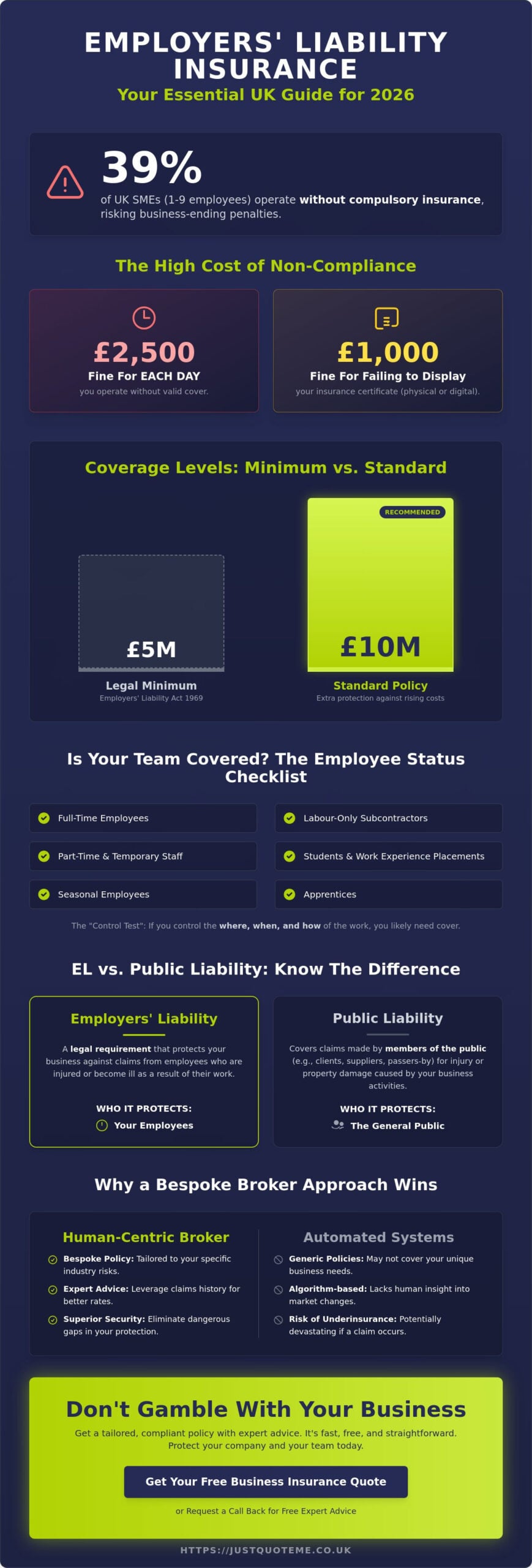
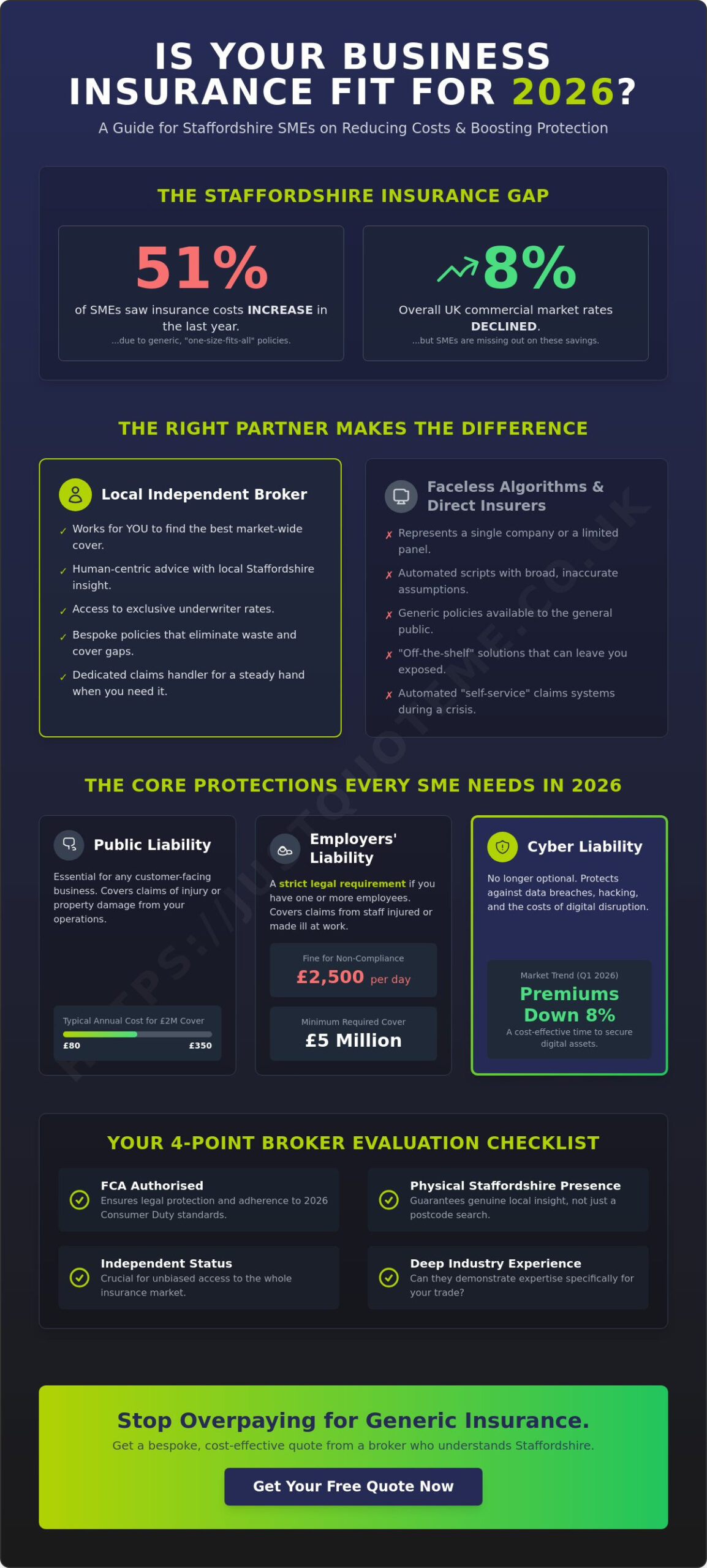
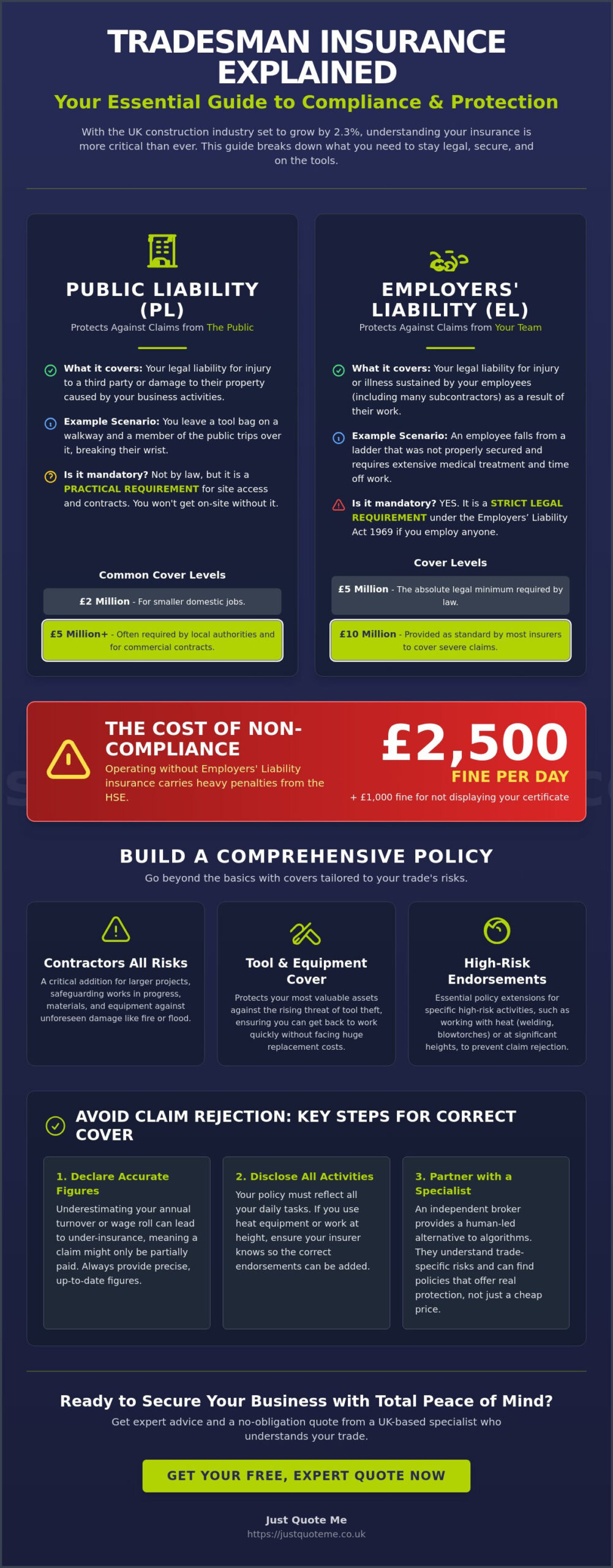
Did you know that 39% of UK small and medium-sized enterprises with one to nine employees were operating without compulsory employers liability insurance as of January 2026? This statistic highlights a massive financial gamble that could lead to business-ending penalties. You likely started your company to build something lasting; you didn’t sign up for the stress of £2,500 daily fines from the Health and Safety Executive or the headache of deciphering complex legal jargon regarding subcontractors and temporary staff.
We believe that managing your legal obligations should be straightforward and stress-free. This guide will help you master the legal requirements and cost-saving strategies available in the current softening market. You’ll gain a clear understanding of the £5 million legal minimum, learn how to protect your business against injury claims, and discover why a tailored approach is vital for full compliance. We’ll show you how to navigate policy limits and avoid the £1,000 fine for failing to display your certificate, ensuring your business remains secure and professional.
Get Your Free Business Insurance Quote now.
Request a Call back for free Expert advice.
Key Takeaways
Understand your specific obligations under the Employers’ Liability (Compulsory Insurance) Act 1969 to avoid severe regulatory penalties.
Use our definitive status checklist to confirm if your subcontractors, students, or part-time staff require mandatory coverage.
Clarify the distinction between Public Liability and employers liability insurance to eliminate dangerous gaps in your company’s protection.
Uncover the primary factors that influence your premiums and how you’ll leverage your claims history for better rates.
Learn why a human-centric, bespoke broker approach offers superior security when it’s compared to automated systems.
Understanding Employers Liability Insurance: Legal Requirements for 2026
Running a business in the UK involves several administrative hurdles, but few are as critical as securing employers liability insurance. If you employ at least one person, this coverage is almost certainly a legal requirement rather than an optional extra. The primary goal is to ensure that if an employee is injured or becomes ill due to their work, your business can cover the resulting compensation and legal fees without facing financial ruin. It acts as a vital safety net for both your staff and your company’s stability. We’ve seen how quickly legal expenses can escalate, which is why we prioritise clarity over complex jargon when helping you set up your policy.
The legal foundation for this requirement is the Employers’ Liability (Compulsory Insurance) Act 1969. This legislation mandates that most employers must maintain a valid policy through an authorised insurer. Failure to comply isn’t just a minor oversight; it’s a criminal offence. The Health and Safety Executive (HSE) enforces these rules strictly across all sectors. If they find you’re operating without the correct cover, they can fine your business up to £2,500 for every single day you’ve been uninsured. For a small firm, these penalties can be devastating, often exceeding the cost of the insurance premium itself by a significant margin.
The £5 Million Minimum and Why Most Policies Offer £10 Million
By law, your policy must provide a minimum of £5 million in cover. While this is the statutory floor, you’ll find that most standard insurance policies actually offer £10 million as a default. This higher limit provides extra breathing room, especially as legal costs and medical compensation awards continue to rise in 2026. For businesses in high-risk sectors, such as construction or heavy manufacturing, even £10 million might be insufficient if multiple employees are involved in a single incident. At Just Quote Me, we specialise in structuring bespoke limits that reflect the unique risks of your specific trade, ensuring you aren’t underinsured when it matters most.
The Legal Role of the Health and Safety Executive (HSE)
The HSE doesn’t just wait for an accident to happen; they conduct regular inspections to ensure your employers liability insurance is up to date and valid. These inspections often occur alongside regular health and safety audits, so keeping your documentation organised is essential for a smooth visit. You’re required to display your insurance certificate where employees can easily read it. In 2026, digital certificates are the standard. You can satisfy legal requirements by making the certificate available on your company intranet or a shared digital drive, provided all staff know how to access it and have the means to do so. If an inspector asks to see your certificate and you can’t produce it or prove it’s accessible, you could face an immediate fine of £1,000.
Get Your Free Business Insurance Quote now.
Request a Call back for free Expert advice.
Who Needs Employers Liability Insurance? The Employee Status Checklist
Determining who requires coverage isn’t always as simple as looking at a payroll list. Many business owners mistakenly believe that only full-time staff count, but the law uses a much broader definition. According to UK government guidelines on employers’ liability insurance, you generally need cover for anyone you have a contract of service or apprenticeship with. This includes part-time staff, temporary workers, and seasonal employees. Even if you only hire someone for a single weekend, you are legally responsible for their safety while they work for you.
The “Control Test” is the primary tool used to decide if someone is an employee for insurance purposes. If you control where, when, and how the work is done, you likely need employers liability insurance for that person. Other indicators include providing the equipment they use, deducting National Insurance and tax from their pay, or preventing them from sending a substitute in their place. If you’re unsure where your team fits, our specialist advisors can help you clarify your status to ensure you’re fully protected.
Bona-Fide vs. Labour-Only Subcontractors
This is a common area of confusion that leads to significant legal gaps. Labour-only subcontractors work under your direct supervision and typically use your materials and tools. For insurance purposes, they’re treated as employees and must be covered by your policy. Bona-fide subcontractors, however, usually work on a specific project basis, provide their own equipment, and carry their own builders insurance. Always check their insurance certificates before they start work, as you could be held liable if they’re injured while working under your direction without their own cover.
Exemptions: When Is EL Insurance Not Required?
While the law is strict, there are a few specific exemptions. You don’t usually need employers liability insurance if your business is a limited company with only one employee who also owns 50% or more of the share capital. Family businesses are also often exempt if they only employ “close” family members, such as a spouse, parent, or sibling. However, this family exemption doesn’t apply if the business is incorporated as a limited company. Be cautious with complex partnership structures; assuming you’re exempt without professional verification is a risk that could lead to the heavy HSE fines mentioned earlier.
Get Your Free Business Insurance Quote now.
Request a Call back for free Expert advice.
Employers’ Liability vs. Public Liability: Knowing the Difference
Understanding the distinction between these two policies is vital for any UK employer. While they often appear together in a single business package, they serve entirely different purposes. Public Liability insurance covers claims made by third parties, which includes anyone who isn’t your employee, for injury or property damage. If a client slips in your office, Public Liability handles it. However, it specifically excludes your staff due to the ‘contract of service’ clauses found in standard commercial wording. If that same accident happens to an employee, your employers liability insurance is the only policy that can respond to the claim. Together, they create a comprehensive shield for your business operations. You can read more about third-party risks in our Public Liability guide.
Why One Policy Is Legal While the Other Is Commercial
The most significant difference lies in their legal status. As we’ve seen, UK government legal requirements make employers liability insurance mandatory for almost all businesses with staff. Public Liability, while not legally required by the state, is often a commercial necessity. Many trade associations, local authorities, and private clients won’t hire you without proof of both. This ensures that any damage you cause to their property or visitors is fully funded. To simplify your coverage, consider how these three pillars work together:
Mandatory Protection: EL is a legal requirement for businesses with staff to cover workplace injuries.
Commercial Credibility: Public Liability is often a contractual requirement for winning work and protecting the public.
Consider a scenario on a busy construction site. If a piece of scaffolding fails, it could cause a complex chain of events that triggers multiple insurance layers. If the falling material injures a site worker, the resulting compensation claim and legal defence fees fall under your EL policy. If that same material strikes a passing car or a member of the public walking nearby, your Public Liability policy takes over. In cases where the site itself, your expensive plant, or the ongoing works are damaged, you might also need contractors all risk insurance to cover the physical assets. Managing these overlaps requires a broker who understands how these policies interact on a practical level, ensuring there are no grey areas where a claim could fall through the cracks.
Get Your Free Business Insurance Quote now.
Request a Call back for free Expert advice.
Calculating the Cost of Employers Liability Insurance in 2026
Predicting the exact price of your coverage involves looking at several variables that insurers use to measure risk. In 2026, the commercial insurance market is experiencing a “softening” trend, with rates having decreased by approximately 6% in the latter half of 2025. This competitive environment offers a prime opportunity for businesses to secure better terms. Your primary cost drivers remain your total payroll and the nature of your trade. For example, low-risk office-based roles typically see premiums around £60 per employee annually. In contrast, manual labor sectors like construction can expect costs of £200 to £250 or more per worker due to the increased likelihood of workplace accidents.
Your claims history acts as a direct reflection of your business’s safety culture. A single significant claim can lead to premium loading for several years, as insurers view past incidents as predictors of future risk. Conversely, a clean record demonstrates reliability. While it’s tempting to search for the lowest possible price, you must ensure the policy remains fully compliant with the £5 million legal minimum. Choosing a “cheap” policy that contains restrictive exclusions or high deductibles can leave you exposed to the heavy HSE fines we discussed earlier. To find the right balance between price and protection, compare employers liability insurance with an expert broker.
High-Risk Industries and Premium Loading
Certain sectors naturally carry a higher risk profile, which is reflected in the premium. Industries like roofing, security insurance, and nightclub insurance often face higher rates because the work environments are inherently more dangerous or prone to conflict. At Just Quote Me, we leverage our 30 years of industry experience to negotiate with specialised underwriters. We present your business in the best possible light, highlighting your specific safety measures to secure rates that automated “one-size-fits-all” systems simply cannot access.
How to Lower Your Risk Profile
Insurers are increasingly rewarding businesses that demonstrate mature risk management practices. You can actively lower your premiums by maintaining robust documentation, including up-to-date risk assessments and detailed employee training logs. For those in sectors where road safety is a factor, you may check out Pass4you Driving School to understand how professional training contributes to a safer workforce. Enforcing strict PPE (Personal Protective Equipment) rules and keeping maintenance records for all machinery shows a commitment to safety that underwriters value. Additionally, ensure your business is correctly registered with the ELTO (Employers’ Liability Tracing Office). This database helps employees find their employer’s insurer even years after an incident, and being organised with your data helps your broker fight for the most competitive pricing available.
Get Your Free Business Insurance Quote now.
Request a Call back for free Expert advice.
Securing Your Policy: Why a Bespoke Broker Approach Wins
Choosing employers liability insurance shouldn’t feel like a transaction with a faceless algorithm. Many business owners get trapped in a “call centre” loop, where staff follow rigid scripts and lack real-world understanding of your specific trade. An independent broker offers a human-centric alternative. We prioritise efficiency without sacrificing the personal touch that defines a local service provider. With over 30 years of industry experience, Just Quote Me understands that your business is unique. We don’t just sell policies; we manage the administrative burden so you can focus on running your company with confidence.
Our independent status provides a significant advantage for your bottom line. Unlike direct insurers who only offer their own products, we access a broad panel of leading UK underwriters to find the most competitive rates. This is especially useful in 2026 as market conditions soften, allowing us to negotiate better terms that aren’t available to the general public. We also stand by you during the entire lifecycle of your policy. If a staff member makes a claim, you aren’t left to navigate the complex legal and medical jargon alone. We provide the steady hand and professional advice needed to ensure the process moves quickly and fairly, protecting your reputation and your finances.
Personalised Advice for Staffordshire and West Midlands Businesses
Local knowledge is invaluable when assessing regional trade risks. Whether your business operates in Stone, Stafford, or Newcastle-under-Lyme, we understand the local economic landscape and the specific challenges facing West Midlands firms. Regional expertise allows us to identify nuances in your operations that a national call centre would likely overlook. For example, a manufacturing firm in the Potteries has a different risk profile than a logistics hub in Stafford. A face-to-face meeting or a detailed phone consultation with an expert often uncovers these details. This ensures your employers liability insurance is tailored to your actual day-to-day activities, avoiding the dangerous gaps found in generic digital policies.
Getting Your Free Business Insurance Quote Now
Obtaining a bespoke quote is a simple, straightforward process designed for busy business owners. We prioritise efficiency and avoid the hyperbolic marketing speak common in the insurance industry. Our goal is to provide a personalised experience that leaves you feeling fully informed and secure in your choices. As an FCA-authorised broker, we adhere to the highest professional standards, ensuring your data and your business are protected by robust regulatory safeguards. Just Quote Me to simplify your administrative burdens and secure a policy that truly fits your needs.
Get Your Free Business Insurance Quote now.
Request a Call back for free Expert advice.
Protecting Your Business Future with Expert Guidance
Securing the right employers liability insurance is a fundamental step in safeguarding your company’s longevity and reputation. By understanding the broad legal definition of an employee and maintaining robust safety documentation, you position your business to thrive even in a complex regulatory environment. We’ve explored how a tailored approach prevents the pitfalls of generic policies while ensuring you meet the mandatory £5 million minimum. This clarity allows you to operate without the constant fear of HSE inspections or unexpected financial liabilities.
As an FCA Authorised independent broker with over 30 years of UK industry experience, Just Quote Me provides the steady hand you need. We leverage our access to a broad network of top UK insurers to find the most competitive terms available in the 2026 market. Our team manages the administrative weight so you don’t have to; providing expert support from the initial quote through to any potential claims. You deserve a partner who understands the nuances of your trade and the regional risks of the West Midlands. Just Quote Me today to simplify your insurance journey and gain the professional protection your business deserves.
Get Your Free Business Insurance Quote now.
Request a Call back for free Expert advice.
Frequently Asked Questions
Is employers liability insurance a legal requirement for a limited company with one director?
No, you’re exempt if you’re the sole employee and own at least 50% of the share capital. This exemption recognises that you’re unlikely to sue your own company for a workplace injury. However, the moment you hire a second person or take on an apprentice, the exemption vanishes. You must then secure a policy to avoid the heavy daily penalties enforced by the Health and Safety Executive.
What happens if I employ a family member without employers liability insurance?
You’re generally exempt if your business isn’t incorporated and you only employ close family like a spouse, sibling, or child. However, this exemption doesn’t apply to limited companies. If your family business is a limited company, you must have cover for everyone. Operating without it could result in a £2,500 daily fine, regardless of your personal relationship with the staff member.
Does employers liability cover subcontractors and freelancers?
Coverage depends on the “Control Test” rather than their tax status. Labour-only subcontractors who use your tools and follow your direct supervision must be covered by your employers liability insurance. In contrast, bona-fide subcontractors who provide their own equipment and work independently usually carry their own insurance. Always verify their certificates to ensure your business isn’t left exposed to an injury claim.
What is the minimum level of employers liability cover required in the UK?
The law requires a minimum of £5 million in cover under the Employers’ Liability (Compulsory Insurance) Act 1969. While this is the legal floor, most insurers in 2026 provide £10 million as a standard offering. This higher limit offers essential protection against rising legal fees and complex medical compensation awards. High-risk trades often require even higher limits to satisfy specific contract requirements.
Can I be fined if I don’t display my employers liability certificate?
Yes, you can be fined £1,000 if you fail to display your certificate or refuse to show it to an HSE inspector. In 2026, digital display is perfectly acceptable. You can store the certificate on a company intranet or a shared drive, provided all employees have easy access and know where to find it. Keeping your documentation organised is a simple way to avoid these unnecessary administrative fines.
Does employers liability insurance cover me for claims from former employees?
Yes, the policy covers claims from former staff for injuries or illnesses that occurred while they were in your employment. This is particularly important for industrial diseases that may take years or even decades to develop. Because of this long-term exposure, you should keep records of your insurance certificates indefinitely. The ELTO database also helps track these historical policies to ensure claims are handled correctly.
Is employers liability insurance tax-deductible for my business?
Yes, your insurance premium is considered a necessary business expense and is fully tax-deductible. You can offset the cost against your company’s Corporation Tax or your self-employed taxable income. This helpfully reduces the net cost of staying legally compliant. Always keep your invoices and policy documents safe to provide evidence for your annual tax returns or in case of an HMRC audit.
What is the difference between employers liability and professional indemnity?
Employers liability covers physical injury or illness suffered by your staff due to their work. Professional indemnity insurance protects you against financial losses a client suffers because of your professional errors, omissions, or bad advice. While EL is a legal mandate for businesses with staff, PI is a commercial necessity for most service providers. Both are essential pillars of a robust business protection strategy in 2026.
Get Your Free Business Insurance Quote now.
Request a Call back for free Expert advice.
Article by
Just Quote Me
JustQuoteMe Ltd is an independent UK insurance brokerage specialising in business and personal insurance solutions. With over 35 years of industry experience, the company provides tailored insurance cover for businesses, landlords, tradespeople, hospitality venues, fleets, and individuals across the UK. Known for its personal service, expert advice, and competitive premiums, JustQuoteMe Ltd works with leading insurers to deliver bespoke policies designed around each client’s unique needs. The company is authorised and regulated by the Financial Conduct Authority (FCA No. 586607) and has built a reputation for trusted, straightforward insurance guidance and long-term client relationships.
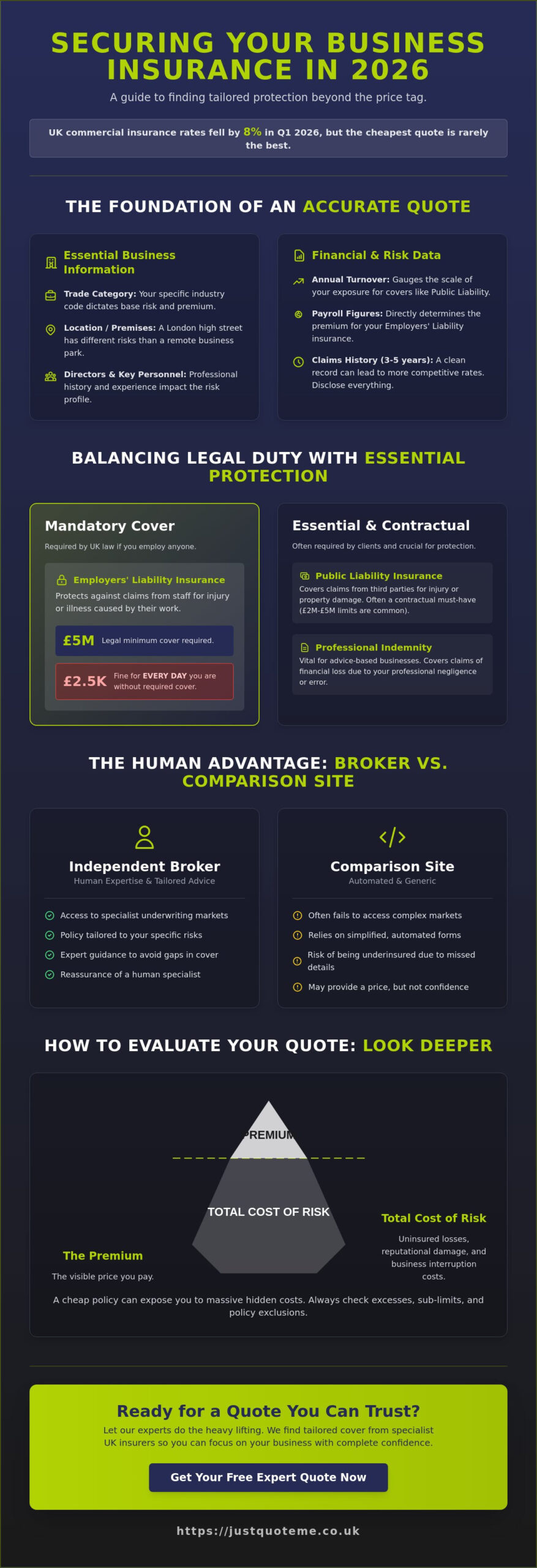
Did you know that UK composite commercial insurance rates fell by 8% in the first quarter of 2026? While falling prices are a welcome trend, simply clicking on the cheapest business insurance quote often leads to gaps that leave your livelihood vulnerable. It’s understandable to feel frustrated by automated forms that don’t grasp the nuances of your trade or to worry that a simple clerical error could result in a rejected claim when you need help most.
We believe you deserve total confidence in your protection. This guide will show you how to secure a tailored policy that satisfies UK legal requirements, such as the £5 million minimum for employers’ liability, while ensuring you don’t overpay on the standard 12% Insurance Premium Tax. You will learn how to navigate the 2026 market to find accurate pricing and the expert reassurance that only a human specialist can provide. We are here to do the heavy lifting so you can focus on running your business.
Get Your Free Business Insurance Quote now.
Request a Call back for free Expert advice.
Key Takeaways
Learn exactly which financial figures and trade categories you need to provide to secure a precise business insurance quote that reflects your actual risk profile.
Understand why human expertise is vital for navigating complex UK underwriting markets that automated comparison sites often fail to access.
Find out how to evaluate a policy by looking past the basic premium to consider the Total Cost of Risk and essential sub-limits.
Distinguish between your mandatory legal obligations and the optional covers needed to protect your assets against third-party claims.
What You Need to Request an Accurate Business Insurance Quote
Accuracy is the foundation of any reliable business insurance quote. Comparison sites often rush you through a form in minutes, but skipping details can lead to a policy that is void when you actually need it. To get a price that truly reflects your risk, you need to have specific data ready before you start the process. Providing precise information ensures that you don’t overpay for coverage you don’t need or, worse, find yourself underinsured during a crisis.
Essential Business Information
Your trade category is the first thing an underwriter looks at. Whether you’re a high-street retailer or a specialist contractor, your specific trade code dictates the base rate of your premium. For many small to medium-sized enterprises, these risks are often bundled into a Business Owner’s Policy (BOP), which combines various protections into one package. However, even with a bundled policy, your exact activities must be disclosed. Location also plays a huge role; operating in a quiet Staffordshire business park carries different risks than a high-traffic London storefront. Finally, identify all directors and key personnel, as their professional history and experience directly impact the final business insurance quote.
Financial and Risk Documentation
Insurers use your estimated annual turnover to gauge the scale of your exposure. This figure is particularly important for public liability insurance, where higher footfall or larger contracts increase the likelihood of a claim. If your turnover increases significantly during the year, you should update your broker to ensure your limits remain adequate. Payroll figures are equally vital because they determine the cost of your employers liability insurance. Remember that in the UK, you are legally required to have a minimum of £5 million in cover if you have employees, and failing to provide accurate staff numbers can lead to heavy daily fines.
You should also prepare a detailed record of your claims for the last three to five years. It is helpful to distinguish between “claims paid” and “claims outstanding.” A business with a clean record or documented safety protocols often secures more competitive rates in the current 2026 soft market. If you have ever had insurance cancelled or had special terms imposed by a previous provider, you must disclose this upfront. Honesty at this stage is the only way to ensure your protection remains valid and that your claims won’t be rejected later due to non-disclosure.
Get Your Free Business Insurance Quote now.
Request a Call back for free Expert advice.
Tailoring Your Quote: Key Covers for UK Businesses in 2026
A generic business insurance quote often fails to account for the specific pressures of your industry. While the 2026 market shows falling premiums across professional lines, the real value lies in how well your policy reacts when things go wrong. It isn’t just about finding the lowest number on a screen. You need a structure that balances legal obligations with the unique operational risks of your trade, whether you’re running a local boutique or a specialist security firm.
Mandatory vs Optional Insurance
Understanding the difference between what the law requires and what your business needs is vital. If you employ even one person, you must secure Employers Liability Insurance. Failing to meet these UK government requirements can lead to a fine of £2,500 for every single day you are without cover, plus a £1,000 penalty for not displaying your certificate. The legal minimum is £5 million, though many insurers provide £10 million as standard.
While Public Liability Insurance isn’t a legal requirement for everyone, it’s often a contractual necessity. Builders and contractors usually find that clients won’t let them on-site without proof of at least £2 million or £5 million in protection against third-party injury or property damage. For advice-based businesses, Professional Indemnity insurance triggers when a client claims that your professional service or advice caused them a direct financial loss. Balancing these covers ensures your business insurance quote provides a safety net that satisfies both the law and your clients.
Specialist Industry Add-ons
Beyond the basics, your trade dictates the “extras” that actually matter. Retailers should look for Shop Insurance that includes specific stock cover for seasonal peaks. If your business relies on heavy equipment, Plant and Machinery Insurance protects high-value assets that basic property policies might exclude. We also see a massive shift in 2026 toward Cyber Liability. As insurers now link pricing to your digital security maturity, having this cover is becoming a badge of reliability for UK SMEs.
We understand that niche sectors need more than a “one size fits all” approach. Whether you require thatched pub insurance, nightclub insurance, or protection for a security company, the nuances of your risk shouldn’t be ignored by an algorithm. Getting bespoke insurance advice ensures these specialist details are baked into your policy from day one.
Get Your Free Business Insurance Quote now.
Request a Call back for free Expert advice.
Independent Broker vs Comparison Site: Making the Right Choice
Choosing between an algorithm and an expert is more than just a matter of convenience. While comparison sites promise a business insurance quote in minutes, they often rely on rigid templates that don’t fit every trade. A bot doesn’t understand the difference between a standard retail unit and a complex industrial site. It simply looks for the path of least resistance, which can leave your business exposed to significant financial gaps if the “standard” assumptions don’t apply to your specific operations.
The Limitations of Automated Quotes
Online forms frequently use “assumed facts” to speed up the process. If you don’t read the small print, you might inadvertently agree to conditions your business can’t meet. This error could void your entire policy. This is why Financial Conduct Authority guidance suggests that SMEs should consider the benefits of a broker’s advice when dealing with complex needs. Specialist risks, such as Thatched Pub Insurance, require a human eye to assess unique construction materials and fire risks. A basic algorithm would simply ignore these nuances or overprice the risk to stay within its safe parameters.
The Advantage of 30 Years Experience
We bring 30 years of experience to the table, providing access to “Broker Only” markets that comparison sites simply cannot reach. These exclusive underwriters often offer more flexible terms and lower premiums for niche sectors. For example, Security Company Insurance requires specific wording regarding efficacy and wrongful arrest that generic policies often lack. Without these bespoke clauses, your business might be technically insured but practically unprotected during a claim. We know which insurers have the appetite for your specific trade, saving you the frustration of rejected applications.
A broker’s role doesn’t end once you’ve paid your premium. We act as your advocate throughout the life of the policy. If you need a mid-term adjustment because you’ve moved premises, hired more staff, or expanded your fleet, you won’t be stuck in an automated phone queue. We handle the negotiations with underwriters on your behalf to ensure changes are reflected accurately. This human-led approach ensures that your business insurance quote isn’t just a number on a screen, but a robust promise of protection that stands up to scrutiny when you need it most.
Get Your Free Business Insurance Quote now.
Request a Call back for free Expert advice.
How to Evaluate Your Business Insurance Quote
Evaluating a business insurance quote requires looking beyond the headline premium. You must consider the Total Cost of Risk (TCOR), which includes your excesses, potential downtime during a claim, and the cost of uninsured losses. High excesses can lower your monthly payments, but they might leave you with a significant bill if an incident occurs. You need to distinguish between voluntary excesses, which you choose to reduce the premium, and compulsory excesses set by the underwriter based on your trade or claims history.
Assessing Policy Limits and Exclusions
Is your Contractors All Risk Insurance limit high enough for your largest project? If you secure a contract worth £500,000 but your policy only covers up to £250,000, you are effectively self-insuring the difference. Standard policies often contain hidden exclusions, such as damage caused by gradual seepage or wear and tear, which can cost you thousands in rejected claims. Claims-made policies cover you based on when the claim is reported, whereas claims-occurring policies cover incidents that happen during the policy period, regardless of when the report is made.
Trust and Regulatory Compliance
Trust is the currency of the insurance industry. You should always verify that your broker is on the FCA Register to ensure they meet strict UK regulatory standards. This is particularly crucial for complex covers like Directors and Officers Insurance, where independent advice protects the personal assets of your leadership team. FCA authorisation also usually grants you access to the Financial Services Compensation Scheme (FSCS), which can provide protection if your insurer fails. Having UK-based support for claims handling means you speak to someone who understands the local legal environment and can act as your advocate when you need it most.
Securing a business insurance quote shouldn’t feel like a second job. We’ve spent over 30 years refining a process that balances digital speed with the necessary human oversight. While comparison sites leave you to guess which boxes to tick, we provide a steady hand to ensure your application is accurate from the start. This prevents the common 2026 pitfall of having a claim rejected because an automated form failed to capture the true nature of your operations.
Our Specialist Expertise in 2026
We take pride in our deep roots in Staffordshire, supporting local businesses in Stone, Stafford, and Newcastle-under-Lyme. However, our reach extends across the UK, providing high-level underwriting access for sectors that many generalist brokers avoid. If you operate in a high-risk industry, such as hospitality or construction, you need a partner who understands your specific pressures. For instance, our approach to Nightclub Insurance focuses on the nuances of late-night licensing and security requirements that standard policies often overlook. We don’t hide behind corporate jargon; we give you straightforward advice that protects your bottom line.
Ready to Protect Your Business?
Choosing an independent broker means you gain an advocate who works for you, not the insurance company. We navigate the 2026 soft market to find the most competitive pricing without sacrificing the quality of your cover. Before you finalise your details, run through this quick checklist to ensure your quote is as accurate as possible:
Double-check your trade category and NACE codes to avoid premium loading.
Ensure your turnover and payroll estimates reflect your projected growth for the next 12 months.
Confirm that your requested limits meet both your legal obligations and any specific client contracts.
Have your claims history for the last three to five years ready for verification.
Our goal is to move you from inquiry to immediate cover with zero friction. We do the heavy lifting by comparing “Broker Only” markets to find the bespoke wording your business requires. You don’t have to navigate this complex market alone. We are ready to provide the professional reassurance you need to operate with total confidence.
Get Your Free Business Insurance Quote now.
Request a Call back for free Expert advice.
Future-Proof Your Business Protection
Securing the right level of protection is a vital step in ensuring your company’s long-term resilience. We’ve explored how accurate data and tailored policy wording form the bedrock of a reliable business insurance quote. By looking beyond the initial price to understand your policy limits and excesses, you’ll prevent the risk of under-insurance that often plagues automated comparison sites. It’s about finding value that lasts, not just the cheapest number on a screen.
As an FCA Authorised Broker with 30+ years of industry experience, we provide more than just a certificate. Our access to a broad network of top UK insurers means we can find the precise coverage your trade requires, whether you’re a local contractor or a specialist hospitality venue. We take the complexity out of the process so you can focus on what you do best. Choose a partner who understands your trade and let us handle the heavy lifting for you. We are ready to help you grow with confidence.
Get Your Free Business Insurance Quote now.
Request a Call back for free Expert advice.
Frequently Asked Questions
How long does it take to get a business insurance quote?
You can receive an initial business insurance quote in just a few minutes through our online portal. For more complex or niche risks, a specialist broker typically reviews the details and provides a bespoke response within 24 hours. This ensures that the pricing is accurate and that the policy wording actually fits your specific trade requirements without leaving dangerous gaps in your protection.
Is public liability insurance a legal requirement for UK small businesses?
No, public liability insurance is not a legal requirement in the UK, unlike employers’ liability insurance which is mandatory for most businesses with staff. However, many clients and trade bodies will refuse to work with you unless you have proof of cover. It is a vital protection against claims for third-party injury or property damage, which can be financially devastating for a small business to settle independently.
Can I get a quote for multiple businesses under one policy?
Yes, you can often consolidate multiple business entities or locations under a single commercial combined policy. This approach simplifies your administration and can sometimes lead to more competitive premiums by leveraging your total risk profile. An independent broker can help you structure this portfolio approach to ensure every subsidiary or trade name is correctly identified and protected under the master policy terms.
What factors affect the cost of my business insurance quote?
Your premium is primarily influenced by your trade category, annual turnover, and total payroll figures. Other key factors include your business location, the level of indemnity you choose, and your claims history over the last three to five years. In 2026, many insurers also consider your digital security maturity when calculating a business insurance quote, especially if you are including cyber liability protection in your package.
For businesses in highly specialized fields, such as adventure sports providers like UK Skydiving, these factors are weighted even more heavily due to the unique operational risks involved.
Do I need to pay for a business insurance quote?
No, we provide business insurance quotes completely free of charge and with no obligation to purchase. We believe in providing transparent access to expert advice so you can make an informed decision about your protection. You only pay the premium once you decide to proceed with the cover, which includes the standard 12% Insurance Premium Tax (IPT) applied to most general UK business policies.
What happens if I provide incorrect information during the quote process?
Providing incorrect information can lead to your policy being voided or claims being rejected by the underwriter. This is known as non-disclosure or misrepresentation. Even accidental errors can cause significant delays during a claim. It’s essential to be honest about your business activities and claims history to ensure your protection remains valid and that you are meeting your legal obligations under the Insurance Act.
How often should I review my business insurance quotes?
You should review your insurance at least once a year before your renewal date. However, it’s also important to update your broker if your business changes significantly mid-term. This includes hiring new staff, moving premises, or taking on much larger contracts. Regular reviews ensure your limits stay adequate and that you take advantage of the current soft market conditions where rates have recently fallen in some sectors.
Can an independent broker find cheaper quotes than comparison sites?
An independent broker often finds better value because they have access to Broker Only markets and exclusive underwriters that don’t appear on comparison sites. While a comparison bot focuses purely on the lowest headline price, a broker negotiates bespoke terms that can save you more in the long run. We focus on the total cost of risk, ensuring you don’t pay for unnecessary extras while keeping your essential protections robust.
For business owners looking to extend this cost-saving approach to other overheads, Green Compare provides a specialized comparison service for commercial utility procurement and business finance solutions.
Get Your Free Business Insurance Quote now.
Request a Call back for free Expert advice.
Article by
Just Quote Me
JustQuoteMe Ltd is an independent UK insurance brokerage specialising in business and personal insurance solutions. With over 35 years of industry experience, the company provides tailored insurance cover for businesses, landlords, tradespeople, hospitality venues, fleets, and individuals across the UK. Known for its personal service, expert advice, and competitive premiums, JustQuoteMe Ltd works with leading insurers to deliver bespoke policies designed around each client’s unique needs. The company is authorised and regulated by the Financial Conduct Authority (FCA No. 586607) and has built a reputation for trusted, straightforward insurance guidance and long-term client relationships.
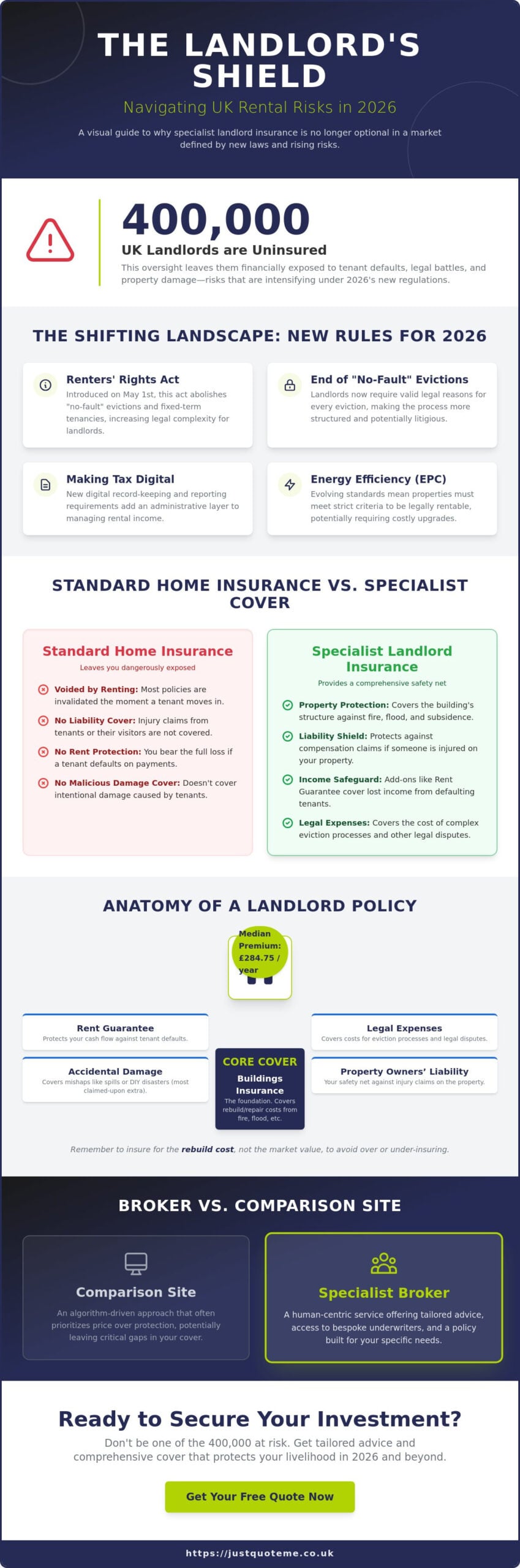
An estimated 400,000 UK landlords are currently operating without specialist landlord insurance, leaving themselves exposed to significant financial risk. In a year defined by the most sweeping regulatory shifts in decades, skipping tailored cover isn’t just a gamble; it’s a threat to your livelihood. We know that managing property in 2026 feels like a constant balancing act. Between the Renters’ Rights Act changes that took effect on May 1 and the new Making Tax Digital requirements, the legal landscape has never been more complex.
You’re likely feeling the squeeze from rising costs while navigating the end of “no-fault” evictions and fixed-term tenancies. This guide simplifies that complexity. You’ll learn exactly how to secure a policy that ensures full legal compliance and protects your rental income when disaster strikes. We will break down everything from the median £284.75 annual premium to the essential add-ons, like rent guarantee cover, that keep your investment profitable in a changing market.
Get Your Free Business Insurance Quote now.
Request a Call back for free Expert advice.
Key Takeaways
Understand why standard home insurance leaves you exposed and how a specialist landlord insurance policy provides the specific liability and property protection required for rentals.
Identify the essential add-ons like rent guarantee and legal expenses cover that safeguard your cash flow against tenant defaults and the costs of complex eviction processes.
Learn the critical difference between market value and rebuild cost to ensure your property is adequately covered without overpaying on your premiums.
Discover why a human-centric specialist broker offers better protection than a comparison site algorithm by accessing bespoke underwriters and tailored advice.
What is Landlord Insurance and Why is it Essential in 2026?
Many property owners mistakenly believe their standard home insurance provides adequate cover. In reality, letting a property usually voids a standard residential policy. Landlord insurance is a specialist product designed to protect property owners from the unique financial losses linked to rental activities, such as malicious damage or loss of rent. For a foundational overview of the different types of protection, you can read more about What is Landlord Insurance? and how it functions. Essentially, landlord insurance acts as a multi-layered shield against property damage, liability, and loss of income. The Financial Conduct Authority (FCA) plays a vital role here, ensuring UK landlords receive fair value and transparent policy terms through their Consumer Duty regulations.
The 2026 Rental Landscape: New Risks for Landlords
The rental market changed fundamentally on May 1, 2026, with the full implementation of the Renters’ Rights Act. With “no-fault” evictions now abolished and all tenancies becoming periodic, the legal risks you face as a property owner are higher than ever. You’re now operating in a world where valid legal reasons are required for every eviction, making the process more structured but potentially more litigious. Evolving energy efficiency standards (EPC) also mean your property must meet strict criteria to remain legally rentable. These shifts make legal expenses cover a necessity rather than an optional extra. A “cheap” policy from a comparison site might save you a few pounds today, but the gaps in coverage could bankrupt a small-scale landlord if a complex legal dispute arises or a major repair is required to meet new standards. It’s about protecting your investment from the unknown.
Is Landlord Insurance a Legal Requirement?
Strictly speaking, there’s no UK law that mandates landlord insurance for all owners. However, if you have a buy-to-let mortgage, your lender will almost certainly make it a mandatory requirement of your loan agreement. Failing to inform your insurer that a property is being let is a form of non-disclosure that can lead to claims being rejected entirely. Beyond the mortgage, professional property management firms often refuse to represent you unless you have valid, specialist insurance in place. It’s also worth noting that by May 31, 2026, you’re legally required to provide all existing tenants with the government-produced information sheet regarding their rights. Without the right insurance in place, you lack the professional support needed to navigate these administrative and legal hurdles efficiently.
Get Your Free Business Insurance Quote now.
Request a Call back for free Expert advice.
Decoding Your Policy: Standard Cover vs. Essential Add-ons
A standard home insurance policy won’t cut it when you’re letting out a property. To truly protect your investment, you need a policy that’s built for the job. Most landlord insurance starts with buildings insurance as the foundation. This covers the cost of repairing or rebuilding the structure if it’s damaged by fire, flood, or subsidence. However, in 2026, a “basic” policy is rarely enough to navigate the financial pressures of the modern rental market. You need to look at the specific components that turn a standard policy into a comprehensive safety net.
Accidental damage is frequently the most-claimed-upon part of any property policy. Whether it’s a tenant’s guest spilling wine on a brand-new carpet or a DIY mishap that leads to a burst pipe, these incidents happen. While some landlords try to save money by omitting this, the out-of-pocket costs for repairs in 2026 have risen significantly. For a detailed breakdown of how these different layers of protection work together, you can consult this guide to landlord insurance cover from a risk-management perspective.
Property Owners’ Liability: Your Safety Net
Property Owners’ Liability is often confused with general public liability insurance, but there’s a key distinction. While public liability covers your business activities, property liability specifically covers risks arising from the building itself. If a tenant trips on a loose floorboard you failed to fix, or a delivery driver is injured by a falling roof tile, you could face a massive compensation claim. This cover handles the legal fees and the eventual payout, ensuring a single accident doesn’t wipe out your rental profits for the year.
Contents Insurance for Furnished vs Unfurnished
Don’t assume that an “unfurnished” property needs no contents cover. Even if you aren’t providing sofas and beds, you likely still own the white goods, carpets, and curtains. Replacing an integrated fridge-freezer and oven after a kitchen fire can cost thousands. It’s also vital to understand the difference between maintenance and insurance. Insurance is for sudden, unforeseen events. It won’t cover “wear and tear,” which remains the landlord’s responsibility to manage through regular maintenance. If your property is part of a mixed-use building with a shop or office downstairs, you might actually require commercial property insurance to ensure the entire structure is correctly protected.
If you’re unsure which add-ons are necessary for your specific postcode or tenant type, you can speak with a specialist broker who understands the local market.
Get Your Free Business Insurance Quote now.
Request a Call back for free Expert advice.
Protecting Your Revenue: Rent Guarantee and Legal Expenses
The abolition of “no-fault” evictions on May 1, 2026, has fundamentally changed how you manage tenant defaults. It’s no longer a simple administrative task to regain possession of your property. Rent guarantee insurance ensures you still get paid if a tenant stops meeting their financial obligations. This specific type of landlord insurance typically costs approximately £195 per year when added to a policy. Legal expenses cover is equally critical, funding the cost of evictions, squatter removals, or complex contract disputes. Rent guarantee is the difference between a minor setback and a mortgage default.
Beyond income protection, you must consider the physical state of the building. If a major incident like a fire or flood makes your property uninhabitable, alternative accommodation cover is vital. This part of your policy pays for your tenants to stay in a hotel or temporary rental while your property is being repaired. It keeps you compliant with your duties as a landlord without you having to foot the bill for their relocation out of your own pocket.
Navigating Tenant Default in a Changing Economy
Current economic factors make rent protection more vital than ever. Statistics from the first quarter of 2026 show that 30% of landlords experienced rental arrears in the past year. With the average monthly private rent in the UK reaching £1,374 as of February 2026, a single month of missing payments can cause a significant deficit. To make a successful claim, most insurers require proof of professional tenant referencing. This ensures you’ve performed due diligence before the tenancy began. If you employ staff to handle property maintenance or admin, you’ll also need to integrate employers liability insurance to meet your legal obligations as an employer.
Legal Expenses and the Eviction Process
The high cost of legal representation in UK courts can be staggering. Since landlords must now use a Section 8 notice and provide a valid legal reason for every eviction, the paperwork must be flawless. Insurance providers handle the heavy lifting of legal documentation and court filings, which saves you hours of administrative stress. Having expert advice from a broker like Just Quote Me during a dispute ensures you don’t make a procedural error that could restart the entire eviction clock. Navigating these new regulations requires a steady hand and a policy that actually pays out when you need to defend your rights in court.
Get Your Free Business Insurance Quote now.
Request a Call back for free Expert advice.
How Much Does Landlord Insurance Cost in 2026?
Understanding the price of landlord insurance is essential for maintaining your margins in a high-regulation market. As of May 2026, the median cost for a standard policy in the UK is £284.75 per year. While you might find basic, buildings-only cover for as low as £170 to £185, these entry-level prices often lack the comprehensive protection needed for modern risks. Your premium is calculated based on several core factors: your property’s location, the specific tenant profile, and the rebuild value of the structure.
A common mistake is insuring a property for its market value. Insurers only care about the rebuild cost, which covers the labour and materials required to reconstruct the property from scratch after a total loss. In 2026, with construction costs remaining high, getting this figure wrong can lead to “under-insurance,” where a claim is only partially paid out. You can often lower your annual premium by increasing your voluntary excess, but ensure you have the cash reserves to cover that higher amount if you need to claim.
Factors That Influence Your Quote
The type of tenant you choose significantly impacts your risk profile. Professionals are often viewed as lower risk compared to students or those on housing benefits, though many specialist insurers now offer competitive rates across all profiles. Property age also plays a role. Period features or non-standard construction, such as those requiring thatched pub insurance or listed building protection, will naturally command higher premiums due to the specialist skills needed for repairs. Providing accurate data during the quote process is non-negotiable; even a small error regarding property history can lead to a rejected claim later.
Portfolio Insurance: The Multi-Property Discount
For landlords managing multiple properties, individual policies are rarely the most efficient choice. Portfolio insurance allows you to group all your properties under a single policy with one renewal date. This reduces your administrative burden and often triggers bulk-buy discounts that aren’t available for single-property lets. At Just Quote Me, we take a bespoke approach to portfolio management, ensuring each property has the specific level of cover it needs while keeping your total costs as low as possible.
Ready to see how much you could save? Just Quote Me for a tailored insurance premium that fits your specific portfolio needs.
Get Your Free Business Insurance Quote now.
Request a Call back for free Expert advice.
Why a Specialist Broker Beats a Comparison Site
Comparison sites are built for speed, but they aren’t always built for the complexities of property management in 2026. They rely on faceless algorithms that often fail to account for the unique character of your building or the specific risks of your tenant profile. A specialist broker provides a human-centric alternative for landlord insurance. We look beyond the simple tick-boxes to find cover that actually fits your needs. Unlike comparison sites that only show you a limited range of standard products, we have access to a panel of specialist underwriters. These professionals offer bespoke terms that automated systems simply cannot reach.
Having a steady hand when things go wrong is the ultimate benefit of using a broker. When you need to make a claim on your landlord insurance, you don’t want to be stuck in an automated phone queue or dealing with a generic call centre. We handle the heavy lifting, acting as your advocate to ensure the process is as smooth as possible. Our “No-Nonsense” philosophy at Just Quote Me means we’re here to do the hard work so you don’t have to. We understand the pressure of maintaining a profitable portfolio, and we’re committed to protecting it through every step of the journey.
The Just Quote Me Personal Touch
We bring over 30 years of experience to the UK insurance market. While our roots are firmly in Staffordshire, our expertise has a national reach that allows us to support landlords across the country. We take pride in being a human alternative to an algorithm. Whether you have a single buy-to-let or a diverse range of properties, we offer tailored solutions. This includes specialist cover for those in the hospitality sector, such as hotel and guest house insurance, where risks are more varied than a standard residential let.
Tailored Solutions for Complex Property Risks
Mixed-use properties, such as a high-street shop with a flat above, often fall through the cracks of automated quoting systems. These buildings need a bespoke touch to ensure both the commercial and residential elements are correctly insured. We specialise in finding residential letting insurance that integrates perfectly with your wider business needs. Our goal is to find the cover that fits your specific situation, rather than forcing you into a generic template that might leave you under-insured when you need it most.
Get Your Free Business Insurance Quote now.
Request a Call back for free Expert advice.
Securing Your Rental Future in a Changing Market
The rental landscape in 2026 requires more than just a passive approach to property management. With the Renters’ Rights Act now in full effect, having the right landlord insurance is your best defence against legal and financial instability. You’ve seen how essential it’s to distinguish between basic buildings cover and the comprehensive protection offered by rent guarantee and legal expenses. You also know that accurate rebuild costs and professional tenant referencing are the keys to a policy that actually pays out when you need it most.
As an independent UK broker with over 30 years of experience, Just Quote Me provides FCA-authorised expert advice that comparison sites simply can’t match. We work with a wide panel of top UK insurers to find the bespoke cover your portfolio deserves, whether you own a single flat or a diverse commercial mix. Secure your investment today and gain the peace of mind that comes from professional, local expertise. Protecting your property shouldn’t be a source of stress; it should be a source of confidence.
Get Your Free Business Insurance Quote now.
Request a Call back for free Expert advice.
Frequently Asked Questions
Do I need landlord insurance if I am only renting to a family member?
Yes, you still need a specialist policy even when letting to a family member. Standard residential insurance is designed specifically for owner-occupiers; any arrangement where someone else lives in the property independently can invalidate your cover. Even if you aren’t charging market rent, the liability risks remain the same. A family member can still experience an accident on the premises, and your mortgage lender will likely require a professional policy to protect their interest in the building.
Is landlord insurance more expensive than standard home insurance?
Landlord insurance typically costs more than standard home insurance because the risks associated with a rental are fundamentally higher. You aren’t just protecting the physical structure; you’re covering public liability for tenants, potential loss of rent, and a higher statistical likelihood of accidental damage. While the median annual cost in the UK is £284.75, this extra expense provides the specific legal and financial protection that a domestic policy lacks. It ensures you have a safety net for scenarios that standard insurance simply won’t touch.
Does landlord insurance cover me if the property is vacant for a long period?
Most standard policies only provide full cover for vacancies up to 30 consecutive days. If your property is empty for longer due to extensive renovations or a difficult void period, you’ll need specific unoccupied property insurance. Statistics from early 2026 show that 43% of landlords reported a void period in the past year. It’s vital to check your policy’s “days unoccupied” limit to ensure you don’t lose coverage during a tenant changeover, as an empty building faces higher risks of theft, vandalism, and undetected water damage.
Can I get landlord insurance for a property with a thatched roof?
Yes, you can get cover for thatched properties, but it requires a specialist underwriter rather than a general provider. Thatched roofs carry a significantly higher fire risk, which means insurers will often require specific safety measures like professional chimney inspections or the installation of spark arrestors. We provide bespoke solutions for non-standard construction. This ensures these unique buildings have the comprehensive protection they need without the generic exclusions often found on automated comparison sites.
What happens if my tenant causes malicious damage to the property?
Malicious damage by tenants is not typically covered under standard accidental damage and usually requires a specific add-on. If a tenant intentionally damages your property, this cover helps pay for repairs and can even include the cost of replacing items like smashed windows or kicked-in doors. It’s an essential consideration for properties in high-turnover areas. Having this protection in place ensures that a single bad experience with a tenant doesn’t result in a massive repair bill that wipes out your annual profit.
How does Property Owners Liability differ from Public Liability?
Property Owners Liability covers injuries or damage caused specifically by the building itself, such as a falling roof tile or a trip on a loose floorboard. Public Liability is a broader term that covers your actions as a business owner or any services you provide to the public. For most individual property owners, the liability included in a landlord insurance policy is specifically tied to the premises. If you run a larger property management firm with multiple employees, you might need additional business-specific liability cover to protect your wider operations.
Is rent guarantee insurance worth the extra cost in 2026?
Rent guarantee insurance is increasingly valuable in 2026 due to the abolition of “no-fault” evictions and the shift to periodic tenancies. With the eviction process now requiring a Section 8 notice and a valid legal reason, disputes can become more complex and time-consuming. Paying approximately £195 per year for this add-on protects your mortgage payments and provides a financial cushion while legal proceedings are underway. It’s a small price to pay for ensuring your cash flow remains stable during a tenant default.
What information do I need to provide for a landlord insurance quote?
To get an accurate landlord insurance quote, you’ll need the rebuild cost of the property, the year it was built, and the specific tenant profile. You should also have information on the security measures in place, such as five-lever mortice deadlocks on external doors or a maintained alarm system. Providing precise data about the property’s history and any previous claims ensures your policy is valid. This attention to detail prevents claims from being rejected later due to non-disclosure or inaccurate information provided at the start.
Get Your Free Business Insurance Quote now.
Request a Call back for free Expert advice.
Article by
Just Quote Me
JustQuoteMe Ltd is an independent UK insurance brokerage specialising in business and personal insurance solutions. With over 35 years of industry experience, the company provides tailored insurance cover for businesses, landlords, tradespeople, hospitality venues, fleets, and individuals across the UK. Known for its personal service, expert advice, and competitive premiums, JustQuoteMe Ltd works with leading insurers to deliver bespoke policies designed around each client’s unique needs. The company is authorised and regulated by the Financial Conduct Authority (FCA No. 586607) and has built a reputation for trusted, straightforward insurance guidance and long-term client relationships.
If you didn’t manufacture the product sitting on your shelf, do you really think you’re safe from a lawsuit if it fails? It’s a common misconception that the blame always stops with the factory. With the Product Regulation and Metrology Act 2025 now in full force, UK retailers and distributors are finding that the legal chain of responsibility is tighter than ever. You’re likely worried about the complexity of consumer protection laws or feeling confused about where your public liability ends and your product liability insurance begins.
We’re here to clear the air. This guide explains exactly how to shield your business from financial ruin, whether you’re a small shop or a large-scale importer. You’ll discover how to secure the right level of cover for your specific trade, with premiums starting from as little as £5.76 per month for certain liability packages. We’ll compare the latest 2026 rates, break down the Law Commission’s current review of liability regimes, and show you how to maintain compliance without the headache. Our goal is to provide the expert clarity you need to protect your supply chain and your bottom line.
Get Your Free Business Insurance Quote now.
Request a Call back for free Expert advice.
Key Takeaways
Learn how product liability insurance shields your business from compensation claims and legal fees if a product you supply causes injury or property damage.
Understand the vital distinction between public liability and product liability to ensure your policy covers both your business actions and the physical goods you distribute.
Discover why sourcing goods from outside the UK or EU could legally classify you as a manufacturer, making you strictly liable for any product faults.
Identify whether a standard £1 million limit is sufficient or if your specific retail contracts require the higher £5 million or £10 million levels of protection.
Find out how working with a specialist broker provides access to a wider panel of UK underwriters for a more tailored and cost-effective insurance solution.
What is Product Liability Insurance and Why Does it Matter in 2026?
Product liability insurance is a specific type of cover that protects your business against the cost of compensation and legal fees if a product you make, supply, or repair causes injury to a person or damage to their property. Under the Consumer Protection Act 1987, product liability insurance provides the legal and financial safety net required to handle claims where a product is deemed unsafe or defective. It’s a simple premise. If you sell it, you’re often responsible for it.
In 2026, the stakes for UK businesses have never been higher. The Product Regulation and Metrology Act, which received Royal Assent on 21st July 2025, has significantly tightened the rules around product safety and market performance. Understanding the foundations of product liability law is vital for any business, as these new regulations empower the government to align UK rules with international standards quickly. For SMEs, securing product liability insurance isn’t just a recommendation; it’s a non-negotiable part of modern risk management.
A comprehensive policy typically includes several layers of protection:
Legal defence costs: The specialist fees required to represent your business in court.
Compensation payouts: The funds awarded to a claimant for injury or property damage.
Investigation fees: The costs associated with determining how and why a product failed.
What Constitutes a ‘Faulty’ Product?
A product doesn’t have to explode to be considered faulty. Manufacturing defects involve errors in the production process, while design defects mean the item was inherently dangerous from the drawing board. Marketing defects, such as inadequate instructions, are also common triggers for claims. In 2026, we’re seeing a rise in “failure to perform” claims. This is a gap many insurers overlook, but it’s critical for digital or refurbished goods. If a smart device’s software fails to perform a safety update and leads to a malfunction, the supplier can be held liable just as easily as the original manufacturer.
Property Damage vs. Personal Injury Claims
The financial impact of a claim varies wildly based on the nature of the fault. A faulty charger causing a £50,000 house fire is a property damage claim, whereas a contaminated food product causing a customer to spend a week in hospital is a personal injury claim. Even “minor” damage can lead to catastrophic legal fees without cover. It’s easy to confuse this with public liability insurance, which covers injuries caused by your business activities rather than the physical products you supply. Both are essential, but they serve very different roles in your protection strategy.
Get Your Free Business Insurance Quote now.
Request a Call back for free Expert advice.
Product Liability vs. Public Liability: The Critical Comparison
Understanding the distinction between these two covers is essential for any UK business owner. At its core, the difference is simple. Public liability covers your actions and the way you conduct your business. Product liability insurance covers the physical goods you supply, sell, or repair. While they are siblings in the insurance family, they protect different ‘fail points’ in your business operations. One guards against human error or negligence during activities, while the other guards against the failure of a tangible item.
Most insurers in the UK ‘wrap’ these two covers together into a single policy for ease of administration. However, you shouldn’t assume that a single premium means a single pot of money. It is vital to check the individual limits for each. A policy might offer £5 million for public liability but only £1 million for products. If a faulty batch of goods leads to multiple claims, that lower limit could be exhausted quickly. Consulting the Association of British Insurers guide provides a clear professional standard on why these distinctions matter during the claims process.
Consider two distinct scenarios. If a customer trips over a loose floorboard in your shop, that falls under public liability. If that same customer buys a takeaway coffee and the cup collapses due to a structural flaw, causing a severe burn, that triggers a product liability insurance claim. The first is about the safety of your premises; the second is about the safety of the item you handed over.
When Does One End and the Other Begin?
The “Premises Rule” is a helpful way to distinguish the two. Public liability typically handles incidents that happen on-site or while you are actively working. Product liability takes over once the item has left your control or the “service” is complete. For those in the construction industry, this is a daily reality. A plumber might have public liability cover for a pipe they burst while working, but they need the products element if a faulty valve they installed months ago fails and floods a kitchen. You can see how this works in practice by looking at tailored builders insurance packages which often combine both to cover the work and the parts used.
Comparison Table: Key Differences at a Glance
Feature
Public Liability
Product Liability
The Trigger
Negligence or business activity
A faulty or defective product
Coverage Area
Your premises or work site
Anywhere the product is used
Claim Example
Slip on a wet floor
Battery overheating/exploding
Necessity
Essential if you meet the public
Essential if you sell/supply goods
For retail business owners, ensuring both are active is a contractual requirement for many high-street landlords. If you are reviewing your shop insurance, check that your product limit matches the expectations of your suppliers and distributors. If you’re unsure which level of cover fits your trade, you can always speak with one of our advisors for a straightforward breakdown.
Get Your Free Business Insurance Quote now.
Request a Call back for free Expert advice.
The Liability Chain: Why Retailers and Importers Are at Risk
UK law is clear. Under the concept of “strict liability,” a victim doesn’t need to prove your business was negligent to win a compensation claim. They only need to prove that the product was faulty and that it caused them injury or property damage. This legal standard, established by the Consumer Protection Act 1987, means that every link in the supply chain is potentially vulnerable. If you’re the one who handed the item to the consumer, you’re often the first person their legal team will contact. The Association of British Insurers (ABI) guide clarifies that this responsibility exists regardless of whether you actually sat at the assembly line.
One of the most dangerous oversights for UK SMEs is what we call the “Importer’s Trap.” If you source products from outside the UK or the European Union, you are legally treated as the manufacturer. This means you inherit 100% of the legal responsibility for the product’s safety and performance. If a batch of electronics imported from overseas fails and causes a fire, you cannot simply point the finger at a factory thousands of miles away. UK courts will hold your business accountable. Similarly, white-labelling generic products by adding your own branding transfers the full weight of product liability insurance needs directly to your shoulders. You’ve claimed the product as your own, so you own the risk too.
It’s a common myth that being “just a dropshipper” provides a shield against these risks. Even if you never touch the physical stock, you are still a supplier within the meaning of UK safety regulations. If the product fails, you are part of the liability chain.
When Does the Retailer Become Responsible?
There are specific scenarios where a retailer moves to the front of the firing line. If the original manufacturer has gone out of business or simply cannot be identified, the responsibility stops with you. This is why maintaining a clear audit trail of your supply chain is vital. Furthermore, if your business repairs, refurbishes, or changes the product in any way before the sale, you’ve effectively created a “new” product in the eyes of the law. Without robust product liability insurance, a single faulty repair could result in a claim that wipes out your annual profit.
Protecting Your Reputation and Your Assets
Beyond the immediate legal costs, a product fault often triggers a mandatory recall. These operations are expensive and can bankrupt a small business through logistics and replacement costs alone. If your business also provides advice on how to use these products, you may need to consider how professional indemnity insurance sits alongside your liability cover. While one covers the physical item, the other covers the expert guidance you gave the customer. Combining these ensures that whether the fault is in the box or in the instructions, your assets remain protected.
Get Your Free Business Insurance Quote now.
Request a Call back for free Expert advice.
How Much Does Product Liability Insurance Cost in 2026?
Pricing for product liability insurance is rarely a one size fits all calculation. While base rates for small businesses can start from as little as £5.76 per month, your actual premium depends heavily on the specific risks your goods carry. Data from early 2026 shows that for a standard £5 million limit of public and products liability, many UK businesses paid an annual premium of around £69.00. However, these figures represent the entry point for lower risk trades. Your turnover, the volume of products you sell, and your position in the supply chain will all influence the final quote.
High risk categories naturally command higher premiums. If you deal in cosmetics, electronics, or baby products, underwriters view your business through a different lens because the potential for systemic injury or widespread property damage is much greater. A faulty batch of baby toys or a skin cream that causes a reaction can lead to multiple simultaneous claims. Most small businesses start with a £1 million cover limit, but if you’re signing contracts with major retailers or local authorities, they’ll often insist on a minimum of £5 million or £10 million. You should review your policy limits every time you launch a new product line to ensure your coverage remains adequate for the new risk profile.
Ways to Manage and Reduce Your Premiums
You can influence your insurance costs by demonstrating that you’re a lower risk to the insurer. Implementing robust quality control (QC) procedures and keeping meticulous documentation of your safety checks can lead to more favourable rates. Sourcing your goods from reputable, fully insured UK manufacturers also helps, as it avoids the “importer’s trap” where you’re treated as the primary manufacturer. If you’re looking for more ways to keep your overheads down, our guide on cheap public liability insurance offers practical tips on reducing costs without sacrificing essential protection.
Understanding the ‘Claims-Made’ Basis
It’s vital to understand that product liability insurance is typically written on a “claims-made” basis. This means the policy that pays out is the one active when the claim is filed, not necessarily the one you had when the product was originally sold. This creates a potential gap if you decide to close your business or change providers. To stay protected against faults discovered years after a sale, you may need “run-off” cover. This ensures that even if you’ve stopped trading, you aren’t left personally liable for a legacy product issue. If you’re unsure about your current exposure, you can get a bespoke assessment from our team.
Get Your Free Business Insurance Quote now.
Request a Call back for free Expert advice.
Securing Bespoke Protection with Just Quote Me
Choosing the right broker is just as important as choosing the right policy. Unlike direct insurers who only sell their own products, Just Quote Me acts as an independent advocate for your business. We access a broad panel of top UK underwriters to find the most competitive rates for your product liability insurance. This market comparison ensures you aren’t overpaying for a generic policy that might leave you exposed in a specific claim scenario. Just Quote Me is fully FCA-authorised, providing a mark of trust and reliability that’s essential when you’re protecting your business assets.
We’ve spent over 30 years building our reputation as insurance specialists across Staffordshire and the West Midlands. While many large providers push you toward a 7-minute automated algorithm, we believe your business deserves a personal touch. Speaking to a human expert beats a computer-generated “best guess” every time, especially when your livelihood is on the line. We take the time to understand the nuances of your trade, from the specific items you import to the way you distribute them. We do the heavy lifting so you don’t have to.
Tailored Solutions for Diverse Industries
Every industry has its own unique set of “fail points.” A business supplying equipment to security companies faces entirely different risks than those operating within nightclubs or retail environments. We help you navigate complex requirements like ‘Working at Height’ or Contractors All Risk insurance, ensuring that every part of your operation is accounted for. Our commitment is to provide jargon-free, honest English in every discussion, so you’ll never feel overwhelmed by industry terminology.
Get Your Custom Quote Today
Our team is based in Stone, offering local support with national-level insurance power. We pride ourselves on being a specialist partner rather than a faceless corporation. Securing your product liability insurance shouldn’t be a source of stress or confusion. Whether you need a quick quote or a deep dive into your supply chain risks, our process is designed to be efficient and straightforward. You can start the process online or request a conversation with one of our experienced advisors to discuss your bespoke needs.
Get Your Free Business Insurance Quote now.
Request a Call back for free Expert advice.
Secure Your Business Future for 2026 and Beyond
Protecting your business in a shifting regulatory landscape requires more than just a standard policy. As we’ve explored, the Product Regulation and Metrology Act 2025 has redefined the safety standards you must meet. Whether you’re importing from outside the UK or white-labelling goods, the legal chain of responsibility is clear. You need robust product liability insurance to shield your assets from the financial impact of compensation claims and legal fees. Understanding the distinction between your business actions and the physical goods you supply is the first step toward a secure operation.
At Just Quote Me, we bring over 30 years of industry experience to the table. As an FCA Authorised independent broker based in Staffordshire, we provide a personal touch that automated algorithms simply cannot match. We leverage our access to a broad network of top UK insurers to find a bespoke policy that fits your specific trade risks and turnover. Don’t leave your business reputation to chance. Our team is ready to help you navigate these legal complexities with straightforward, expert advice. Choose a partner who understands the UK market and prioritises your protection.
Get Your Free Business Insurance Quote now.
Request a Call back for free Expert advice.
Frequently Asked Questions
Is product liability insurance a legal requirement in the UK?
Product liability insurance isn’t a legal requirement in the UK in the same way that employers liability insurance is. You won’t face government fines for not having it, but you might find it impossible to trade. Most major retailers, wholesalers, and online marketplaces demand a minimum level of cover before they’ll sign a contract or allow you to sell on their platforms.
Does product liability cover the cost of a product recall?
A standard policy typically doesn’t cover the logistical costs of a product recall. It’s designed to pay for compensation and legal fees if a product actually causes injury or damage. If you need to pull thousands of units off the shelves to prevent a future incident, you’ll usually need a specific “Product Recall” extension added to your bespoke coverage.
Can I get product liability insurance for a home-based business?
You can certainly get cover for a home-based business. Whether you’re making handmade crafts in your kitchen or dropshipping from a spare room, you’re still legally liable for the goods you supply. Most standard home insurance policies specifically exclude business liability, so a dedicated policy is essential to protect your personal assets from a potential claim.
What happens if I sell a product that was manufactured abroad?
Selling products manufactured outside the UK or EU places you in a high-risk category. Under the Consumer Protection Act 1987, you’re legally treated as the manufacturer if you’re the first person to bring the goods into the UK market. This means you’re 100% responsible for any faults, making product liability insurance a top priority for importers.
Does product liability cover second-hand or refurbished goods?
It does, but insurers will look closely at your testing and refurbishment process. You’re responsible for ensuring second-hand items meet current UK safety standards. If you’ve modified or repaired an item, you’ve effectively taken on the manufacturer’s liability. You’ll need to demonstrate a clear safety testing audit trail to secure the most competitive premiums.
What is the difference between product liability and professional indemnity?
The difference lies in what caused the harm. Product liability covers physical goods that cause injury or damage, such as a faulty heater. Professional indemnity covers the advice or professional services you provide. If you give a customer incorrect instructions on how to install a product and that leads to a loss, it’s a professional indemnity matter rather than a product fault.
How much cover do I need if I sell online through Amazon or eBay?
Amazon’s UK terms generally require Pro Merchant sellers to have at least £1 million in liability insurance once they hit specific sales milestones. Many sellers opt for £2 million or £5 million limits to satisfy larger distribution contracts or to provide a greater safety net. The exact amount depends on your specific trade and the volume of units you’re moving.
Are digital products like software covered by product liability insurance?
Digital products are a major focus for UK regulators in 2026. Traditionally, policies covered tangible items, but the Law Commission’s 2026 review is expanding definitions to include software and AI. If a software bug causes physical damage, such as a smart home system failing and causing a flood, modern product liability insurance wordings are increasingly designed to trigger and protect the developer.
Get Your Free Business Insurance Quote now.
Request a Call back for free Expert advice.
Article by
Just Quote Me
JustQuoteMe Ltd is an independent UK insurance brokerage specialising in business and personal insurance solutions. With over 35 years of industry experience, the company provides tailored insurance cover for businesses, landlords, tradespeople, hospitality venues, fleets, and individuals across the UK. Known for its personal service, expert advice, and competitive premiums, JustQuoteMe Ltd works with leading insurers to deliver bespoke policies designed around each client’s unique needs. The company is authorised and regulated by the Financial Conduct Authority (FCA No. 586607) and has built a reputation for trusted, straightforward insurance guidance and long-term client relationships.
Did you know that while some property insurance rates are dropping by over 25% in 2026, liquor liability costs jumped by 20% at the end of 2025? Securing the right hotel and guest house insurance has become a balancing act between these shifting property markets and rising liability risks. You’ve likely felt the sting of high renewal premiums and the headache of trying to figure out which legal requirements are mandatory. It’s worrying to think a single line of fine print could lead to a rejected claim. We believe insurance should be straightforward, not stressful.
We’ll show you how to protect your hospitality business with bespoke coverage that handles everything from public liability to property damage. This guide explains how to navigate a market where litigation funding has reached $16 billion, ensuring your policy is robust enough to stand up to scrutiny. You’ll learn how to stay compliant with UK law while securing a policy that grows with your business. We’ve simplified the technical details so you can get back to your guests with total peace of mind.
Get Your Free Business Insurance Quote now.
Request a Call back for free Expert advice.
Key Takeaways
Understand why standard residential insurance is insufficient for hospitality and how a dedicated commercial policy protects your livelihood.
Identify the essential legal requirements and core protections included in comprehensive hotel and guest house insurance.
Learn how to safeguard your revenue against unforeseen events with specialist covers like Business Interruption and Loss of License.
Discover practical risk management strategies, such as safety audits and security upgrades, that can help reduce your insurance costs.
See why the personal touch of an expert broker offers superior security and clarity compared to automated comparison sites.
Understanding Hotel and Guest House Insurance: Why Standard Cover Isn’t Enough
A comprehensive hotel and guest house insurance policy isn’t just a single product. It’s a multi-risk commercial framework designed to shield your assets, your reputation, and your legal standing. Many new owners mistakenly assume their existing residential home insurance will suffice, especially if they only let out a few rooms. This is a dangerous misconception. The moment you accept money from a guest, you’ve transitioned from a private dwelling to a commercial enterprise. Most standard home insurers will void a policy immediately if they discover business activity they haven’t approved.
Understanding Property Insurance Basics helps clarify why this happens. While a standard policy covers fire or theft in a private setting, the presence of paying guests introduces significantly higher risks. From increased footfall to the use of commercial kitchen equipment, the risk profile shifts. In 2026, the UK hospitality sector faces more scrutiny than ever. Bespoke cover ensures that if a guest causes accidental damage or a fire, you aren’t left footing a massive bill because your residential policy was deemed invalid.
The Legal Reality of Running a Hospitality Business
Operating a business in the UK carries heavy legal weight. If you employ even one person, perhaps a part-time cleaner or a seasonal waiter, you’re legally required to have Employers’ Liability Insurance. Without it, you could face fines of up to £2,500 for every single day you’re uninsured. Beyond staffing, you owe a strict duty of care to every person who enters your premises. Under the Occupiers’ Liability Act 1957, you’re responsible for their safety. Failing to have a robust commercial policy means you’re personally liable for legal fees and compensation that can easily reach six figures.
B&B vs. Guest House vs. Hotel: Which Policy Fits?
The distinction between these business types usually comes down to scale and service. For most insurers, a B&B is a private home with fewer than 6 guest rooms where the owner lives on-site. Once you exceed this room count or hire professional staff, you’ve moved into guest house or hotel territory. This change dictates the complexity of your hotel and guest house insurance. You must also consider unoccupancy. If your property closes for more than 30 consecutive days during the winter, standard cover might be restricted unless you’ve specifically negotiated terms for seasonal closures. If you also rent out any properties separately, it’s worth understanding how landlord insurance in 2026 differs from commercial hospitality cover to ensure you have the right protection in place for each asset.
Get Your Free Business Insurance Quote now.
Request a Call back for free Expert advice.
The Core Components: Must-Have Protection for Your Business
Building a solid foundation for your hotel and guest house insurance requires more than just ticking boxes. It’s about understanding the specific threats your property faces every day. A boutique hotel in a city centre has different needs than a rural guest house, but both require a core set of protections to remain viable. These components work together to ensure that a single accident doesn’t lead to financial ruin.
Public Liability: Protecting Against the Unexpected
Public liability is your first line of defence. It covers you if a guest or visitor is injured or their property is damaged while on your premises. Common claims in the hospitality sector include slips on wet floors or trips over loose carpets. In some cases, food poisoning allegations can also arise. Given that the litigation funding industry has grown to $16 billion as of 2026, the cost of defending a claim is higher than ever. While £2 million used to be standard, many modern policies now recommend £5 million or £10 million indemnity limits. Implementing proactive Risk Management Strategies can help document your safety protocols, making it easier to defend against claims. You can learn more about how this works on our Public Liability Insurance page.
Employers’ Liability: Your Legal Obligation
If you have even one part-time staff member, Employers’ Liability Insurance is a legal requirement. This isn’t just for full-time employees; it covers seasonal workers, cleaners, and even family members who help out. The law mandates a minimum of £5 million in cover, though most reputable insurers provide £10 million as standard. This protection ensures that if a staff member is injured while working, perhaps from a kitchen burn or a back injury while moving luggage, the policy handles the compensation and legal costs. It’s a non-negotiable part of your business structure.
Commercial Property and Asset Protection
Protecting your physical assets involves more than just the roof over your head. You need to distinguish between the building structure and the high-value contents inside. This includes everything from commercial kitchen equipment to the fine linens in your guest rooms. It’s also vital to include ‘Guest Effects’ cover, which protects your guests’ belongings, like laptops or jewellery, while they stay with you. Standard policies often cover perils like fire or flood, but you should ensure your hotel and guest house insurance includes accidental damage for those inevitable spills or breakages. For a deeper look at protecting your premises, read our Commercial Property Insurance Guide. If you’re unsure which limits are right for your specific room count, it’s worth speaking with a specialist broker to tailor your policy.
Get Your Free Business Insurance Quote now.
Request a Call back for free Expert advice.
Specialist Risks: The Hidden Dangers in Hospitality
While protecting your physical property and meeting legal requirements for staff are vital steps, they only cover the visible parts of your business. Modern hospitality faces a range of “invisible” threats that can be just as devastating as a fire or flood. A truly robust hotel and guest house insurance policy in 2026 must account for digital vulnerabilities, regulatory hurdles, and the long-term fallout of a forced closure. Relying on basic cover leaves these gaps wide open, potentially costing you your livelihood.
Business Interruption: Your Income Safety Net
If a significant event like a fire forces you to close your doors, your property insurance handles the repairs. However, it doesn’t pay your mortgage, utility bills, or staff wages while the work is carried out. This is where business interruption cover becomes essential. It replaces your lost revenue during the “period of restoration.” In 2026, we recommend looking closely at your indemnity period. While 12 months was once the standard, supply chain delays and planning hurdles mean 24 months is often more realistic to ensure you can fully recover. You should also decide whether to claim on a “gross profit” basis, which covers the loss of profit after variable costs, or a “revenue” basis, which covers the total income lost. The right choice depends on your specific business model and fixed overheads, and many owners explore SkyTab POS to ensure they have the precise transaction data needed to support such claims.
Data Security and Cyber Liability in 2026
Cybercriminals are increasingly targeting the hospitality industry because of the high volume of sensitive guest data stored in Property Management Systems (PMS). A single ransomware attack can lock you out of your bookings, guest records, and payment gateways. Beyond the immediate operational chaos, you face the heavy burden of GDPR fines and the cost of notifying every affected guest. A specialized Cyber Insurance policy provides the technical support to recover your data and the financial protection to handle legal penalties. Given that hospitality is now a prime target for digital extortion, this is no longer an optional extra for modern guest houses.
Protecting Your Alcohol License
For many hotels and guest houses, the bar or restaurant is a primary revenue driver. If your alcohol license is revoked due to circumstances beyond your control, the impact is two-fold. You lose immediate sales, and the overall market value of your property often depreciates significantly. Loss of License cover protects you against this financial loss, providing a payout that accounts for the drop in your business’s value. This is particularly relevant in 2026 as insurers implement stricter underwriting practices in response to rising reports of workplace violence and the need for rigorous risk management plans.
Get Your Free Business Insurance Quote now.
Request a Call back for free Expert advice.
Risk Management: Strategies to Lower Your Insurance Premiums
Reducing the cost of your hotel and guest house insurance isn’t just about shopping for a lower price. It’s about demonstrating to underwriters that your business is a well managed, low risk operation. In 2026, insurers are rewarding owners who take a proactive approach to safety. By tightening your internal protocols and investing in modern technology, you can often secure more favourable rates and avoid the sharp premium hikes affecting less prepared competitors.
Health and Safety Compliance
Rigorous documentation is your strongest defence against liability claims. Every guest house should maintain up to date Fire Risk Assessments and ensure all portable electrical equipment undergoes PAT testing every 12 to 24 months. Beyond fire safety, daily cleaning logs are vital. If a guest claims they slipped on a wet floor, a timestamped log showing the area was inspected and dried 15 minutes prior can be enough to dismiss a claim. In 2026, insurers are also paying closer attention to kitchen hygiene and allergen control protocols. Following the latest Food Standards Agency guidelines and documenting staff training on these standards shows a level of professionalism that insurers value during the quoting process.
Security Systems and Premium Discounts
Investing in physical security provides an immediate return in the form of lower property insurance premiums. Installing a NACOSS-approved alarm system, which is monitored 24/7, significantly reduces the risk of undetected theft. Similarly, smart locks and CCTV in public areas provide both a deterrent and a clear evidence trail if an incident occurs. Guest room safes also play a role; they allow you to increase your “Guest Effects” coverage limits without a proportional rise in cost, as the risk of theft is lower. When you speak to your broker, provide a detailed list of these upgrades, including model numbers and certification dates, to ensure they’re factored into your premium calculation.
Beyond hardware, your staff are your most important risk management tool. Regular training on manual handling and emergency evacuation protocols reduces the likelihood of an accident ever reaching your insurer. You might also consider adjusting your voluntary excess. By agreeing to pay a slightly higher amount in the event of a claim, you can often significantly lower your annual premium. If you’re ready to see how these improvements affect your costs, you can get a tailored insurance quote here based on your specific risk profile.
Get Your Free Business Insurance Quote now.
Request a Call back for free Expert advice.
Why Choose a Specialist Broker for Your 2026 Policy?
In a market where property insurance rates for catastrophe-exposed properties can drop by 25% while liability costs for alcohol service climb by 20%, a “one size fits all” approach simply doesn’t work. Algorithms on comparison sites are designed for speed, not accuracy. They often miss the nuances of your specific operation. At Just Quote Me, we bring 30 years of independent brokerage experience to the table. We understand that your business is more than just a set of data points on a spreadsheet. Choosing a specialist broker means you aren’t just buying a policy; you’re securing a partnership with an expert who knows how to navigate the complexities of hotel and guest house insurance.
The Personal Touch in a Digital World
While the world becomes increasingly automated, the value of human expertise remains unmatched. Our team provides UK-based expertise with deep local knowledge, particularly in the Stafford area. This local insight allows us to understand the regional risks and opportunities that a faceless algorithm would overlook. Brokers have access to “niche” markets and specialist underwriters who don’t list their products on mass-market comparison sites. This means we can find bespoke coverage for unique properties, such as those with thatched roofs or historic status, ensuring you have the right protection at the right price. You can explore our specific Hotel & Guest House Insurance solutions to see how we tailor our services to your needs.
Bespoke policy design is about efficiency. We ensure you only pay for the cover your specific premises needs, removing unnecessary “extras” that bloat your premium. If the worst happens and you need to make a claim, having a broker in your corner is invaluable. We act as your advocate, dealing with the paperwork and negotiating with insurers to ensure a fair and fast settlement. In 2026, when legal and cyber risks are at an all-time high, having an experienced hand to guide you through the claims process provides true peace of mind. It’s the difference between being a policy number and being a valued client.
Securing Your Quote Today
We’ve stripped away the complexity and the jargon to make securing your hotel and guest house insurance as simple as possible. Our “no-nonsense” approach means you get clear, honest advice without the corporate fluff. We do the heavy lifting, comparing the market and verifying the fine print so you don’t have to. It’s a fast-paced process designed to save you time and protect your bottom line. Whether you’re a small B&B or a large boutique hotel, we’re ready to help you grow with confidence.
Get Your Free Business Insurance Quote now.
Request a Call back for free Expert advice.
Secure Your Hospitality Business for 2026 and Beyond
Securing the right hotel and guest house insurance is no longer a simple administrative task; it’s a strategic necessity. We’ve explored why commercial cover is essential to avoid voided policies and how specialist protections like cyber liability and business interruption shield you from modern threats. By implementing documented risk management protocols, you aren’t just improving safety; you’re actively positioning your business for lower premiums in a shifting market. Every safety audit and security upgrade serves as proof of your commitment to excellence.
As an FCA-authorised independent broker with over 30 years of industry experience, Just Quote Me provides the human expertise that automated algorithms lack. We leverage our broad network of top UK insurers to build bespoke policies that fit your specific room count and service level. We’re here to do the heavy lifting so you can focus on providing an exceptional guest experience. Take the first step toward total peace of mind by partnering with a specialist who understands your trade and your goals.
Get Your Free Business Insurance Quote now.
Request a Call back for free Expert advice.
Frequently Asked Questions
Is hotel insurance a legal requirement in the UK?
Employers’ Liability is the only legal requirement if you employ staff, carrying a potential £2,500 daily fine for non-compliance. While public liability isn’t legally mandated by the government, it’s often a contractual requirement for mortgage lenders and booking platforms. Operating without it leaves you personally responsible for legal fees and compensation. Most professional associations also require proof of cover before granting membership or accreditation.
Does my guest house insurance cover food poisoning claims?
Yes, food poisoning claims are covered under the public liability section of your policy. This protection handles legal costs and compensation if a guest falls ill after consuming food or drink provided on your premises. Given that litigation funding grew to $16 billion by 2026, having this protection is vital. It’s important to document your hygiene protocols to help your insurer defend against fraudulent or exaggerated claims.
How much does insurance for a B&B or guest house cost in 2026?
Premiums are tailored to your specific property, but property insurance rates for smaller, low-risk risks are moving between -5% and +5% in 2026. However, businesses serving alcohol saw liquor liability rates increase by up to 20% in the final quarter of 2025. Your final cost depends on factors like your location, room count, and previous claims history. We compare multiple insurers to find the most competitive rate for your risk profile.
What is the difference between Guest House and B&B insurance?
The distinction is usually based on the scale of the operation and whether the owner resides on the property. A B&B typically has fewer than 6 guest rooms and is the owner’s primary residence. A guest house is often a larger, more commercial venture with more rooms and professional staff. Your hotel and guest house insurance will be structured differently to reflect these higher occupancy levels and increased operational risks.
Am I covered if a guest damages my property or steals items?
You are covered if your policy includes “Accidental Damage” and “Guest Effects” extensions. Standard buildings and contents cover often excludes damage caused by guests unless it’s specifically added. Theft is also covered, though some insurers require evidence of forcible entry for high-value items. Including these options ensures you aren’t out of pocket for broken furniture or stolen guest belongings, maintaining your reputation and your bottom line.
Do I need separate insurance for a hotel bar or restaurant?
You don’t need a separate policy, but these facilities must be declared to ensure your hotel and guest house insurance includes specific liquor and food liability. Serving alcohol or running a public restaurant significantly changes your risk profile. Because liquor liability rates climbed by 20% in late 2025, it’s essential that your broker accurately reflects these services to ensure your claims aren’t rejected due to non-disclosure.
Can I pay my hotel insurance premium in monthly instalments?
Yes, you can typically pay your premium in monthly instalments via Direct Debit to help manage your business cash flow. Most of the insurers we work with offer flexible payment plans, though a small interest charge usually applies. This allows you to secure high-quality cover without a large upfront capital outlay. Our team can set this up quickly during the quoting process to keep things efficient for you.
What happens to my insurance if my guest house is unoccupied for part of the year?
Most policies include a “30-day unoccupancy clause” that restricts cover if the property is empty for longer than a month. If you run a seasonal guest house that closes during winter, you must inform your broker. We can arrange specific terms that maintain protection during the off-season. This might include requirements to drain water systems or maintain a minimum temperature to prevent burst pipes while guests are away. If you also own residential rental properties, our guide to landlord insurance for UK property owners in 2026 explains how to keep those assets equally well protected.
Get Your Free Business Insurance Quote now.
Request a Call back for free Expert advice.
Article by
Just Quote Me
JustQuoteMe Ltd is an independent UK insurance brokerage specialising in business and personal insurance solutions. With over 35 years of industry experience, the company provides tailored insurance cover for businesses, landlords, tradespeople, hospitality venues, fleets, and individuals across the UK. Known for its personal service, expert advice, and competitive premiums, JustQuoteMe Ltd works with leading insurers to deliver bespoke policies designed around each client’s unique needs. The company is authorised and regulated by the Financial Conduct Authority (FCA No. 586607) and has built a reputation for trusted, straightforward insurance guidance and long-term client relationships.
51% of SMEs reported an increase in their business insurance costs over the preceding 12 months, despite the overall UK commercial market seeing an 8% rate decline in the first quarter of 2026. This frustrating gap often results from generic, “one-size-fits-all” policies that fail to account for the specific nuances of your trade. Partnering with a dedicated commercial insurance broker staffordshire like Just Quote Me helps bridge this divide by providing human-centric advice rather than automated algorithms. If you’ve ever struggled with faceless claims systems, you’ll understand why a local, steady hand is essential for protecting your livelihood.
We understand that securing comprehensive cover shouldn’t be a stressful burden. This 2026 guide reveals how a specialist Staffordshire broker secures bespoke protection, navigates the latest business rate revaluations, and reduces costs through direct underwriter access. From Stone to Newcastle-under-Lyme, we’ll show you how to simplify your insurance procurement while ensuring you have the right level of cover for every risk.
Get Your Free Business Insurance Quote now.
Request a Call back for free Expert advice.
Key Takeaways
Understand why choosing an FCA-authorised commercial insurance broker staffordshire provides essential legal protection and local geographic insight for your business.
Identify the “Big Three” essential policies every SME needs to stay compliant and protected against common industry risks in 2026.
Learn why a dedicated local claims handler is significantly more effective than automated “self-service” systems when you need to make a claim.
Use our evaluation checklist to verify a broker’s credentials, ensuring they have a physical presence in Staffordshire and deep industry experience.
Discover how independent status allows for tailored coverage that often reduces premiums compared to generic, direct-to-consumer policies.
What is a Commercial Insurance Broker and Why Does Staffordshire Localism Matter?
An Insurance broker acts as a professional intermediary between your business and the insurance market. Unlike an agent who represents a single company, a commercial insurance broker staffordshire works exclusively for you. This distinction is the bedrock of our service at Just Quote Me. It means our primary objective is to find the right protection for your specific needs, rather than pushing a specific insurer’s product. For businesses in the West Midlands, ensuring your broker is authorised by the Financial Conduct Authority (FCA) is essential. This regulation guarantees that the advice you receive meets the strict 2026 Consumer Duty standards for fair value and transparency.
Choosing a local partner over a national comparison site replaces a “faceless algorithm” with a personal advisor. While a digital form might categorise your business based on broad assumptions, a local broker understands the actual environment where you operate. We don’t rely on automated scripts; instead, we use a human-centric approach to simplify the often-stressful process of securing coverage. This local presence means you have a reliable point of contact who is available for a phone call or a meeting when you need it most.
The Role of an Independent Broker in 2026
Independent brokers access a broad panel of top UK underwriters to find competitive rates unavailable to the general public. This access is vital in 2026’s competitive market. We handle the heavy lifting of policy administration and mid-term adjustments as your business grows. Bespoke coverage is insurance specifically tailored to your unique risk profile rather than a generic, off-the-shelf solution. This ensures you’re never paying for cover you don’t need while filling dangerous gaps in your protection.
Staffordshire Geographic Insight as a Risk Management Tool
Local knowledge is a powerful risk management tool. A broker in Stone or Newcastle-under-Lyme understands the regional factors influencing commercial property insurance or fleet insurance. We know the logistics of the A34 and the industrial landscape of Stafford. This insight allows us to present a more accurate risk profile to underwriters, often leading to lower premiums. Face-to-face consultations for complex risks remain the most efficient way to ensure your cover is accurate. We can walk through your premises to identify hazards that a computer program would overlook, providing a steady hand in a complex market.
Get Your Free Business Insurance Quote now.
Request a Call back for free Expert advice.
Essential Commercial Insurance Policies for Staffordshire Businesses
Building a resilient business in the West Midlands requires more than just a solid growth strategy; it demands a robust safety net. Most SMEs find their protection rests on three core pillars: Public Liability, Employers’ Liability, and Professional Indemnity. As a local commercial insurance broker staffordshire, we’ve observed that while specific risks vary, these foundations remain constant. For example, public liability insurance is vital for any customer-facing firm. For a policy with £2 million in coverage, typical annual costs range from £80 to £350, providing essential protection against claims for injury or property damage.
If you employ even one person, Employers’ Liability (EL) insurance is a strict legal requirement in the UK. The law mandates a minimum coverage of £5 million, though many policies offer up to £10 million as standard. Failing to hold this cover can result in fines of up to £2,500 per day. Looking ahead to the rest of 2026, cyber liability insurance has moved from an optional extra to a critical necessity. Despite a rise in global incidents, cyber premiums actually saw an 8% decrease in early 2026, making it a cost-effective time to secure your digital assets. You can compare business insurance options to see how these rates apply to your specific industry.
Sector-Specific Coverage: From Construction to Retail
Staffordshire’s economy is diverse, and your insurance should reflect that. Firms in the construction sector need specialized builders insurance to account for high-risk sites and sub-contractor activities. Meanwhile, retail hubs in Newcastle-under-Lyme and Stone require shop insurance that covers stock, glass, and business interruption. We also provide niche solutions like nightclub insurance and security insurance, where risks are higher and require a more nuanced underwriting approach.
Protecting Assets: Property and Fleet
For landlords and business owners with physical premises, commercial property insurance is the primary defense against fire, flood, and theft. Interestingly, property insurance rates in the UK saw a 10% decrease in the first quarter of 2026, offering local businesses a chance to reduce overheads. If your operations involve logistics or transport, motor fleet insurance consolidates your vehicles under one manageable policy. This is particularly beneficial for Staffordshire’s haulage firms. Finally, plant and machinery insurance ensures that expensive, heavy equipment is covered whether it’s on-site or in transit. If you also own residential rental properties, our comprehensive guide to landlord insurance in 2026 explains how to protect your rental income and stay compliant with the latest regulatory changes.
Get Your Free Business Insurance Quote now.
Request a Call back for free Expert advice.
Broker vs. Direct: Comparing Your Insurance Procurement Options
Choosing how to buy your cover is as important as the cover itself. Many business owners are tempted by the “Self-Service” model offered by national direct insurers, lured by the promise of an instant “Buy Now” button. While these platforms work for simple, low-risk scenarios, they often fall short for the nuanced needs of a growing firm. In contrast, a commercial insurance broker staffordshire acts as your professional advocate. We don’t just sell you a policy; we manage your risk profile to ensure you’re protected when things go wrong.
The real difference emerges during the claims process. Direct insurers often rely on automated help systems or offshore call centres, leaving you to navigate complex paperwork alone during a crisis. A local broker provides a dedicated claims handler who understands your business and talks directly to the loss adjusters. This human-centric approach is often the difference between a rejected claim and a full settlement. We believe that the cheapest premium often leads to the most expensive claim if the policy isn’t fit for purpose. A small saving on your annual premium is quickly forgotten if a large property claim is declined due to a technicality you didn’t understand when ticking boxes online.
For complex trades, such as construction, the “one-size-fits-all” approach of direct sites is particularly dangerous. Managing contractors all risk insurance requires a steady hand to coordinate cover for plant, machinery, and ongoing works. We do the heavy lifting, ensuring every sub-contractor and site hazard is accounted for, providing a level of sovereignty over your risk that an algorithm simply cannot match.
The Value of Expert Advice in 2026
Brokers are trained to spot “underinsurance” gaps that comparison sites miss. With 51% of SMEs reporting increased insurance costs in 2025, it’s tempting to cut corners. However, our role is to ensure your sums insured are accurate, protecting you from the “average clause” that could reduce your claim payout. You can use our Small Business Insurance UK Checklist as a starting point to audit your current protection. Remember, our advice is backed by our own professional indemnity protection, giving you an extra layer of security.
Efficiency and Speed in Quoting
A common myth is that brokers are slower than direct websites. At Just Quote Me, we debunk this with modern quoting technology that accesses dozens of underwriters simultaneously. Our philosophy is built on frictionless, efficient service. You get a single point of contact for all your needs, from fleet to public liability, saving you hours of repetitive data entry. We handle the market research so you can focus on running your business. To understand how falling 2026 market rates can work in your favour, read our detailed breakdown on how to get a bespoke business insurance quote in 2026 and avoid the common pitfalls of automated pricing tools.
Get Your Free Business Insurance Quote now.
Request a Call back for free Expert advice.
Checklist: How to Evaluate Your Staffordshire Insurance Broker
Selecting the right commercial insurance broker staffordshire is a decision that impacts your business’s financial resilience for years. It’s not a choice to be made based on a flashy website alone. Your first step should always be verifying their credentials on the Financial Services Register. FCA registration is a non-negotiable requirement that ensures your broker adheres to strict codes of conduct and professional standards. Beyond legalities, verify their physical presence. A broker with a dedicated office in a local hub like Stone provides a level of accountability that national, remote firms can’t match. Being able to visit your advisor face-to-face builds a foundation of trust that is essential when discussing sensitive commercial risks.
Once you’ve confirmed their location and status, assess their specific trade knowledge. A generalist might miss the nuances of tradesman insurance, such as specific height limits or depth restrictions that could invalidate a claim. Ask if they offer bespoke policy wording or if they simply sell standard, off-the-shelf packages. A high-quality broker will tailor your coverage to your specific risk profile, ensuring you don’t pay for irrelevant extras while closing dangerous gaps in your protection. You can evaluate our commercial insurance services to see how we apply this tailored approach to local West Midlands businesses.
Questions to Ask Your Potential Broker
“Which insurers are on your panel?” A broker with a narrow panel limits your options. Look for access to major UK underwriters and niche specialists to ensure competitive pricing.
“How do you assist during a claim?” You need a partner who takes a lead role in negotiations with loss adjusters, not someone who simply passes you a phone number for the insurer.
“Can I see local testimonials?” Always check independent reviews and testimonials from other Staffordshire business owners to gauge their reputation for reliability and service.
Identifying a Long-Term Insurance Partner
Your business won’t stay the same, and your insurance shouldn’t either. A reliable broker schedules annual policy reviews to reflect your growth, new equipment, or changes in staff numbers. This proactive “Expert advice” is a hallmark of a partner, not just a service provider. They should communicate in plain, honest English, avoiding unnecessary jargon that creates confusion. If a broker can’t explain your cover in straightforward terms, they aren’t the right steady hand for your business. We pride ourselves on this “no-nonsense” attitude, ensuring you always feel fully informed and secure in your choices.
Get Your Free Business Insurance Quote now.
Request a Call back for free Expert advice.
Just Quote Me: Staffordshire’s Specialist Independent Broker
Since our establishment in Stone over 30 years ago, Just Quote Me has evolved into a leading commercial insurance broker staffordshire. We’ve built our reputation on a simple premise: providing local businesses with the sophisticated protection usually reserved for large corporations, combined with the accessibility of a local partner. Our independent status is our greatest asset. It allows us to scan a vast network of top UK insurers without bias. This ensures that the bespoke solutions we recommend are driven entirely by your specific needs, not an insurer’s sales targets.
We serve as the steady hand for diverse sectors across the West Midlands. Whether you’re navigating the complexities of thatched pub insurance in the hospitality sector or managing high-risk sites with builders insurance, we understand the hazards unique to your trade. Property management firms also rely on our expertise to secure commercial property insurance that accounts for the 2026 business rate revaluations and transitional relief caps mentioned earlier in this guide. We understand how a 5% cap on rateable value increases for small properties affects your overheads and adjust your protection accordingly. Residential property owners in the region can also benefit from our expertise — read our in-depth guide on landlord insurance for 2026 to understand how the Renters’ Rights Act and new tax requirements affect your cover needs.
A Personal Approach to Business Protection
We pride ourselves on a “no-nonsense” approach to insurance. The industry is inherently complex, but your experience with it shouldn’t be. We strip away the jargon and replace “faceless algorithms” with UK-based expertise. This human-centric alternative ensures that when you call us, you speak to a professional who understands the nuances of Staffordshire’s economy. This dedication to local, personalized service is a philosophy we share with specialized agencies like SI Insurance. We’re committed to saving you time by doing the heavy lifting. Our team handles the market research, policy comparisons, and technical fine print, allowing you to focus on the daily operations of your firm.
Securing Your Quote Today
The process for obtaining a tailored quote is designed to be frictionless. Regardless of your business size, we provide a pragmatic path to comprehensive cover. We don’t believe in generic policies because no two businesses in the West Midlands are identical. Our team is ready to provide the reliable support you need to protect your assets, your reputation, and your employees. Experience the difference that three decades of local expertise makes for your business resilience.
Get Your Free Business Insurance Quote now.
Request a Call back for free Expert advice.
Future-Proof Your Business Protection
The first quarter of 2026 has already demonstrated significant shifts in the UK market, with property insurance rates falling by 10% and cyber premiums decreasing by 8%. These trends offer a unique window for firms to secure higher levels of bespoke protection without increasing their annual spend. By choosing a dedicated commercial insurance broker staffordshire, you gain access to national underwriting networks combined with the geographic insight only a local partner can provide. It’s about more than just a policy; it’s about having sovereignty over your risk.
Based in Stone, Just Quote Me has spent over 30 years simplifying the insurance process for businesses across the West Midlands. As an FCA-authorised independent broker, we ensure your firm meets the 2026 Consumer Duty standards while avoiding the dangerous pitfalls of underinsurance. We are here to act as your long-term risk partner, providing the reliable, jargon-free support you deserve. Let us handle the heavy lifting so you can focus on growing your business with confidence. Explore our range of commercial insurance solutions to get started today.
Get Your Free Business Insurance Quote now.
Request a Call back for free Expert advice.
Frequently Asked Questions
Why should I use a commercial insurance broker in Staffordshire instead of a comparison site?
Using a commercial insurance broker staffordshire provides human advocacy and geographic insight that automated algorithms simply cannot match. Comparison sites often miss trade-specific nuances, which leads to dangerous underinsurance gaps. We act as your representative, not the insurer’s, ensuring your policy is tailored to actual risks like West Midlands logistics or Stone’s retail environment. This personal touch ensures you have a reliable point of contact when you need it most.
Is it more expensive to buy business insurance through a broker?
No, using a broker is often more cost-effective because we access wholesale rates from a broad panel of UK underwriters. While 51% of SMEs reported rising costs in 2025, our ability to compare dozens of insurers simultaneously allows us to find highly competitive premiums. We also prevent expensive “average clause” penalties by ensuring your sums insured are accurate, which saves you significant money if you ever need to make a claim.
What information do I need to provide for a commercial insurance quote?
You need to provide your business address, estimated annual turnover, and your total employee count. For specialized cover, we also require a five-year claims history and specific details of your daily trade activities. Having these documents ready allows our team to use modern quoting technology to find the best terms across multiple providers. We handle the heavy lifting of the application process to save you time and effort. For a full breakdown of what to expect and how to prepare, our guide to securing an accurate business insurance quote for bespoke UK coverage in 2026 walks you through every step of the process.
Can a Staffordshire broker help with specialized policies like Motor Trade or Nightclub insurance?
Yes, we have extensive experience in high-risk and niche sectors including Motor Trade and Nightclub insurance. These industries require a nuanced approach to public liability and specific asset protection that generalist websites can’t provide. We work with specialized underwriters who understand the unique risk profiles of Staffordshire’s late-night economy and automotive hubs, ensuring you get comprehensive cover that meets all industry-specific safety standards.
How does an independent broker help during the claims process?
An independent commercial insurance broker staffordshire acts as your steady hand during a crisis by providing a dedicated claims handler. We don’t just give you an automated phone number; we manage the communication with loss adjusters and insurers to ensure a fair settlement. This human-centric support is vital for complex commercial claims where automated systems often fail to provide the clarity or urgency required to protect your business.
What are the legal insurance requirements for a small business in the UK in 2026?
Employers’ Liability insurance remains a legal mandate for any UK firm with one or more employees, requiring a minimum cover of £5 million. For 2026, businesses must also adhere to the FCA’s Consumer Duty regulations to ensure they receive fair value and clear communication from their providers. While Public Liability isn’t always legally required by statute, it is often a contractual necessity for most trades and customer-facing operations.
Can I get a bespoke insurance quote for a niche business like a thatched pub or security company?
Absolutely, providing bespoke cover for niche businesses like thatched pubs or security companies is a core part of our service. These trades face unique risks, such as specialized fire hazards for historic buildings or high-liability scenarios for close protection firms. We tailor every policy wording to your specific risk profile. This ensures you have comprehensive protection that generic, off-the-shelf policies from national providers simply cannot match.
Get Your Free Business Insurance Quote now.
Request a Call back for free Expert advice.
Article by
Just Quote Me
JustQuoteMe Ltd is an independent UK insurance brokerage specialising in business and personal insurance solutions. With over 35 years of industry experience, the company provides tailored insurance cover for businesses, landlords, tradespeople, hospitality venues, fleets, and individuals across the UK. Known for its personal service, expert advice, and competitive premiums, JustQuoteMe Ltd works with leading insurers to deliver bespoke policies designed around each client’s unique needs. The company is authorised and regulated by the Financial Conduct Authority (FCA No. 586607) and has built a reputation for trusted, straightforward insurance guidance and long-term client relationships.
Did you know that failing to have the correct employers’ liability insurance can result in a fine of £2,500 for every single day you remain uncovered? With the UK construction industry forecast to grow by 2.3% in 2026, the pressure to stay compliant while managing rising tool theft costs has never been higher. You have likely felt the frustration of trying to find tradesman insurance that actually protects you instead of just hiding behind fine print. We know you need more than just a certificate; you need the confidence that a claim won’t be rejected when you need it most.
This guide explains how to secure the exact protection your business requires to stay legally compliant and financially secure. You will learn which covers are mandatory for site access and how to safeguard your livelihood against the risks that standard policies often miss. We will walk you through the essential steps to get your business fully protected through a simple, human-led process that puts you back on the tools faster. Our goal is to provide the clarity you need to work with total peace of mind.
Get Your Free Business Insurance Quote now.
Request a Call back for free Expert advice.
Key Takeaways
Understand the legal distinction between Public Liability and Employers’ Liability, including the £5 million mandatory minimum required to avoid heavy daily fines.
Discover how to bundle essential protections into a single tradesman insurance policy tailored to the unique risks of your specific trade.
Learn why Contractors All Risk insurance is a critical addition for larger projects to safeguard your works in progress against unforeseen damage.
Avoid the risks of claim rejection by accurately estimating your annual turnover and wage roll to ensure your business is never under-insured.
Find out how partnering with an independent specialist broker offers a more secure, human-led alternative to faceless insurance algorithms.
Essential Components of Tradesman Insurance in 2026
Securing the right tradesman insurance is about more than just ticking a box for a contract. It is a strategic bundle of protections designed to safeguard your business against the unique physical and financial risks inherent in manual work. While a generic commercial policy might suit a retail shop, it rarely accounts for the complexities of a live construction site. For example, a standard policy might exclude damage caused by “work away” from your premises, which is exactly where most tradespeople spend their entire day. Tradesman insurance is a multi-layered shield against liability and asset loss.
The necessity for bespoke coverage has never been more apparent. As the UK construction industry prepares for a 2.3% growth spurt in 2026, the complexity of projects is increasing. You can’t afford to rely on a one-size-fits-all approach when your livelihood depends on specific machinery or the ability to work at height. Professional protection ensures that if a pipe bursts or a wall collapses, your business doesn’t collapse with it. It’s about staying resilient.
The Core Pillars: Liability and Protection
Public liability is the non-negotiable foundation. It covers you if a third party is injured or their property is damaged. Over the last decade, UK requirements have tightened; you won’t get on a site without a valid certificate. Understanding liability insurance is vital for every contractor. A broker identifies hidden risks, like efficacy clauses, that algorithms often miss. Liability is key.
Why Your Trade Dictates Your Policy
Your trade dictates your terms. An electrician needs cover for electrical fires, while a landscaper needs protection for underground utility damage. High-risk activities, like heat work using blowtorches, require specific policy endorsements to avoid claim rejection. Whether you need tradesman insurance for a large crew or yourself, the policy must reflect your actual daily tasks. Your trade matters.
Get Your Free Business Insurance Quote now.
Request a Call back for free Expert advice.
Public Liability vs. Employers’ Liability: What’s Mandatory?
While choosing your tradesman insurance, understanding the split between these two covers is the most critical step you’ll take. Many contractors assume that if they have one, they’re covered for everything. This is a dangerous misconception that can lead to rejected claims or even criminal prosecution. Public Liability (PL) and Employers’ Liability (EL) serve entirely different purposes; one protects the public, while the other protects your team and satisfies UK law.
Understanding Public Liability Insurance
Public Liability insurance covers your business if a member of the public is injured or their property is damaged because of your work. It’s the foundation of any public liability insurance for builders uk policy. For example, if you leave a tool bag on a walkway in Stafford town centre and a passerby trips, breaking their wrist, PL handles the legal fees and compensation costs. While PL isn’t a legal requirement by the state, it’s a practical requirement for site access. Most local authorities in Staffordshire won’t even look at your tender unless you have at least £2 million or £5 million in cover. It’s about professional credibility as much as protection.
Employers’ Liability: The Legal Necessity
Unlike PL, there is a strict legal requirement for employers’ liability (EL) insurance under the Employers’ Liability (Compulsory Insurance) Act 1969. If you employ anyone, you must have a minimum of £5 million in cover. However, most insurers provide £10 million as standard because a single serious injury claim can quickly exceed the legal minimum. If you’re unsure about your specific needs, getting expert insurance advice can prevent costly gaps in your cover.
Failing to comply with EL laws is a massive risk. The Health and Safety Executive (HSE) can fine your business £2,500 for every single day you operate without it. You can also be fined £1,000 just for failing to display your insurance certificate or refusing to show it to an inspector. A common trap for sole traders is assuming they don’t need EL because they only use “subbies.” In the eyes of the law, if you provide the tools, dictate the hours, or hire casual labour and apprentices, they often count as employees. You can check the full details on our employers liability insurance page to ensure you aren’t accidentally breaking the law. Staying compliant is cheaper than the alternative.
Get Your Free Business Insurance Quote now.
Request a Call back for free Expert advice.
Tailoring Your Policy: Cover for Specific Trades
A carpenter’s risk profile is a world away from a roofer’s. While one works primarily indoors with precision hand tools, the other faces significant height risks and constant weather exposure. Generic tradesman insurance often fails because it doesn’t account for these nuances. For builders, a standard liability policy might not be enough for larger developments. You should consider contractors all risk insurance, which covers the physical works, materials, and temporary structures against fire, flood, or vandalism before the project is handed over.
Plumbers and electricians face their own specific hurdles. If you’re a plumber using blowtorches, you must ensure your policy includes a “heat work” permit; without it, an accidental fire could lead to a total claim rejection. Electricians, on the other hand, often provide technical advice or layout designs. Professional indemnity insurance is essential here, as it protects you if a client suffers a financial loss due to a design error. You can find more detail on this via our professional indemnity insurance page. Always check for “working at height” restrictions too. Many standard policies cap height at 10 or 15 metres. If you’re working on a three-storey project in Stafford and your policy has a 10-metre limit, you are effectively uninsured while on that top scaffolding lift.
Van and Tool Protection: Securing Your Livelihood
Tool theft has reached epidemic levels across the West Midlands and the wider UK. A van break-in can wipe out thousands of pounds of equipment in seconds, bringing your business to a standstill. Don’t confuse “Tools in Transit” with comprehensive overnight cover. Many policies require specific security measures, such as an alarm or parking in a locked compound, to remain valid after 9pm. To ensure your gear is protected 24/7, explore our van and tools insurance options. It’s about protecting your ability to work tomorrow.
Hired-in Plant and Machinery
Even if you don’t own the excavator or scissor lift, you’re usually responsible for it the moment it’s dropped at the site. Most hire agreements, particularly those under Construction Plant-hire Association (CPA) terms, mandate that the hirer provides insurance for loss or damage. Our plant and machinery insurance covers these hired-in assets, saving you from a massive bill if a hired digger is stolen or damaged on your watch. Always read the hire contract before signing. Your tradesman insurance should be as flexible as your workload.
Get Your Free Business Insurance Quote now.
Request a Call back for free Expert advice.
How to Get the Best Value Tradesman Insurance Quote
Price is one thing. Value is another. When you’re looking for tradesman insurance in Stafford or Newcastle-under-Lyme, it’s easy to get distracted by the lowest monthly premium. However, the cheapest policy often comes with high excesses or restrictive clauses that could leave you footing a massive bill yourself. Real value means having a policy that actually pays out when you need it. Local factors can influence your risk profile too. For instance, certain postcodes in the West Midlands might see higher premiums for tool theft, making it even more important to get a quote that balances cost with robust protection.
You can often lower your premiums by demonstrating that you’re a lower-risk professional. Membership in trade bodies like the Federation of Master Builders (FMB) or NICEIC shows underwriters that you adhere to high industry standards. Accuracy is also vital. When providing figures for your annual turnover or wage roll, don’t guess. If you underestimate these numbers to save a few pounds on your premium, you risk being under-insured. It’s much better to provide realistic estimates and update them as your business grows throughout 2026. Start by securing a tailored tradesman insurance quote that reflects your actual business scale.
Avoiding the Pitfalls of Under-Insurance
Under-insurance is the single biggest risk to UK small businesses following a major claim. Many policies include an “Average Clause.” This means if you insure your tools for £5,000 but they’re actually worth £10,000, the insurer may only pay out 50% of any claim you make, regardless of the claim size. If you’ve recently invested in new plant or high-end diagnostic gear, your policy needs a quick review. Regular check-ins ensure your coverage keeps pace with your equipment list and your contract values.
The Broker Advantage vs. Comparison Sites
Comparison site algorithms are blunt instruments. They often fail to capture the nuance of bespoke trades, especially if you handle high-risk work or have unique requirements for site access in Staffordshire. A broker acts as a steady hand, negotiating directly with underwriters on your behalf. We understand the local market and can often find flexibility that a computer program simply can’t. If you need to make a claim, having a human advisor to manage the process makes a stressful situation much easier to handle. We do the heavy lifting so you don’t have to.
Get Your Free Business Insurance Quote now.
Request a Call back for free Expert advice.
Why Choose Just Quote Me for Your Tradesman Cover
Securing tradesman insurance shouldn’t feel like a second job. With over 30 years of industry experience, we’ve built our reputation on being a human-centric alternative to the faceless, automated algorithms that dominate the modern market. As an independent broker, we aren’t tied to a single insurer. This independence allows us to scour the market for the most robust protection, ensuring your policy is a perfect fit for your specific risk profile rather than a generic template. We believe in a no-nonsense approach that prioritises clarity over corporate jargon.
Complex construction risks require more than just a basic certificate. Whether you’re managing a large-scale development or working as a specialist contractor, you need a partner who understands the nuances of the UK building trade. Our deep industry insights allow us to identify gaps in coverage that others might overlook, particularly when it comes to high-risk activities or niche trade requirements. You can find more in-depth analysis of these specific risks in our comprehensive guide to builders insurance, which explores the protection levels required for modern construction projects. We focus on the details so you can focus on the build.
Staffordshire Expertise with National Reach
Our roots are firmly planted in Staffordshire. With offices in Stone and Stafford, we offer the reliability and personal touch of a local broker combined with the significant reach of a national specialist. We’re an FCA-authorised firm with direct access to the UK’s top insurers, which gives us the leverage to negotiate better terms and premiums on your behalf. We take pride in doing the heavy lifting for our clients. From the initial quote to managing a complex claim, we act as your steady hand in a volatile market. You’re never just a policy number to us; you’re a business owner we’re proud to protect.
Get Protected Today
The Just Quote Me process is designed for efficiency. We know your time is valuable, so we’ve stripped away the unnecessary hurdles to make getting covered as simple as possible. Even the most experienced professionals face unexpected challenges on site, and accidents can happen regardless of your skill level. Proper protection isn’t just a legal or contractual requirement; it’s the safety net that ensures one bad day doesn’t end your career. Don’t leave your livelihood to chance when expert help is just a phone call away. We make the process quick, easy, and reassuringly straightforward.
Get Your Free Business Insurance Quote now.
Request a Call back for free Expert advice.
Secure Your Business Success in 2026
Securing the right tradesman insurance is the most important step you can take to protect your livelihood today. We’ve explored how mandatory legal requirements and tailored trade protections form a vital safety net for your daily operations. By focusing on bespoke coverage and avoiding the trap of under-insurance, you’re building a resilient business that can handle any on-site challenge. It’s about more than just a certificate; it’s about financial peace of mind.
As an FCA-authorised independent broker with over 30 years of brokerage experience, Just Quote Me provides access to a broad network of top UK insurers. We take the stress out of the process by doing the heavy lifting for you. You can trust our expert team to find the comprehensive protection your specific trade requires. Don’t leave your business to chance when professional advice is so accessible. We’re ready to help you get back to work with total confidence.
Get Your Free Business Insurance Quote now.
Request a Call back for free Expert advice.
Frequently Asked Questions
Do I legally need tradesman insurance to work in the UK?
Only Employers’ Liability is a legal requirement if you have staff, apprentices, or casual labour. However, most site managers and local councils in Stafford require Public Liability before you can start work. Without it, you’re effectively locked out of the 2.3% growth predicted for the construction industry in 2026. It’s a business necessity even if the law doesn’t mandate every part of the policy bundle.
How much does tradesman insurance cost per year in 2026?
Costs vary based on your specific trade and risk level, but basic policies in early 2026 started from as little as £55 per year. Factors like your annual turnover and whether you require tool cover will influence the final price. Remember that the standard Insurance Premium Tax (IPT) rate is currently 12%, which is always included in the final quote we provide for you.
Does tradesman insurance cover my tools if they are stolen from my van overnight?
Yes, provided you’ve added specific “Tools in Transit” or overnight tool cover to your tradesman insurance. Most packages require you to meet security criteria, such as parking in a locked compound or having a Thatcham-approved alarm. Always check your policy for exclusions regarding unattended vehicles between 9pm and 6am to ensure your claim isn’t rejected during a theft epidemic.
Is Public Liability insurance the same as Employers Liability?
No, they protect different people. Public Liability covers injury or damage to third parties, like your customers or passersby. Employers’ Liability is a legal requirement if you employ anyone and provides a minimum of £5 million in cover. You usually bundle both into one policy to ensure you’re fully protected on site and compliant with the 1969 Act.
Can I get tradesman insurance if I am a sole trader with no employees?
You certainly can, and it’s highly recommended for protecting your personal assets. As a sole trader, you’re personally liable for any mistakes or accidents that happen during your work. A tailored policy protects you if a claim is made against you. It also gives your clients in the West Midlands confidence that you’re a professional, insured contractor who takes their work seriously.
What happens if I don’t have insurance and someone makes a claim against me?
You’ll be personally responsible for all legal fees and compensation costs. A single injury claim can easily reach six figures, which could bankrupt a small business or individual. Additionally, if you’re found to be working without legally required Employers’ Liability, the HSE can fine you £2,500 for every day you were uninsured. The financial risk far outweighs the cost of a policy.
Can I add “Contractors All Risk” to my standard tradesman policy?
Yes, we can add Contractors All Risk to your existing tradesman insurance coverage. This is particularly useful for larger projects where you need to protect the permanent works, temporary structures, and materials on site against fire or theft. It provides a more comprehensive level of protection than a basic liability policy, covering the project from the first day of work until completion.
How quickly can I get a certificate of insurance for a new job?
You can often receive your certificate via email immediately after your quote is accepted and payment is processed. We understand that tradespeople often need proof of cover to access a site on short notice or to win a last-minute contract. Our process is designed to be fast and efficient, so you don’t lose out on a job while waiting for paperwork.
Get Your Free Business Insurance Quote now.
Request a Call back for free Expert advice.
Article by
Just Quote Me
JustQuoteMe Ltd is an independent UK insurance brokerage specialising in business and personal insurance solutions. With over 35 years of industry experience, the company provides tailored insurance cover for businesses, landlords, tradespeople, hospitality venues, fleets, and individuals across the UK. Known for its personal service, expert advice, and competitive premiums, JustQuoteMe Ltd works with leading insurers to deliver bespoke policies designed around each client’s unique needs. The company is authorised and regulated by the Financial Conduct Authority (FCA No. 586607) and has built a reputation for trusted, straightforward insurance guidance and long-term client relationships.
The cheapest pub and bar insurance policy on the market might actually be your most expensive mistake if the fine print leaves you exposed during a crisis. For UK landlords, the hospitality landscape in 2026 is defined by volatility, from shifting consumer habits to the implementation of new safety legislation. You’re likely feeling the squeeze of rising premiums and the constant worry that your current cover isn’t quite enough to satisfy complex licensing requirements. It’s a frustrating position to be in when you’re trying to focus on your trade.
We believe that your coverage should be a bespoke safety net, not a generic box-ticking exercise. This guide simplifies the process of protecting your livelihood by breaking down the essential components of a robust policy. We will preview the core legal mandates, specialist add-ons like loss of license cover, and practical ways to reduce your premium through better risk management. At Just Quote Me, we offer the personal touch of a local broker combined with thirty years of industry expertise to do the heavy lifting for you.
Get Your Free Business Insurance Quote now.
Request a Call back for free Expert advice.
Key Takeaways
Understand why standard business policies often exclude late-night risks and how specialized pub and bar insurance provides the specific protection your licensed premises needs.
Learn the essential legal requirements for Employers’ Liability to ensure your business remains compliant and avoids severe penalties.
Explore specialist add-ons like Loss of License and Business Interruption cover that protect your income and the long-term value of your venue.
Gain insight into the variables that dictate your premium, including your venue’s location, opening hours, and the type of entertainment you provide.
Discover the advantage of working with a specialist broker to access bespoke rates and personalized support tailored to the UK hospitality trade.
What is Pub and Bar Insurance and Why is it Essential in 2026?
Pub and bar insurance is a specialized collection of covers designed to protect the specific operational risks of the hospitality trade. While a general business policy might cover basic fire and theft, it often lacks the depth required for licensed premises. In 2026, the complexity of running a bar has evolved. You aren’t just selling drinks; you’re managing a high-traffic environment where alcohol consumption and late-night hours create unique liabilities. A standard policy might fail to cover incidents involving glass-related injuries or noise-related disputes with local authorities, leaving your livelihood exposed to significant financial risk. Investing in dedicated pub and bar insurance ensures that these industry-specific challenges are fully managed.
The 2026 economic climate has made specific coverage even more critical. Inflation has driven up the cost of replacement furniture and professional kitchen equipment by over 12% in the last year alone. If your sums insured haven’t been updated to reflect these 2026 valuations, you could face the “average clause” during a claim, where your payout is reduced because you were underinsured. This is why a tailored approach is necessary. An independent broker helps you navigate these rising costs by finding underwriters who specialize in hospitality, ensuring your protection keeps pace with current market values.
Legal Requirements vs. Recommended Protection
It is vital to distinguish between what the law demands and what your business actually needs to survive. The Licensing Act 2003 remains the cornerstone of your operational obligations, requiring you to maintain a safe environment for both staff and patrons. While employers liability insurance is a strict legal mandate for any pub with employees, other covers like public liability insurance are often contractual requirements set by your landlord or mortgage provider. Understanding the history of pubs shows how these establishments have transitioned from simple alehouses to complex community assets, each with its own set of modern liabilities that “basic” cover simply cannot address.
The Human Element: Why Brokers Beat Algorithms
The rise of automated quote generators has led many landlords toward one-size-fits-all policies that ignore the nuances of their specific venue. A chatbot won’t notice that your beer garden has an unfenced water feature or that your basement cellar has a particularly steep staircase. At Just Quote Me, we rely on 30 years of experience to spot these hidden risks before they become claims. We take a straightforward, no-nonsense approach to securing your cover, acting as a human-centric alternative to faceless algorithms. We do the heavy lifting to ensure your bar’s layout and unique services are fully accounted for in your premium.
Get Your Free Business Insurance Quote now.
Request a Call back for free Expert advice.
The Core Components of a Robust Pub Insurance Policy
Building a solid foundation for your pub and bar insurance requires a look at four specific pillars of protection. It’s not just about meeting the bare minimum; it’s about anticipating the unique chaos that comes with the hospitality trade. A robust policy ensures that if a pipe bursts behind the bar or a customer suffers an injury, your business doesn’t have to foot the bill alone. While every venue is different, the following components form the essential core of any professional insurance package in 2026.
Deep Dive into Public Liability for Pubs
Dealing with the public means dealing with the unpredictable. Public liability insurance is your primary defense against claims of injury or property damage made by third parties. Think of a customer slipping on a spilled drink in a crowded beer garden or a patron being injured by broken glass during a busy Friday night set. These aren’t just hypothetical risks. In 2026, high-traffic city centre bars are increasingly moving toward £10 million limits to account for rising legal costs and high-value settlements. You can find more specific details on our Public Liability Insurance page to see how we tailor these limits to your footfall.
Employers’ Liability: Protecting Your Team
If you employ anyone, you’re legally bound by UK law to have at least £5 million in cover. This isn’t optional. It applies whether you have a full-time kitchen crew, seasonal glass collectors, or contracted door security. The penalty for failing to have this cover is a fine of £2,500 for every day you’re uninsured. A comprehensive policy covers your entire team under one roof, providing peace of mind that you’re protected if a staff member is injured while handling heavy kegs or working in a high-pressure kitchen. Our Employers’ Liability Insurance options are designed to scale with your staff numbers throughout the year.
Beyond these liabilities, you must safeguard your physical assets. Buildings and contents insurance protects the structure of your pub and the expensive equipment inside, from high-end sound systems to industrial glass washers. If you’re a gastropub or serve any food, product liability is also essential. This protects you if a customer falls ill from a meal or drink served on your premises. If you’re unsure which limits are right for your specific venue, you can speak to our team for a tailored review of your current risks.
Get Your Free Business Insurance Quote now.
Request a Call back for free Expert advice.
Specialist Add-ons: Tailoring Cover to Your Venue’s Needs
While core coverages protect the basics, your pub and bar insurance needs to reflect the reality of operating in 2026. This means looking beyond the building and the staff to the very things that make your business profitable. For example, stock insurance isn’t just about bottles on a shelf. It covers the thousands of pounds worth of draught beer in your cellar and perishable food in your kitchen. If a refrigeration unit fails overnight, you could lose your entire weekend’s inventory. We ensure these specific trigger points are clearly defined in your policy so that a equipment failure doesn’t become a financial disaster.
A critical update for 2026 is the full implementation of Martyn’s Law, also known as the Protect Duty. This legislation requires venues to have robust public safety and counter-terrorism plans in place. Your insurance must align with these new responsibilities. We help you ensure that your liability coverage accounts for these 2026 requirements, protecting you from potential negligence claims related to security protocols. It is a specialized area that many generic providers have not yet addressed, leaving landlords exposed to significant legal risks.
Loss of License and Revenue Protection
If your premises license is revoked or suspended, the value of your business could plummet overnight. Loss of license insurance provides a financial cushion, covering the depreciation in your property’s value or lost profits during the appeal process. This works alongside business interruption cover, which keeps your cash flow steady if a fire or flood forces you to close for repairs. While commercial property insurance covers the physical structure, business interruption covers the lifeblood of your trade. It ensures you can still meet your financial obligations even when your doors are closed.
Covering Specific Risks: From Thatched Roofs to Nightclubs
Certain venues carry a high risk label that scares off standard insurers. If you run a historic building, you will need specialized thatched pub insurance to account for the unique fire risks and specialist repair costs associated with traditional materials. Similarly, nightclub insurance requires a different approach to security and late-night liability than a quiet village inn. We also ensure you meet mandatory requirements like Employers’ Liability (EL) insurance, which is a legal must-have for any venue with a team. Whether you host live DJ sets or operate a thatched gastropub, we find the right underwriters for your specific niche.
Get Your Free Business Insurance Quote now.
Request a Call back for free Expert advice.
Calculating the Real Cost: What Influences Your Premium?
Pricing for pub and bar insurance isn’t a “one-size-fits-all” calculation. Underwriters look at a wide range of variables to determine your risk profile, meaning two venues on the same street could pay vastly different amounts. Location is perhaps the most significant factor. A quiet village pub might see annual premiums between £600 and £900, while a busy urban bar in a city centre could pay £1,200 to £2,000 or more. If you require a full package including commercial buildings insurance, the average starting cost in the UK is now over £4,400 per year. Insurers aren’t just looking at your postcode; they’re looking at local crime rates and how quickly emergency services can reach your door.
Your operating model also dictates the price. A venue with a 24-hour license or one that hosts regular live DJ sets and “experiential socializing” activities will naturally face higher costs than a traditional alehouse. These features increase the statistical likelihood of a public liability claim. Security measures like industry-approved fire suppression systems and high-definition CCTV can help mitigate these hikes, as they provide concrete evidence of your commitment to risk management.
Risk Management Strategies to Lower Premiums
You can actively make your bar more “insurable” by documenting your safety protocols. Underwriters value proof over promises. Keeping detailed staff training records and incident logs shows that you have a professional handle on your operations. This documentation is vital for defending against liability claims, which we previously noted can average £13,500 per settlement. Another practical tip is to review your voluntary excess. While a “cheap” policy with a high excess might look attractive on a monthly statement, it can leave you dangerously out of pocket when a freak accident occurs. Striking the right balance between a manageable premium and a realistic excess is key to long-term financial health.
The 2026 Hospitality Squeeze
In 2026, the hospitality sector is facing a unique squeeze. Asset values for kitchen equipment and building materials have risen sharply, meaning policies from even two years ago might now leave you underinsured. If your sum insured doesn’t reflect 2026 replacement costs, you won’t receive the full value of a claim. We recommend a specialist broker review to ensure your limits are accurate and to strip out any policy “fluff” you don’t actually need. For landlords managing mixed-use venues, our 2026 Restaurant and Takeaway Insurance Checklist offers a great benchmark for protecting diverse hospitality assets. If you operate accommodation alongside your bar, our guide to hotel and guest house insurance is equally valuable for understanding how shifting property markets and rising liquor liability costs affect your overall coverage needs.
If you want to ensure your coverage is accurate for today’s market, you should get a bespoke premium review from our hospitality specialists today.
Get Your Free Business Insurance Quote now.
Request a Call back for free Expert advice.
Securing Your Future with Just Quote Me
Just Quote Me isn’t just another name in an insurance directory. We bring over 30 years of experience in the UK insurance brokerage market to every conversation. This longevity gives us a deep understanding of the hospitality sector’s volatility, especially as we move through 2026. Unlike automated platforms that treat every pub like a series of data points, we recognize that your business is a unique operation. We access a broad network of underwriters to find bespoke hospitality rates that reflect your actual risk, not just a generic postcode average. We don’t rely on faceless algorithms; we rely on established relationships and industry expertise.
Dealing with a claim is often the most stressful part of being a landlord. When things go wrong, you don’t want to talk to a chatbot or navigate a complex phone menu. Our approach is built on the personal touch. You deal with a human expert who understands the nuances of the trade. We offer simplified claims support, doing the heavy lifting so you can focus on getting your doors back open. This steady hand is what differentiates a specialist broker from a generalist aggregator. We’re here to ensure that your pub and bar insurance actually delivers when you need it most.
A Bespoke Approach to Pub Insurance
We don’t just provide a number. We consult with you to ensure your specific risks are fully covered, from your historic building’s quirks to your modern security protocols. While some providers might offer generic Shop Insurance, a pub requires a much more intricate level of protection. Our commitment to the Staffordshire and West Midlands hospitality community means we’re local enough to care but established enough to provide the authority you need. We understand the local landscape and the specific challenges facing venues in this region.
Next Steps for Your Pub or Bar
Our quoting process is designed to be efficient and no-nonsense. We know your time is spent managing stock and serving customers, not filling out endless forms. By choosing a partner who understands the 2026 hospitality landscape, you’re securing the future of your livelihood against the unpredictable. Whether you’re a small village local or a high-volume city centre bar, the right advice is just a conversation away. Protecting your staff, your customers, and your reputation starts with a policy that fits.
Get Your Free Business Insurance Quote now.
Request a Call back for free Expert advice.
Future-Proof Your Licensed Premises Today
Running a pub in 2026 means balancing community tradition with increasingly complex legal and financial risks. We’ve explored how a robust policy protects you from expensive liability claims and ensures you meet the latest safety legislation like Martyn’s Law. Securing the right pub and bar insurance means your livelihood is protected against both everyday accidents and major business interruptions that could otherwise end your trade. It’s about having a safety net that reflects the true value of your assets and staff in today’s economy.
As an FCA-authorised independent broker with 30+ years of industry experience, Just Quote Me provides bespoke cover from top UK insurers. We strip away the policy fluff so you can focus on your patrons and your team. You don’t have to navigate these shifting regulations alone. Our specialists are ready to provide the human expertise that automated algorithms simply can’t replicate. It’s time to protect your hospitality business with a partner who understands the UK trade. We look forward to helping you stay open and successful for years to come.
Get Your Free Business Insurance Quote now.
Request a Call back for free Expert advice.
Frequently Asked Questions
Is pub insurance a legal requirement in the UK?
Employers’ Liability insurance is a strict legal requirement in the UK if you employ anyone, including part-time or seasonal staff. Failing to have at least £5 million in cover can result in daily fines of £2,500. While other forms of pub and bar insurance like public liability or buildings cover aren’t mandated by law, they are almost always required by your mortgage provider or commercial landlord to protect their financial interests.
Does bar insurance cover me for live music and DJs?
Most standard policies can include cover for live music and DJs, but you must disclose these specific activities to your broker. Entertainment increases your risk profile because of higher noise levels and potential crowd incidents. We ensure your policy specifically accounts for these events, protecting you against claims related to equipment failure or accidents that basic policies might exclude. This clarity prevents claim rejection during busy weekend sets.
What happens if a customer gets food poisoning at my gastropub?
If a customer falls ill after eating at your venue, your product liability insurance handles the legal costs and any resulting compensation. This protection is essential for any gastropub or bar serving food. It shields your business from the financial fallout of accidental contamination or allergic reactions, provided you have maintained accurate health and safety records. It is a vital safety net for your reputation and cash flow.
Can I get insurance for a pub with a thatched roof?
You can certainly get insurance for a thatched property, but it requires a specialist underwriter who understands the unique fire risks. Standard insurers often avoid these historic buildings because of the specialized rebuilding costs. We use our network to find providers who offer dedicated thatched pub insurance, ensuring you have the right protection for traditional materials and specialist repairs that modern policies won’t cover.
Does my policy cover cash stolen from the premises?
Yes, “money cover” is a common add-on that protects your cash while it is on the premises, in a safe, or in transit to the bank. Most policies have specific limits for cash kept overnight, and insurers often require an approved safe for higher amounts. We help you set these limits based on your typical weekend takings so you aren’t left out of pocket if a theft occurs during your operations.
What is the difference between public and product liability for bars?
Public liability covers injuries or property damage caused by your business operations, such as a customer slipping on a wet floor. Product liability specifically covers illness or injury caused by the items you sell, like a contaminated drink or a faulty glass. Both are critical components of pub and bar insurance, as they address different types of third-party claims that can arise during a normal shift.
How much does pub insurance cost on average in 2026?
In 2026, basic quotes start from £53.26 per month for policies including employers’ and public liability. However, the average cost for a full package including buildings insurance is over £4,400 per year. Your specific premium depends on your venue’s location, turnover, and claims history. We recommend a personalized review to find a rate that fits your unique risk profile while ensuring you aren’t paying for unnecessary policy fluff.
Will Martyn’s Law affect my bar insurance requirements?
Martyn’s Law, also known as the Protect Duty, impacts your insurance by requiring more robust public safety and counter-terrorism measures. Insurers in 2026 now look for evidence of these security protocols when assessing your liability risk. We work with you to ensure your policy aligns with these new legislative requirements, preventing potential gaps in cover that could arise from non-compliance with these important 2026 safety standards.
Get Your Free Business Insurance Quote now.
Request a Call back for free Expert advice.
Article by
Just Quote Me
JustQuoteMe Ltd is an independent UK insurance brokerage specialising in business and personal insurance solutions. With over 35 years of industry experience, the company provides tailored insurance cover for businesses, landlords, tradespeople, hospitality venues, fleets, and individuals across the UK. Known for its personal service, expert advice, and competitive premiums, JustQuoteMe Ltd works with leading insurers to deliver bespoke policies designed around each client’s unique needs. The company is authorised and regulated by the Financial Conduct Authority (FCA No. 586607) and has built a reputation for trusted, straightforward insurance guidance and long-term client relationships.
The lowest quote on a comparison site feels like a win until a £5 million claim arrives and you discover a hidden exclusion. It’s a common worry for UK business owners in 2026, especially as you try to balance rising operational costs with the need for robust protection. You want cheap public liability insurance, but you don’t want to gamble with your livelihood. We understand that the average small business premium now sits between £115 and £155 per year. While the market is currently softening, securing a deal that satisfies both your budget and your clients requires a tactical approach.
This article explains how to drive down your insurance costs without stripping away essential cover. We will explore how to leverage current market trends and avoid the jargon that leads to rejected claims. You will learn how to secure a policy that offers genuine peace of mind at a price that makes sense for your bottom line.
Get Your Free Business Insurance Quote now.
Request a Call back for free Expert advice.
Key Takeaways
Learn why public liability is a vital commercial requirement for securing contracts, even when it isn’t legally mandated.
Understand how your specific trade and annual turnover levels directly dictate the premium you pay.
Discover how to secure cheap public liability insurance by bundling policies and demonstrating proactive risk management to insurers.
Identify the hidden traps in budget policies, such as high excesses, that can leave your business financially exposed during a claim.
Find out why using an independent broker provides access to exclusive markets and tailored cover that comparison sites often miss.
What is Public Liability Insurance and Why is Cost Rising?
Public liability insurance serves as a financial safety net for your business. It steps in if a client, delivery driver, or passerby suffers an injury or property damage due to your business activities. While it’s not a legal requirement in the UK, most clients will refuse to let you on-site without a valid certificate. To get a better grasp of the legalities, you can read about what is public liability and how it relates to civil law. In 2026, the search for cheap public liability insurance has intensified as businesses face a complex economic environment.
The cost of cover is shifting. While some sectors saw premium reductions of 11% to 20% at the end of 2025, other areas are under pressure. Rising costs for building materials and specialist labour mean that property damage claims are more expensive to settle than they were two years ago. When repair costs go up, insurers eventually pass those expenses on to the policyholder. This makes it crucial to distinguish between a “cheap” policy that cuts corners and an “affordable” policy that provides genuine security.
The Core Components of a Public Liability Policy
A robust policy is built on three pillars. First, it covers legal defence costs. Even if you’ve done nothing wrong, defending a claim in court is expensive. Second, it handles compensation payouts, which include medical fees and loss of income for the claimant. Finally, it covers property damage. Whether you’re a cleaner who accidentally ruins a carpet or a builder involved in a major structural mishap, these costs can easily reach six figures without insurance.
Why Businesses are Desperate for Lower Premiums in 2026
Small business overheads are under more scrutiny than ever. With the UK insurance market projected to reach $836.5 billion by 2033, the industry is growing, but so are the risks. AI integration and cyber threats are adding new layers of complexity to standard business operations. Many owners look for cheap public liability insurance to keep their margins healthy. Just Quote Me helps by cutting through the noise of automated algorithms. We find bespoke solutions that fit your specific trade, ensuring you don’t pay for cover you don’t need. You can find more details on our public liability insurance service page.
Get Your Free Business Insurance Quote now.
Request a Call back for free Expert advice.
Factors That Determine the Price of Your Insurance Quote
Insurers don’t pick numbers out of a hat. They use complex actuarial data to decide your premium, and your trade is often the most significant factor. A florist working in a controlled environment faces far lower risks than a scaffolder working at height. If your work involves dangerous equipment, heat, or high altitudes, the insurer expects a higher likelihood of a significant claim. This is where finding cheap public liability insurance becomes a balancing act between the lowest price and the specialist expertise required for your specific industry.
Your business scale also dictates the cost. A firm with a £50,000 turnover has fewer interactions with the public than one turning over £5 million. More jobs mean more opportunities for an accident to occur. Similarly, your employee count changes the risk profile. While you might be looking for a basic policy, having more staff often correlates with a higher volume of work and increased public liability exposure. A clean claims history is your best tool for negotiation. If you’ve operated for five years without a single incident, you’re in a much stronger position to secure a discount. This track record highlights the role of liability insurance in your broader asset protection strategy. It isn’t just an overhead; it’s a shield for your business capital.
Location and Territorial Limits
Where you work changes what you pay. Rates in London are often higher due to increased legal costs and higher settlement values. However, if you’re based in the West Midlands or Staffordshire, you might find more competitive local rates. Working on-site at various locations is generally riskier than working from a fixed base. For those with a permanent physical presence, dedicated Shop Insurance often provides a more cost-effective way to bundle public liability with other essential covers. You should speak with a broker to ensure your territorial limits actually cover where you work.
The Limit of Indemnity: £1m, £2m, or £5m?
The limit of indemnity is the maximum amount the insurer will pay for a single claim. While a £1 million limit might seem like enough, it’s often the bare minimum. Most public sector contracts and local authority projects require a minimum of £5 million in cover. Choosing a lower limit might help you find cheap public liability insurance today, but it could cost you a lucrative contract tomorrow. We often find that the price difference between £2 million and £5 million of cover is surprisingly small, making the higher limit a better long-term value.
Get Your Free Business Insurance Quote now.
Request a Call back for free Expert advice.
The Hidden Risks of Choosing the Cheapest Policy
“I just need the certificate to get on-site.” It’s a phrase we hear often from contractors looking for cheap public liability insurance. While getting the paperwork sorted is necessary for access, viewing insurance as a mere box-ticking exercise is a dangerous gamble. If a policy is priced significantly below the market average of £115 to £155, the insurer has likely stripped away essential protections or inflated the excess to an unmanageable level. You might save a few pounds today, but the long term cost of an inadequate policy can be devastating.
A high policy excess is one of the most common traps. You might save £20 on your annual premium, but if the policy carries a £500 or £1,000 excess, you’ll be paying out of pocket for minor accidents that a better policy would have covered in full. When you consider the factors that determine insurance price, remember that the lowest upfront cost often hides the highest eventual liability. There’s also the risk of “unrated” insurers. These companies aren’t backed by the same financial guarantees as established UK providers, meaning they could potentially fold before your claim is settled, leaving you to face the legal costs alone.
Common Exclusions in Budget Public Liability Policies
Budget policies are often riddled with narrow definitions that leave builders or tradesmen vulnerable. For example, many low-cost options include strict height and depth restrictions. If your policy limits work to 2 metres and you’re working on a 3-metre scaffold, your cover is effectively void. Similarly, the use of heat is a major sticking point. “Cheap” policies frequently exclude welding, soldering, or blowtorch work unless you pay an additional premium. For comprehensive protection that covers the full scope of a project, a Contractors All Risk Insurance policy might be a more appropriate investment than a basic liability certificate.
Cheap vs. Comprehensive: A Comparison
Imagine a “bare bones” policy costing £10 per month versus a bespoke policy at £15 per month. That extra £5 usually buys you lower excesses, higher indemnity limits, and fewer exclusions. For consultants or service-based firms, it also provides the opportunity to bundle essential add-ons. Combining your liability with Professional Indemnity Insurance ensures that both physical accidents and professional errors are covered. If your business sells or distributes physical goods, it’s equally important to understand where your public liability ends and your product liability insurance begins, as budget policies rarely make this distinction clear. Investing in cheap public liability insurance is only a success if the policy actually pays out when you need it most.
Get Your Free Business Insurance Quote now.
Request a Call back for free Expert advice.
5 Practical Ways to Secure Cheap Public Liability Insurance
Securing a competitive rate doesn’t mean you have to settle for inferior cover. By taking a proactive approach to how you present your business to underwriters, you can unlock discounts that automated systems often overlook. There’s power in being a well-prepared applicant. Here are five practical methods to reduce your premiums while maintaining the high level of protection your business deserves.
Optimise your trade description: Be specific about what you do. If you’re listed as a general contractor but only perform domestic decorating, you’re likely paying a premium for risks you don’t actually face.
Bundle your insurance: Combining different types of cover is one of the most effective ways to find cheap public liability insurance. For instance, if you have any staff, you’re legally required to have employers liability insurance. Purchasing these together usually results in a lower total cost than buying them separately.
Pay the full amount annually: Monthly direct debits often come with interest rates that can add 10% to 15% to your total bill. Paying upfront eliminates these finance charges and simplifies your accounting.
Demonstrate risk management: Show the insurer you’re a safe bet through documented procedures and safety accreditations.
Adjust your voluntary excess: Taking on a slightly higher portion of the initial claim cost can significantly lower your ongoing premium.
Risk Assessments and Safety Accreditations
Insurers look for evidence that you take safety seriously. Memberships in trade bodies or holding safety accreditations signal to an underwriter that you’re a low-risk prospect. A risk assessment is a proactive tool that proves business competence to an insurer. By keeping these documents updated and available, you’re in a much better position to negotiate. If you haven’t reviewed your safety protocols lately, you should get a specialist quote to see how your improved standards affect your rate.
Adjusting Your Voluntary Excess
The relationship between your excess and your premium is a simple mathematical trade-off. By increasing your voluntary excess from £250 to £500, you reduce the insurer’s potential payout on small claims, which they reward with a lower premium. However, you must find a “sweet spot” where the savings are meaningful but the excess remains affordable if you need to claim. This is particularly relevant in high-risk sectors; for example, firms seeking Security Insurance often use higher excesses to manage the costs of specialized liability cover. Always ensure you have the funds set aside to cover the excess at a moment’s notice.
Get Your Free Business Insurance Quote now.
Request a Call back for free Expert advice.
Why an Independent Broker Beats a Comparison Site for Price
Comparison sites offer speed, but they often sacrifice the depth required for complex business risks. While they might show a low price, they rarely provide the context needed to ensure your cover is actually valid. Just Quote Me has spent over 30 years building a reputation with a panel of top-tier UK insurers. This longevity gives us access to “Broker-Only” markets. These are specialist insurers who avoid comparison platforms to focus on businesses that require a more considered approach. By tapping into these exclusive markets, we often secure cheap public liability insurance that isn’t available to the general public.
Bespoke policy tailoring is where a human advisor truly adds value. Instead of a generic package that might include irrelevant add-ons, we strip away the excess. You only pay for the specific protection your business requires. Whether you’re a tradesman or a professional consultant, we ensure your policy reflects your actual turnover and activities. Having a broker on your side during a claim also provides a level of advocacy that a faceless call centre cannot match. We act as your voice, dealing with the insurer so you don’t have to navigate the stress of a claim alone.
Faceless Algorithms vs. Expert Advice
Automated systems are binary; they often flag businesses as “high risk” based on a single keyword or postcode. This can lead to inflated premiums or outright rejections for perfectly safe operations. As a local specialist in Staffordshire and the West Midlands, we understand the local business landscape. We can speak directly to underwriters to explain your safety protocols and specific risk profile. This human intervention often results in a fairer price and more robust cover than any algorithm can provide.
Ready to Lower Your Business Insurance Costs?
The transition from searching for “cheap” insurance to finding “smart” insurance is about value. It’s about knowing your business is safe without overpaying for the privilege. We’ve helped thousands of UK businesses navigate the complexities of the 2026 market with honesty and efficiency. By choosing a partner who understands your trade, you gain both competitive rates and the peace of mind that your policy will perform when you need it most.
Get Your Free Business Insurance Quote now.
Request a Call back for free Expert advice.
Secure Your Business Future Today
Securing cheap public liability insurance doesn’t have to be a race to the bottom that leaves your assets exposed. By focusing on proactive risk management and choosing the right indemnity limits for your specific trade, you can protect your livelihood without overspending. We’ve explored how avoiding the hidden traps of budget policies and opting for bespoke tailoring ensures that your cover remains valid when it matters most. As an FCA-authorised independent broker with over 30 years of UK industry experience, Just Quote Me provides the specialist knowledge that automated algorithms lack. We leverage our access to a top-tier panel of UK insurers to find competitive rates that generic sites often miss.
Don’t leave your business protection to chance. Whether you need to meet a £5 million contract requirement or simply want a more efficient way to manage your overheads, we’re here to help. You can start your journey to better cover by speaking with our team today. We look forward to helping your business thrive with the right protection in place.
Get Your Free Business Insurance Quote now.
Request a Call back for free Expert advice.
Frequently Asked Questions
Is the cheapest public liability insurance always the best option?
No, the lowest price rarely guarantees the best protection. While you might save money on your monthly premium, budget policies often feature high excesses of £500 or more and narrow exclusions that could leave you footing the bill for a claim. It’s vital to ensure the policy actually covers your specific trade activities before committing to the cost.
How can I get cheap public liability insurance as a sole trader?
The most effective way for a sole trader to secure cheap public liability insurance is to pay your premium annually and provide a precise trade description. Avoiding monthly interest charges and ensuring you aren’t rated for high-risk activities you don’t perform can lead to significant savings. Bundling your liability with other covers, such as tools or professional indemnity, also typically reduces the total cost.
Will my premium go down if I have a health and safety policy?
Yes, insurers often view businesses with documented health and safety policies as lower-risk prospects. By proving you have proactive risk management in place, you give underwriters the confidence to offer more competitive rates. Documented risk assessments and safety accreditations serve as tangible proof of your business competence and can lead to lower annual premiums.
Can I change my public liability cover mid-year to save money?
You can switch providers at any time, but you should check for cancellation fees in your current contract first. If you find a significantly better rate elsewhere, the savings might outweigh the exit costs. However, it’s usually most efficient to review your options 30 days before your renewal date to avoid administrative penalties and gaps in cover.
What is the average cost of public liability insurance in the UK for 2026?
As of March 23, 2026, the average annual cost for small businesses in the UK typically falls between £115 and £155. While some low-risk businesses can find cover from around £50 per year, high-risk trades or those with large turnovers may pay £500 or more. Your specific premium depends on your claims history and the level of indemnity you choose.
Does “cheap” insurance cover me for working on larger construction sites?
Budget policies often include restrictive clauses that prevent work on major construction sites or at specific heights. Many low-cost certificates are designed for domestic work and exclude high-risk environments. You must verify that your policy meets the specific contractual requirements of the site manager, which often include a minimum of £5 million in cover.
Why is my public liability quote so high compared to last year?
Rising labour and material costs have increased the average value of property damage claims throughout 2025 and into 2026. If your business turnover has increased or you’ve moved into a higher-risk postcode, insurers will adjust your premium accordingly. Even without a claim, industry-wide inflation means insurers must increase rates to remain solvent and meet FCA requirements.
How does an independent broker find cheaper rates than a comparison site?
Brokers have access to specialist “broker-only” markets that are not available on public comparison tools. Instead of relying on a generic algorithm, a broker manually negotiates with underwriters to find cheap public liability insurance that is tailored to your specific risks. This personal touch ensures you don’t pay for unnecessary add-ons that automated systems often include by default.
Get Your Free Business Insurance Quote now.
Request a Call back for free Expert advice.
Article by
Just Quote Me
JustQuoteMe Ltd is an independent UK insurance brokerage specialising in business and personal insurance solutions. With over 35 years of industry experience, the company provides tailored insurance cover for businesses, landlords, tradespeople, hospitality venues, fleets, and individuals across the UK. Known for its personal service, expert advice, and competitive premiums, JustQuoteMe Ltd works with leading insurers to deliver bespoke policies designed around each client’s unique needs. The company is authorised and regulated by the Financial Conduct Authority (FCA No. 586607) and has built a reputation for trusted, straightforward insurance guidance and long-term client relationships.