

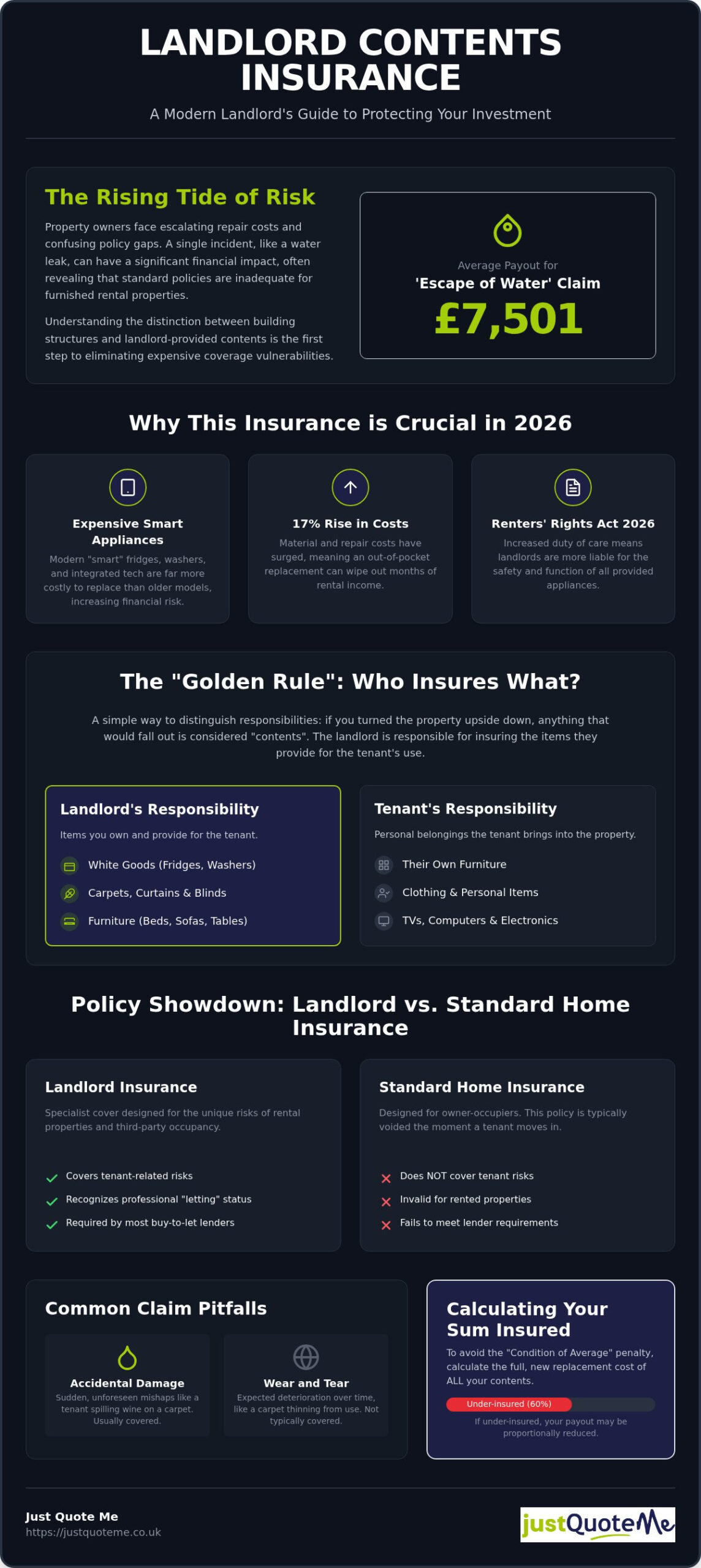
Did you know that the average payout for an ‘escape of water’ claim has reached £7,501? For many property owners, the real shock isn’t the leak itself, but the discovery that their basic policy doesn’t cover the expensive carpets or integrated appliances they’ve provided. If you’re unsure where your building cover ends and your landlord contents insurance begins, you aren’t alone. It’s a common source of anxiety, especially when you’re worried that a tenant’s negligence might lead to a rejected claim or that you’re overpaying for a policy full of loopholes.
We understand that you want a straightforward way to protect your investment without the headache of complex jargon. This guide will help you identify exactly what needs covering while ensuring you meet your legal and financial liabilities under the 2026 Renters’ Rights Act. We’ll clarify the confusing distinction between fixtures and contents, explain how to protect your white goods effectively, and show you how to move away from impersonal call centres toward expert, bespoke advice. By the end, you’ll have a clear roadmap to a policy that offers genuine security for your rental property’s furnishings and appliances.
Key Takeaways
- Define the clear line between building structures and your rental furnishings to eliminate expensive coverage gaps.
- Navigate the higher replacement costs of 2026 by securing landlord contents insurance that specifically includes smart white goods and soft furnishings.
- Apply the “Golden Rule” of property ownership to distinguish your insurance liabilities from your tenant’s personal responsibilities.
- Protect your financial interests by learning how to calculate an accurate sum insured and avoid the pitfalls of the “Condition of Average.”
- Gain the advantage of bespoke, human-centric advice that tailors your policy to your specific property portfolio instead of relying on a generic algorithm.
What is Landlord Contents Insurance and Why is it Essential in 2026?
Landlord contents insurance is a specialist policy that safeguards the furniture and appliances you provide while acting as a critical liability shield for the essential items that make a property habitable. It’s designed to repair or replace items you supply for a tenant’s use that aren’t part of the building’s fabric. While the law doesn’t strictly require you to have this cover, it’s a non-negotiable condition for almost all buy-to-let mortgage lenders in the UK. If you’re renting out a property with even a few basic appliances, this insurance serves as your primary financial safety net.
In 2026, the risks facing property owners have shifted significantly. Modern furnishing trends lean towards higher-quality “smart” appliances and integrated technology which are far more expensive to replace than traditional models. With material and repair costs rising by 17% over the last year, an out-of-pocket replacement for a high-spec washing machine or a touch-screen fridge can instantly wipe out your monthly rental yield. Understanding What is Insurance? in a professional context means recognizing that you’re transferring these high-stakes financial risks to a provider who understands the current market volatility.
The Difference Between Landlord and Standard Home Insurance
Standard home insurance is built for owner-occupiers and is typically voided the moment a tenant moves in. These domestic policies don’t account for the unique risks of third-party occupancy, such as accidental damage by tenants or the specific liability issues that arise in a rental environment. A dedicated landlord policy ensures your professional “letting” status is recognized in the contract. This distinction is vital; it ensures you’re covered for the specific wear and tear and legal risks that occur when you aren’t living on the premises yourself.
Regulatory Context: Renters’ Rights and Landlord Liabilities
The implementation of the Renters’ Rights Act on May 1, 2026, has professionalised the sector and increased the duty of care you owe to your tenants. You’re now more accountable for the safety and functionality of every appliance you provide. If a faulty item you’ve supplied causes a fire or flood, the financial repercussions extend far beyond the cost of the item itself. You could face significant liability claims. Working with an expert broker ensures your residential letting insurance is robust enough to handle these evolving legal landscapes, protecting you from modern regulatory pitfalls that automated comparison sites often overlook.
What Does Landlord Contents Insurance Cover? A Detailed Breakdown
A standard landlord contents insurance policy protects the items you provide that would fall out if you turned the house upside down. This includes high-value white goods like fridges, freezers, dishwashers, and washing machines. In 2026, these are often smart appliances with complex electronics, making them significantly more costly to replace than older, purely mechanical models. Soft furnishings such as curtains, carpets, and blinds are also covered. These are statistically the most claimed-for items because they’re highly susceptible to stains, tears, and physical damage during a tenancy.
For those offering fully or part-furnished lets, the policy extends to beds, sofas, and dining sets. If you manage a House in Multiple Occupation (HMO) or a block of flats, you can also secure cover for communal area contents, such as furniture in shared hallways or residents’ lounges. Ensuring every item is accounted for prevents significant out-of-pocket expenses when a mishap occurs. If you’re managing multiple units or a large building, you might find that commercial property insurance offers a more comprehensive solution for the entire structure and its internal assets.
Accidental Damage vs. Wear and Tear
The distinction between accidental damage and wear and tear is where many claims fail. Accidental damage covers sudden, unforeseen mishaps like a tenant spilling red wine on a new carpet or dropping a heavy object on a glass hob. Conversely, wear and tear is the expected deterioration of an item over time. This includes a carpet becoming thin in high-traffic areas or a sofa cushion losing its shape after years of use. Insurers never cover wear and tear. You can manage tenant expectations and streamline the claims process by maintaining a detailed property inventory. A professional inventory provides the evidence needed to prove that damage was sudden rather than gradual.
Specialist Add-ons: Loss of Rent and Alternative Accommodation
If a major event like a fire or significant “escape of water” makes the property uninhabitable, your contents cover can do more than just replace a sofa. The average payout for an escape of water claim is currently £7,501, which highlights the financial risk. Specialist add-ons like “Loss of Rent” protect your cash flow by replacing the income you lose while the property is under repair. Some policies also cover the cost of alternative accommodation for your tenants if you’re legally obligated to provide it. This level of protection ensures a single disaster doesn’t derail your entire investment strategy. To see how these options fit your specific needs, you can compare bespoke policy features with our expert team.
Landlord vs. Tenant Insurance: Clearing the Confusion
The Golden Rule of property insurance is simple: you cannot insure items you don’t own. This principle defines the boundary between your responsibilities and those of your tenant. While your landlord contents insurance protects the furniture, appliances, and floor coverings you provide, it offers zero protection for the tenant’s personal belongings. If a burst pipe destroys a tenant’s laptop or expensive clothing, your policy won’t pay out for their loss. Clear communication is essential here. You should explicitly state in the tenancy agreement that your insurance only covers the landlord’s inventory, and advise tenants to secure their own contents cover or “Tenant Liability” insurance to protect their interests.
Disputes often arise when boundaries aren’t clearly defined before a claim occurs. By providing a comprehensive inventory at the start of the tenancy, you establish a documented list of exactly what your policy covers. This transparency helps avoid the common misconception that a landlord’s policy is a catch-all for every item inside the building. Ultimately, a landlord contents insurance policy serves as a protective shield specifically for the items you’ve supplied to make the property habitable, leaving the tenant responsible for their own possessions. For those currently purchasing or selling property to grow their portfolios, Eagle Haus Conveyancing Consultants provides the specialist legal support needed for smooth residential transactions across England and Wales.
The “Grey Areas”: Carpets, Laminate, and Fixtures
One of the most frequent points of confusion is how insurers categorise flooring. Most providers view carpets as “contents” because they can be removed and replaced without damaging the building’s structure. However, laminate, vinyl, or tiled flooring is often classified under buildings insurance because it’s considered a permanent fixture. Similarly, a fitted kitchen with integrated cupboards is a building element, but a freestanding washing machine or microwave falls under contents. At Just Quote Me, we help clarify these technical definitions during the quote process, ensuring you don’t accidentally leave high-value items uninsured or pay twice for the same coverage.
Liability Protection for Landlords
Contents insurance isn’t just about physical objects; it’s about the risks those objects carry. If a faulty kettle or a poorly maintained sofa you provided causes an injury to a tenant, you could be held legally liable for damages. Many policies include “Property Owners Liability” as a standard or optional feature. This is distinct from public liability insurance, which focuses on your broader business interactions. Having this specific protection within your contents policy ensures that if an item in your inventory leads to a legal claim, your financial interests and professional reputation remain secure.
How Much Cover Do You Need? Calculating Your Sum Insured
Calculating your sum insured correctly is the difference between a full payout and a significant financial shortfall. Many property owners fall into the trap of under-insurance, which triggers the “Condition of Average” clause. If you insure your contents for £5,000 but the true replacement value is £10,000, you’re 50% under-insured. In the event of a £2,000 claim for a flooded carpet, the insurer may only pay out £1,000. You must value every item based on its current replacement price to ensure your landlord contents insurance provides the protection you expect. Utilizing a professional data resource like Property Deals Insight can offer the unified UK property data and AI intelligence required to maintain precise asset valuations across your portfolio.
The type of settlement you choose is equally critical for your 2026 strategy. “New for Old” cover ensures you receive the current market value for a brand-new equivalent item. With the 17% rise in material and appliance costs seen over the last year, this is usually the safer choice. The alternative is “Indemnity Value,” which deducts for wear and tear. While indemnity policies might have slightly lower premiums, they often leave you with a significant bill when it’s time to actually replace high-spec smart appliances or quality furnishings.
Valuing Part-Furnished Properties
A common mistake is assuming that a part-furnished property requires minimal landlord contents insurance. Even if you don’t provide beds or sofas, the cost of replacing all carpets, curtains, and blinds simultaneously can be staggering. Walk through each room and record every item you own, from the integrated fridge to the hallway runner. A digital inventory, including photos and serial numbers for white goods, is the best way to maintain an accurate valuation. This document acts as your primary evidence should you ever need to file a claim after a tenant moves out.
Security Requirements and Premium Impact
Your property’s security features directly influence your premium and your eligibility for certain types of cover. Insurers often require specific lock types, such as five-lever mortice deadlocks complying with BS3621, on all external doors. Having a monitored alarm system can also reduce your risk profile and lower your costs. Because these requirements vary significantly between providers, getting expert advice on your landlord policy helps you navigate these technicalities. For a broader look at protecting your investment beyond just your contents, read our Landlord Insurance in 2026: The Ultimate UK Guide. Our team can help you find a bespoke solution that balances high-level security with competitive premiums.
Securing Your Rental Property with Just Quote Me
Just Quote Me isn’t just another name on a screen. We’re an independent UK broker with 30 years of industry experience. Based in Stone, Staffordshire, our team provides a human-centric alternative to the impersonal algorithms found on most comparison sites. When you’re looking for landlord contents insurance, you shouldn’t have to settle for a one-size-fits-all policy that leaves you vulnerable to the coverage gaps we’ve discussed. Our approach is built on reliability and a desire to simplify the complex administrative processes that often overwhelm property owners.
Our status as an FCA-authorised firm gives us access to a broad network of top UK insurers. This allows us to find competitive, bespoke pricing that reflects the actual risks of your property rather than a generic average. You won’t be directed to an impersonal call centre. Instead, you’ll speak directly with experts who understand the nuances of the 2026 rental market. We take pride in being a steady hand in a complex market, managing the heavy lifting so you can focus on your tenants and your yields.
Bespoke Policies for Every Type of Landlord
Whether you own a single studio flat or manage an extensive commercial portfolio, we tailor the cover to your specific needs. We understand that every landlord’s situation is unique. For example, some property owners prefer to handle their own repairs and maintenance to keep costs down. If this sounds like you, we can also discuss tradesman insurance to ensure your tools and liability are protected while you’re working on-site. We handle the technical details and policy comparisons, providing you with clear, honest communication throughout.
Our professional restraint means we focus on value and security rather than hyperbolic marketing. By choosing a partner with three decades of regional expertise, you’re securing more than just a policy; you’re gaining a trusted advisor who understands the local landscape. We move you quickly from a state of inquiry to a state of protection, ensuring your furnishings and appliances are shielded against the unexpected.
Get Your Quote Today
Securing your investment shouldn’t be a frictionless experience only in theory. We’ve streamlined our process to provide immediate value. You can start the process online or speak with us directly to get the expert guidance your portfolio deserves. Don’t leave your assets to chance when professional, bespoke advice is just a click away.
Protect Your Investment with Professional Certainty
Navigating the complexities of the 2026 rental market requires more than just a generic policy; it demands a clear understanding of where your buildings cover ends and your contents protection begins. By accurately valuing your inventory and recognizing the liability risks associated with provided appliances, you safeguard your long-term yields from sudden, expensive mishaps. Specialist landlord contents insurance ensures that whether you’re dealing with a minor spill or a major flood, your financial recovery is swift and supported by expert guidance.
As an FCA-authorised independent broker with over 30 years of industry experience, we provide access to a broad network of top UK insurers. We handle the administrative burdens so you don’t have to, offering a steady hand in an evolving regulatory landscape. You can secure your property assets today with a partner who prioritizes human-centric service over automated systems. Taking the time to professionalise your insurance now provides the peace of mind you need to grow your rental business with confidence.
Frequently Asked Questions
Is landlord contents insurance a legal requirement in the UK?
No, there’s no UK law mandating this cover. However, it’s almost always a strict requirement for buy-to-let mortgage lenders. Failing to maintain a policy could put you in breach of your loan agreement. Beyond lending rules, it’s a vital financial safeguard. Without it, you’re personally liable for replacing expensive items like carpets and appliances if they’re damaged by fire, flood, or specific tenant mishaps.
Does landlord contents insurance cover my tenants belongings?
No, your policy only covers items you own and provide for the tenant’s use. Tenants are responsible for insuring their own personal possessions, such as laptops, clothes, and jewellery. It’s best practice to explain this boundary clearly in your tenancy agreement. You should encourage tenants to take out their own contents or “Tenant Liability” insurance to ensure they’re protected against loss or accidental damage to your property.
Will my buildings insurance cover the carpets in my rental property?
Typically, buildings insurance excludes carpets because they’re considered removable contents rather than permanent fixtures. While laminate or tiled flooring is often part of the building structure, carpets require specific landlord contents insurance. If a leak or fire ruins the flooring across your entire property, the replacement costs can be substantial. Including contents cover ensures these soft furnishings are protected under a professional policy tailored for rental risks.
What is accidental damage cover for landlords and is it worth it?
Accidental damage cover protects you against sudden, one-off mishaps like a tenant spilling red wine on a carpet or smashing a ceramic hob. It doesn’t cover gradual wear and tear or deliberate damage. Given that the average payout for escape of water is currently £7,501, and soft furnishings are the most claimed-for items, this add-on is usually considered essential for maintaining your property’s standards without dipping into your monthly profits.
Can I get contents insurance for an unoccupied rental property?
Yes, but you’ll need a policy that specifically accounts for unoccupancy. Most standard landlord policies limit or remove cover if a property is empty for more than 30 or 60 consecutive days. During void periods, risks like theft or undetected leaks increase significantly. Specialist unoccupied property cover ensures your furnishings remain protected while you’re between tenancies or carrying out renovations, providing continuous security for your internal assets.
How much does landlord contents insurance typically cost in 2026?
Costs vary based on your property’s location, the total value of the items provided, and your previous claims history. In 2026, premiums have been influenced by a 17% rise in material and appliance replacement costs. While general market ranges exist, your specific premium will depend on whether you choose “New for Old” cover or more basic indemnity options. Speaking with an independent broker allows you to compare bespoke quotes from a broad network of insurers.
What happens if a tenant steals my furniture?
Theft by a tenant is a specific risk that isn’t always included in basic policies. You must check that your policy includes “theft by person legally on the premises.” If a tenant leaves with your furniture, you’ll typically need to provide a police crime reference number to process the claim. A robust inventory and professional tenant referencing are your best defences against these rare but costly incidents occurring during a tenancy.
