
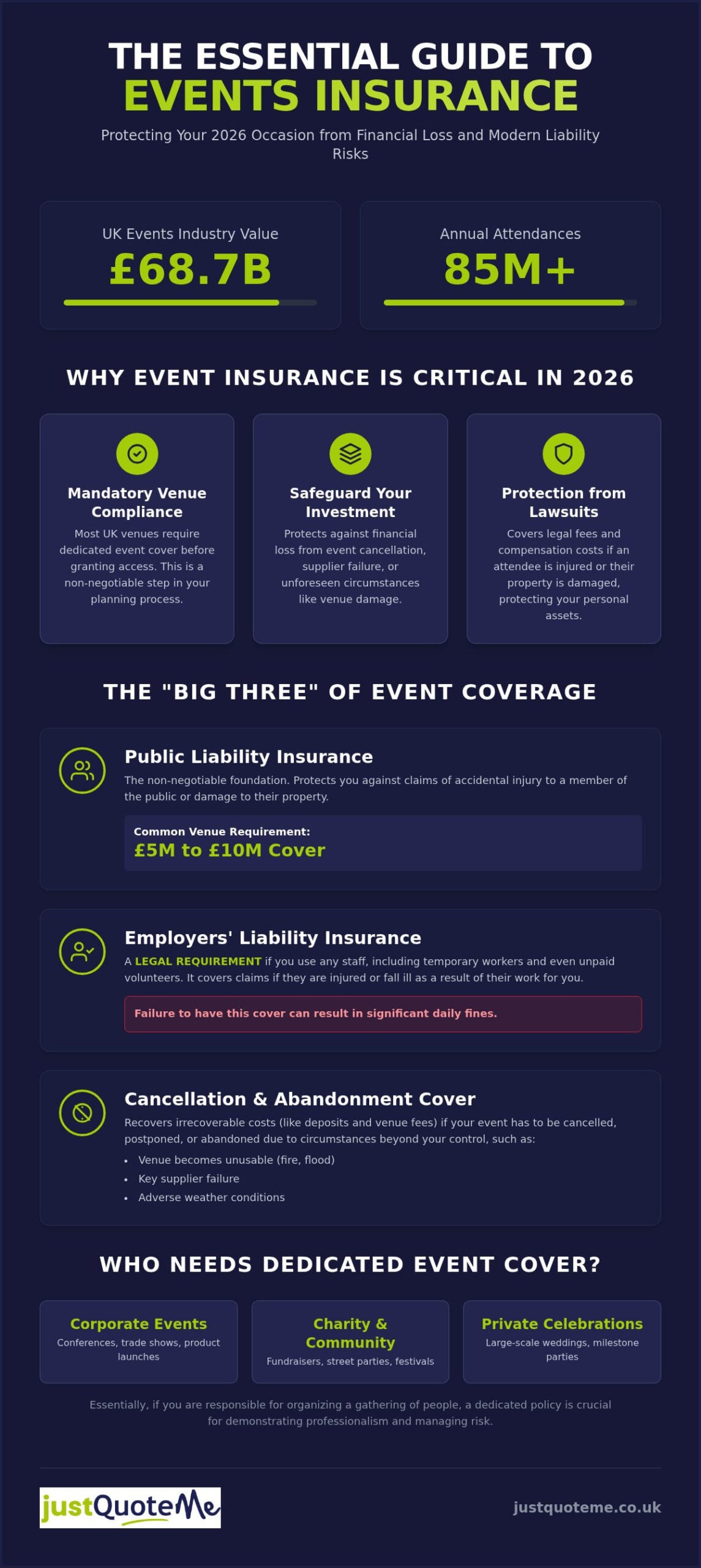
Did you know the UK events industry is now valued at a staggering £68.7 billion? With over 85 million attendances recorded annually, the scale of modern gatherings is immense, but so are the potential risks for organisers. Whether you’re planning a small community festival in Staffordshire or a major corporate conference, securing the right events insurance is no longer just a “nice to have.” It’s a critical requirement for venue compliance and your own financial survival in an increasingly litigious environment.
It’s completely natural to feel overwhelmed by the prospect of legal liabilities or the threat of unpredictable British weather ruining months of hard work. You want to focus on the guest experience, not the constant worry of a lawsuit or a flooded marquee. This comprehensive 2026 guide simplifies the complex world of bespoke cover. We’ll walk you through everything from current public liability limits to the immediate impact of the Terrorism (Protection of Premises) Act 2025 on your planning. You’ll discover how to protect your investment and gain the peace of mind needed to run a successful, compliant event.
Key Takeaways
- Understand how a multi-layered policy shields your occasion from financial loss and specific 2026 liability risks that standard plans might miss.
- Identify the essential protections you need, including why employers’ liability is a legal must-have for anyone using staff or volunteers.
- Determine whether a one-off policy or annual multi-event cover provides the best value for your specific planning schedule.
- Learn how to accurately assess your guest count and activities to meet the strict liability limits often mandated by UK venues.
- See why bespoke Events insurance through an independent broker offers more flexibility and better security than automated online systems.
What is Events Insurance and Why is it Essential in 2026?
Organising a successful gathering in 2026 involves more than just logistics and guest lists. It requires a robust safety net. Events insurance is a multi-layered policy designed to protect against legal liability and sudden financial loss. In the broader market, this falls under the category of Niche insurance, providing tailored protections that a standard business policy might lack. Put simply, events insurance is the primary financial shield for organisers against third-party claims and property damage.
You might already hold public liability insurance for your daily business operations. However, these general policies often contain exclusions for specific event-related risks. For instance, they might not cover temporary staging, hired equipment, or the unique security obligations now required under Martyn’s Law. UK venues have become increasingly stringent in recent years. Most now require proof of dedicated event cover with specific indemnity limits, often starting at £5 million or £10 million, before they’ll even allow you on-site to begin your setup.
The Core Purpose of Event Coverage
The primary goal is to keep your personal or business assets safe from litigation. If an attendee suffers an injury or their property is damaged during your event, the resulting legal fees and compensation claims can be devastating. A bespoke policy ensures that attendees are compensated fairly without you having to foot the bill personally. Beyond accidents, it provides a vital financial buffer for your investment. If a key supplier fails or the venue becomes unusable due to fire or flood, you can recover non-refundable deposits and venue costs that would otherwise be lost. This protection allows you to focus on the event itself rather than the “what-ifs.”
Who Needs a Dedicated Policy?
Dedicated cover isn’t just for massive festivals. It’s essential for anyone taking on the responsibility of hosting others. Some common scenarios include:
- Charity fundraisers: Small community street parties or bake sales still carry risks involving volunteers and the public.
- Corporate events: Trade exhibitions and conferences involve high footfall and expensive equipment that needs protection.
- Private celebrations: Large-scale weddings or milestone parties represent a significant financial investment that deserves a safeguard.
Whether the event is for profit or a local cause, the legal expectations for safety remain the same. Having a dedicated policy shows your partners and attendees that you take your responsibilities seriously. It demonstrates a professional approach to risk management that automated systems simply cannot match.
Understanding the Different Types of Event Cover
Events insurance isn’t a single product but a combination of protections tailored to your specific risks. Most organisers start with a foundation known as the “Big Three”: Public Liability, Employers’ Liability, and Cancellation cover. While these form the core, an effective policy must be bespoke to the occasion. For example, if your event runs into the early hours with music and alcohol, you may require elements of nightclub insurance to address specific late-night risks. You should also consider protecting physical assets through equipment cover for hired tech and “event money” cover to protect cash held on-site.
If you use any staff or volunteers, employers liability insurance is a legal requirement in the UK. Even if your helpers are unpaid, you’re responsible for their safety while they work. Failing to hold this cover can result in significant daily fines from regulators. Following the Health and Safety Executive (HSE) guidance helps you document these risks and fulfill your legal duties as an organiser.
Public Liability: The Non-Negotiable
Public liability is the most frequent area for claims. It protects you if a member of the public suffers an accidental injury or if their property is damaged during your event. In 2026, UK venues rarely accept anything less than £5 million in cover; many large-scale or local authority sites now mandate a minimum of £10 million. Common claims involve simple accidents like a guest tripping over an unsecured power cable or a display stand collapsing. Without this protection, you’re personally responsible for both the legal fees and the eventual compensation costs.
Event Cancellation and Abandonment
This cover protects your financial outlays. If your venue closes unexpectedly or extreme weather makes the site unsafe, you could lose your entire investment. Modern 2026 insurance contracts place heavy emphasis on “Force Majeure” clauses, which define exactly what counts as an uncontrollable event. Cancellation cover reimburses your non-refundable costs for marketing, catering, and entertainment. This ensures that a single unforeseen disaster doesn’t lead to total financial ruin. If you’re unsure which specific protections your contract requires, seeking bespoke insurance advice is the most efficient way to identify potential gaps in your cover.
One-Off vs. Multiple Event Insurance: Which is Right for You?
Deciding between a one-off policy and annual cover depends entirely on your calendar and long-term strategy. Regardless of how often you host gatherings, as an organiser, you’re legally responsible for ensuring a safe environment for every attendee and staff member. For those building complex exhibition stands or temporary structures, the risks often mirror those found in the construction trade. This is where builders insurance logic becomes relevant; you must protect the build phase and the structural integrity of your installation as much as the live event itself.
Single Event Insurance for One-Off Occasions
If you’re planning a single wedding, a community street party, or a one-time charity fundraiser, a one-off policy is the most logical choice. These policies are designed for simplicity and immediate protection. They typically cover the specific duration of your event plus the necessary days for set-up and take-down. This ensures you’re protected from the moment the first equipment arrives until the last contractor leaves the site. It’s a straightforward solution for infrequent gatherings where an annual commitment doesn’t make financial sense.
Annual Multi-Event Policies for Professionals
Professional event planners, regular exhibitors, and market stallholders often find that Events insurance on an annual basis offers far superior value. These “multiple event” policies typically cover organisers running up to 45 events a year under a single premium. This approach eliminates the administrative burden of arranging separate cover for every single booking. You benefit from one renewal date and one set of core documents, which makes proving compliance to venue managers much faster and more efficient.
For stallholders attending various markets across the UK, annual cover provides a vital “blanket” protection. You don’t have to worry if a last-minute opportunity arises at a new location; your policy stays active and ready. It’s an efficient way to manage risk while maintaining the flexibility needed in a competitive industry. By choosing an annual policy, you often secure more competitive pricing than buying dozens of separate one-off plans. It’s a pragmatic choice for anyone making a living through regular public engagements.
How to Assess Your Event Risk and Choose Your Limits
Calculating the correct level of Events insurance requires a methodical look at your specific operational risks. You can’t rely on a “one size fits all” approach because every gathering has a unique risk profile. Start by evaluating your guest count and the nature of the activities. A quiet corporate seminar involves far less risk than a community firework display or a festival with live music. Understanding these nuances helps you avoid paying for unnecessary cover while ensuring you aren’t left exposed.
Follow these four steps to build your risk profile:
- Evaluate scale and activity: Higher attendance levels and physical activities naturally increase the likelihood of an accident.
- Review venue contracts: Most UK venues specify exactly how much public liability insurance you must hold. This is often the non-negotiable starting point for your limits.
- Identify high-risk elements: Temporary staging, marquee structures, and alcohol service all add layers of complexity. These require specific scrutiny as they are frequent sources of claims.
- Consult a professional: Automated systems often miss the nuances of your specific plan. Speaking with a broker ensures your bespoke policy has no hidden gaps.
Choosing the Right Liability Limit
While £1 million in cover might suffice for small, low-attendance indoor meetings, it’s rarely enough for anything public-facing. In 2026, £5 million has become the standard requirement for most UK local authority venues and community halls. If you’re hosting high-attendance public events, especially those with over 800 people, venues and local councils frequently demand a minimum of £10 million. This higher limit accounts for the increased scale of potential claims and aligns with the security tiers now seen in UK safety legislation.
Common Exclusions to Watch Out For
Even the best policies have boundaries. You’ll typically find that dangerous activities like bungee jumping, professional motor racing, or high-risk pyrotechnics are excluded from standard cover and require a specialist rider. Similarly, cancellation cover often excludes issues caused by pre-existing medical conditions of key speakers or performers. If your event relies on digital streaming to reach a global audience, you should also check for exclusions regarding cyber-related disruptions. To ensure your specific risks are fully accounted for, you can get expert advice on your event risks from our team of specialists.
The Advantage of Using an Independent Broker for Events Insurance
While instant online platforms promise speed, they often lack the nuance required for complex event planning. Just Quote Me brings over 30 years of industry experience to the table, acting as a human-centric alternative to automated systems. We don’t rely on a single algorithm. Instead, we access a broad panel of top UK insurers to negotiate competitive, bespoke pricing on your behalf. This ensures you get the most robust protection for your specific budget. Our regional expertise in Staffordshire and the West Midlands provides better local context for event risks, ensuring your cover aligns with specific venue expectations in our area.
Bespoke Solutions vs. One-Size-Fits-All
Automated quote engines often fail when an event involves multiple locations or unique activities. They tend to offer rigid packages that might include cover you don’t need while missing critical risks. We take a different approach. By tailoring your policy to include only the coverages you actually need, such as public liability insurance or specific cancellation cover, we ensure you aren’t overpaying for generic protection. This bespoke method simplifies the administrative burden, as we handle the complex paperwork and insurer negotiations so you don’t have to. It’s a pragmatic way to manage risk without the headache of DIY insurance management.
Expert Support During a Claim
The real test of any Events insurance policy comes when you need to make a claim. In these stressful moments, having an independent broker is a significant advantage. We act as your advocate, managing the communication with the insurer to ensure a fast and fair settlement. This level of support protects your event’s future reputation and your financial standing. You’ll have direct access to expert advice without having to navigate frustrating automated phone menus or generic help centres. Our status as an FCA-authorised firm means we operate with professional restraint and honesty, providing a steady hand when you need it most.
We understand that event organisers work under tight deadlines. Our goal is to provide a frictionless experience that moves you quickly from an initial inquiry to full protection. This efficiency is the result of three decades spent refining our processes and building relationships with underwriters who trust our expertise. When things go wrong, the value of a knowledgeable partner cannot be overstated. We provide the pragmatic solutions you need to navigate the legal and administrative hurdles of the insurance market.
Securing the Future of Your 2026 Events
Hosting a successful gathering in 2026 requires a shift from managing administrative burdens to focusing on the guest experience. Throughout this guide, we’ve explored how identifying specific liability limits and understanding the nuances of modern “Force Majeure” clauses provides the foundation for a safe event. Securing the right Events insurance ensures that unforeseen weather shifts or supplier failures don’t derail your financial investment or professional reputation. It’s about moving from a state of uncertainty to a position of total operational confidence.
Just Quote Me offers the steady hand and regional expertise needed to navigate this complex market. With over 30 years of experience as an independent, FCA-authorised broker, we match your unique risks with bespoke coverage from a broad panel of UK insurers. Instead of struggling with automated systems, you gain a human partner who handles the paperwork and advocates for you if a claim arises. We manage the technical details so you can focus on delivering an unforgettable occasion.
Frequently Asked Questions
Do I legally need events insurance in the UK?
No, there is no single law requiring events insurance for every occasion, but you’ll find it nearly impossible to book a venue without it. Most venue contracts and local council permits mandate a minimum level of public liability cover. Crucially, if you employ anyone, including volunteers, you are legally required to hold employers’ liability insurance. Failing to meet these contractual or legal obligations can lead to immediate event closure or heavy fines.
How much does events insurance cost for a one-day event?
The cost depends on several variables including your guest count, the nature of the activities, and the required indemnity limits. A small indoor seminar will naturally attract a lower premium than a large outdoor festival with high-risk elements like fireworks. Because every gathering has a unique risk profile, we provide bespoke quotes for Events insurance rather than fixed rates. This ensures you only pay for the specific protections your individual event requires without any unnecessary overhead.
Does my standard business insurance cover me for an exhibition?
Most standard business policies are designed for your primary premises and everyday operations, often excluding off-site exhibitions or large public gatherings. While you might have some general liability cover, it may not meet the specific indemnity limits demanded by exhibition hall managers. It is vital to check your existing policy for geographical limits and event exclusions before assuming you’re protected. A dedicated policy fills these gaps, ensuring your equipment and liability are covered on-site.
What happens if my event is cancelled due to bad weather?
If you have included cancellation and abandonment cover, your policy can reimburse non-refundable expenses if extreme weather makes the event unsafe or impossible to hold. This typically covers scenarios where a venue becomes inaccessible or a local authority issues a safety warning. However, it doesn’t usually cover disappointing weather that merely reduces attendance. The policy focuses on uncontrollable circumstances that force a total cancellation, protecting your marketing, catering, and venue deposits from total loss.
Can I get events insurance for a private party at my home?
Yes, you can secure protection for private celebrations held on your own property, such as large weddings or milestone birthday parties. Standard home insurance often has low limits for public liability and may exclude risks associated with marquee hire or external caterers. Dedicated Events insurance provides much higher indemnity limits and covers accidental damage to hired equipment. This ensures that a private celebration doesn’t lead to a personal financial crisis if an accident occurs on your land.
What is the difference between public liability and event cancellation insurance?
Public liability protects you against legal claims if a guest is injured or their property is damaged during your event. In contrast, event cancellation insurance is a financial safeguard for your out-of-pocket expenses if the occasion cannot go ahead. While public liability deals with accidents involving people, cancellation cover deals with the loss of your investment due to venue failure, supplier bankruptcy, or extreme weather. Both are essential components of a robust, bespoke insurance strategy.
Is equipment cover included in a standard event policy?
Equipment cover is typically an optional addition to a basic policy rather than a standard inclusion. This protection is vital if you’re hiring expensive lighting, sound systems, or marquees that you’re contractually responsible for. It covers the cost of repair or replacement if the items are stolen or accidentally damaged while in your care. We recommend listing high-value items separately to ensure your bespoke policy provides the exact level of protection needed for your technical setup.
