

If you think a flood claim is only about replacing soggy carpets and ruined stock, you’re likely leaving thousands of pounds on the table. When the water recedes, the real challenge begins: identifying the true cost of the disruption to your livelihood. You’re likely asking, “my business has been flooded what do i claim for” while staring at a policy document that feels like it’s written in another language. We understand that the fear of a rejected claim or a lowball settlement can be just as stressful as the flood itself.
You’ve worked too hard to let a disaster end your story, and it’s right to expect your insurance to work as hard as you do. This guide provides a definitive checklist for UK business owners to identify every claimable loss, including hidden operational costs and business interruption. We’ll show you how to document your evidence properly, navigate complex policy wording, and build a clear roadmap for a full financial recovery. To ensure your future is protected by specialists who understand the nuances of your specific sector, Just Quote Me.
Key Takeaways
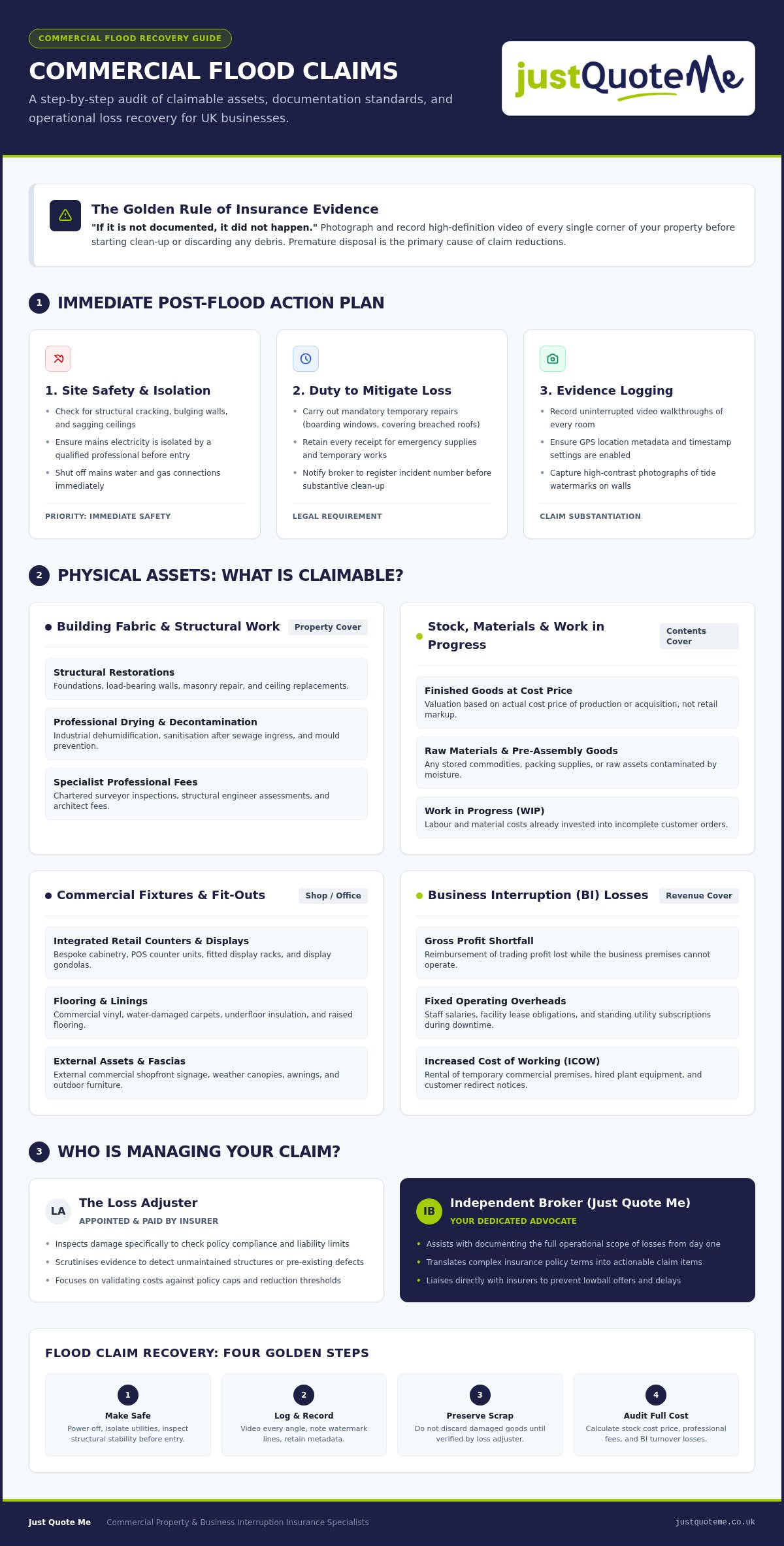
- Learn why the ‘Golden Rule’ of evidence is critical and how photographing every inch of your premises before the clean-up protects your settlement.
- Identify the full scope of physical asset claims, from structural repairs and professional surveyor fees to fixtures that may look fine but are water-damaged.
- Discover how to recover lost income through Business Interruption, answering the vital question: if my business has been flooded what do i claim for beyond just physical stock?
- Understand the crucial difference between a Loss Adjuster and an independent broker to ensure you have a dedicated advocate managing the complex paperwork on your behalf.
Immediate Post-Flood Action: The Safety & Evidence Checklist
Entering your premises after a flood is a high-stakes moment where adrenaline often overrides caution. Your first priority must be safety. Before you even think about the inventory, check for structural cracks, bulging walls, or sagging ceilings. Floodwater is incredibly heavy and can undermine the foundations of even the sturdiest commercial buildings. Electricity and water are a lethal combination; never enter a flooded building until the power is confirmed off at the mains by a professional.
Once the site is safe, contact your broker immediately. At Just Quote Me, we act as your steady hand during this crisis, helping you log the claim and secure an incident number. Speed is essential, but so is the duty to mitigate loss. This is a standard insurance requirement where you must take reasonable steps to prevent further damage to your property. These steps might include boarding up broken windows or covering a damaged roof. Keep every single receipt for these emergency measures, as they are typically claimable under your commercial property insurance policy.
Securing the Premises and Utilities
Isolate your gas, water, and electricity supplies right away. You must ensure a certified professional signs off on the safety of these systems before you attempt to reconnect them. Beyond the utilities, be wary of what the water has brought inside. Floods often move hazardous materials or sewage into business spaces, creating a biological risk. If you are standing in a foot of water asking, “my business has been flooded what do i claim for”, the answer starts with safety and decontamination. You can often include the cost of professional sanitisation and specialist cleaning in your final settlement.
Creating Your Evidence Log
The Golden Rule of insurance claims is simple: if it isn’t documented, it didn’t happen. Use your phone to take high-resolution video walkthroughs of the entire site. Focus on the height of water marks on the walls, as this helps loss adjusters determine the severity of the surge. In 2026, most smartphones automatically embed metadata; ensure your location services and date settings are active to provide a digital timestamp that insurers cannot dispute.
Do not dispose of any soaked stock, warped furniture, or damaged equipment yet. Even if a piece of machinery looks like scrap, the loss adjuster needs to see it to verify its value. Discarding items too early is one of the most common reasons claims are reduced or rejected. While physical items are obvious, remember that your policy may also cover the financial fallout through business interruption insurance, which handles the income you lose while the doors are closed.
Physical Asset Checklist: What to Claim for Buildings and Contents
When you’re trying to figure out “my business has been flooded what do i claim for”, it’s helpful to categorise your losses into buildings, contents, and stock. Many owners only think of the obvious ruined items. However, a comprehensive claim includes the fabric of the building itself. You can claim for structural repairs, professional drying-out costs, and the fees of architects or surveyors required to oversee the restoration. These professional fees are often overlooked but are essential for ensuring the building is safe to reoccupy.
Stock is another major category. You should calculate the cost price of all damaged goods. This doesn’t just mean finished products ready for sale; it includes raw materials and work-in-progress items that were contaminated. Even if an item looks “okay” on the surface, exposure to floodwater can lead to mould or structural weakness later. List every desk, chair, and shelving unit. If you are unsure about the specifics of your coverage, it’s often best to speak with an independent broker who can review your policy limits.
Commercial Property and Shop Fittings
For retailers and office-based businesses, fixed items represent a significant portion of the value. You can claim for counters, display units, and integrated flooring that has been compromised by water. You should review your Commercial Property Insurance to understand your typical coverage limits for these items. Don’t forget the exterior of your premises. Items like external signage, awnings, and outdoor furniture are frequently overlooked but are fully claimable. If you operate a retail outlet, your Shop Insurance usually provides the framework for these specific retail-related losses.
Specialised Equipment and Tools
Industrial and technical businesses face unique challenges. Water damage to sensitive electronics often requires more than just a wipe down. You can claim for the cost of professional cleaning and the recalibration of machinery to ensure it meets safety standards. For those in heavy industry, Plant and Machinery Insurance is the primary vehicle for recovering the value of heavy equipment. If your business uses mobile equipment or vehicles that were on-site during the flood, check your Van and Tools Insurance. This can cover portable equipment that might not be included under a standard building and contents policy. Every item, from a laptop to a lathe, must be documented to ensure a fair settlement.
Business Interruption: Claiming for Lost Income and Hidden Costs
Equally vital is the Increased Cost of Working (ICOW). This covers the extra expenses you incur to keep your business running during the recovery phase. If you need to rent temporary premises, lease emergency equipment, or pay for additional transport to reach customers, these costs are typically claimable. For example, you can discover JOIN ME flex office for inspiration on the type of modern, flexible workspaces available to keep your operations running smoothly. You should also account for staffing costs. If you’re paying wages to employees who cannot work because the site is closed, or if you’ve reassigned them to the clean-up effort, these payroll expenses are part of your claim. Check your policy for contractual penalties too; some coverage includes fines for missed delivery deadlines directly caused by the flood.
To justify your claim, you’ll need to provide robust data. This involves comparing your projected 2026 revenue against previous years to establish a clear trend. You must account for seasonal peaks, which is particularly relevant for Hotels and Guest Houses that rely on specific holiday windows. Understand your ‘indemnity period’ as well. This is the maximum length of time your insurer will pay out for lost income, which can range from 12 to 36 months. If your repairs take longer than the period specified in your policy, the financial support will stop.
Relocation and Recovery Expenses
The road to recovery involves many small, hidden costs that quickly add up. You can claim for administrative expenses like redirecting mail, moving telephone lines, and updating your website to inform customers of your temporary location. Professional ‘decontamination’ and ‘deodorising’ services are also claimable to ensure your premises are safe for staff and clients. These sector-specific closure costs are a major factor in Nightclub Insurance or Restaurant Insurance, where hygiene and atmosphere are critical to your brand’s survival. When asking “my business has been flooded what do i claim for”, remember that these specialist cleaning services are often essential for meeting health and safety regulations.
The Claims Process: Navigating Loss Adjusters and Paperwork
Understanding the roles of the people who walk through your door is the first step in managing your recovery. While you’re still cataloguing items and asking, “my business has been flooded what do i claim for”, the administrative machine of the insurance company is already moving. The insurer will appoint a Loss Adjuster to visit your premises. It’s vital to remember that the Loss Adjuster is a professional paid by the insurance company to verify the claim and limit their liability. In contrast, an independent broker or a Loss Assessor works specifically for you, acting as your advocate to ensure you receive every penny you’re entitled to.
Maintain a rigorous ‘claims diary’ from the first hour. Log every phone call, save every email, and record the name of every official who visits the site. This log becomes an invaluable piece of evidence if there are disputes later regarding what was said or agreed upon. Don’t wait for the final settlement to address your financial needs. You can, and should, request interim payments. These early funds help maintain your cash flow, allowing you to pay staff and fund emergency repairs while the larger claim is still being processed.
If the flood wasn’t a natural disaster but originated from a third party’s negligence, such as a burst water main on a construction site next door, the situation changes. You should immediately review your Public Liability Insurance and discuss the possibility of subrogation with your broker. This ensures that the responsible party’s insurer is held accountable, which can sometimes simplify your own claims process.
Documentation You Will Need
To support your business interruption claim, you’ll need to gather at least three years of audited accounts and your latest VAT records. This data proves your business’s health before the incident and provides a baseline for lost earnings. Specialist advisory firms like Business Wise can help you maintain the robust financial and payroll records required for such detailed assessments. For physical assets, locate the original purchase invoices for high-value equipment and machinery. Betterment refers to the deduction an insurer makes when a replacement item is of a higher specification or newer condition than the original, effectively improving your position at their expense. Having original invoices helps you argue for a fairer replacement value based on like-for-like quality.
Negotiation is a standard part of the insurance world. Don’t feel pressured to accept the first offer if it doesn’t cover your full loss or if the figures seem arbitrary. Always ask for a detailed breakdown of how the insurer calculated their offer. When negotiating, revisit your original question: my business has been flooded what do i claim for to ensure nothing has been missed in the insurer’s initial assessment. An independent broker with deep regional expertise in Staffordshire can provide the steady hand needed to challenge unfair valuations and push for a fair settlement. To ensure you have a dedicated advocate managing these complexities, contact our expert team today.
How Just Quote Me Helps You Recover Faster
When disaster strikes, having an expert by your side makes the difference between business survival and a permanent closure. Just Quote Me brings over 30 years of experience as an independent broker in the Staffordshire and West Midlands market. We act as your steady hand, navigating the complex administrative hurdles that often overwhelm business owners during a crisis. If you find yourself asking, “my business has been flooded what do i claim for”, we provide the clear, jargon-free answers you need. Our role isn’t just to sell a policy; it’s to manage the entire lifecycle of your insurance, from initial setup to the final settlement of a claim.
We provide access to a broad network of top UK insurers, which means we can find coverage that is truly fit for purpose. Unlike automated online systems, we offer a human-centric approach. We understand that every business is unique, and a generic policy rarely covers the specific risks of your sector. By working with an FCA-authorised advisor, you ensure that your business’s long-term stability is prioritised over a quick, off-the-shelf sale. For a partner who manages the complex administrative burdens so you don’t have to, Just Quote Me.
Bespoke Protection for Every Sector
Our regional expertise allows us to offer tailored solutions for a vast range of industries. Whether you need specialist Builders Insurance to protect tools and materials on site or Nightclub Insurance that accounts for complex licensing and closure risks, we have the knowledge to help. We understand the local landscape in Stone, Stafford, and Newcastle-under-Lyme, giving us a unique perspective that national corporations lack. This local focus ensures your coverage reflects the specific environmental and economic risks of your area.
Take Action Today
You don’t want to wait for the next flood to discover that your current policy limits are insufficient. Many business owners assume they’re covered until they try to file a claim and meet resistance. Reviewing your coverage with an expert today can prevent a financial catastrophe tomorrow. We’ll help you identify gaps in your current protection and ensure that your business is resilient enough to withstand the unexpected. When you review your policy, you should be able to answer the question: if my business has been flooded what do i claim for with absolute certainty. Don’t leave your recovery to chance; secure your future with a professional who understands your needs.
Securing Your Recovery and Future Resilience
Recovering from a flood is a complex process that requires more than just a clean-up crew. Success depends on the quality of your evidence and your ability to account for the total economic impact on your operations. While physical assets like stock and buildings are the most visible losses, the hidden costs of business interruption often represent the largest portion of a fair settlement. If you are currently asking, “my business has been flooded what do i claim for”, remember that the right documentation is the key to unlocking the full value of your policy.
Just Quote Me provides the expert advocacy you need to navigate these administrative hurdles. As an FCA Authorised Broker with 30+ years of industry experience, we act as a steady hand during times of crisis. We ensure your claim is handled fairly and that your future coverage is bespoke to your sector’s specific risks. To protect your livelihood, Get Your Free Business Insurance Quote now. You can also Request a Call back for free Expert advice from our approachable team. Your business has a future; let’s work together to secure it.
Frequently Asked Questions
Can I claim for the time I spent cleaning up my business after the flood?
Yes, you can usually claim for the labour costs associated with the initial clean-up. If you or your employees spend time clearing debris or sanitising the premises, this is considered a cost of mitigating your loss. You must keep a detailed log of the hours worked and the specific tasks completed. Most insurers will reimburse these costs at a standard hourly rate, provided they are reasonable and documented.
What happens if my business is flooded by a burst pipe instead of a river?
Insurers typically treat a burst pipe as an ‘escape of water’ rather than a ‘flood’. While the physical damage might look identical, the policy limits and excess amounts often differ between these two categories. If you are asking, “my business has been flooded what do i claim for” after a plumbing failure, you should specifically check the escape of water section of your policy for any sub-limits on damage or drying-out costs.
Will my insurance cover the cost of moving to a temporary location?
Your insurance will cover relocation costs if your policy includes ‘Increased Cost of Working’ (ICOW) as part of your business interruption cover. This essential feature pays for the extra expenses incurred to keep your business operational while your main site is repaired. This includes the rent for temporary premises, the cost of moving equipment, and the installation of temporary phone lines or internet connections to maintain service for your clients.
How long does a business flood insurance claim usually take to settle?
The settlement timeline varies significantly depending on the severity of the damage. While minor claims might resolve in a few weeks, complex cases involving structural drying and lost revenue often take several months or even over a year to fully settle. It is standard practice to request interim payments from your insurer to maintain cash flow for wages and emergency repairs while the final figures are being calculated by the loss adjusters.
Is my stock covered at its retail price or its cost price?
Stock is almost always covered at its cost price rather than its retail value. The principle of insurance is to return your business to the exact financial position it was in before the flood, not to provide a profit on damaged goods. However, the profit you would have earned from selling that stock is usually claimable under the business interruption section of your policy, provided you have the correct coverage in place.
Does flood insurance cover the loss of customers after I reopen?
This depends entirely on the length of the ‘indemnity period’ in your business interruption cover. If your policy has a 24 or 36-month indemnity period, it can continue to pay out for the shortfall in your turnover while you work to win back customers. Many basic policies only offer a 12-month period, which often expires before a business has fully recovered its pre-flood footfall and revenue levels.
What if I don’t have a specific Business Interruption clause in my policy?
Without a business interruption clause, you will only be able to claim for the physical damage to your building, contents, and stock. You will not receive any compensation for lost revenue, ongoing staff wages, or the extra costs of working from a temporary site. This is a common gap in basic insurance packages. Having a broker like Just Quote Me review your policy ensures these critical protections are never overlooked.
Can I claim for professional fees like surveyors or loss assessors?
Most commercial policies cover the professional fees of surveyors, architects, and structural engineers required to repair your building. These are essential costs for ensuring the premises meet modern building regulations after a flood. However, the fees for a private loss assessor who negotiates on your behalf are typically not covered by the insurer unless your policy specifically includes a ‘claims preparation’ clause. Always consult your broker to verify these specific terms.
