
Did you know that the UK events industry is now worth a staggering £68.7 billion? While that growth is exciting, the risks are just as substantial. By mid-June 2026, twenty independent festivals had already announced cancellations or postponements. For any organiser, the fear of losing everything to a single weather event or a legal claim is a heavy burden to carry. Securing the right events insurance isn’t just a box-ticking exercise; it’s the foundation of a successful, stress-free occasion.
We understand that the administrative side of planning can feel like a minefield. You’re likely juggling confusion over what the law requires versus what your venue demands, all while worrying about the financial fallout of an unexpected accident. This guide offers expert-led advice tailored to your specific risks and budget, giving you the clarity needed to protect your hard work. We’ll explore exactly which covers are essential, how to satisfy venue contracts, and how to manage your financial risks with confidence.
Key Takeaways
- Distinguish between legal mandates and the contractual requirements set by your venue to avoid critical gaps in your protection.
- Build a bespoke events insurance framework using a tailored menu of cover options designed for your specific risks and budget.
- Evaluate the cost-efficiency of one-off policies versus annual cover based on your event frequency throughout 2026.
- Learn to navigate indemnity limits by aligning your policy with the specific demands of your venue contracts and guest numbers.
- Discover the benefits of human-led advice and how an independent broker manages the complex administrative side of your insurance.
What is Events Insurance and Why is it Essential?
Events insurance is a bespoke package of protections designed to shield organisers from the financial fallout of accidents, damage, or legal claims. It isn’t a single policy but a combination of covers tailored to your specific occasion. As a form of Niche and specialist insurance, it addresses the unique risks that come with gathering people in a specific space for a limited time. Whether you’re hosting a small garden party or a national conference, having this safety net ensures that one mishap doesn’t lead to total financial ruin.
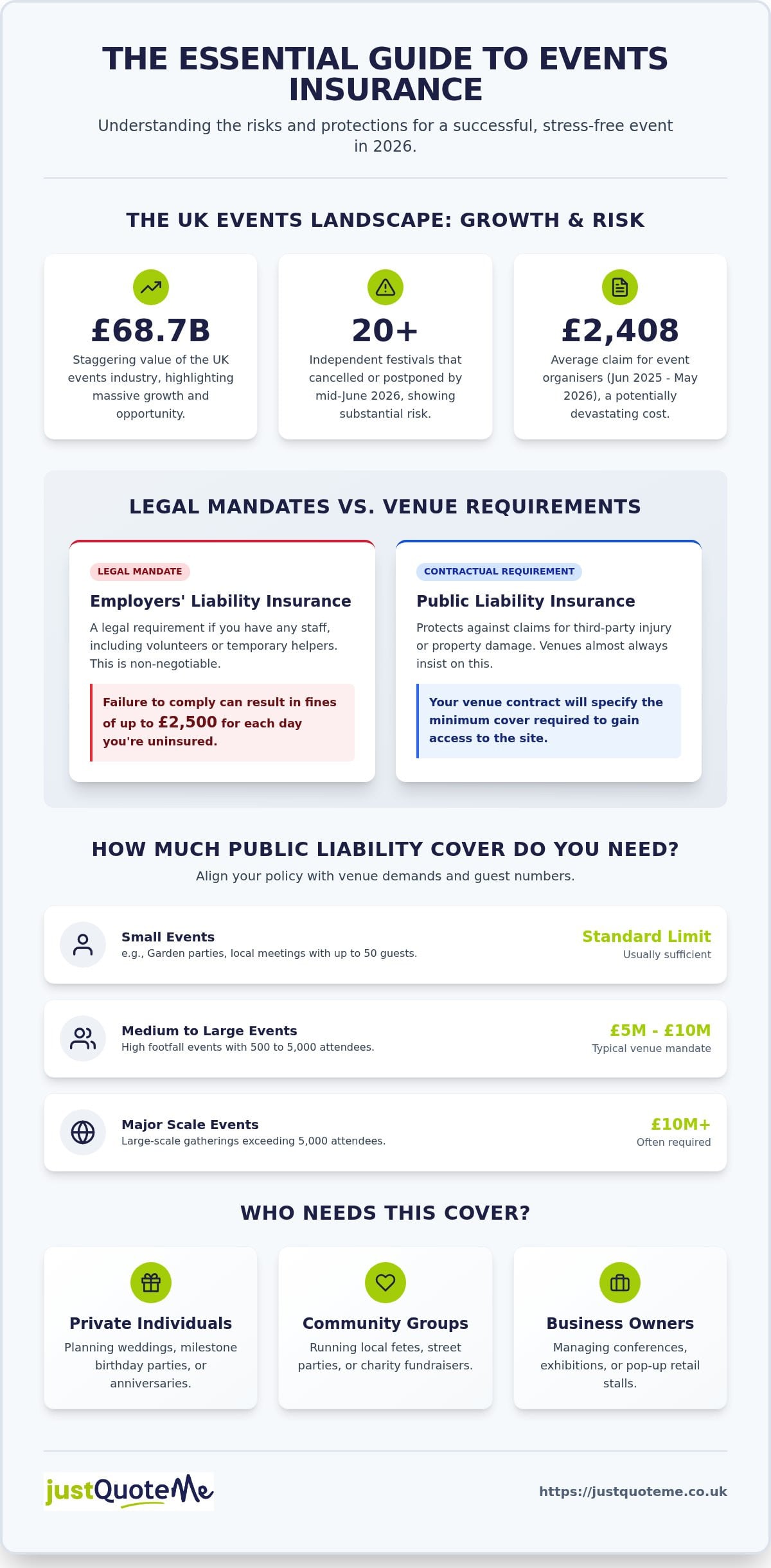
Understanding the difference between legal and contractual requirements is vital for any organiser. Employers Liability Insurance is a legal mandate if you have any staff, including volunteers or temporary helpers. Failing to have this cover can result in fines of up to £2,500 for each day you’re uninsured. Conversely, Public Liability Insurance is usually a contractual requirement. Venue owners almost always insist on seeing a valid insurance certificate before they’ll let you on-site. They need to know that if a guest is injured or the property is damaged, your policy will handle the costs rather than theirs.
The financial reality of event planning is that things can go wrong despite your best efforts. Data shows the average claim for event organisers between June 2025 and May 2026 was £2,408. While that might sound manageable for a large corporation, it can be devastating for a small community group or a private individual. Securing events insurance early in the planning process mitigates these risks, allowing you to focus on the logistics of the day rather than the “what-ifs.”
The Core Risks Covered by a Standard Policy
A standard policy focuses on three primary areas of concern that could otherwise derail your budget. It’s about protecting your liability and your assets simultaneously. Most policies include:
- Accidental injury: Coverage for legal fees and compensation if a guest or member of the public is injured during your event.
- Venue damage: Protection if you or your attendees accidentally damage the building, fixtures, or hired equipment.
- Theft of funds: Security against the loss of money or event funds through theft or accidental loss.
Who Needs This Cover?
If you’re responsible for the safety of others or the condition of a venue, you likely need protection. We help a wide range of organisers, including:
- Private individuals: Those planning significant life events like weddings, milestone birthday parties, or anniversaries.
- Community groups: Volunteers running local fetes, street parties, or charity fundraisers.
- Business owners: Professionals managing conferences, exhibitions, or pop-up retail stalls.
The complexity of these risks is why a human-led approach is so valuable. We manage the administrative burden so you don’t have to, ensuring your policy satisfies every venue requirement while staying within your budget.
Essential Cover Types: Building Your Protection Framework
Think of events insurance as a menu rather than a fixed meal. While every organiser needs a base level of protection, the specific “ingredients” of your policy change depending on the nature of your gathering. A corporate conference in a city hotel faces different hazards than a regional sporting competition held on a public field. The key is ensuring you have the right insurance for your specific risks, rather than just a generic certificate that might fail you when a claim arises.
A sporting event might prioritise medical malpractice or participant injury cover, whereas a high-tech trade show will focus heavily on expensive AV equipment. Regardless of the format, public liability insurance remains the foundation. It provides the essential legal and financial buffer that allows you to operate in professional venues with confidence.
Public Liability: The Foundation of Every Event
This cover protects you against claims for third-party injury or property damage. Common incidents include a guest tripping over an unsecured cable or a heavy speaker cabinet falling and damaging a venue’s heritage flooring. While a standard limit might suffice for a local party with 50 guests, high-footfall events require more. For gatherings with 500 to 5,000 attendees, venues typically mandate a minimum of £5 million to £10 million in cover. Large-scale events exceeding 5,000 attendees often push these requirements beyond £10 million to account for the increased risk of a multi-person accident.
Employers’ Liability for Staff and Volunteers
If you use any staff to run your event, employers liability insurance is a legal requirement. It’s a common misconception that this only applies to full-time, paid employees. In the eyes of the law, volunteers, temporary helpers, and even students on work experience are often classified as employees. If a volunteer is injured while lifting heavy staging during the setup phase, you could be held liable. The legal minimum is £5 million, though most policies provide £10 million as standard. Operating without it is a serious risk; the government can issue fines of up to £2,500 for every single day you remain uninsured.
Event Equipment and Property Cover
Organisers are often responsible for thousands of pounds worth of hired-in equipment. This includes marquees, lighting rigs, stages, and sound systems. Standard liability doesn’t usually cover damage to items in your care, custody, or control. Securing the right events insurance ensures that hired-in equipment is protected against loss, theft, or accidental damage while on-site or in transit. If your event involves heavy lifting or earth-moving gear, you may also need to consider plant and machinery insurance to cover specific technical risks.
Managing these different layers of protection can be complex, but you don’t have to do it alone. You can speak with a specialist broker to ensure every gap is closed before your first guest arrives.
One-Off vs. Multiple Event Insurance: Choosing the Right Policy
Deciding between a single-event policy and annual cover depends almost entirely on your calendar. If you’re a professional organiser running a series of workshops or a business attending several trade shows, an annual policy is the pragmatic choice. It simplifies your administration by providing one renewal date and consistent protection across various UK venues. However, if you’re planning a unique celebration, one-off events insurance offers the flexibility to protect that specific window of time without the commitment of a year-long contract.
Cost-effectiveness is a major factor here. For those hosting more than three or four events a year, the total cost of individual policies often exceeds the price of a single annual premium. Professional organisers also benefit from the ability to handle variations in scale. A multi-event policy can be structured to cover different attendee numbers or venue types under one umbrella; this removes the need to re-apply for cover every time you book a new space.
Single Event Cover for Private Celebrations
Single event cover is the standard choice for weddings, milestone parties, and community fetes. These policies aren’t just for the day itself. They typically include the crucial setup and breakdown periods, protecting you while marquees are being erected or heavy equipment is being moved. Don’t assume that “one-off” means a generic, basic product. We ensure these policies remain bespoke, allowing you to add specific protections for event cancellation or hired-in property that matches the exact scale of your celebration.
Annual Multi-Event Policies for Professionals
For trainers, exhibitors, and frequent conference organisers, annual cover is a significant time-saver. Instead of managing dozens of individual certificates, you have one steady safety net. This is particularly useful when venues demand proof of insurance at short notice. Having a policy already in place allows you to secure bookings faster and focus on your event delivery rather than administrative paperwork. It provides a level of professional readiness that automated, single-transaction systems often struggle to match.
Specialist Cover for Stallholders and Performers
Street food vendors, market stallholders, and pop-up shop owners have specific needs that standard event policies might overlook. If you’re selling goods, product liability becomes just as important as public liability. This protects you if a customer is injured or falls ill due to a product you’ve sold at an event. For those with a more permanent physical presence, integrating this with shop insurance can provide a more comprehensive shield for your business assets, both on and off the event site.
Whether you’re a one-time host or a seasoned professional, we manage the complex administrative burdens so you don’t have to. Our 30 years of experience helps us identify which frequency and scale of cover actually fits your business model.
How Much Cover Do You Need? A Practical Planning Guide
Choosing the right level of indemnity isn’t a matter of guesswork; it’s a strategic calculation based on your audience size, activities, and contractual obligations. While it’s tempting to opt for the lowest possible limit to save on premiums, underinsurance can be a fatal mistake for your business or project. Your required level of events insurance is usually dictated by the parties you’re working with, specifically your venue and any local authorities involved in the licensing process.
Most UK venues mandate proof of public liability insurance before they’ll allow you to step on-site. If you’re using public land or council-owned spaces, the requirements are often even stricter. Local authorities frequently set higher minimums to account for the increased complexity of managing public spaces. Before you seek a quote, conduct a thorough risk assessment to identify potential “worst-case scenarios” that could lead to a multi-person claim.
Determining Your Public Liability Limits
While some small, private gatherings might find a £2 million limit acceptable, the industry standard has shifted. For small events with fewer than 500 attendees, venues typically require between £2 million and £5 million in cover. Medium-sized events with 500 to 5,000 guests usually see this requirement jump to a minimum of £5 million or £10 million. If you’re hosting a large-scale occasion with over 5,000 people, you’ll almost certainly need £10 million or more. Staffordshire venues, for instance, often have specific regional requirements for public land use that align with these higher tiers to ensure full protection against complex legal claims.
The Role of Cancellation and Adverse Weather Cover
If your event involves high-cost venues or significant non-refundable deposits, cancellation cover is essential. The 2026 season has already proven how volatile the industry can be; by mid-June, twenty independent UK festivals had already announced cancellations or postponements. This type of protection typically costs between 1% and 3% of your total event budget and covers unforeseen circumstances like venue damage or extreme weather. However, you must read the fine print. Cancellation cover specifically excludes commercial risks like “lack of interest” or poor ticket sales. It also frequently excludes pre-existing conditions or losses related to communicable diseases unless specified.
Getting your limits right the first time prevents last-minute administrative scrambles. You can get tailored advice on your indemnity levels from our team to ensure your policy meets every contractual demand without overstretching your budget.
Securing Bespoke Events Insurance with Just Quote Me
Securing events insurance through an independent broker offers a strategic advantage that direct insurers and automated platforms cannot replicate. While a direct insurer can only offer you their own products, we operate with an independent status. This means we scan a wide network of the UK’s leading insurers to find the underwriter best suited to your specific risks. With 30 years of industry experience, we’ve seen how the market has evolved, and we use that knowledge to ensure you aren’t just buying a policy, but a safety net that actually works when you need it.
Our human-led approach is designed to contrast with the faceless nature of online quote engines. We act as your trusted advisor, managing the complex administrative burdens so you can focus on the logistics of your occasion. This support doesn’t end once you’ve paid your premium. If your event scale changes or you need mid-term adjustments to your cover, we’re here to handle those updates quickly and professionally. We pride ourselves on being a steady hand in a complex market, providing reliability you can count on as an FCA-authorised firm.
Why an Independent Broker Beats an Online Algorithm
Comparison sites often prioritise the lowest price, but they frequently overlook the nuances of your specific event. This can lead to dangerous gaps in cover. By working with an independent broker, you gain access to a wider panel of insurers, many of whom don’t list their products on public comparison tools. This is essential for complex or high-risk events that require a more tailored approach than a standard algorithm can provide.
Our regional expertise is another key differentiator. Being Staffordshire-based with a national reach, we understand the specific requirements of venues across the West Midlands and beyond. We know what local authorities expect to see on an insurance certificate, which helps you avoid delays in securing your event licences. We combine this local knowledge with three decades of professional experience to deliver a service that is both personal and highly expert. When you need to protect your financial interests and satisfy venue requirements, Just Quote Me for a bespoke solution that manages the administrative burden for you.
Get Your Professional Event Quote Today
The transition from inquiring to being fully protected is designed to be fast and efficient. We understand that event organisers are often working against tight deadlines, so we’ve streamlined our process to provide bespoke protection without the wait. You can rely on our team to provide clear, straightforward advice that helps you make an informed choice for your budget and your risks. We manage the complex details so you don’t have to, ensuring your event is backed by a policy that satisfies every contractual demand.
Get Your Free Business Insurance Quote now
Request a Call back for free Expert advice
Securing Your Event’s Future with Expert Protection
Planning a successful occasion in 2026 requires balancing creative vision with pragmatic risk management. The right events insurance does more than satisfy a venue contract; it protects your financial investment against the unpredictable nature of live gatherings. From meeting the legal mandates of employers’ liability to calculating the necessary indemnity for a high-footfall festival, having a tailored policy ensures your hard work isn’t undone by a single accident or unforeseen weather event.
You don’t have to manage these administrative burdens alone. Just Quote Me provides a human-centric alternative to faceless algorithms. As an independent broker with access to top UK insurers and over 30 years of industry experience, we offer FCA-authorised expert advice that’s bespoke to your needs. Our team manages the complex details, from policy adjustments to underwriter negotiations, so you can focus on delivering an unforgettable experience. Get started with our expert team today and move forward with the confidence that your occasion is fully protected.
Get Your Free Business Insurance Quote now
Request a Call back for free Expert advice
Frequently Asked Questions
Is events insurance a legal requirement in the UK?
Employers liability is a legal mandate if you employ staff or volunteers, with a minimum legal requirement of £5 million cover. While public liability isn’t a universal law, it’s almost always a contractual requirement. Most UK venues won’t allow you to operate without a valid certificate. Failing to have the correct employers’ cover can lead to government fines of up to £2,500 for every day you remain uninsured.
Does events insurance cover my venue if I accidentally damage it?
Yes, protecting the venue against accidental damage is a core component of public liability. If you or your guests damage the building’s structure, fixtures, or flooring, your policy handles the repair costs and legal fees. Without this protection, you would be personally responsible for expensive restoration bills. Most venues set a minimum indemnity limit, often £5 million, to ensure their assets are fully protected during your hire period.
Can I get insurance for a one-day event?
Absolutely, one-off policies are a standard offering within the industry. These are designed for unique celebrations like weddings, anniversaries, or community fetes. A single-day policy typically covers the duration of the event plus the essential setup and breakdown days. This ensures you’re protected while heavy equipment is being moved or marquees are being erected, providing a cost-effective solution without the need for an annual commitment.
What is the difference between public liability and event insurance?
Public liability is a specific type of cover, whereas events insurance refers to the entire package of protections. While public liability focuses on third-party injury and property damage, a full event policy can include employers’ liability, equipment cover, and cancellation protection. Think of public liability as the foundation and the broader event policy as the complete structure tailored to your specific risks and budget requirements.
Does event insurance cover cancellation due to bad weather?
Cancellation and abandonment cover can be added to protect against adverse weather that makes the event impossible or dangerous to hold. This is particularly vital for outdoor festivals and winter gatherings. However, it’s important to remember that these policies don’t cover commercial failure. You won’t be protected if you cancel due to poor ticket sales or a lack of interest; the cause must be an unforeseen circumstance beyond your control.
Am I covered if a guest gets food poisoning from the catering?
Product liability, which is frequently bundled with your public liability cover, protects you against claims related to food and drink. If a guest falls ill because of the catering you’ve provided, this cover manages the legal and compensation costs. Even if you’re using external caterers who have their own insurance, as the organiser, you still face a secondary risk that requires your own professional safety net.
Do I need employers liability if my staff are all volunteers?
Yes, the law generally treats volunteers with the same status as paid employees regarding your duty of care. If a volunteer is injured while helping with your event, you can be held liable for their medical costs and loss of earnings. Having employers’ liability is a legal necessity in these cases. Operating without it puts your organisation at risk of significant daily fines and leaves your helpers without essential financial protection.
