
If you didn’t manufacture the product sitting on your shelf, do you really think you’re safe from a lawsuit if it fails? It’s a common misconception that the blame always stops with the factory. With the Product Regulation and Metrology Act 2025 now in full force, UK retailers and distributors are finding that the legal chain of responsibility is tighter than ever. You’re likely worried about the complexity of consumer protection laws or feeling confused about where your public liability ends and your product liability insurance begins.
We’re here to clear the air. This guide explains exactly how to shield your business from financial ruin, whether you’re a small shop or a large-scale importer. You’ll discover how to secure the right level of cover for your specific trade, with premiums starting from as little as £5.76 per month for certain liability packages. We’ll compare the latest 2026 rates, break down the Law Commission’s current review of liability regimes, and show you how to maintain compliance without the headache. Our goal is to provide the expert clarity you need to protect your supply chain and your bottom line.
Get Your Free Business Insurance Quote now.
Request a Call back for free Expert advice.
Key Takeaways
- Learn how product liability insurance shields your business from compensation claims and legal fees if a product you supply causes injury or property damage.
- Understand the vital distinction between public liability and product liability to ensure your policy covers both your business actions and the physical goods you distribute.
- Discover why sourcing goods from outside the UK or EU could legally classify you as a manufacturer, making you strictly liable for any product faults.
- Identify whether a standard £1 million limit is sufficient or if your specific retail contracts require the higher £5 million or £10 million levels of protection.
- Find out how working with a specialist broker provides access to a wider panel of UK underwriters for a more tailored and cost-effective insurance solution.
What is Product Liability Insurance and Why Does it Matter in 2026?
Product liability insurance is a specific type of cover that protects your business against the cost of compensation and legal fees if a product you make, supply, or repair causes injury to a person or damage to their property. Under the Consumer Protection Act 1987, product liability insurance provides the legal and financial safety net required to handle claims where a product is deemed unsafe or defective. It’s a simple premise. If you sell it, you’re often responsible for it.
In 2026, the stakes for UK businesses have never been higher. The Product Regulation and Metrology Act, which received Royal Assent on 21st July 2025, has significantly tightened the rules around product safety and market performance. Understanding the foundations of product liability law is vital for any business, as these new regulations empower the government to align UK rules with international standards quickly. For SMEs, securing product liability insurance isn’t just a recommendation; it’s a non-negotiable part of modern risk management.
A comprehensive policy typically includes several layers of protection:
- Legal defence costs: The specialist fees required to represent your business in court.
- Compensation payouts: The funds awarded to a claimant for injury or property damage.
- Investigation fees: The costs associated with determining how and why a product failed.
What Constitutes a ‘Faulty’ Product?
A product doesn’t have to explode to be considered faulty. Manufacturing defects involve errors in the production process, while design defects mean the item was inherently dangerous from the drawing board. Marketing defects, such as inadequate instructions, are also common triggers for claims. In 2026, we’re seeing a rise in “failure to perform” claims. This is a gap many insurers overlook, but it’s critical for digital or refurbished goods. If a smart device’s software fails to perform a safety update and leads to a malfunction, the supplier can be held liable just as easily as the original manufacturer.
Property Damage vs. Personal Injury Claims
The financial impact of a claim varies wildly based on the nature of the fault. A faulty charger causing a £50,000 house fire is a property damage claim, whereas a contaminated food product causing a customer to spend a week in hospital is a personal injury claim. Even “minor” damage can lead to catastrophic legal fees without cover. It’s easy to confuse this with public liability insurance, which covers injuries caused by your business activities rather than the physical products you supply. Both are essential, but they serve very different roles in your protection strategy.
Get Your Free Business Insurance Quote now.
Request a Call back for free Expert advice.
Product Liability vs. Public Liability: The Critical Comparison
Understanding the distinction between these two covers is essential for any UK business owner. At its core, the difference is simple. Public liability covers your actions and the way you conduct your business. Product liability insurance covers the physical goods you supply, sell, or repair. While they are siblings in the insurance family, they protect different ‘fail points’ in your business operations. One guards against human error or negligence during activities, while the other guards against the failure of a tangible item.
Most insurers in the UK ‘wrap’ these two covers together into a single policy for ease of administration. However, you shouldn’t assume that a single premium means a single pot of money. It is vital to check the individual limits for each. A policy might offer £5 million for public liability but only £1 million for products. If a faulty batch of goods leads to multiple claims, that lower limit could be exhausted quickly. Consulting the Association of British Insurers guide provides a clear professional standard on why these distinctions matter during the claims process.
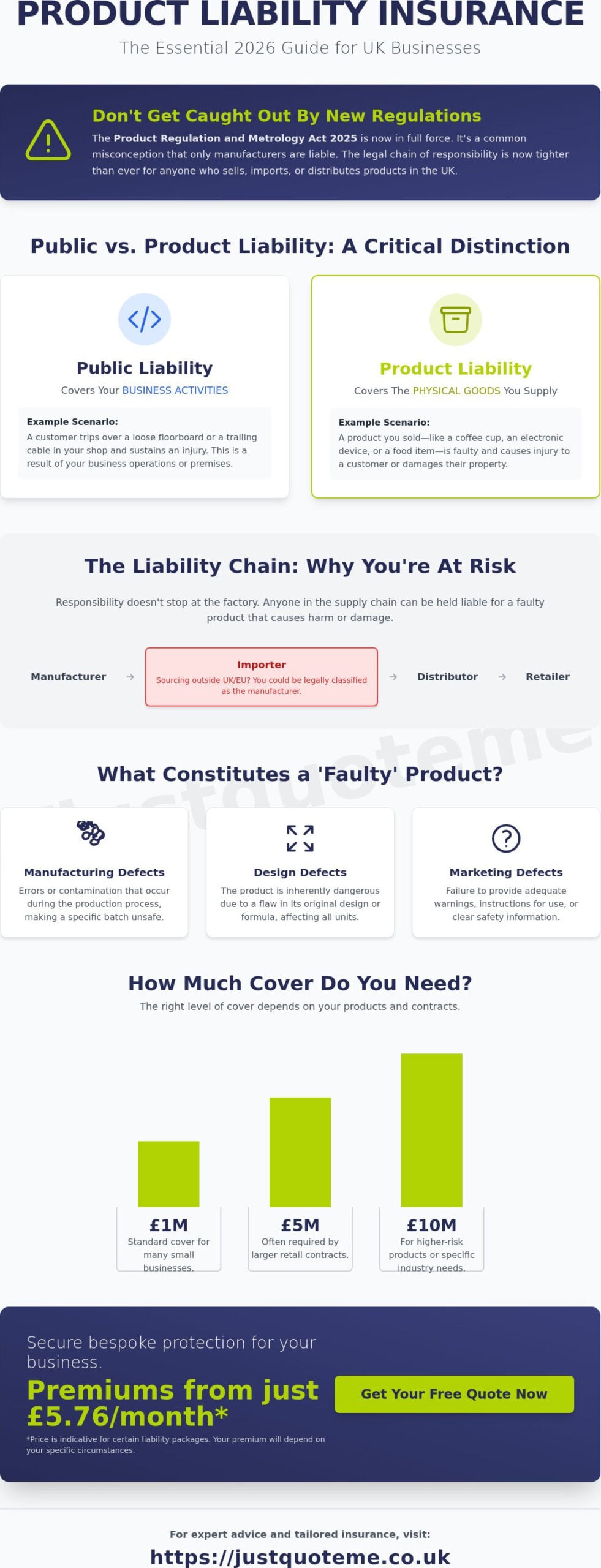
Consider two distinct scenarios. If a customer trips over a loose floorboard in your shop, that falls under public liability. If that same customer buys a takeaway coffee and the cup collapses due to a structural flaw, causing a severe burn, that triggers a product liability insurance claim. The first is about the safety of your premises; the second is about the safety of the item you handed over.
When Does One End and the Other Begin?
The “Premises Rule” is a helpful way to distinguish the two. Public liability typically handles incidents that happen on-site or while you are actively working. Product liability takes over once the item has left your control or the “service” is complete. For those in the construction industry, this is a daily reality. A plumber might have public liability cover for a pipe they burst while working, but they need the products element if a faulty valve they installed months ago fails and floods a kitchen. You can see how this works in practice by looking at tailored builders insurance packages which often combine both to cover the work and the parts used.
Comparison Table: Key Differences at a Glance
| Feature | Public Liability | Product Liability |
|---|---|---|
| The Trigger | Negligence or business activity | A faulty or defective product |
| Coverage Area | Your premises or work site | Anywhere the product is used |
| Claim Example | Slip on a wet floor | Battery overheating/exploding |
| Necessity | Essential if you meet the public | Essential if you sell/supply goods |
For retail business owners, ensuring both are active is a contractual requirement for many high-street landlords. If you are reviewing your shop insurance, check that your product limit matches the expectations of your suppliers and distributors. If you’re unsure which level of cover fits your trade, you can always speak with one of our advisors for a straightforward breakdown.
Get Your Free Business Insurance Quote now.
Request a Call back for free Expert advice.
The Liability Chain: Why Retailers and Importers Are at Risk
UK law is clear. Under the concept of “strict liability,” a victim doesn’t need to prove your business was negligent to win a compensation claim. They only need to prove that the product was faulty and that it caused them injury or property damage. This legal standard, established by the Consumer Protection Act 1987, means that every link in the supply chain is potentially vulnerable. If you’re the one who handed the item to the consumer, you’re often the first person their legal team will contact. The Association of British Insurers (ABI) guide clarifies that this responsibility exists regardless of whether you actually sat at the assembly line.
One of the most dangerous oversights for UK SMEs is what we call the “Importer’s Trap.” If you source products from outside the UK or the European Union, you are legally treated as the manufacturer. This means you inherit 100% of the legal responsibility for the product’s safety and performance. If a batch of electronics imported from overseas fails and causes a fire, you cannot simply point the finger at a factory thousands of miles away. UK courts will hold your business accountable. Similarly, white-labelling generic products by adding your own branding transfers the full weight of product liability insurance needs directly to your shoulders. You’ve claimed the product as your own, so you own the risk too.
It’s a common myth that being “just a dropshipper” provides a shield against these risks. Even if you never touch the physical stock, you are still a supplier within the meaning of UK safety regulations. If the product fails, you are part of the liability chain.
When Does the Retailer Become Responsible?
There are specific scenarios where a retailer moves to the front of the firing line. If the original manufacturer has gone out of business or simply cannot be identified, the responsibility stops with you. This is why maintaining a clear audit trail of your supply chain is vital. Furthermore, if your business repairs, refurbishes, or changes the product in any way before the sale, you’ve effectively created a “new” product in the eyes of the law. Without robust product liability insurance, a single faulty repair could result in a claim that wipes out your annual profit.
Protecting Your Reputation and Your Assets
Beyond the immediate legal costs, a product fault often triggers a mandatory recall. These operations are expensive and can bankrupt a small business through logistics and replacement costs alone. If your business also provides advice on how to use these products, you may need to consider how professional indemnity insurance sits alongside your liability cover. While one covers the physical item, the other covers the expert guidance you gave the customer. Combining these ensures that whether the fault is in the box or in the instructions, your assets remain protected.
Get Your Free Business Insurance Quote now.
Request a Call back for free Expert advice.
How Much Does Product Liability Insurance Cost in 2026?
Pricing for product liability insurance is rarely a one size fits all calculation. While base rates for small businesses can start from as little as £5.76 per month, your actual premium depends heavily on the specific risks your goods carry. Data from early 2026 shows that for a standard £5 million limit of public and products liability, many UK businesses paid an annual premium of around £69.00. However, these figures represent the entry point for lower risk trades. Your turnover, the volume of products you sell, and your position in the supply chain will all influence the final quote.
High risk categories naturally command higher premiums. If you deal in cosmetics, electronics, or baby products, underwriters view your business through a different lens because the potential for systemic injury or widespread property damage is much greater. A faulty batch of baby toys or a skin cream that causes a reaction can lead to multiple simultaneous claims. Most small businesses start with a £1 million cover limit, but if you’re signing contracts with major retailers or local authorities, they’ll often insist on a minimum of £5 million or £10 million. You should review your policy limits every time you launch a new product line to ensure your coverage remains adequate for the new risk profile.
Ways to Manage and Reduce Your Premiums
You can influence your insurance costs by demonstrating that you’re a lower risk to the insurer. Implementing robust quality control (QC) procedures and keeping meticulous documentation of your safety checks can lead to more favourable rates. Sourcing your goods from reputable, fully insured UK manufacturers also helps, as it avoids the “importer’s trap” where you’re treated as the primary manufacturer. If you’re looking for more ways to keep your overheads down, our guide on cheap public liability insurance offers practical tips on reducing costs without sacrificing essential protection.
Understanding the ‘Claims-Made’ Basis
It’s vital to understand that product liability insurance is typically written on a “claims-made” basis. This means the policy that pays out is the one active when the claim is filed, not necessarily the one you had when the product was originally sold. This creates a potential gap if you decide to close your business or change providers. To stay protected against faults discovered years after a sale, you may need “run-off” cover. This ensures that even if you’ve stopped trading, you aren’t left personally liable for a legacy product issue. If you’re unsure about your current exposure, you can get a bespoke assessment from our team.
Get Your Free Business Insurance Quote now.
Request a Call back for free Expert advice.
Securing Bespoke Protection with Just Quote Me
Choosing the right broker is just as important as choosing the right policy. Unlike direct insurers who only sell their own products, Just Quote Me acts as an independent advocate for your business. We access a broad panel of top UK underwriters to find the most competitive rates for your product liability insurance. This market comparison ensures you aren’t overpaying for a generic policy that might leave you exposed in a specific claim scenario. Just Quote Me is fully FCA-authorised, providing a mark of trust and reliability that’s essential when you’re protecting your business assets.
We’ve spent over 30 years building our reputation as insurance specialists across Staffordshire and the West Midlands. While many large providers push you toward a 7-minute automated algorithm, we believe your business deserves a personal touch. Speaking to a human expert beats a computer-generated “best guess” every time, especially when your livelihood is on the line. We take the time to understand the nuances of your trade, from the specific items you import to the way you distribute them. We do the heavy lifting so you don’t have to.
Tailored Solutions for Diverse Industries
Every industry has its own unique set of “fail points.” A business supplying equipment to security companies faces entirely different risks than those operating within nightclubs or retail environments. We help you navigate complex requirements like ‘Working at Height’ or Contractors All Risk insurance, ensuring that every part of your operation is accounted for. Our commitment is to provide jargon-free, honest English in every discussion, so you’ll never feel overwhelmed by industry terminology.
Get Your Custom Quote Today
Our team is based in Stone, offering local support with national-level insurance power. We pride ourselves on being a specialist partner rather than a faceless corporation. Securing your product liability insurance shouldn’t be a source of stress or confusion. Whether you need a quick quote or a deep dive into your supply chain risks, our process is designed to be efficient and straightforward. You can start the process online or request a conversation with one of our experienced advisors to discuss your bespoke needs.
Get Your Free Business Insurance Quote now.
Request a Call back for free Expert advice.
Secure Your Business Future for 2026 and Beyond
Protecting your business in a shifting regulatory landscape requires more than just a standard policy. As we’ve explored, the Product Regulation and Metrology Act 2025 has redefined the safety standards you must meet. Whether you’re importing from outside the UK or white-labelling goods, the legal chain of responsibility is clear. You need robust product liability insurance to shield your assets from the financial impact of compensation claims and legal fees. Understanding the distinction between your business actions and the physical goods you supply is the first step toward a secure operation.
At Just Quote Me, we bring over 30 years of industry experience to the table. As an FCA Authorised independent broker based in Staffordshire, we provide a personal touch that automated algorithms simply cannot match. We leverage our access to a broad network of top UK insurers to find a bespoke policy that fits your specific trade risks and turnover. Don’t leave your business reputation to chance. Our team is ready to help you navigate these legal complexities with straightforward, expert advice. Choose a partner who understands the UK market and prioritises your protection.
Get Your Free Business Insurance Quote now.
Request a Call back for free Expert advice.
Frequently Asked Questions
Is product liability insurance a legal requirement in the UK?
Product liability insurance isn’t a legal requirement in the UK in the same way that employers liability insurance is. You won’t face government fines for not having it, but you might find it impossible to trade. Most major retailers, wholesalers, and online marketplaces demand a minimum level of cover before they’ll sign a contract or allow you to sell on their platforms.
Does product liability cover the cost of a product recall?
A standard policy typically doesn’t cover the logistical costs of a product recall. It’s designed to pay for compensation and legal fees if a product actually causes injury or damage. If you need to pull thousands of units off the shelves to prevent a future incident, you’ll usually need a specific “Product Recall” extension added to your bespoke coverage.
Can I get product liability insurance for a home-based business?
You can certainly get cover for a home-based business. Whether you’re making handmade crafts in your kitchen or dropshipping from a spare room, you’re still legally liable for the goods you supply. Most standard home insurance policies specifically exclude business liability, so a dedicated policy is essential to protect your personal assets from a potential claim.
What happens if I sell a product that was manufactured abroad?
Selling products manufactured outside the UK or EU places you in a high-risk category. Under the Consumer Protection Act 1987, you’re legally treated as the manufacturer if you’re the first person to bring the goods into the UK market. This means you’re 100% responsible for any faults, making product liability insurance a top priority for importers.
Does product liability cover second-hand or refurbished goods?
It does, but insurers will look closely at your testing and refurbishment process. You’re responsible for ensuring second-hand items meet current UK safety standards. If you’ve modified or repaired an item, you’ve effectively taken on the manufacturer’s liability. You’ll need to demonstrate a clear safety testing audit trail to secure the most competitive premiums.
What is the difference between product liability and professional indemnity?
The difference lies in what caused the harm. Product liability covers physical goods that cause injury or damage, such as a faulty heater. Professional indemnity covers the advice or professional services you provide. If you give a customer incorrect instructions on how to install a product and that leads to a loss, it’s a professional indemnity matter rather than a product fault.
How much cover do I need if I sell online through Amazon or eBay?
Amazon’s UK terms generally require Pro Merchant sellers to have at least £1 million in liability insurance once they hit specific sales milestones. Many sellers opt for £2 million or £5 million limits to satisfy larger distribution contracts or to provide a greater safety net. The exact amount depends on your specific trade and the volume of units you’re moving.
Are digital products like software covered by product liability insurance?
Digital products are a major focus for UK regulators in 2026. Traditionally, policies covered tangible items, but the Law Commission’s 2026 review is expanding definitions to include software and AI. If a software bug causes physical damage, such as a smart home system failing and causing a flood, modern product liability insurance wordings are increasingly designed to trigger and protect the developer.
Get Your Free Business Insurance Quote now.
Request a Call back for free Expert advice.
