

What if a “no-win, no-fee” claim isn’t the end of your property business, but simply a procedural hurdle you’re already equipped to clear? For many landlords, receiving a letter of claim feels like a personal attack that threatens years of hard work. It’s completely natural to feel overwhelmed by the prospect of massive legal bills or the complexity of updated housing laws. You aren’t alone in this anxiety. If you’re wondering what happens if a tenant sues me uk, you’ll find that the process is manageable when you have the right information.
This guide provides a clear roadmap through the legal system. You’ll learn how to handle the initial notification, identify the financial risks involved, and implement strategies to protect your assets. We’ll walk you through the 2026 procedural timeline, explore ways to settle disputes before they reach a courtroom, and explain how expert insurance support can simplify these administrative burdens. Knowledge is your best defence. By the end of this article, you’ll have the tools needed to face legal challenges with the confidence of a seasoned professional.
Key Takeaways
- Learn to identify common legal triggers like property disrepair and deposit breaches to resolve issues before they reach the court.
- Understand what happens if a tenant sues me uk by following our breakdown of the legal timeline and Pre-Action Protocols.
- Evaluate the financial risks of a claim, including legal fees and the impact of litigation on your future borrowing capacity.
- Discover the essential documentation you need to protect your business, such as gas safety records and detailed repair logs.
- Find out how specialized Landlord Insurance acts as a steady hand, managing the administrative and financial burden of tenant disputes.
Common Grounds for Tenant Lawsuits in the UK
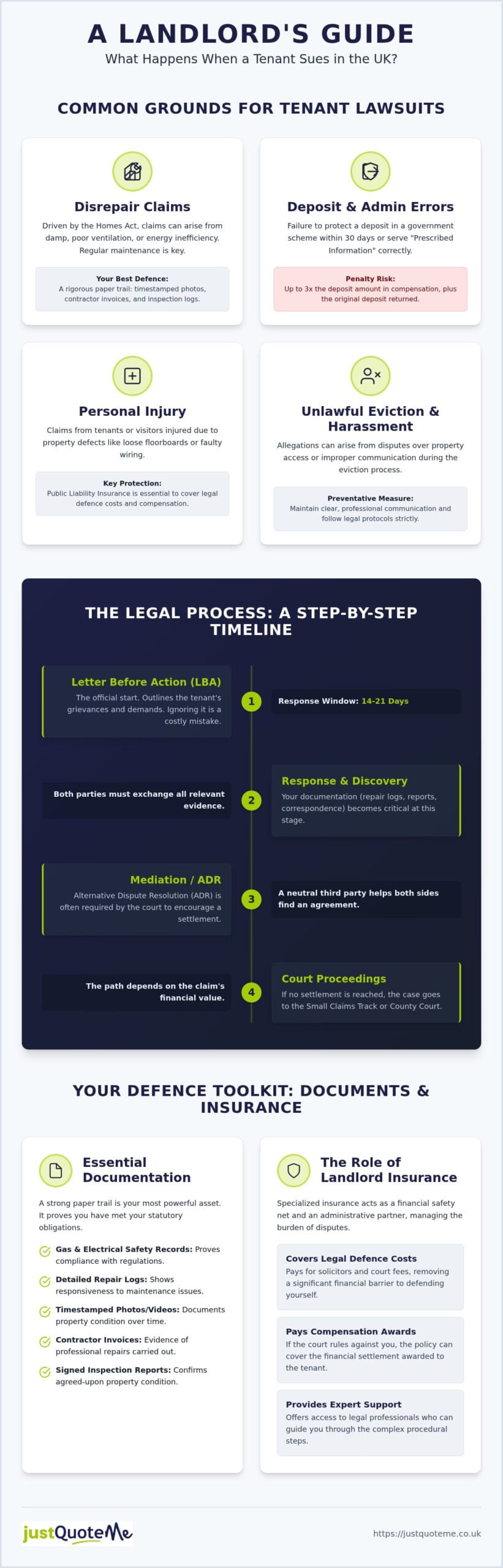
Most legal disputes between landlords and tenants aren’t random. They usually stem from specific statutory obligations that have become stricter over the last few years. If you’re asking what happens if a tenant sues me uk, you’ll likely find the claim falls into one of four categories: property disrepair, deposit mishandling, personal injury, or allegations of harassment and unlawful eviction. Understanding these triggers is the first step in building a resilient property business.
The Rise of Disrepair Claims
The Homes (Fitness for Human Habitation) Act has significantly changed the landscape for UK property owners. By 2026, housing standards have evolved to place even greater emphasis on energy efficiency, ventilation, and damp prevention. Tenants now have a direct route to sue if a property is deemed “unfit” for habitation at any point during the tenancy. This shift has fueled a surge in “no-win, no-fee” solicitors who actively target landlords for even minor maintenance delays.
Your best defence is a rigorous paper trail. Documentation proves you’ve met your obligations. Without timestamped photos, contractor invoices, and signed inspection logs, a court may find it difficult to side with you, even if you believe the claim is frivolous. Regular maintenance isn’t just about property value; it’s about legal survival. If a claim does arise, having a clear history of your responsiveness can stop a legal action before it gains momentum.
Deposit and Administrative Errors
Administrative mistakes are often the easiest for tenants to win in court. Under Tenancy Deposit Scheme (TDS) regulations, you must protect a tenant’s deposit in a government-approved scheme within 30 days. Failing to do so, or failing to serve the “prescribed information” correctly, carries heavy financial penalties. A judge can order you to pay the tenant up to three times the original deposit amount as compensation, plus the return of the original deposit.
- Prescribed Information: You must provide the tenant with specific details about the scheme and how the deposit is held.
- Strict Deadlines: Missing the 30-day window is an automatic breach; there is very little room for “reasonable excuses” in court.
- Section 21 Restrictions: You cannot serve a valid notice to quit if the deposit wasn’t handled correctly from the start.
Beyond these, personal injury claims are a significant risk. If a tenant or visitor trips on a loose floorboard or suffers an injury due to faulty wiring, they may seek substantial damages. This is where Public Liability Insurance becomes essential. It provides a financial safety net that covers legal defence costs and any compensation awarded, ensuring a single accident doesn’t bankrupt your business. Allegations of harassment or unlawful eviction also remain serious grounds for litigation, often arising from disputes over property access or failed communication during the eviction process.
The Legal Timeline: What Happens After a Claim is Made?
Many landlords mistakenly believe that a dispute goes straight to a judge. In reality, the UK legal system requires several procedural steps designed to encourage settlement before a court date is ever set. Understanding what happens if a tenant sues me uk requires a look at the specific stages mandated by the Ministry of Justice. Following these steps isn’t optional; failing to adhere to the Pre-Action Protocol can result in cost penalties against you, even if you eventually win the case.
The Letter Before Action (LBA)
The Letter Before Action (LBA) is the document that officially signals the start of the litigation process. It outlines the tenant’s grievances, the legal basis for their claim, and what they want you to do to remedy the situation. You’ll typically have between 14 and 21 days to provide a formal response. Ignoring this letter is one of the most expensive mistakes a property owner can make. It often triggers the tenant’s solicitor to escalate the matter immediately to the County Court, which adds significant fees to the total bill.
Once you respond, the discovery phase begins. This is where both parties exchange evidence. You’ll need to provide your repair logs, inspection reports, and any correspondence related to the claim. Before a hearing is scheduled, the court will often expect you to engage in Mediation or Alternative Dispute Resolution (ADR). This is a less formal meeting where a neutral third party helps both sides reach an agreement. Many landlords find that consulting an independent insurance broker early in this timeline provides the clarity needed to handle these administrative hurdles efficiently.
Small Claims vs. County Court
The path your case takes depends largely on the financial value of the claim. When evaluating what happens if a tenant sues me uk, the financial threshold is the primary factor in determining your legal strategy. Most simple disputes under £10,000 are allocated to the Small Claims Track. However, for housing disrepair, the rules are more nuanced. If the cost of repairs is estimated at over £1,000 or the compensation claim is high, the case may move to the Fast Track or Multi-Track in the County Court. These higher tracks involve more complex rules of evidence and significantly higher legal costs; you can learn more about how direct access barristers help landlords navigate these complex legal environments.
By 2026, many of these preliminary hearings and small claims cases are conducted via virtual platforms. If a settlement isn’t reached through ADR, a final hearing will take place where a judge reviews the evidence and issues a judgement. This judgement is legally binding and could include orders for you to carry out specific works, pay compensation, or cover the tenant’s legal expenses. Clear, chronological record-keeping remains your most potent tool throughout this entire timeline.
Receiving a claim is a significant financial event that extends far beyond the immediate dispute. While most landlords focus on potential compensation payouts, the true cost of litigation often lies in the invisible expenses that accumulate over months of legal back-and-forth. If you’re wondering what happens if a tenant sues me uk, you need to look beyond the court’s final order. The direct financial burden includes court filing fees, expert witness costs for disrepair surveys, and the hourly rates of solicitors.
UK civil litigation generally follows the “costs shifting” rule, where the losing party pays the winner’s legal fees. However, this isn’t a guarantee of full reimbursement. Courts often limit the amount of costs that can be recovered, leaving you to bridge the gap from your own pocket. Beyond the money, the drain on your time and mental health can be substantial. Managing a complex claim can take dozens of hours away from your core business or personal life, impacting your ability to manage other properties in your portfolio.
Understanding Legal Fee Exposure
One of the harshest realities of the UK court system is that a “victory” doesn’t always mean you break even. Even if a judge dismisses a tenant’s claim, you might find that your own legal expenses exceed the value of the dispute. This is particularly common in the Small Claims Track, where the ability to recover costs is strictly limited to very specific circumstances. It’s a pragmatic reality that many landlords find frustrating.
Tenant insolvency adds another layer of risk. If a court orders a tenant to pay your legal costs but they have no assets or income, you’re left holding the bill. This is why a pragmatic, early settlement is often a more professional business choice than a principled stand in court. Securing comprehensive Landlord Insurance can help mitigate these exposures by providing access to legal expenses cover, ensuring your personal finances aren’t drained by a single aggressive claim.
Reputational and Portfolio Risks
For professional property owners in the West Midlands and Staffordshire, reputation is a tangible asset. A County Court Judgement (CCJ) against you can be catastrophic for your future growth. Most mortgage lenders view a CCJ as a major red flag, which could lead to significantly higher interest rates or the outright rejection of future buy-to-let finance applications. It’s an indirect cost that can haunt your business for years.
Local authorities and letting agents also keep records of landlord conduct. Being involved in frequent litigation can make it difficult to maintain professional relationships or secure high-quality tenants. In a competitive market, being known as a landlord who handles disputes through the courts rather than through efficient management can devalue your entire portfolio. Protecting your professional standing requires a proactive approach to risk management and a commitment to resolving issues before they ever reach a courtroom.
Immediate Steps to Take When a Tenant Sues
Receiving a Letter Before Action or a court summons is a high-pressure moment. However, your response in the first 48 hours determines what happens if a tenant sues me uk and whether the case is settled or escalated. Your priority must be to secure your legal and financial position before engaging with the tenant’s allegations. Speed and accuracy are your two most valuable assets during this initial phase.
Notify your insurance broker immediately. Many Landlord Insurance policies include legal expenses cover, but this protection often relies on early notification. Delaying this step can sometimes lead to a “late notification” clause being triggered, which might limit your insurer’s ability to defend the claim or cover the costs. Professional brokers provide a human-centric alternative to automated claims lines, helping you navigate the paperwork with confidence.
Evidence Gathering Checklist
While tenant advocacy groups often suggest that landlords keep poor records, you can dismantle a claim early by presenting a comprehensive evidence pack. Your defence relies on proving you’ve met all statutory and contractual obligations. Collect these documents into a single, organised file:
- Compliance Certificates: Valid Gas Safety, EICR, and EPC certificates for the duration of the tenancy.
- Repair Logs: A chronological record of every maintenance request and the date it was resolved.
- Contractor Invoices: Professional proof from third-party tradespeople that work was completed.
- Check-in and Check-out Reports: Detailed reports with photos are essential for deposit disputes.
- Communication Logs: Save all emails and text messages. Avoid deleting anything, even if it seems irrelevant.
The “No Contact” Rule
Once a legal claim is active, stop all direct, informal communication with the tenant regarding the dispute. Even a well-meaning “off the record” apology can be interpreted as an admission of liability in court. Such admissions can void your insurance policy, leaving you to pay the entire bill yourself. Direct all tenant or solicitor enquiries to your appointed legal representative or broker.
Remember that your statutory duties don’t stop just because a claim is active. You must still carry out emergency repairs or essential maintenance. If you need to enter the property for these reasons, keep the interaction strictly professional and limited to the task at hand. For guidance on how your policy covers these specific legal challenges, you can contact Just Quote Me for expert assistance.
How Landlord Insurance Defends Your Business
While many legal firms suggest hiring a solicitor as your first priority, for most property owners, the insurance policy is actually the primary line of defence. If you find yourself in a position where you need specific legal counsel, you can check out Feltons Solicitors LLP for professional guidance on property matters. Understanding what happens if a tenant sues me uk becomes much less daunting when you realise that a comprehensive policy provides both the financial backing and the legal expertise needed to resolve a dispute. Instead of paying high hourly rates out of your own pocket, your insurance framework manages the complexity for you.
A standard policy usually combines several types of protection. Public Liability Insurance is the cornerstone for injury claims, covering you if a tenant or visitor is hurt on your premises due to alleged negligence. However, the most active component in modern property litigation is Legal Expenses Insurance. This doesn’t just pay for compensation; it pays for the professional defence that keeps your business running while a claim is being processed.
Legal Expenses Insurance (LEI) is designed to cover the costs of solicitors, barristers, and court fees. When you notify your broker of a claim, the insurer evaluates the case based on a “Prospect of Success” clause. This typically requires a 51% or greater chance of winning the case or successfully defending the allegations. If your documentation is in order, as discussed in previous sections, meeting this threshold is usually straightforward.
Once triggered, the policy appoints a legal team to act on your behalf. They handle the filings, the mediation sessions, and any eventual court appearances. This specialized Residential Letting Insurance ensures that you aren’t forced into a disadvantageous settlement simply because you can’t afford to keep fighting. It levels the playing field against “no-win, no-fee” solicitors who rely on landlords being too intimidated by costs to defend themselves.
The Just Quote Me Advantage
Bespoke protection is always superior to “off-the-shelf” policies found on price comparison sites. At Just Quote Me, we bring over 30 years of industry experience to the table, acting as a human-centric alternative to automated systems. We understand the specific risks facing property owners in Staffordshire and the West Midlands, from local court tendencies to regional property standards. Our role is to simplify the administrative burden so you can focus on your portfolio.
We provide access to a broad network of top UK insurers, allowing us to find tailored solutions that match your specific risk profile. Whether you manage a single flat or a large commercial block, we ensure your coverage is robust enough to handle any challenge. For a deeper look at the current market, read our guide on Landlord Insurance in 2026. Having a steady hand to guide you through what happens if a tenant sues me uk is the best way to secure your financial future.
Securing Your Property Business Against Future Claims
Facing a legal claim doesn’t have to be a personal catastrophe for a professional landlord. Success in 2026 relies on procedural discipline and a commitment to high maintenance standards. By following the Pre-Action Protocol and keeping a meticulous paper trail of all property inspections and repairs, you create a robust shield against opportunistic litigation. Understanding what happens if a tenant sues me uk is the first step toward transforming a stressful situation into a manageable administrative task.
Having the right partner makes all the difference when navigating complex housing laws. As an FCA-authorised independent broker with 30+ years of experience, we specialise in protecting your assets from the financial and reputational fallout of court disputes. Our Stone-based team is ready to help you navigate these burdens so you can focus on growing your portfolio. With the right preparation and expert support, you can face the future of the UK rental market with absolute confidence.
Frequently Asked Questions
Can a tenant sue me after they have moved out of the property?
Yes, a tenant can bring a claim against you after the tenancy has ended. Legal obligations regarding deposit protection and property safety don’t expire the moment the keys are returned. If a former tenant discovers a breach of the Homes (Fitness for Human Habitation) Act or a failure to protect their deposit during their stay, they can initiate a claim. Keeping records for several years after a tenant leaves is essential for your long-term legal defence.
How long does a tenant have to sue a landlord in the UK?
Under the Limitation Act 1980, tenants generally have six years to bring a claim for breach of contract or property disrepair. However, if the claim involves personal injury, the time limit is typically reduced to three years from the date of the accident or the date the injury was discovered. Because these windows are quite long, maintaining an organised archive of safety certificates and repair logs is a vital part of your business risk management.
What happens if I don’t have landlord insurance and I am sued?
If you don’t have specialized cover and find yourself asking what happens if a tenant sues me uk, the financial burden falls entirely on you. You’ll be responsible for hiring your own legal representation, paying court filing fees, and settling any compensation awarded by the judge. Without the backing of an independent broker like Just Quote Me, you also lose access to expert claims handling, which often leads to higher settlements and significant personal stress.
Can I evict a tenant if they are currently suing me?
You can still serve an eviction notice, but it’s more complex if a disrepair claim is active. Courts may view a Section 21 notice as a retaliatory eviction if the tenant has recently complained about property standards or started legal action. It’s often safer to rely on Section 8 if there are clear grounds like rent arrears. Always consult your legal representative before serving notice to ensure you don’t compromise your position in the ongoing lawsuit.
Will my landlord insurance cover the cost of a tenant suing for disrepair?
Most comprehensive Landlord Insurance policies include Legal Expenses cover specifically for these scenarios. This typically pays for your solicitor’s fees and court costs, provided the case has a reasonable prospect of success. It’s important to check your policy for specific exclusions regarding pre-existing issues. Having this protection ensures that a single maintenance dispute doesn’t escalate into a financial crisis, allowing you to defend your professional reputation without draining your personal business capital or savings.
What is a “Letter Before Action” and how should I respond?
A Letter Before Action is a formal notification that a tenant intends to start legal proceedings. It outlines their grievances and provides a deadline for you to resolve the issue or provide a defence. You should never ignore this document. Your first step should be to contact your insurance broker to notify them of a potential claim. A prompt, professional response within the 14 to 21-day window can often prevent the case from reaching court.
Is mediation mandatory in tenant disputes?
While mediation isn’t strictly mandatory in all cases, UK courts strongly expect parties to engage in Alternative Dispute Resolution (ADR) before a hearing. Refusing to participate without a valid reason can lead to the judge ordering you to pay the tenant’s legal costs, even if you win. Mediation is often a faster and cheaper way to resolve what happens if a tenant sues me uk, as it focuses on reaching a pragmatic, out-of-court agreement.
