

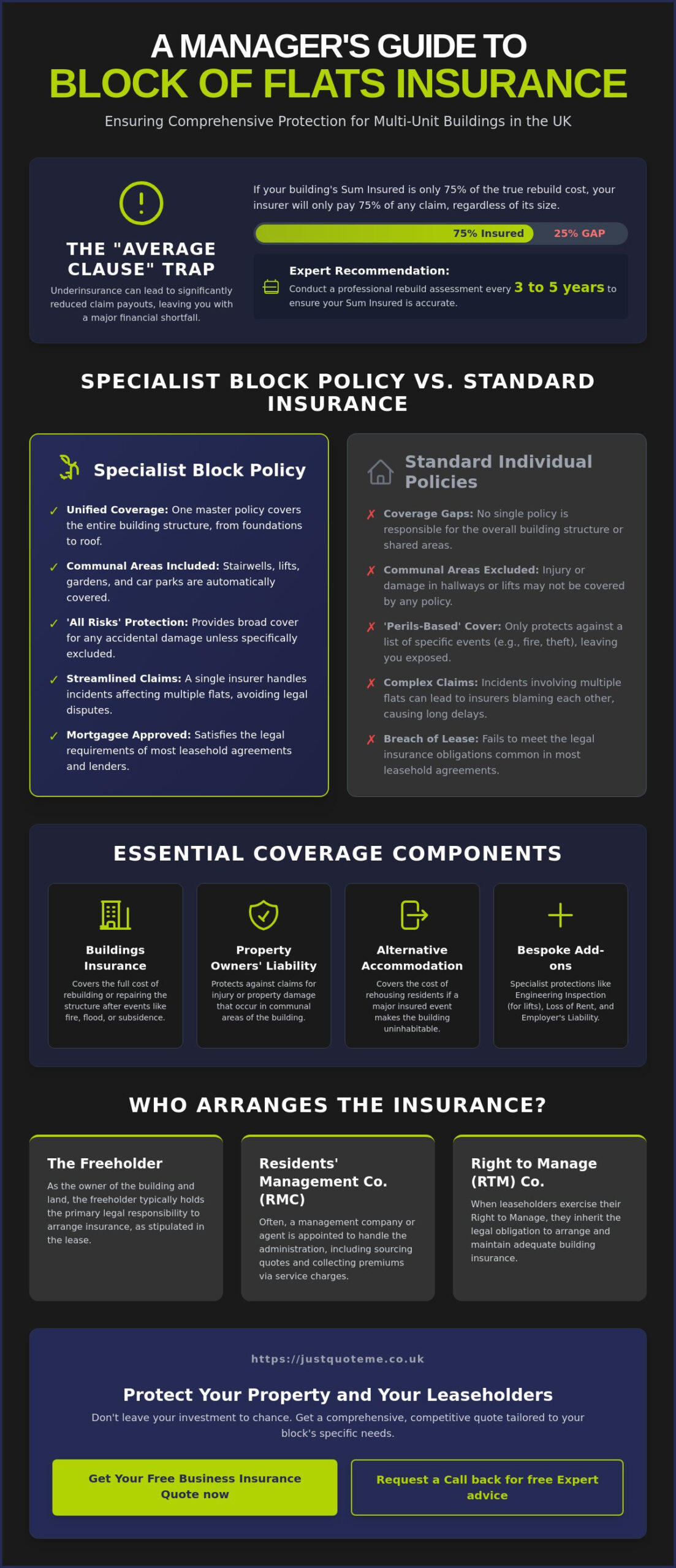
Did you know that underinsurance remains a critical risk for multi-unit buildings, with experts recommending professional rebuild assessments every three to five years to avoid the “average clause” during a claim? As a property manager or freeholder, you already understand that managing these assets is a complex balancing act of legal compliance and financial precision. It’s often a struggle to identify exact responsibilities for different parts of the building while trying to keep service charge accounts manageable for every resident. This 2026 guide simplifies the process of securing insurance for a block of flats uk, ensuring your policy satisfies mortgage lenders and aligns with the transparency requirements of the Leasehold & Freehold Reform Act. We’ll explore specialist protections like Engineering Inspection and explain how to navigate the current 12% Insurance Premium Tax environment. You will learn how to provide the data-led risk management evidence that insurers now demand while securing a competitive premium that never compromises on essential coverage for your leaseholders.
Get Your Free Business Insurance Quote now.
Request a Call back for free Expert advice
Key Takeaways
- Understand why a unified policy is mandatory for multi-unit buildings and how it differs from standard residential buildings insurance.
- Discover how to safeguard the interests of leaseholders and mortgagees using the ‘Joint Insured’ clause within your management structure.
- Learn how to accurately calculate your sum insured by focusing on reinstatement costs rather than market value to avoid the risks of underinsurance.
- Identify the essential components of insurance for a block of flats uk, including property owners’ liability and coverage for communal areas.
- Gain the confidence to evaluate excess levels and compare quotes effectively to find a balance between competitive premiums and robust protection.
What is Insurance for a Block of Flats in the UK?
A block of flats isn’t just a collection of individual homes; it’s a single structural entity with shared liabilities. Therefore, insurance for a block of flats uk is designed as a master policy that covers the entire building fabric from the foundations to the roof. Standard buildings insurance fails here because it doesn’t account for the complex Legal Responsibilities: Freeholders, RTMs, and Management Companies established in the property’s lease. Without a unified policy, you risk gaps in coverage where a claim in a communal hallway might not be covered by any individual flat owner’s insurance. This type of protection ensures that the structural integrity of the entire building is maintained under one umbrella.
Most leasehold agreements legally mandate that the building is insured under one comprehensive policy. This ensures that every mortgagee’s interest is protected and that the building can be fully reinstated after a major event like a fire or flood. It eliminates the chaos of trying to coordinate multiple insurers when a single incident affects several units at once.
Specialist vs. Standard Property Insurance
Standard residential policies often exclude communal areas like lift shafts, shared gardens, and stairwells. A specialist block policy treats these as integral parts of the risk. It’s much more efficient to have one insurer handling the entire structure. If a leak starts in flat A and damages flat B, having a single insurer prevents the long, expensive legal disputes that occur when multiple companies try to shift blame. We usually recommend ‘All Risks’ cover rather than simple ‘Perils-based’ insurance. While perils-based cover only protects against specific named events like fire or theft, ‘All Risks’ provides a broader safety net for any accidental damage unless specifically excluded. This level of detail is a vital component of commercial property insurance for landlords managing multi-unit sites where the unexpected is common.
Who is Responsible for Arranging the Policy?
The duty to arrange insurance usually falls on the freeholder. They own the land and the building’s shell, so they have a vested interest in protecting the structural integrity. However, many blocks are managed by a Residents’ Management Company (RMC) or a Management Company (ManCo) appointed by the freeholder. In these cases, the agent handles the administration while recharging the premium to leaseholders via service charges.
Right to Manage (RTM) groups also hold significant responsibility. When leaseholders exercise their legal right to take over management, they also inherit the obligation to maintain adequate insurance for a block of flats uk. Failing to do so is a breach of the lease and can lead to severe legal consequences. It’s a heavy administrative burden, but it ensures that the residents maintain control over their protection and costs. Just Quote Me to simplify your search for the right policy and ensure every legal box is ticked.
Get Your Free Business Insurance Quote now.
Request a Call back for free Expert advice
Essential Coverage Components for Multi-Unit Buildings
Securing insurance for a block of flats uk requires a granular understanding of both physical and financial risks. The foundation of any policy is buildings insurance, which covers the cost of repairing or rebuilding the structure following damage from fire, flood, or subsidence. Because building costs remain volatile in 2026, it’s vital to base your sum insured on a professional rebuild assessment conducted within the last three to five years. This prevents the “average clause” from reducing your claim payout if the property is found to be underinsured.
Property owners’ liability is equally critical. This protects the freeholder or management company against claims for injury or property damage occurring in communal areas like stairwells, car parks, and gardens. If a visitor trips on a loose carpet in a hallway, the legal costs and compensation can be astronomical. A robust policy also includes alternative accommodation for residents if a major incident makes the building uninhabitable. For those managing mixed-use blocks, loss of rent cover ensures that the income stream from commercial ground-floor units remains stable while repairs are carried out. You can find more detail on protecting your rental income via our landlord insurance solutions.
Engineering Inspection and Lift Insurance
If your block includes a lift, you have a statutory legal obligation under LOLER (Lifting Operations and Lifting Equipment Regulations) to have it inspected by a competent person every six months. Standard buildings insurance doesn’t typically cover these inspections or sudden mechanical breakdowns. An engineering policy provides the necessary certification and covers the repair of communal machinery, including boiler systems and pressurized tanks. Integrating this into your primary policy simplifies your administration and ensures you remain compliant with UK safety laws. Expert advice is often the quickest route to securing a tailored policy that includes these specific technical requirements.
Directors & Officers (D&O) Liability
Many property managers overlook the personal risks faced by directors of Residents’ Management Companies (RMC) or Right to Manage (RTM) groups. These individuals are often volunteers, yet they are personally liable for “wrongful acts,” including allegations of mismanagement, breach of duty, or failure to comply with the Leasehold & Freehold Reform Act 2026. D&O insurance covers the legal defense costs and awards for such claims, ensuring that a director’s personal assets aren’t at risk. While this protects the individuals, management professionals may also want to consider Professional Indemnity Insurance to cover errors in professional advice or service delivery. Protecting your leadership team is just as important as protecting the bricks and mortar when arranging insurance for a block of flats uk.
Get Your Free Business Insurance Quote now.
Request a Call back for free Expert advice
Legal Responsibilities: Freeholders, RTMs, and Management Companies
The legal architecture of a multi-unit building requires a policy that recognizes multiple stakeholders simultaneously. Central to this is the ‘Joint Insured’ clause. Unlike a standard homeowner policy, insurance for a block of flats uk must name the freeholder, the management company, and the collective interests of the leaseholders. This structure ensures that if one party inadvertently invalidates the policy through an act of negligence, the interests of the other parties remain protected. It’s a vital safety net that prevents a single individual’s mistake from leaving the entire building without cover.
When a Right to Manage (RTM) company takes over, maintaining insurance continuity is a primary legal duty. You must ensure there’s no gap during the transfer of responsibilities, as any lapse could breach the terms of every individual lease in the building. Compliance with the Landlord and Tenant Act is also non-negotiable. This legislation dictates that insurance costs recovered from residents must be “reasonably incurred.” In the 2026 regulatory environment, you’re expected to demonstrate that you’ve tested the market to find the best value, rather than simply renewing the first quote you receive. A broker acts as an essential mediator here, balancing the demands of the freeholder with the cost-sensitivity of the leaseholders.
Satisfying Mortgage Lenders
High street and commercial lenders have strict requirements before they’ll release funds for a flat purchase. They typically demand ‘Non-Invalidation’ and ‘Vesting’ clauses. These clauses guarantee that the lender’s interest in the property stays secure even if a leaseholder breaches a policy condition. Because every lender has slightly different criteria, a broker is far better equipped to navigate these demands than a direct insurer. We ensure the policy wording matches the specific requirements of the UK’s major lending institutions, preventing delays in property sales or refinancings.
Managing Service Charges and Premiums
Under the Leasehold & Freehold Reform Act 2026, transparency is the new standard for service charges. Property managers must provide clear breakdowns of how premiums are calculated and justify any administrative fees. Most leases allow for the full recovery of insurance costs through the service charge account, but this doesn’t give managers a blank check. You need to show that you’ve balanced the premium cost against the quality of protection. For mixed-use developments where shops sit beneath residential units, the complexity increases. In these scenarios, aligning your block policy with specialized Commercial Property Insurance ensures that the business and residential risks don’t conflict, keeping the service charge fair and transparent for all parties.
Get Your Free Business Insurance Quote now.
Request a Call back for free Expert advice
How to Compare Block Insurance Quotes Effectively
Comparing insurance for a block of flats uk requires looking past the annual premium to ensure the policy actually performs when needed. The most common mistake is confusing market value with the reinstatement value. Market value includes the land’s price and location desirability, whereas the reinstatement value is purely the cost of materials, labor, and professional fees required to rebuild the structure from scratch. If your sum insured is based on market value, you’re likely paying for cover you can’t claim or, worse, leaving yourself dangerously underinsured.
You must also evaluate “Trace and Access” limits carefully. In multi-storey buildings, finding the source of a leak often involves tearing into walls or floors across multiple units. Without adequate Trace and Access cover, the cost of simply locating the problem can exceed the cost of the actual repair. This leaves the service charge account to bridge the gap, which can lead to disputes with leaseholders. A policy that seems cheap on the surface often hides low sub-limits for these essential “hidden” costs.
The Danger of Underinsurance
Underinsurance triggers the “Average Clause,” a standard policy condition that many property managers overlook. If you insure a building for £800,000 but the true rebuild cost is £1 million, you’re 20% underinsured. In this scenario, the insurer can reduce any claim payout by 20%, even for small partial losses like a minor kitchen fire. This is why professional valuations are essential every three to five years. If you’re planning major structural work or extensions, a standard policy won’t suffice. You’ll need to secure Contractors All Risk Insurance to protect the existing structure and the new works during the construction phase.
Selecting the Right Excess and Limits
While a higher excess reduces your premium, it can cause friction with leaseholders if they’re asked to contribute more during a claim. For Property Owners’ Liability, £5 million is the industry standard minimum, though many modern management agreements now require £10 million to account for rising legal costs. Pay close attention to water damage excesses; blocks with older plumbing systems often face higher specific excesses for “escape of water” claims. For individual flat owners who rent out their units, ensuring their personal residential letting insurance aligns with the main block policy prevents coverage gaps for contents and loss of rent.
Don’t settle for a generic policy that leaves your residents at risk. Just Quote Me to compare specialized block insurance quotes from the UK’s leading underwriters today.
Get Your Free Business Insurance Quote now.
Request a Call back for free Expert advice
Securing Bespoke Protection with Just Quote Me
Just Quote Me provides a steady hand in what can often feel like a volatile market. With over 30 years of experience as an independent UK insurance broker, we’ve built professional relationships that go far beyond simple transactions. We maintain access to a broad network of top UK underwriters, allowing us to negotiate competitive pricing on your behalf. Unlike automated comparison sites that rely on rigid algorithms, we take a human-centric approach. We look at the unique nuances of your management structure to ensure every leaseholder and freeholder is fully protected under a single, cohesive policy.
Our deep expertise in the Staffordshire and West Midlands property markets is a core part of our identity. We understand the local landscape, from the industrial heritage buildings of the Black Country to the high-density residential blocks in modern city centers. This regional insight allows us to anticipate risks that national providers might overlook. When you seek insurance for a block of flats uk through us, you’re partnering with an advisor who knows the specific challenges of your postcode. We take the administrative burden off your desk so you can focus on the day-to-day management of your residents.
Why Choose an Independent Broker?
Every building has its own history and architectural quirks. A 19th-century converted mill requires vastly different considerations than a 2026 steel-framed development. We provide bespoke solutions tailored to your building’s specific age, construction type, and occupancy profile. If you ever need to make a claim, you won’t be stuck in an endless call center queue. You’ll have a dedicated advisor supporting you through the entire claims process, ensuring the building’s reinstatement stays on track. For a deeper look at how we support local businesses, read our comprehensive guide for a Commercial Insurance Broker Staffordshire.
Next Steps for Your Block Insurance
To get a quick and accurate quote for insurance for a block of flats uk, it’s best to have your property details ready. We’ll need the year of construction, the date of your last professional rebuild valuation, and a clear history of any previous claims. For larger blocks, we often recommend a professional risk assessment to identify potential fire or water damage hazards before they become expensive problems. This proactive approach demonstrates to underwriters that the building is well-managed, which can often lead to more favorable premium terms. Just Quote Me to simplify your renewal process and secure the protection your property deserves.
Get Your Free Business Insurance Quote now.
Request a Call back for free Expert advice
Secure Your Multi-Unit Property with Confidence
Securing the right insurance for a block of flats uk isn’t just about finding the lowest price. It’s about protecting the building’s fabric and the personal liability of your directors. By focusing on accurate reinstatement values and ensuring your policy includes essential clauses like ‘Non-Invalidation’, you’ll navigate the 2026 regulatory landscape with confidence. You now have the tools to identify gaps in standard policies and understand why specialist cover is non-negotiable for modern management. Accuracy in your data ensures that your residents remain protected and your legal obligations are met without compromise.
Just Quote Me brings over 30 years of industry experience to your side. As an FCA Authorised independent broker, we have direct access to top UK insurers. This allows us to build bespoke policies that automated systems simply can’t match. We manage the complex administrative burdens and provide steady support during claims, ensuring you always satisfy mortgage lenders and leasehold agreements. Our human-centric approach ensures your building’s specific risks are handled with professional precision. Don’t leave your property’s protection to chance. Secure your building’s future with expert guidance today.
Get Your Free Business Insurance Quote now.
Request a Call back for free Expert advice
Frequently Asked Questions
Is block of flats insurance a legal requirement in the UK?
No, it isn’t a statutory legal requirement like motor insurance, but it’s a mandatory contractual obligation in almost every UK leasehold agreement. Mortgage lenders won’t release funds without proof of a valid policy. Failing to maintain cover puts the freeholder in breach of contract, which can lead to legal action from leaseholders or the forfeiture of the lease.
What is the difference between buildings insurance and block insurance?
Block insurance is a specialist type of buildings insurance designed for multi-unit structures. While standard buildings insurance protects a single home, insurance for a block of flats uk covers the entire external fabric, foundations, and communal areas like lift shafts and hallways. It also includes specific liability protections that a standard residential policy would exclude.
Who pays the premium for a block of flats insurance policy?
The freeholder or Residents’ Management Company (RMC) pays the initial premium to the insurer. This cost is then recovered from each leaseholder through the annual service charge. Under the 2026 reforms, managers must provide a transparent breakdown of these costs to ensure they’re reasonable and fair for all residents.
Does block insurance cover individual flat contents?
No, the master policy only covers the building’s structure, fixtures, and communal areas. Individual residents must arrange their own contents insurance to protect personal belongings, furniture, and non-fixed items inside their flats. We recommend residents check that their personal policies include tenant’s liability cover for accidental damage to the building’s fixtures.
What happens if our block is underinsured during a claim?
If the building is underinsured, the insurer will apply the “Average Clause” to your claim. This means if you’ve only insured for 80% of the true rebuild cost, the insurer only pays 80% of any claim, even for minor damage. This leaves a significant financial gap that the management company or leaseholders must fund personally.
Can leaseholders arrange their own structural insurance?
Leaseholders cannot typically arrange their own structural insurance because the building’s lease usually mandates a single, unified policy. Having multiple insurers for one building creates massive legal complications during a claim, especially if damage affects shared walls or the roof. A single policy for insurance for a block of flats uk ensures there are no disputes over which company is responsible.
How often should we have a professional reinstatement cost assessment?
You should commission a professional reinstatement cost assessment every three to five years. Building material costs and labor rates change frequently, so a valuation from five years ago is likely outdated in 2026. Regular assessments are the only way to guarantee your sum insured is accurate and avoid the penalties of underinsurance during a major loss.
Does the policy cover communal lifts and boilers?
The main policy covers these items against insured perils like fire or flood damage. However, it won’t typically cover mechanical breakdown or the statutory inspections required by law. You should add Engineering Inspection cover to your policy to handle the mandatory safety checks for lifts and pressurized boiler systems.
Get Your Free Business Insurance Quote now.
Request a Call back for free Expert advice
