

In 2026, treating your haulage cover as a simple box-ticking exercise is the fastest way to erode your profit margins. With the mandatory rollout of Smart Tachograph Version 2 for international transport and stricter Direct Vision Standards, securing HGV insurance UK is no longer just about finding the lowest number on a comparison site. You likely feel the pressure of rising premiums and the constant worry that a minor technicality could lead to a rejected claim. It’s a frustrating reality for many operators who want to keep their wheels turning without the administrative headache.
We’re here to help you regain control. This guide shows you how to master the complexities of specialist haulage cover by accessing expert advice and bespoke policies that actually protect your bottom line. You’ll learn how to navigate the latest regulatory shifts, leverage risk management to lower your rates, and find a partner who understands the nuances of multi-vehicle fleet management. We’ll break down everything from high-limit compliance to the benefits of working with specialist underwriters who value human expertise over automated systems. By the end, you’ll have a clear roadmap to securing reliable, high-limit cover that simplifies your business instead of complicating it.
Key Takeaways
- Understand why vehicles over 3.5 tonnes require specialised protection and how standard commercial van policies can leave your business exposed.
- Navigate the 2026 landscape for HGV insurance UK by choosing bespoke, broker-led cover that prioritises your specific operational risks over generic automated quotes.
- Access a wide network of industry-leading insurers not found on standard aggregators, leveraging decades of expertise to secure the most reliable terms.
- Implement proactive risk management and driver training protocols to demonstrate high standards to underwriters and reduce your annual premium costs.
- Reduce your administrative burden by partnering with a steady advisor who handles the complexities of policy management and compliance on your behalf.
Understanding HGV Insurance in the UK: More Than Just a Legal Requirement
HGV insurance UK is a specialised protection package designed for vehicles with a gross weight exceeding 3.5 tonnes. While Understanding Vehicle Insurance basics is a good starting point, heavy goods vehicles operate under a completely different regulatory framework than standard cars or light vans. Standard commercial van insurance doesn’t have the capacity to handle the weight limits, longer stopping distances, or the intense regulatory scrutiny that comes with heavy haulage. If you try to use a standard policy for an HGV, you’ll likely find your claims rejected and your business exposed to massive financial risk.
Maintaining an Operator’s Licence (O-Licence) is non-negotiable for anyone running HGVs in the UK. A critical part of keeping that licence in good standing is proving you have adequate, compliant cover. Insurers don’t just look at your driving history; they look at your commitment to safety and maintenance. For example, international operators often look to specialized services like mécanique mobile Québec to maintain their fleet on-site, a practice that insurers globally recognize as a commitment to safety. If you fail to maintain proper cover, you risk losing your licence and your livelihood. It’s a strategic asset that keeps your wheels turning and ensures you remain on the right side of the DVSA.
The Core Components of a Haulage Policy
Modern haulage fleets are diverse, and your insurance must reflect the specific vehicles you operate. We provide bespoke solutions for a wide range of trucks and specialised units. A generic policy often fails to account for the unique risks associated with different vehicle types. Our coverage includes:
- Standard trucks: Flatbeds, box vans, lutons, and curtain-siders.
- Specialised vehicles: Tippers, cement mixers, and tankers.
- Temperature-controlled units: Refrigerated trucks that require specific cover for cooling system failure.
Whether you’re running a single 7.5t truck for local deliveries or a fleet of 44t articulated lorries for international logistics, each vehicle requires a policy tailored to its specific use case and risk profile.
Request a Call back for free Expert advice
Comparing HGV Insurance Tiers: Bespoke vs. Off-the-Shelf
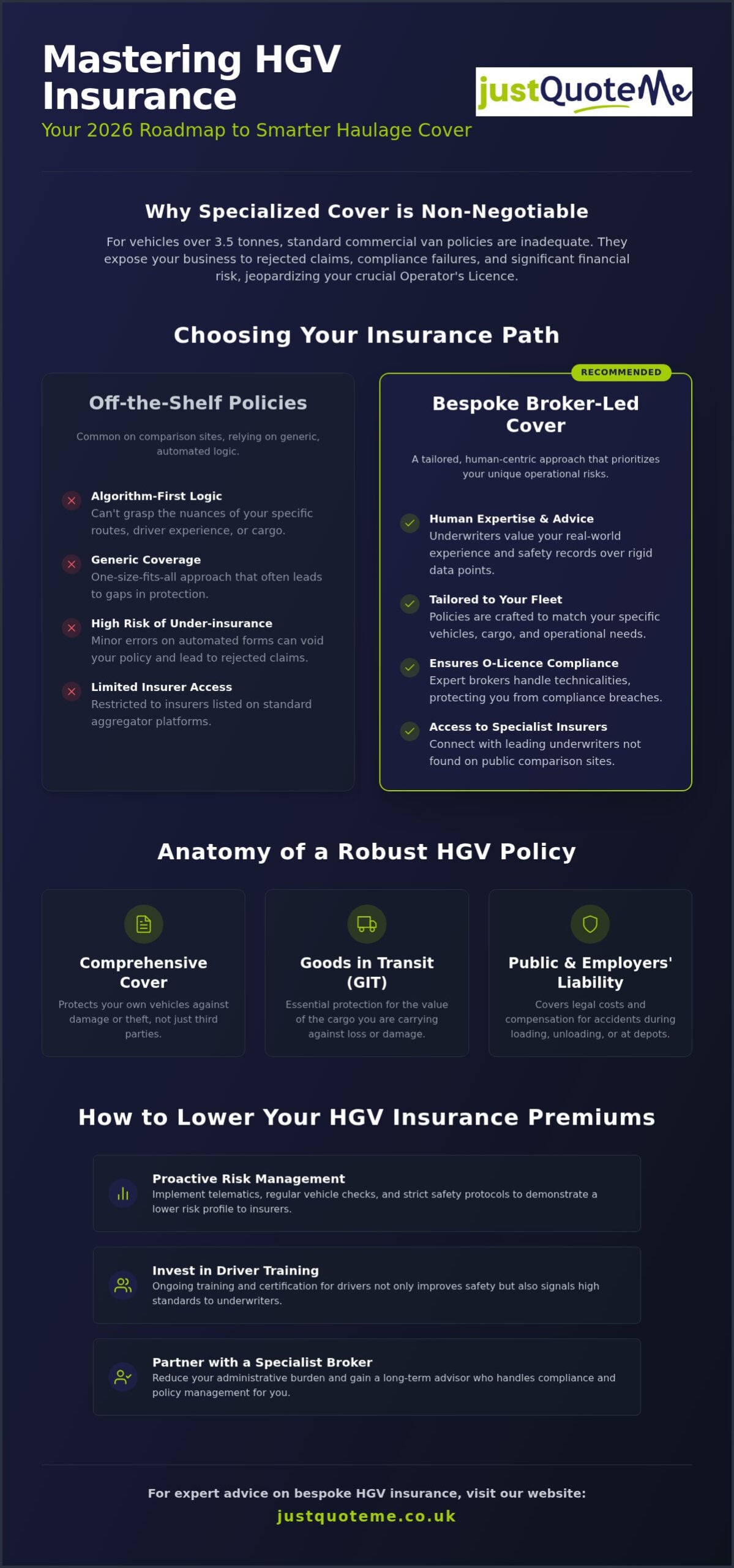
Comparison sites rely on algorithm-first logic. This works for standard cars but often fails when you’re securing HGV insurance UK. A generic form can’t distinguish between a truck doing local site deliveries and one doing long-haul motorway routes. Specialist underwriters look at the human element, such as your driver’s specific experience and your safety record. They understand that a haulier with 20 years of clean driving on specific routes is a lower risk than a rigid algorithm might suggest. By opting for a human-centric approach, you ensure your policy reflects the reality of your daily operations rather than a best-guess estimate.
The danger of under-insurance is a significant threat to your O-Licence. If you miss a minor detail on an automated form, you might save a small amount on your premium today but face a rejected claim tomorrow. Staying compliant with Goods Vehicle Operator Licensing requires an accurate representation of your business operations. Working with a human broker ensures these technicalities are handled correctly from the start. This protects you from technicalities that automated systems often overlook, giving you the confidence that your cover is actually valid when you need it most.
Owner-Driver Insurance vs. Fleet Policies
Independent operators often start with single-vehicle policies tailored to their specific niche. These provide the focused protection a one-person business needs without unnecessary extras. However, as your business expands, Fleet Insurance Solutions offer much better administrative efficiency by putting all vehicles under one renewal date. “Any Driver” policies are particularly popular for growing fleets. They allow any qualified driver over a certain age to operate any vehicle in the fleet. This flexibility is vital for maintaining delivery schedules and managing staff turnover without needing to update your insurer every time a new driver joins your team.
The Role of Excess and Voluntary Contributions
Your voluntary excess is a powerful lever for controlling costs. Increasing your excess will lower your annual premium, but it requires you to have enough cash on hand to cover those costs if an incident occurs. For high-mileage HGVs, the statistical likelihood of a minor claim is higher than for standard commercial vehicles. Balancing your risk retention with your monthly cash flow is a delicate calculation. Getting bespoke advice from a specialist ensures you don’t set an excess so high that a single accident disrupts your entire operation’s liquidity.
Request a Call back for free Expert advice
Why Use an Independent Insurance Broker in 2026?
Just Quote Me acts as a steady hand in an increasingly volatile market. With over 30 years of industry experience, we understand that the haulage sector requires more than just a standard policy. One of the primary advantages of working with an independent broker is our access to a broad network of top UK insurers. Many of these specialist underwriters don’t list their products on comparison sites, preferring to work with trusted partners who can accurately assess a firm’s risk profile. This gives you access to rates and terms for HGV insurance UK that simply aren’t available to the general public.
When you’re dealing with a complex claim, the last thing you need is an automated bot or a scripted response from a national call centre. We provide personalised support throughout the entire claims process. You speak to real people who understand your business and are committed to resolving issues quickly. This human-centric approach is a core part of our service, ensuring you feel secure and informed at every stage. Reliability is our priority, and we focus on simplifying administrative processes so you can focus on your deliveries.
The Local Advantage: Staffordshire Expertise
Regional knowledge is a powerful tool in logistics. Our deep roots in Staffordshire mean we understand the specific challenges faced by hauliers in Newcastle-under-Lyme, Stone, and Stafford. Whether it’s the local road networks or the regional logistics hubs, this expertise allows us to provide more accurate advice than a distant national provider. If you’re looking for a Commercial Insurance Broker Staffordshire businesses can rely on, we offer a level of familiarity that large corporations can’t match. We also stay aligned with standards set by the Road Haulage Association, ensuring your business remains compliant with the latest industry best practices.
Bespoke Policy Administration
Administrative burdens can slow your business down. We manage the complex tasks so you don’t have to, including mid-term adjustments (MTAs) when you add new vehicles to your fleet. Navigating the regulatory shifts of 2026 requires precise, professional advice. FCA authorisation is the gold standard for UK insurance consumer protection. As an FCA-authorised firm, we ensure that every piece of advice we give is grounded in legal compliance and professional integrity. This level of oversight provides the reassurance you need when making critical choices about your haulage cover and risk management strategy.
Request a Call back for free Expert advice
How to Lower Your HGV Insurance Premiums: Proactive Risk Management
Proactive risk management is the most effective way to secure lower rates for HGV insurance UK in 2026. Instead of reacting to premium hikes, successful operators build a profile that underwriters find attractive. This starts with a clear understanding of your fleet’s vulnerabilities. Security is a major factor. Vehicles stored in gated, CCTV-monitored depots or secure overnight locations carry significantly less risk than those parked on public roads. When you demonstrate a commitment to physical security, you provide insurers with the reassurance they need to offer more competitive terms. Additionally, choosing to pay your premiums annually rather than monthly can result in savings of up to 25%, providing an immediate boost to your cash flow.
Technology and Safety Integration
Advanced telematics and route-tracking software are no longer optional extras. They provide real-time data that proves your commitment to safe operation. Following the 1 July 2026 mandate for Smart Tachograph Version 2 in international transport, insurers are looking for firms that embrace data-driven compliance. Dashboard cameras are equally vital. They provide objective evidence during incident investigations, which helps accelerate claim resolution and protects your hard-earned No Claims Discount (NCD). Underwriters in 2026 view factory-fitted speed limiters and lane-departure warnings as essential risk-reduction tools that justify lower base premiums. By meeting the stricter 2026 Direct Vision Standard (DVS) requirements, you also signal to insurers that your fleet is equipped with the latest safety technology.
Driver Management and Recruitment
Your drivers are your biggest risk or your best asset. Hiring drivers with existing points or convictions can lead to immediate premium increases. Conversely, maintaining meticulous CPC (Certificate of Professional Competence) records shows a commitment to professional standards. The updated CPC categories introduced in January 2026 mean training is more rigorous than ever. Implementing a formal driver handbook that outlines safety protocols and emergency procedures further lowers your perceived risk. For those managing multiple vehicles, centralising your NCD through a fleet insurance policy can often lead to better long-term savings than managing individual discounts. We can help you build this profile through a bespoke risk assessment that highlights your safety investments to our panel of insurers.
Request a Call back for free Expert advice
Securing Your Bespoke HGV Quote with Just Quote Me
Securing HGV insurance UK is the final step in protecting your haulage business from the regulatory and financial risks of 2026. We don’t just provide a policy; we act as a dedicated partner that manages the administrative burdens so you don’t have to. Our process is designed for efficiency and clarity. It begins with an initial consultation where we learn the specifics of your operation, from the types of cargo you carry to the routes your drivers frequent. Once we have a clear picture, we move into bespoke underwriter negotiation. We use our established relationships with a broad network of insurers to present your risk profile in the best possible light. This human-led approach often secures terms that automated systems simply cannot offer. For smaller operators in the construction sector, we also provide specialised Tradesman Insurance that scales with your business as you transition from light commercial vehicles to heavy trucks.
Comprehensive Protection for Hauliers
A truly robust insurance strategy looks beyond the vehicle itself. If you employ drivers, warehouse staff, or administrative teams, you must integrate Employers Liability Insurance to meet your legal obligations. We also provide Professional Indemnity cover for logistics consultants and managers who provide expert advice or supply chain coordination. Centralising these covers under one broker reduces your administrative workload and ensures there are no gaps in your protection. Our regional expertise in Staffordshire, specifically across Stone, Stafford, and Newcastle-under-Lyme, makes us the preferred choice for local business owners. We understand the regional logistics hubs and the local road networks, allowing us to provide advice that is both practical and authoritative.
Next Steps: Get Your Expert Quote
To ensure your quote process is as fast as possible, it’s helpful to gather your vehicle details, driver records, and claims history before getting in touch. Having this information ready allows us to move quickly into the negotiation phase with underwriters. We pride ourselves on being a human-centric alternative to the impersonal nature of online aggregators. If you prefer an expert conversation over filling out endless digital forms, our “Request a Call back” feature is the ideal solution. You’ll speak with a knowledgeable advisor who can answer your questions and guide you through the complexities of the 2026 insurance market. We offer a reliable, straightforward, and professional service that lets you focus on what you do best: keeping your fleet moving and your customers satisfied.
Request a Call back for free Expert advice
Secure Your Haulage Future in 2026
Navigating the 2026 logistics landscape requires more than just meeting minimum legal standards. The mandatory shift toward Smart Tachograph Version 2 and stricter safety requirements means your HGV insurance UK must be as precise as your operations. Moving away from algorithm-driven aggregator sites toward bespoke, broker-led policies ensures you aren’t just covered on paper, but fully protected during a claim. Proactive risk management remains your strongest tool for keeping premiums affordable in a high-cost market.
Just Quote Me brings over 30 years of industry experience as an FCA-authorised independent broker to help you manage these complexities. We focus on the human side of insurance, providing regional expertise across Staffordshire and the West Midlands that national call centres can’t replicate. We’re here to take the administrative weight off your shoulders so you can focus on your fleet. Let’s work together to keep your business moving forward with confidence.
Request a Call back for free Expert advice
Frequently Asked Questions
Is HGV insurance more expensive than standard van insurance?
Yes, HGV insurance is typically more expensive because the vehicles are heavier, carry higher-value cargo, and pose a greater risk on the road. Standard commercial van insurance covers vehicles up to 3.5 tonnes, whereas HGVs require specialised cover for their specific weight classes and regulatory requirements. Factors like longer stopping distances and the potential for greater damage in an accident contribute to the higher premium costs associated with heavy haulage operations.
What is the minimum level of HGV insurance I need by law in the UK?
The minimum legal requirement for HGV insurance UK is Third-Party Only (TPO) cover, as mandated by the Road Traffic Act 1988. This covers your liability for injury to others or damage to their property. However, most professional operators choose Comprehensive cover to protect their own assets. Additionally, if you employ any staff, you’re legally required to have Employers’ Liability Insurance to comply with UK law and protect your workforce from workplace injuries.
Can I include Goods in Transit cover within my HGV insurance policy?
You can certainly include Goods in Transit (GIT) cover as part of a bespoke haulage package. While standard vehicle insurance protects the truck, GIT specifically covers the cargo against theft, loss, or damage while it’s being moved. Many brokers recommend combining these covers to ensure there are no gaps in your protection; for instance, you can discover Cargo Insure Online to find specialized insurance for global logistics and trucking freight. It’s an essential component for any business responsible for delivering high-value or sensitive items to clients across the country.
Does HGV insurance cover me for driving in Europe in 2026?
Yes, HGV insurance can cover European driving, but you must ensure your policy includes specific territorial extensions for 2026. From 1 July 2026, all goods vehicles over 2.5 tonnes used for international transport must have a Smart Tachograph Version 2 fitted. Your insurer will likely require proof of this compliance before extending cover for cross-border operations. Always check your policy’s territorial limits to confirm you’re protected outside the UK before starting a journey.
How does a No Claims Discount (NCD) work for HGV fleets?
No Claims Discounts for fleets work differently than for individual vehicles. Instead of a discount per truck, insurers often look at the overall claims experience of the entire fleet. This is known as “Claims Experience Rated” insurance. Maintaining a low frequency of incidents across all vehicles allows a broker to negotiate a lower overall premium for the entire fleet. We help you manage this data to prove your safety record to specialist underwriters during renewals.
What information do I need to provide for an HGV insurance quote?
To get an accurate HGV insurance UK quote, you’ll need to provide your vehicle registration, gross vehicle weight, and details of any specialised equipment like tail lifts. You also need to share your drivers’ experience, ages, and any motoring convictions. Additionally, insurers require information about the goods you carry, your annual mileage, and your operating radius. Providing a full claims history for the last three to five years is also essential for securing the best rates.
Can I insure an HGV for personal use only?
While insuring an HGV for personal use is possible, it’s a highly specialised request that most standard commercial policies don’t cover. Personal use might include driving a horsebox or a vintage truck for non-commercial purposes. However, if the vehicle is over 3.5 tonnes, you still need to meet specific licensing and safety requirements. Most brokers focus on commercial haulage, so you’ll need to specify that no “hire or reward” work is being undertaken.
How do telematics systems affect my HGV insurance premiums?
Telematics systems significantly influence your premiums by providing objective data on driving behaviour. Insurers view the use of route-tracking and speed-monitoring software as a proactive approach to risk management. By demonstrating consistent safety standards and adherence to speed limits, you prove to underwriters that your fleet is a lower risk. In 2026, this data is increasingly used to reward safe operators with more competitive rates and faster claim resolutions after an incident.
Request a Call back for free Expert advice
