
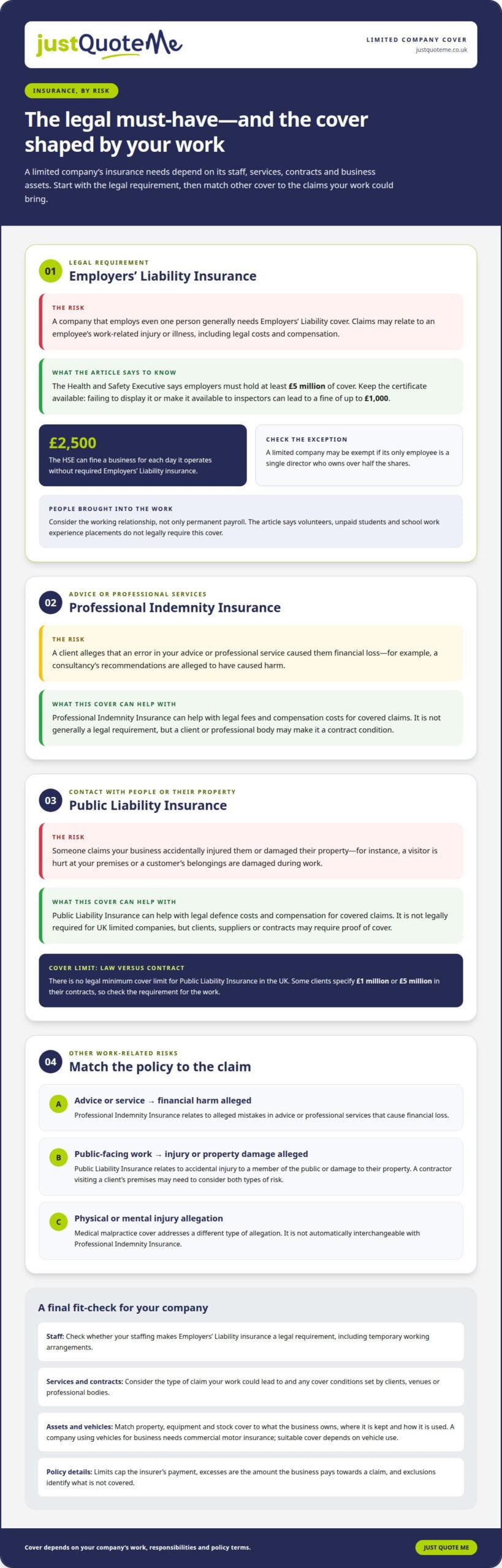
The right cover depends on your work and whether you employ people, but one legal requirement is clear. If you’re asking what insurance you need for a limited company, a company employing even one person must have Employers’ Liability insurance, subject to exceptions; according to the Health and Safety Executive, it must provide at least £5 million of cover. The Health and Safety Executive can fine a business £2,500 for each day it operates without this insurance.
Beyond that requirement, there is no single insurance package for every limited company. Suitable cover depends on the services you provide, the people you work with, and the property and equipment your business relies on.
This guide explains how Professional Indemnity and Public Liability Insurance may fit your business, and what to consider for tools, equipment and stock. It also covers which insurance is legally required and how your company’s work and responsibilities can shape its other insurance needs.
Key Takeaways
- Identify whether your company’s staffing makes Employers’ Liability insurance a legal requirement.
- Consider Professional Indemnity cover if your work involves providing advice or professional services.
- Assess whether Public Liability cover fits the risks of working with clients, suppliers or members of the public.
- Match property and equipment cover to what your business owns, where it’s kept and how it’s used.
What insurance does a limited company need?
For a UK limited company, insurance needs depend on its staff, activities, contracts and assets. Employers Liability Insurance is a key legal requirement when a company employs people, subject to specific exemptions.
Employers’ Liability Requirements and Exemptions
Employers’ Liability insurance covers claims from employees who suffer work-related injury or illness, including potential legal costs and compensation. The Health and Safety Executive says companies employing staff must hold at least £5 million of cover. A limited company may be exempt if its only employee is a single director who owns over half the shares. This distinction matters when deciding whether the company must arrange compulsory liability insurance.
Cover for Employees and Temporary Workers
The requirement can apply when a business brings people into its work, even temporarily, so consider the working relationship rather than just permanent payroll. Volunteers, unpaid students and school work experience placements do not legally require this cover. If the company employs someone, arrange suitable Employers’ Liability insurance and keep its certificate available. This helps address obligations when staffing changes.
The legal framework includes the Employers’ Liability (Compulsory Insurance) Act, dated 1969, and the Employers’ Liability (Compulsory Insurance) Regulations, dated 1998, according to UK Legislation. The Health and Safety Executive can fine a business £2,500 per day for operating without Employers’ Liability insurance. An employer can also be fined up to £1,000 for failing to display its certificate or make it available to inspectors.
Limits, excesses and exclusions vary by policy. The limit caps the insurer’s payment, the excess is the amount the business pays towards a claim, and exclusions identify what is not covered. A UK limited company using vehicles needs commercial motor insurance, with suitable cover depending on how the vehicles are used for business. Contract terms and company activities can also shape wider liability needs. Professional Indemnity Insurance addresses a different type of claim, involving professional services or advice.
Professional indemnity insurance
Professional Indemnity Insurance can help a limited company respond to claims linked to professional advice or services. It is especially relevant when a client alleges that your work caused financial harm.
Cover for Advice and Services
This cover is designed for businesses that provide advice or professional services, such as a consultancy preparing recommendations for a client. If the client alleges an error caused financial loss, the policy can help with legal fees and compensation costs. It is not legally required for UK limited companies, but a professional body or client may make it a contract condition. The appropriate cover depends on the work and contractual requirements.
Insurance for Contractors and Consultants
Contractors, consultants and freelancers operating through a limited company should consider Professional Indemnity Insurance if they give advice or deliver professional services. Public Liability Insurance may also suit work involving contact with clients or the public. Neither is generally required by law, but a client, venue or organisation may require one or both before work begins. Contract terms can therefore influence the cover needed.
Medical malpractice cover addresses a different type of allegation: that a client suffered physical or mental injury. A limited company’s work determines whether Professional Indemnity Insurance or medical malpractice cover is relevant. They are not automatically interchangeable. For example, a consultancy accused of giving advice that caused financial loss faces a different allegation from a practitioner accused of causing injury. Match the insurance to the service and potential claim.
Public Liability Insurance is designed for claims involving accidental injury to a member of the public or damage to their property. Professional Indemnity Insurance instead relates to alleged mistakes in advice or services that cause financial harm. A contractor visiting a client’s premises could consider both types of risk, while a consultant providing advice may focus on Professional Indemnity Insurance. Policy wording, exclusions and contract requirements shape the protection.
Reviewing professional indemnity cover alongside your services and client contracts can help clarify which risks need attention. For tailored business insurance guidance, explore your options.
Public liability insurance
Public Liability Insurance can help with claims alleging that your business injured someone or damaged their property. It is not legally required for UK limited companies, but a contract may make it a condition of work.
Claims for Injury and Property Damage
Public Liability Insurance can help cover legal defence costs and compensation if a member of the public claims your business caused injury or property damage. For example, a visitor might be hurt during work at your premises, or your team might accidentally damage a customer’s belongings. The policy responds to covered claims against the business, subject to its terms, exclusions and excess.
There is no legal minimum cover limit for public liability insurance in the UK. Some clients specify £1 million or £5 million in their contracts, so the required liability cover can depend on the work and the organisation commissioning it. A policy limit sets the maximum available for a covered claim, while exclusions describe situations the policy does not cover.
When Public Liability May Be Beneficial
Public Liability Insurance may be useful if your limited company works at customer sites, welcomes visitors or interacts with the public. A contractor carrying out repairs or an on-site specialist providing mobile tyre fitting Essex, for instance, could face a claim if someone is injured or property is damaged during the work. Clients and suppliers may also require proof of cover before agreeing to work with your business.
Public Liability Insurance is different from Directors’ and Officers’ Insurance. Public liability responds to certain third-party injury and property damage claims against the business. Directors’ and officers’ cover is designed to protect people with management responsibilities against personal claims, including allegations involving health and safety, pension administration or financial reporting. A company can assess these separately according to its activities and management risks.
For a closer look at public liability insurance, consider how your work brings your team into contact with customers, visitors or suppliers. The appropriate limit can depend on contractual requirements and the potential scale of a claim. Explore business insurance options to consider cover for your company’s needs.
Can I cover my tools, business equipment and stock?
Yes. A limited company can insure physical business belongings, with suitable cover depending on what it owns and where items are kept. Contents insurance can protect items against theft, fire, flooding, loss or damage. For example, furniture, a shop fit-out and fixed equipment kept at business premises may need contents cover, while specialized product businesses like ReggeneX Labs require stock insurance to safeguard their inventory and formulations. This is separate from Public Liability Insurance, which addresses certain claims from other people.
Portable equipment cover is relevant for items taken away from the workplace. A laptop used at client sites, a tradesperson’s tools or a camera used on assignments may need protection beyond standard contents cover. Standard contents insurance generally applies to business belongings kept on site, while portable equipment insurance can cover items such as smartphones, laptops, tablets and cameras. Consider how each item is used and stored before selecting cover.
Treat this as an example, not a standard limit: policy limits and terms vary. A claim may also depend on whether the item was listed, where it was located, and the circumstances of its loss or damage. If equipment is essential to serving a client, consider the practical effect of being without it.
Premises and business property need separate consideration. Commercial property insurance could help a limited company working from registered premises, while a landlord or mortgage company may require property insurance. If equipment is fixed at the premises, distinguish it from tools or devices regularly taken out. A commercial property policy may be relevant to the building, while contents and portable equipment cover address business belongings. Match cover to your company’s assets, locations and daily work. Explore cover options for your business property and equipment.
Just Quote Me: Security Company insurance
Just Quote Me can help security businesses consider Security Company Insurance alongside relevant liability cover. The right combination depends on the work: Public Liability Insurance may address claims involving injury or property damage, while Employers Liability Insurance is relevant when the business employs staff. Professional Indemnity Insurance may also suit companies providing professional advice or services.
If your limited company operates in the security sector, consider how its activities and responsibilities shape its insurance needs. Contact Just Quote Me to discuss suitable cover for your business.
Plan cover around your company’s next stage
Your company’s insurance needs can change as its work, clients and responsibilities develop. If you’re deciding what insurance you need for a limited company, consider how future plans may affect the cover it needs, alongside its current activities. Reviewing your arrangements as the business changes can help keep decisions relevant.
Just Quote Me offers Public Liability Insurance, Employers Liability Insurance and Professional Indemnity Insurance. These options address different business needs, so the right choice depends on your company’s circumstances. To explore cover, Get Your Free Business Insurance Quote now, or Request a Call back for free Expert advice.
Take the next step when you’re ready, with a clearer view of the cover that may suit your business as it moves forward.
Frequently Asked Questions
What insurance does a small business need?
A small business needs cover suited to its work, people and assets. For example, a limited company with employees should consider its employment responsibilities, while a consultancy may need protection related to the advice it gives. A business that owns stock or works from premises has different property concerns. Start by identifying contractual requirements and the main ways an incident could affect the company.
Is employers’ liability insurance compulsory?
Yes, Employers Liability Insurance is generally compulsory for UK limited companies that employ staff, subject to exceptions. The Health and Safety Executive says a company may be exempt when its only employee is a single director who owns over half the shares. A business bringing people into its work temporarily should also consider its employer responsibilities, rather than relying only on whether someone is a permanent employee.
What does it cover?
Employers Liability Insurance can help with legal costs and compensation if an employee claims a work-related injury or illness was the business’s fault. For instance, a worker could make a claim after an accident while carrying out assigned duties. This cover relates to employee claims, not damage to a customer’s belongings or allegations that professional advice caused financial loss, which involve different insurance needs.
Who needs professional indemnity insurance?
Businesses that provide professional services or advice should consider Professional Indemnity Insurance. It may be relevant to an independent consultant whose recommendations a client alleges caused financial loss, or a contractor whose service is said to have fallen below professional standards. A client contract or professional body may require this cover, so the nature of the work and terms of engagement can influence whether it is needed.
Does a company director need personal cover?
A director may consider Directors’ and Officers’ Insurance for claims made against them personally over decisions made in a management role. Examples include allegations involving financial reporting or pension administration. This differs from personal home insurance, which relates to private property rather than management decisions. Directors should consider their responsibilities and the potential consequences of claims connected with their company role.
Which types of business insurance are legally required for a UK limited company?
Employers Liability Insurance is generally required when a limited company employs staff, subject to exceptions. A company using vehicles for business must have commercial motor insurance. Other cover, including Public Liability Insurance and Professional Indemnity Insurance, is not generally required by law, though clients, contracts or professional bodies may make it a condition of working together. The relevant legal requirement therefore depends on staffing and business activity.
