

The charity may hold the policy, but trustee indemnity insurance for charities can protect an individual trustee against covered claims. That distinction matters: trustees of unincorporated charities can be personally liable for the charity’s debts and obligations. A claim about a decision made in their role can also bring legal costs and financial exposure.
It is reasonable to expect insurance to protect the organisation first. Trustee indemnity cover focuses on claims against trustees for alleged wrongful acts, which may include breach of duty, misuse of funds, health and safety issues or unfair dismissal. The policy wording sets the scope, exclusions and limits, so cover depends on the specific policy.
This guide explains how the cover works, which claims it may respond to, and how a charity’s governing documents and Charity Commission rules relate to paying the premium. It also distinguishes trustee protection from other insurance a charity may need, helping you understand where each type of cover fits.
Key Takeaways
- Look beyond the policy name: wording, exclusions and limits determine which claims and legal costs may be covered.
- Separate governance-related claims from risks linked to the charity’s advice, services or other professional work.
- Review the charity’s governing document and make sure any premium paid from charity funds is reasonable.
- Understand which details shape a charity’s quote so you can assess whether the cover fits its activities and risks.
How does trustee indemnity insurance work?
Trustee indemnity insurance can protect individual trustees against claims connected with their charity role. The policy wording defines who is insured, which activities qualify and what claims are covered.
Who the Cover Can Protect
For an unincorporated charity, trustees can be personally liable for its debts and contractual obligations. Joint and several liability means one trustee could bear costs if the others cannot pay. Whether cover extends to a trustee’s role with another not-for-profit entity depends on the policy wording, including whether that role and organisation are among the insured activities. Premiums and limits depend on factors such as the charity’s activities, claims history, number of trustees and selected limit.
Covered Claims and Related Policies
Policies may respond to claims alleging misuse of charity funds, breach of authority, unfair dismissal or health and safety failures. They can also cover alleged wrongful acts, breach of trust or breach of duty, including negligence. The exclusions and limit in the wording define the protection. Claims outside those terms, or above the limit, are not covered. The UK Corporate Manslaughter and Homicide Act is dated 2007, according to the UK legislation register; insurance does not replace sound organisational risk management.
Directors’ and officers’ cover addresses claims involving organisational mismanagement and associated legal costs. Professional indemnity cover addresses risks from professional services, such as advice or training, rather than trustee governance decisions. A charity may need both where trustees govern an organisation that also provides advice. If it employs staff, the Health and Safety Executive says an organisation can be fined £1,000 for not displaying its employers’ liability certificate. Employers’ liability insurance is a separate cover.
Claims-Made Policies and Continuous Cover
Charity professional indemnity policies are written on a claims-made basis. For claims-made policies, the timing of the incident and the report can affect whether cover applies. A retroactive date may include historic work from an agreed date, provided cover remains continuous. For example, a gap between policies could affect cover for a later-reported claim about earlier advice. Check the policy dates and retroactive date when arranging or renewing cover.
Rules for Insuring Trustees
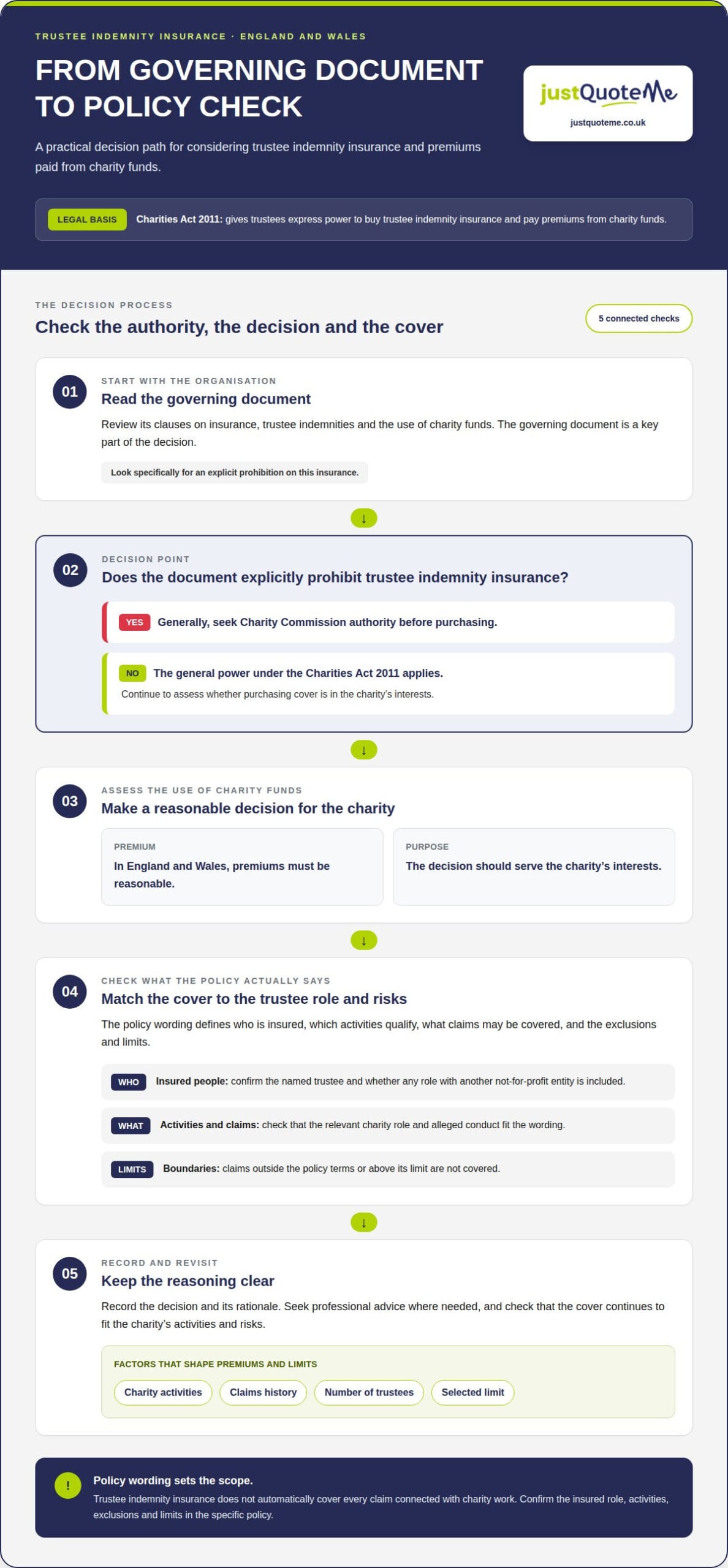
The Charities Act 2011 gives trustees express power to buy trustee indemnity insurance and pay premiums from charity funds. In England and Wales, premiums must be reasonable, and the decision should serve the charity’s interests. Review the governing document: if it explicitly prohibits this insurance, the charity generally needs Charity Commission authority to purchase it. Record the decision and its rationale, and seek professional advice where needed.
Claims for breach of trust, breach of duty, negligence and defamation
Claims against trustees can concern decisions, oversight or statements made while serving a charity. The allegation matters, as do the trustee’s role and the policy wording.
Breach, Negligence and Defamation Claims
A breach of trust claim may allege that a trustee mishandled assets or failed to protect the charity’s interests. A breach of duty or negligence claim may challenge how trustees made or carried out a decision. For example, after a building project runs over budget, a contractor might allege negligent oversight, while the charity faces a dispute about approval or payment. Cover depends on the alleged act, the insured role, and the policy’s exclusions and limits.
Defamation claims may arise from statements made about a person or organisation during charity work. A dispute about denying access could also allege that trustees acted unfairly by restricting someone’s use of a charity service or premises. These examples do not establish cover automatically: the wording must address the type of claim and circumstances. Professional indemnity is distinct, focusing on risks from professional advice or services rather than trustees’ governance decisions.
Claims and Investigations Against Trustees
Trustees may face pressure even before a formal claim. An investigation into a charity decision can require records, explanations and legal support, even if no one seeks compensation. The Charity Commission may be relevant where concerns involve charity governance, but an investigation does not itself prove that a trustee breached a duty. The policy should explain whether it responds to investigations, who can notify the insurer and how it handles legal costs.
When a complaint arrives, preserve relevant minutes, emails, contracts and project records, then notify the insurer using the process stated in the policy. Do not assume a claim is covered simply because it concerns charity work. Check whether the named trustee, activity and alleged conduct fit the policy. To distinguish governance liability from professional-service exposure, Request a Call back for free Expert advice.
What do Charity Commission rules and a charity’s governing document say about insuring trustees?
In England and Wales, the Charities Act 2011 gives charity trustees express power to buy trustee indemnity insurance and pay its premiums from charity funds. The power supports trustee protection, but it does not remove the need to make a careful decision for the charity. The Charity Commission is the regulator for charities in England and Wales, and the governing document remains a key part of that decision.
Start with the governing document’s clauses on insurance, trustee indemnities and use of charity funds. If it explicitly prohibits trustee indemnity insurance, a charity generally needs Charity Commission authority before purchasing it. If it contains no such prohibition, the general power under the 2011 Act applies. Read the exact wording, since a restriction on indemnifying trustees may differ from an express ban on buying insurance.
Any premium paid from charity funds in England and Wales must be reasonable. Trustees should weigh the charity’s interests, its activities, the risks they face and the protection the policy provides. For example, a charity handling substantial finances may assess governance risks differently from one with limited activities. The decision should reflect the organisation’s circumstances, not simply the availability of a policy.
A practical approval process can keep the reasoning clear:
- Review the governing document for insurance powers, restrictions and relevant indemnity clauses.
- Identify the charity’s needs and compare them with the proposed policy’s scope, exclusions and limit.
- Consider whether the premium is reasonable and whether charity funds can properly meet it.
- Record the decision, its rationale and any professional advice taken.
Professional advice can help when a clause is unclear or the policy’s protection is difficult to assess. Keep the governing document, policy wording and decision record together. This creates a clear record of how trustees considered the charity’s interests and the reasonableness of the spending, rather than treating insurance as an automatic renewal expense.
How much does trustee indemnity insurance cost for a UK charity?
There is no single price for every charity. A quote depends on the organisation’s activities, governance risks and the protection it needs. A charity providing advice may face different exposures from one focused on grant-making, while complex operations can affect the cover required. The cost reflects the charity’s risk profile, not simply its charitable status.
The price depends on the charity’s circumstances and is provided after a quote request. Activities, claims history, requested limit and policy terms can all shape the premium. The limit of indemnity is the maximum the insurer will pay under the policy. A higher limit changes the protection selected, so trustees should weigh it against the claims and legal costs the charity could face.
Before requesting a quote, prepare a clear picture of the charity’s work. Include its services, governance arrangements, financial responsibilities and any previous claims. For example, trustees overseeing a building project may want to explain their decision-making and oversight responsibilities. Accurate details help insurers assess the exposure and provide terms relevant to the organisation, rather than a generic estimate.
- Describe the charity’s activities and the decisions trustees oversee.
- Summarise previous claims and any changes to the charity’s work.
- Decide what level of protection the charity is seeking.
- Review the proposed limit, exclusions and excess alongside the premium.
A lower premium may come with a different limit or narrower policy terms. Compare the scope of protection, not just the headline cost. Check how the wording treats legal costs, different trustee roles and claims arising from the charity’s activities. At renewal, tell the insurer about material changes, such as new services or altered governance responsibilities. This gives trustees a sound basis for assessing the quote and whether it fits.
For a tailored quote based on your charity’s circumstances, Get Your Free Business Insurance Quote now.
Just Quote Me: Professional Indemnity Insurance
Just Quote Me can help charities consider Professional Indemnity Insurance for risks arising from advice, training or other professional services. This cover addresses a different exposure from trustee indemnity insurance, which focuses on claims connected with trustees’ governance roles. If your charity provides professional services, the two covers may serve distinct purposes.
Just Quote Me can also help charities consider Public Liability Insurance and Employers Liability Insurance in relation to their activities and staffing. The appropriate protection depends on the work the charity carries out and the risks it faces. Reviewing the policy wording alongside the charity’s activities helps clarify which cover addresses each exposure.
For advice about insurance options for your charity, Request a Call back for free Expert advice.
Make your next insurance review count
Use your next insurance review to connect the charity’s plans with the protection it needs. Changes to services, partnerships or trustee responsibilities can alter the organisation’s risk profile. Treat the review as part of forward planning: identify emerging exposures, clarify which policy addresses each one, and keep the board’s decisions aligned with the charity’s activities.
Trustee indemnity insurance for charities is one part of a wider assessment. Just Quote Me offers Professional Indemnity Insurance, Public Liability Insurance and Employers Liability Insurance for related professional, public and staff risks. These covers address different exposures, so consider them in the context of your charity’s work.
A clear discussion can help you identify the cover relevant to your organisation and its next steps. Contact Just Quote Me about cover, and move forward with a practical insurance review for your charity.
Frequently Asked Questions
Can a charity use its money to buy insurance?
Yes, a charity can use its funds to buy trustee indemnity insurance, subject to its governing document and the charity’s interests. Trustees can record why the cover is relevant, how the premium relates to the charity’s needs and whether the governing document restricts insurance. If the document expressly prohibits the purchase, the charity generally needs Charity Commission authority before proceeding.
Are trustees jointly and severally liable?
Trustees of an unincorporated charity can have joint and several liability for the charity’s obligations. This means one trustee may face the cost if the others cannot pay. For example, if a charity cannot meet a contractual debt, trustees’ personal exposure may become relevant. The organisation’s legal structure and the circumstances of the obligation affect how liability applies.
Are trustees liable for a charity’s debts?
Trustees of an unincorporated charity can be personally liable for its debts and contractual obligations. For instance, if the charity enters a supplier contract but cannot meet its payment obligations, trustees may face personal exposure. This differs from a claim that a trustee personally acted improperly. The charity’s legal structure matters, so trustees should understand its effect on obligations before signing contracts.
How does it work?
The charity arranges a policy that names eligible trustees and sets out the claims, activities and costs it may cover. If a claim arrives, the trustee should follow the policy’s notification process and provide relevant documents, such as correspondence or meeting records. The insurer assesses the claim against the wording, exclusions and limit. A claim connected with charity work is not automatically covered.
What is trustee indemnity insurance for UK charities?
Trustee indemnity insurance is designed to protect individual charity trustees against covered claims arising from their trustee roles. Depending on the wording, this may include allegations involving wrongful acts or governance decisions. The policy may help with legal costs and claims for which a trustee is personally responsible. It does not replace careful governance, and its protection depends on the insured roles and policy terms.
Is trustee indemnity insurance the same as directors and officers insurance?
These are related forms of protection, but their names do not mean their policy terms are identical. Directors’ and officers’ insurance can cover claims arising from organisational mismanagement and associated legal costs. Trustee indemnity insurance focuses on claims against trustees in their charity roles. If a charity’s trustees also act as directors, compare the wording, insured people and activities to understand how the policies fit together.
