

A Statement of Fact for insurance is a record of key information about you or your business and the risk being insured. To understand what a Statement of Fact for insurance means in practice, think of it as the information the insurer uses to assess the cover and set its terms. You usually don’t need to sign it physically or digitally; asking the insurer to put the cover in place is treated as accepting the facts recorded.
Check each detail carefully: inaccurate or outdated information can affect your cover and a later claim. Disclose relevant information when arranging insurance, at renewal and when circumstances change during the policy. This guide explains what the document does, when to report new or corrected information, and how non-disclosure or misrepresentation may affect a policy or claim. It also explains what accepting the recorded facts means before cover begins.
Key Takeaways
- Understand what information a Statement of Fact records and how it helps an insurer assess a risk.
- Know when to disclose relevant details, including when arranging cover, renewing it and when circumstances change.
- Learn how inaccurate or missing information may affect your policy or a future claim.
- See how Just Quote Me can help businesses looking for Factory insurance.
Consequences of non-disclosure or misrepresentation
An inaccurate Statement of Fact can affect the insurance contract and a later claim. In the United Kingdom, non-disclosure or misrepresentation may lead an insurer to reduce a claim payment, decline the claim or void the policy. For example, leaving out a relevant business activity could mean the insurer assesses a claim without a complete picture of the risk. The outcome depends on what information was missing and how it influenced the insurer’s decision.
For consumers, the Consumer Insurance (Disclosure and Representations) Act 2012 sets out a duty to take reasonable care not to make a misrepresentation. Deliberate or reckless misrepresentation can allow an insurer to avoid the policy and refuse claims. For careless misrepresentation, the remedy reflects what the insurer would have done with the correct details. If it would have charged a higher premium, it may reduce a claim payment proportionately.
An honest mistake differs from deliberately giving a false answer, but any incorrect answer still needs attention. The Consumer Insurance Act’s reasonable-care test is central: an honest error is not automatically treated as reckless conduct. If you discover that an answer was wrong, tell the insurer promptly and provide the correct information. The insurer can update the record and explain any changes to the cover.
If a Statement of Fact contains incorrect information, contact the insurer or your insurance adviser promptly. Explain the error, supply the correct details and, where possible, do this before proceeding with cover. Keep a record of the correction. This helps ensure an inaccurate answer does not remain part of the insurance contract.
If you do not check the document, errors may go unnoticed until a claim is made. For example, a business might miss an incorrect description of its activities or claims history. The insurer may then consider whether that information would have affected its decision to insure or the terms it offered. Possible outcomes include changed terms, a reduced settlement, a declined claim or an invalidated policy.
Commercial policies also carry a duty of fair presentation before a policy begins, at renewal or when certain variations are made. According to The National Archives (legislation.gov.uk), a business must disclose material circumstances it knows or ought to know, or give enough information to prompt an insurer to ask further questions. That makes reviewing the Statement of Fact and raising conflicts with previous information important before the contract is agreed.
Disclosure at policy inception, renewal and during the policy
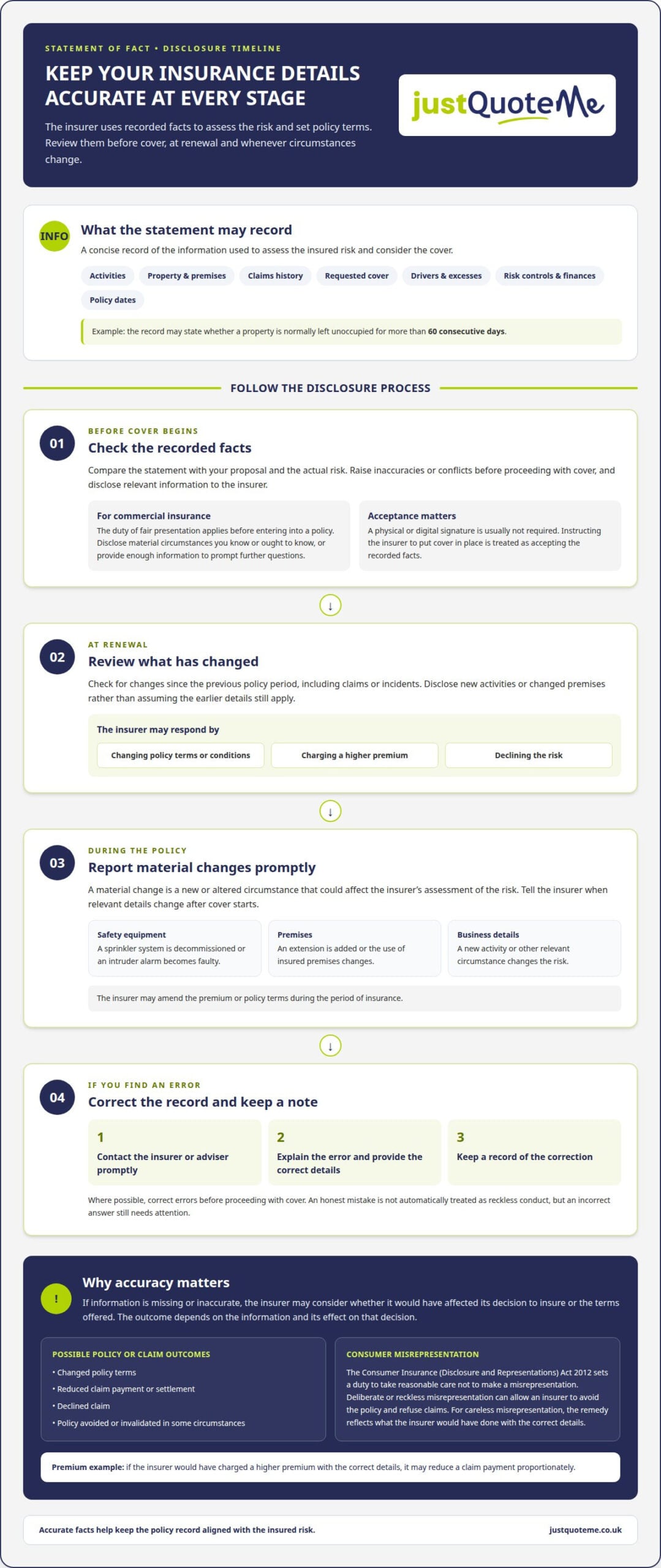
Disclosure matters when cover begins, at renewal and whenever circumstances change. The Statement of Fact records details the insurer uses to assess the risk and set policy terms.
Information in the Statement
A Statement of Fact can record the insured activities, property, cover, drivers, excesses and policy dates. It may also include claims history, risk controls and information about the business’s finances. These details help show what the insurer understood when setting the terms. For example, a commercial policy may record whether a property is normally left unoccupied for more than 60 consecutive days.
Material Changes and Declarations
A material change is a new or altered circumstance that could affect the insurer’s assessment of the risk. Examples include a decommissioned sprinkler system, a faulty intruder alarm, or an extension or change of use at insured premises. A policyholder declaration confirms the information submitted for the insurer’s assessment. Accurate declarations help keep the policy record aligned with the actual risk.
Before cover begins, review the recorded facts and raise any inaccuracies or conflicts with a proposal form. For UK commercial insurance, the duty of fair presentation applies before entering into a policy, at renewal and before certain variations. According to The National Archives (legislation.gov.uk), a business must disclose material circumstances it knows or ought to know, or provide enough information to prompt a prudent insurer to ask further questions.
At renewal, consider what has changed since the previous policy period, including any claims or incidents. If your business has added an activity or changed premises, disclose this rather than assuming the previous details still apply. The insurer may change policy terms or conditions, decline the risk or charge a higher premium.
If information changes after cover starts, tell the insurer promptly and explain the correct details. For example, report an alarm fault or a change in how insured premises are used. The insurer may amend the premium or policy terms during the period of insurance.
A Statement of Fact usually does not require a physical or digital signature. Instructing the insurer to bind cover is treated as accepting the recorded facts. Correct errors before cover starts and report relevant changes afterwards.
Definition and purpose of a Statement of Facts
A Statement of Facts is a concise record of key information an insurer uses to assess an insured risk. It brings together details supplied by the applicant or adviser, such as the business’s activities, premises, claims history and requested cover. For example, a manufacturer’s activities and the equipment at its premises help describe the risk being insured. The document records the factual basis on which the insurer considers the policy.
The purpose is to help the insurer decide whether to accept the risk and on what terms. A business’s activities or past claims may affect the cover offered, its conditions or the premium. If the insurer and policyholder agree with the facts, the insurer uses them as a basis for the insurance contract. So the statement is more than a quote summary: it helps define the risk the insurer has agreed to consider.
A Statement of Fact differs from a proposal form in who prepares it and how the information is presented. A Statement of Fact usually sets out details gathered through an insurer’s system, a telephone conversation or an adviser. The applicant completes a proposal form by answering the insurer’s questions. Both documents can record information used to assess insurance, but they are not interchangeable.
For example, an insurer may use a Statement of Fact for a standard business package, while requiring a proposal form for a non-standard risk or when a business reaches a turnover threshold. A proposal form may allow broader declarations about processes and controls. A Statement of Fact route may instead include more restrictions and exclusions, so the questions and terms can differ.
Read the Statement of Fact alongside the proposed policy wording. For example, if the business description leaves out an activity, the stated risk may not match the work the business actually does. Raise any conflict with a proposal form before cover is bound. The insurer can then consider the correct information before the contract is agreed, rather than relying on documents that describe different risks.
Meaning and purpose of an insurance statement of fact
A Statement of Fact records information about the insured risk and what was disclosed to the insurer. Its purpose is to show the factual basis used to arrange cover, not to replace the policy wording. It may describe a business’s activities, premises, claims history or risk controls. Read it alongside the policy, which sets out the applicable cover, conditions and exclusions.
Statements of Fact can be used with car, home and business insurance, but their questions depend on the risk and policy. A motor insurance statement may ask about drivers and motoring history; a home statement may record facts about the property. A business example might include whether premises are normally unoccupied for more than 60 consecutive days, or whether the policyholder reported losses or incidents during the previous 5 years. These are examples, not universal questions for every policy.
The document can also help clarify what the insurer knew if questions arise during a later claim. It records information presented when cover began and the factual basis on which the insurance contract was formed. However, it may not include every material fact relevant to the policy. For example, a statement describing a workshop may not detail every activity carried out there, so wider disclosures and the policy terms also matter.
If you believe an insurer has handled a Statement of Fact unfairly, make a formal complaint through the insurer’s complaints process. Identify the disputed entry, provide the correct information and explain how the issue affected your cover or claim. Keep copies of the statement, relevant correspondence and the response so your complaint clearly sets out what happened.
The key distinction is that a Statement of Fact records disclosed information, while the policy explains the agreed cover. An accurate record helps both sides understand the risk being insured. For example, if a business’s activities change, its previous description may no longer reflect the current risk. Read the statement alongside the policy and any proposal form, rather than treating it as a complete account of every term.
Just Quote Me: Factory insurance
Just Quote Me helps businesses arrange Factory Insurance and present the information insurers need to assess their risk. This can be useful when insuring factory premises, machinery or business activities and you want support providing accurate details.
A clear Statement of Fact helps ensure the insurer’s record reflects the risk being insured. Relevant details may include the factory’s activities, premises and claims history. Tell the insurer about changes so the information remains accurate. Just Quote Me also offers Public Liability Insurance and Employers Liability Insurance for businesses that need these types of cover.
Request a Call back for free Expert advice about your Factory insurance requirements.
Make your next insurance decision with confidence
Use the Statement of Fact as a prompt for a practical conversation about the cover you need. Consider whether the information still reflects your circumstances and what you want the policy to protect. When deciding what a statement of fact for insurance means for your next policy, focus on how clearly the record describes your particular risk, not just whether the paperwork is complete.
For business cover, the relevant questions depend on the activity and exposure. Just Quote Me offers Public Liability Insurance, Employers Liability Insurance and Professional Indemnity Insurance. You can discuss which type of cover relates to your business and what information may matter to the insurer’s assessment.
Take the next step at a pace that suits you: Get Your Free Business Insurance Quote now, or Request a Call back for free Expert advice to discuss your insurance needs and understand your options.
Frequently Asked Questions
Do I need to sign a Statement of Fact to make it legally binding?
A physical or digital signature usually isn’t required. Instructing the insurer to bind cover is treated as acceptance of the recorded facts, so correct errors before asking the insurer to start the policy. For example, if the document names the wrong premises, raise the discrepancy before cover is arranged. The policy wording and the insurer’s terms remain important parts of the insurance contract.
Why does Statement of Facts (SoF) exist?
A SoF gives the insurer a record of information used to assess an application and decide policy terms. It can help clarify what was disclosed if a later claim raises questions about the risk. For instance, a record of a business’s activities can show what work the insurer considered. It also gives the policyholder a chance to spot mismatches before cover proceeds.
What happens if I do not disclose one?
If you leave out relevant information, the insurer’s response may depend on the circumstances and type of policy. For example, a business that omits a significant change in its operations could face a claim decision based on an incomplete picture of the risk. Possible outcomes include changed terms, a reduced payment, a declined claim or an avoided policy. Deliberate or reckless misrepresentation can have serious consequences.
What is a “material fact” and why is it so important?
A material fact is information that could influence a prudent insurer’s decision to insure a risk or the terms offered. For a business, a change in premises use or relevant claims history could affect that assessment. Materiality matters because the insurer may have priced, limited or excluded cover differently if it had known the information. Disclose relevant facts clearly instead of relying on assumptions.
What is considered “Material Information” when checking these documents?
Material information is detail that could affect the insurer’s view of the risk. Depending on the policy, it may include business activities, claims or incidents, security arrangements, property use, or relevant information about directors or partners. For example, an alarm fault or a new activity at insured premises may change the risk picture. Review the questions asked and raise relevant details that need clarification.
What is a statement of fact in UK insurance?
A statement of fact for insurance in the UK records information about an insured risk for the insurer’s assessment. The format and questions vary by policy: a motor policy might record named drivers, while a business policy describes its operations. It does not replace the full policy wording. Read both documents together to understand the recorded information and the cover terms.
