

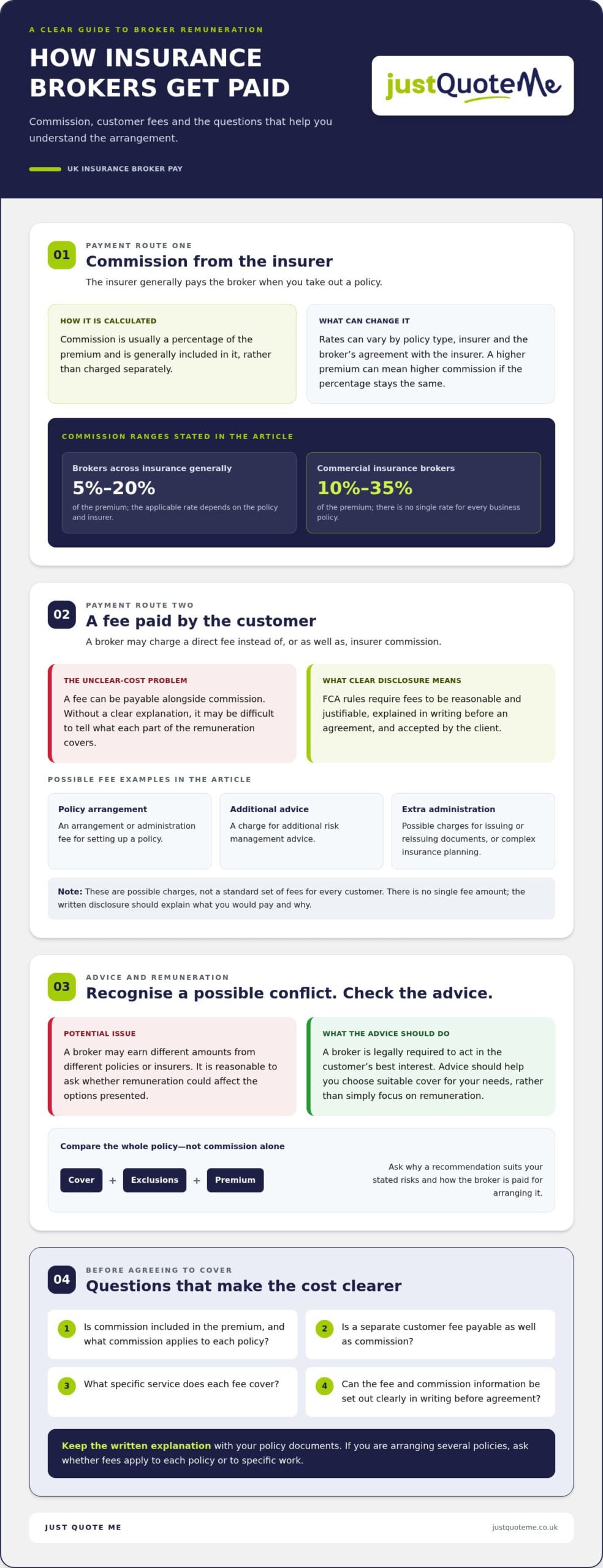
An insurance broker’s pay usually comes from commission included in the premium, a fee charged to the customer, or both. In the UK, brokers commonly receive commission of 5% to 20% of the premium; commercial insurance brokers typically receive 10% to 35%. If you’re asking how insurance brokers get paid in the UK, the key point is that commission rates vary, and any customer fee should be explained separately.
It’s reasonable to ask who pays your broker and whether their remuneration affects the advice you receive. Understanding how payment works helps you compare costs and ask clear questions before arranging cover.
This article explains how commission and fees work, when brokers must disclose them, and what responsibilities shape their advice. It also explores when broker support may help a business with specific risks or more complex insurance needs.
Key Takeaways
- Brokers commonly earn insurer commission as a percentage of the premium, with rates varying by policy and insurer.
- Some brokers also charge fees; understand what each fee covers and when it will be disclosed.
- A broker’s remuneration is only one part of the relationship: their advice should support your insurance needs and interests.
- Clear information about commission and fees can help you understand how your broker is paid.
- A broker may be especially useful when your business has specialist risks or needs cover across different areas.
How does an insurance broker get paid?
In the UK, insurance brokers commonly earn commission from insurers when they arrange a policy. Some also charge customers direct fees, depending on the service and agreement.
Commission as a Percentage of Premiums
Commission is usually a percentage of the premium charged by the insurer. The insurer pays the broker when a client takes out the policy, so commission is generally included in the premium rather than charged separately.
The premium may be the same whether customers buy through a broker or directly from the insurer. Commission rates can vary by policy type, insurer and the broker’s agreement with the insurer. If the percentage stays the same, a higher premium can mean a higher commission.
Typical Commercial Commission Rates
Commercial insurance brokers in the UK typically receive commission of 10% to 35% of the premium. Across insurance more generally, brokers commonly receive 5% to 20%, although the applicable rate depends on the policy and insurer.
Commission arrangements vary, so there is no single rate for every business policy. Cover for property, staff and professional risks may involve different arrangements. Ask what commission applies to each policy and whether a separate fee is payable.
Commission and Conflicts of Interest
A potential conflict of interest can arise if a broker earns different amounts from different policies or insurers. Since rates vary, it’s reasonable to ask whether remuneration could affect the options presented.
That possibility does not mean the advice is unsuitable. A broker should help you select appropriate cover and explain relevant remuneration. Compare cover, exclusions and premiums, not commission alone. Ask why a recommendation suits your stated risks and how the broker is paid for arranging it.
Broker Pay Compared with Other Channels
Insurance brokers commonly receive commission from insurers and some also charge customers fees. Comparison websites are a separate sales channel, while direct insurers sell their own policies. Payment arrangements depend on each business model.
For car and home insurance, brokers commonly receive commission within the overall 5% to 20% range. The exact percentage varies by policy, insurer and agreement, so this range does not establish the rate for a particular quote. A comparison result or direct quote may present a different route to cover, but the premium and policy terms remain important points to compare.
Before agreeing to a policy, ask whether commission is included in the premium, whether a direct fee also applies, and what the fee covers. This gives you a clearer view of the broker’s remuneration and the cost of your cover.
Broker fees and advance disclosure
A UK broker may charge a direct fee instead of, or as well as, insurer commission. The Financial Conduct Authority’s regulations require broker fees to be reasonable and justifiable, disclosed in writing before an agreement, and accepted by the client.
Disclosure of Broker Fees
Advance disclosure means the broker explains in writing what a fee covers before you agree to the service. You can then understand the charge before committing to a policy or arrangement.
FCA rules require broker fees to be reasonable and justifiable, disclosed in writing and accepted by the client. The explanation should identify the service covered, such as arranging a policy or providing additional risk management advice. If a fee applies alongside commission, ask for both parts of the remuneration to be set out clearly.
Before agreeing, read the fee information alongside the proposed cover and any other charges. If an arrangement fee is listed, for example, establish whether it relates to setting up the policy or a separate service. Keep the written explanation with your policy documents for future reference.
UK insurance brokers can charge customers fees, but there is no single amount. The charge depends on the broker and the service involved. The written disclosure should explain what you would pay and why.
Direct Broker Fees
A direct broker fee is a charge you pay for a service, unlike commission paid by an insurer. The distinction matters because a fee may be payable alongside commission, so it’s useful to understand the full remuneration arrangement.
Examples include arrangement or administration fees, or a charge for additional risk management advice. Some brokers may also charge for extra administration, issuing or reissuing documents, or complex insurance planning. These are possible charges, not a standard set of fees for every customer.
Ask the broker to explain each charge separately. If a fee covers administration, ask what work it includes. If it covers advice, ask what the service involves. Compare the explanation with the written terms before agreeing. This makes it easier to distinguish a customer fee from insurer commission and see whether both apply.
If your business is arranging several policies, ask whether fees apply to each policy or to specific work. Find out how adjustments or document reissues are handled if these services matter to you. FCA disclosure requirements mean fees should be explained in advance, not appear as unexplained charges after you agree.
These details help you understand the cost structure without assuming every broker charges customers directly. Focus on the written fee, the service it covers and whether commission also applies.
The broker’s duty to act in a client’s best interest
In the UK, an insurance broker is legally required to act in the customer’s best interest. That means the broker’s advice should help the client choose suitable cover for their needs, rather than simply focus on remuneration.
Using a broker does not automatically mean paying an extra fee. Brokers typically receive commission from insurers, while some also charge customers for specific services. Distinguish the premium and any commission within the insurance arrangement from a separate fee you pay directly to the broker.
For example, a business comparing professional indemnity policies should consider how each policy responds to its risks, not just the price. The broker should explain relevant cover and options to support an informed choice. Ask how a recommendation fits your circumstances and whether the broker receives commission or a direct fee.
A broker’s responsibilities may extend beyond presenting options. For commercial cover, a broker may assess risks, approach insurers, review policy wording, negotiate, handle mid-term adjustments and advocate during claims. The support provided matters: a business with changing operations may value help adjusting its policy, while a client with straightforward needs may focus on comparing cover and terms.
Chartered brokers are bound by a code of ethics that requires them to act in clients’ best interests. This professional commitment sits alongside the general legal duties that apply to UK insurance brokers. Look for clear explanations, relevant advice and recommendations connected to your stated risks.
Can customers negotiate or avoid insurance broker fees in the UK? Ask whether a fee can be reduced, removed or avoided before agreeing to the service. If you don’t accept a disclosed fee, don’t agree to that arrangement. Commission or another fee structure may still apply.
Before deciding, use these questions to clarify the relationship:
- What service does each direct fee cover?
- Does the broker also receive insurer commission?
- How does the recommended policy address the client’s stated risks?
- What support is included after the policy starts, such as adjustments or claims advocacy?
These answers help you compare the advice and cost structure together. Assess whether the service supports your interests, rather than assuming commission alone makes advice unsuitable or that every broker charges in the same way.
Transparency about broker remuneration
UK insurance brokers must be transparent about how they earn money under Financial Conduct Authority (FCA) regulations. Clear information helps you understand whether a broker receives insurer commission, charges a direct fee or uses both.
Transparency matters before you choose a policy, not just when you review the paperwork afterwards. Ask the broker to explain the remuneration connected with a recommendation and how it relates to the service. If a policy involves insurer commission and a separate administration charge, ask for each to be identified.
The explanation should clarify the relationship between the broker, insurer and customer. An insurer may pay commission for placing a policy, while a direct charge may relate to a service provided to you. These are different payment routes, even when they relate to the same policy. A clear breakdown shows what the insurer pays and what you may owe directly.
Use focused questions to make the information practical:
- Does the broker receive commission from the insurer for this policy?
- Will I pay a separate fee, and what service does it cover?
- Does the arrangement combine commission and a customer charge?
- How does the broker’s remuneration relate to the recommendation?
These questions help you compare policies without treating remuneration as the only measure of value. Two business policies may differ in cover, exclusions and service, even if both involve broker commission. Review the terms alongside the remuneration details to understand the full arrangement.
If an explanation is unclear, ask the broker to restate it in plain language before you decide. A useful response should distinguish insurer payments from fees charged to you and explain the service associated with each. Keep the written information with your quote and policy documents so you can refer to it later.
Transparency also gives you a clearer basis for discussing a recommendation. Ask why a particular policy suits your needs, what alternatives were considered and whether a direct charge applies. FCA requirements concern clarity about how the broker earns money; your questions connect that information to the cover being offered.
If your business is arranging several policies, consider each one separately. Remuneration may vary by policy type, insurer and broker agreement, so one explanation may not cover every part of your insurance programme. Ask about differences between policies, especially when a separate fee applies alongside commission.
A clear explanation of remuneration helps you make an informed choice without guessing who pays the broker. Consider it alongside the policy terms, the service provided and the risks you need covered.
When a business may benefit from a broker
A broker can be useful when business risks don’t fit neatly into a standard policy. In the UK, 78% of businesses rely on insurance brokers to identify major risks. A broker can discuss the activities, property, staff and contracts that shape a business’s insurance needs, then advise on policies from multiple insurers.
A range of insurer options can help when your business needs to compare more than premiums. For example, a construction business may need to consider how its work, equipment and contractual responsibilities affect its cover. A broker can explain differences in policy terms and help the business assess which options suit its risks.
Advice can also be useful when operations are specialist or changing. A business adding a service, taking on staff or moving premises may need to review its policies. Explaining these changes to a broker provides context for assessing whether the existing arrangements still fit the business’s activities.
Claims support is another point to consider, but it varies. Some insurance brokers support clients with complex claims, while others do not. Ask what help the broker provides if a claim becomes complicated, and distinguish that support from the insurer’s role in handling the claim.
A broker may be particularly helpful when a business has:
- Several activities or risks that need to be considered together.
- Specialist cover requirements or policy wording that is difficult to compare.
- Changes to its workforce, premises, services or contracts.
- A need to understand what support is available during a complex claim.
Before seeking advice, prepare a clear description of your business: what it does, where it operates and what has changed. This gives the broker useful context for discussing relevant policies and identifying gaps or overlaps in existing cover. Gather current policy documents and details of recent business changes so the conversation can focus on meaningful comparisons.
A broker may add less value if your needs are straightforward and you’re comfortable comparing policy terms yourself. The decision depends on the complexity of your risks and the help you want with choosing and managing cover. Consider both the advice and any applicable remuneration when assessing the service.
If you want help considering cover for your business, explore business insurance options and discuss the risks that matter to your operations.
Just Quote Me: Public Liability Insurance
Just Quote Me helps businesses explore Public Liability Insurance and consider cover for their operations and risks. It also offers Employers Liability Insurance, Professional Indemnity Insurance and Landlord Insurance for a range of business and property needs.
If you’re reviewing broker remuneration alongside insurance options, ask for a clear explanation of how the cover fits your circumstances and how the broker is paid. This helps you weigh policy terms, advice and any applicable fees together. Just Quote Me provides tailored insurance solutions for businesses, including those in hospitality, construction and property management.
For help considering suitable business cover, contact Just Quote Me or visit justquoteme.co.uk.
Make your next insurance decision with confidence
Understanding how insurance brokers get paid in the UK helps you approach your next insurance decision with clearer expectations. Consider what you want advice to help you achieve, and keep those priorities in view as you discuss your options. A focused conversation can clarify what information you need before choosing cover.
Just Quote Me can help you explore business insurance options and discuss cover relevant to your circumstances. To get started, request a quote online or speak with the team for advice.
Start with Get Your Free Business Insurance Quote now, or choose Request a Call back for free Expert advice. Choose the route that suits you and move forward with greater clarity.
Frequently Asked Questions
Are insurance brokers regulated?
Yes. The Financial Conduct Authority (FCA) regulates insurance brokers in the UK, and Just Quote Me is an FCA-authorised firm. This is relevant when considering who provides insurance advice and how a firm handles its responsibilities. When arranging business cover, consider the firm’s regulatory status and ask who will advise you, alongside reviewing policy terms and broker remuneration.
Does this create a conflict of interest?
Commission can create a potential conflict because brokers may receive different remuneration for different policies or insurers. That alone doesn’t mean a recommendation is unsuitable. Consider the reasons for the recommendation: does it address your business activities, relevant risks and desired cover? Ask how the options compare and whether remuneration differs. A clear explanation helps you assess the advice alongside the policy terms, rather than treating commission as the only factor.
Does using a broker cost more than going direct?
Not necessarily. Commission is generally included in the premium, and customers typically pay the same premium whether they buy through a broker or directly from the insurer. However, some brokers charge separate fees. Compare the full cost of equivalent cover, including stated fees and policy differences. A lower headline premium, for example, may not provide equivalent cover if exclusions or limits differ.
What do you actually get for the commission?
Commission can pay for work involved in arranging and supporting a policy, not just making an introduction. For business insurance, this work may include assessing risks, approaching insurers, reviewing policy wording and negotiating terms. It may also include mid-term adjustments or claims advocacy. The support depends on the broker’s service. Ask what tasks are included, especially if you expect help after the policy begins.
What services are included in a broker’s commission?
There is no universal list of services covered by commission. Work may include gathering information about your business, presenting its risks to insurers, comparing policy wording and arranging cover. Some brokers also help with policy changes or claims advocacy. If you’re arranging cover for several activities, clarify what service applies to each policy. This helps distinguish ongoing support from separately charged administration or specialist work.
Why does broker compensation matter?
Understanding how insurance brokers get paid in the UK helps you see the financial relationship behind a recommendation and distinguish insurer-paid commission from charges you pay directly. When comparing business policies, ask about remuneration as well as cover, exclusions and service. You’ll then have a clearer basis for assessing the advice and overall arrangement, rather than relying on the premium alone.
How do UK insurance brokers earn money?
If you’re asking how insurance brokers get paid in the UK, they commonly earn commission from insurers when arranging policies, and some also charge customers direct fees. The combination depends on the broker’s arrangements and services. An insurer may pay commission for placing a policy, while a broker may separately charge for administration or additional advice. Ask for each payment type to be explained clearly.
What commission do UK insurance brokers receive from insurers?
UK brokers commonly receive commission of 5% to 20% of the premium. Commercial insurance brokers typically receive 10% to 35%, with the rate varying by product and insurer. These ranges don’t identify the commission on a particular policy. The insurer, policy type and broker’s agreement affect the rate. Ask which arrangement applies to your quote and consider the policy’s coverage and terms alongside the commission.
