
What if a factory policy that appears comprehensive still leaves a gap around your machinery, stock or time out of production? Factory insurance UK businesses need should reflect how their site actually operates, not just fit a general business template.
It’s reasonable to find the options difficult to compare. Property damage, machinery breakdown, business interruption and liability each address different risks, while limits, exclusions and policy conditions can affect how well the cover fits your operation. Not every factory needs the same combination.
This guide explains the main types of cover manufacturers may want to consider and how to assess whether a policy matches the risks on site. You’ll also find out what details to gather before requesting a quote, from your manufacturing activities and machinery to stock values and staffing. Just Quote Me is an independent UK insurance broker with over 30 years of industry experience, helping businesses work through cover choices and discuss options tailored to their circumstances.
Key Takeaways
- Factory insurance uk should be shaped around your site’s activities, premises, equipment, stock and people, rather than treated as a standard package.
- Separate cover areas address different exposures. Read policy wording to understand how each section defines cover and what it excludes.
- Compare policies side by side, paying attention to limits, excesses, exclusions and conditions, not just the types of cover named.
- Organise details about your premises, manufacturing activities, machinery, stock and interruption concerns before discussing a tailored quote.
- An independent broker can use your factory’s circumstances to explore relevant options through a network of UK insurers.
What is factory insurance in the UK, and which risks can it address?
Factory insurance is a tailored arrangement of business covers designed around a manufacturer’s premises, processes, equipment, stock and people, rather than one universal policy for every factory. The right factory insurance UK arrangement starts with understanding what happens on site and what could be affected if property is damaged, someone makes a claim, or production is disrupted.
A factory may need to consider several different exposure areas. Damage to buildings or machinery is a physical property concern. Injury or damage involving employees, visitors or products raises liability questions. A halt to production can affect income and commitments to customers. These risks may relate to different sections of cover, and one policy label doesn’t establish what is insured.
Policy scope depends on the insurer’s wording, the activities declared and the factory’s individual circumstances. Describe the operation accurately, including processes and how different parts of the site are used. The policy documents set out the applicable definitions, limits, exclusions and conditions.
What makes a factory’s insurance needs different?
Production methods, machinery, building layout and stored materials all shape the risks to consider. A site using heat or chemicals may raise different property and operational questions from one assembling components by hand. Machinery value, how it is used and its role in production can also affect the conversation about equipment cover.
Some premises combine manufacturing with offices, storage or a retail counter. These functions shouldn’t be treated as interchangeable: an office area and a production line have different activities, equipment and visitor patterns. For example, a factory that makes furniture may need to discuss woodworking machinery, timber stock and customer collections, while a site that packs food may need to describe its packaging process and stored ingredients.
Which factory risks should a business map first?
Start by listing what could be damaged, who could be affected and what might interrupt the work. This gives you a practical overview to discuss when considering factory insurance UK cover, without assuming every business needs the same combination.
- Physical property: premises, machinery, tools, stock and materials that could be damaged.
- People and liability: employees, visitors, contractors and potential claims connected with the factory’s activities or products.
- Operational disruption: production delays, unavailable equipment, damaged stock or restricted access to the site.
Keep physical damage concerns separate from liability and interruption concerns. A damaged machine is different from a claim involving an injury, and both differ from lost production following an insured incident. Some businesses may wish to discuss plant and machinery insurance as part of the equipment conversation. The appropriate cover depends on the operation and insurer terms, so map the exposures first, then consider which policy sections may respond.
What can factory insurance cover? Understand the main policy sections
Factory insurance UK cover can bring together different types of business insurance, but no section should be assumed to apply automatically. A business may need to discuss cover for its premises, machinery, stock, interruption to trading and liability as separate questions. The insurer’s policy wording determines what each section covers, how key terms are defined, and which limits, exclusions and conditions apply.
Physical damage cover is concerned with insured damage to property or equipment, while business interruption cover may address certain resulting effects on trading, subject to the policy wording. These covers serve different purposes. A policy that addresses damage to a building or machine doesn’t, by that fact alone, establish what support may apply if production stops.
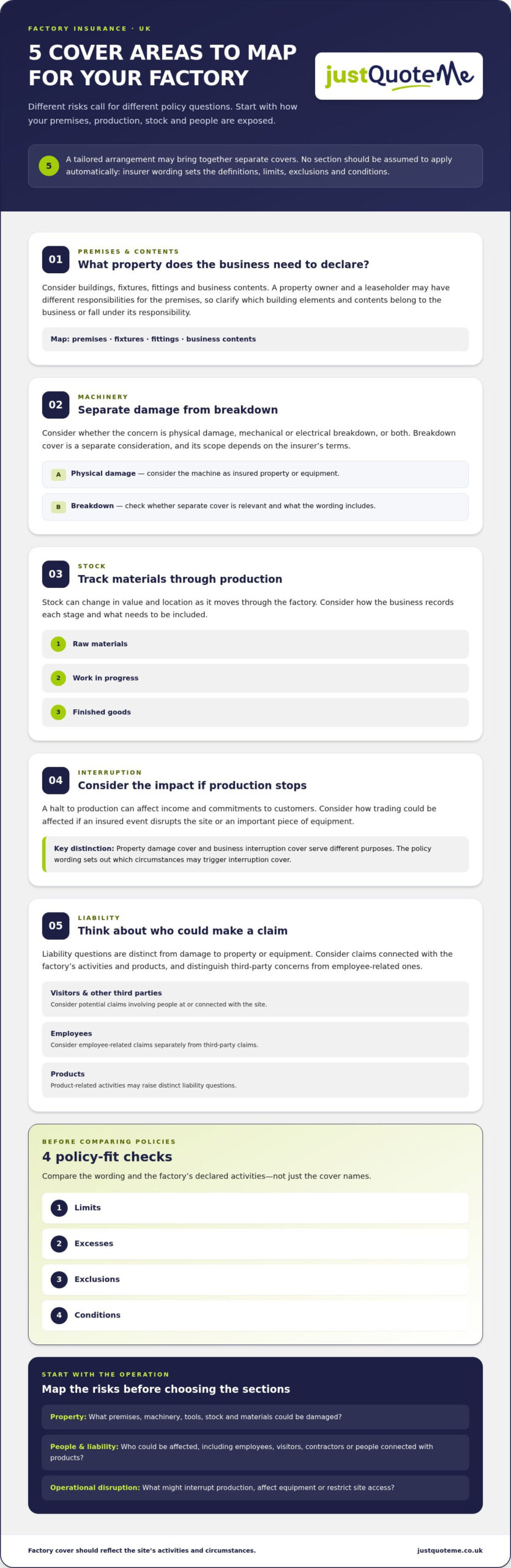
- Premises and contents: Consider buildings, fixtures, fittings and business contents, and establish which interests the business needs to declare. A leaseholder and a property owner may have different responsibilities for the premises.
- Machinery: Machinery may need to be considered in relation to physical damage and breakdown. Breakdown cover is a separate consideration, and its scope depends on the insurer’s terms.
- Stock: Account for raw materials, work in progress and finished goods. These can differ in value and location as they move through production, so consider how the business records them.
- Interruption: Consider how production and trading might be affected if an insured event disrupts the site or an important piece of equipment. The policy wording sets out which circumstances may trigger cover.
- Liability: Consider claims involving visitors or other third parties separately from claims involving employees. Product-related activities may also raise distinct liability questions.
How can property, machinery and stock cover differ?
Property cover concerns the premises and items insured under the relevant wording. For a leased factory, the business might need to clarify which building elements it is responsible for and which contents belong to it. Machinery cover raises further questions: is the concern physical damage, mechanical or electrical breakdown, or both? These are not necessarily treated the same way.
Stock needs its own careful review. A factory may hold raw materials awaiting production, partly completed goods and finished products ready for dispatch. Think about where each is stored and how its value changes during the production cycle. Accurate information helps ensure the insurance discussion reflects what the business actually holds.
When might interruption and liability cover matter?
If an event covered by the policy interrupts production, interruption cover may help address defined financial effects, subject to the wording, limits and conditions. Consider which processes are essential, whether a damaged machine could halt other work, and how delays might affect customer orders. This helps frame the business’s needs without assuming every stoppage is insured.
Public liability generally concerns claims from third parties in connection with business activities. Employers’ liability concerns claims involving employees. They address different relationships and should be considered separately. A factory can discuss employers’ liability insurance alongside other relevant sections. For every area, compare the actual policy wording rather than relying on a cover name alone.
Compare Factory Insurance: Match Policies to Operations
Factory insurance UK policies can look similar at first glance, but a shared list of cover headings doesn’t mean the protection is equivalent. There’s no single standard package that suits every factory or production process. Compare how each policy responds to your declared activities and the practical details in its wording, not just the headline premium.
Use a table to compare the main sections side by side. Record what each policy says is covered, then note the relevant limits, excesses, exclusions and conditions. If a section isn’t included or the wording is unclear, mark that as a point to discuss rather than assuming it works like another insurer’s version.
| Cover section | What to compare in the wording |
|---|---|
| Insured property | Which buildings, fixtures, contents or other property are defined as insured, and what types of damage are addressed? |
| Machinery | Does the wording distinguish physical damage from breakdown, and what equipment or events fall within the section? |
| Stock | How are raw materials, work in progress and finished goods treated, including any relevant definitions or limits? |
| Business interruption | Which insured events may trigger cover, and how does the wording describe interruption and its effects? |
| Liability | Which activities, people or products are relevant to the section, and what exclusions or conditions apply? |
Then check the excess for each section, the limits that apply and any conditions that could affect a claim. A lower premium alone can’t establish equivalent protection. One policy may differ in its definitions, exclusions or limits, so compare the wording against the risks you’ve identified rather than judging by price alone.
Which policy wording details deserve close attention?
Look closely at how the policy defines insured property, damage and business interruption. Read exclusions and conditions alongside the cover description, and note the excess that would apply to a claim. Check that the business activities declared to the insurer still describe the operation accurately, especially if processes or site use have changed. These details can materially affect how a section responds.
How do factory activities change the comparison?
Production methods, machinery use, storage arrangements and subcontracted work can all shape the underwriting questions. A site that stores materials for longer periods or uses specialist equipment may need a different discussion from one with limited storage and simpler production. Also describe each use of the premises, including manufacturing, office, storage or customer-facing areas.
If machinery is central to production, include its role and use in your comparison and discuss plant and machinery insurance as a relevant cover area. A clear, current description of the operation helps make comparisons more meaningful and supports a conversation about policy fit.
What information should you prepare before requesting a factory insurance quote?
A clear picture of your site and day-to-day work helps make a factory insurance UK discussion more focused. You don’t need to guess at figures or decide in advance which policy sections you need. Gather reliable records, note any gaps, and be ready to explain how the business operates. This gives a broker useful context to explore relevant options, rather than relying on assumptions about a typical factory.
Use this sequence to organise the information:
- Describe the premises. Record the site address, how each area is used, and whether the business owns or leases the property. Include separate activities such as offices, storage, production or customer visits.
- Explain the work. Summarise what the factory makes and the main production processes. Note any materially different activities at the premises, changes to operations, or work carried out by subcontractors.
- Gather asset records. Use business records to describe machinery and equipment, including their role in production. Prepare stock information that distinguishes raw materials, work in progress and finished goods. Avoid presenting estimates as confirmed values.
- Outline interruption concerns. Identify equipment, processes, suppliers or site areas that production depends on. Describe what a disruption could mean for operations and trading, without assuming a particular event would be insured.
- Collect existing insurance details. If relevant, have current policy schedules and wording available, along with the renewal date you’re working towards. Prior claims information may also be useful when it applies to the quote discussion.
How to describe your site, production and assets
Be specific about how the premises are occupied and used. If one building includes a production floor, a separate warehouse and an office, describe each function rather than labelling the whole site simply as a factory. Accurate machinery inventories and stock records can help clarify what the business wants to discuss and where it may need to check its figures.
Include project or contract work if it forms part of the operation. For example, if the factory undertakes work at a customer’s site, explain what that involves and whether it differs from activity at the factory. Contractors all risks insurance may be relevant to discuss for certain projects, depending on the work and policy terms.
How to explain interruption concerns and existing cover
Think through the practical dependencies behind production. Which equipment or process would be difficult to work around? Could a delay affect fulfilment or other trading commitments? These details help frame an interruption discussion without treating every disruption as insured.
Keep current schedules and policy documents together so existing cover can be compared with the operation you’ve described. If details have changed, flag them rather than relying on old paperwork. Just Quote Me can use your factory information to discuss tailored business insurance options. Discuss factory insurance options based on your operation and the records you’ve gathered.
Arrange factory insurance through a broker: tailored advice and next steps
A broker can help turn your factory’s operational details into a focused discussion about insurance. Rather than treating every manufacturer as the same risk, an independent broker can clarify how your premises are used, what your business produces, which assets matter to production and what cover areas you want to consider. Access to a network of UK insurers can also help explore options suited to your circumstances.
Just Quote Me arranges bespoke business insurance and uses the information you provide to discuss relevant factory insurance UK options. As an FCA-authorised independent broker with over 30 years of industry experience, Just Quote Me can help explain differences between policy sections and wording in straightforward terms. The aim is to make the choices clearer, not to assume a particular policy will suit every operation.
What to expect when discussing factory insurance with a broker
Be ready to talk through your production processes, site use, machinery, stock and any interruption concerns. A broker can use these details to clarify which areas deserve attention and help you compare how insurers describe cover, limits, exclusions and conditions. If liability is part of the discussion, distinguish claims involving members of the public from other liability concerns. The public liability insurance page offers further context on that cover area.
Any options discussed remain subject to the insurer’s underwriting, terms and the details of the specific proposal. A quote is a route to exploring relevant cover, not a guarantee that a particular policy or set of terms will be available or appropriate. Review the documents carefully before deciding whether the proposed cover fits your business.
Choose a clear next step for your factory
If you’ve organised your factory details and are ready to start an enquiry, use the online route to share them and explore a tailored business insurance quote. This can give the discussion a practical starting point, especially if you have current policy documents or renewal information to hand.
Get Your Free Business Insurance Quote now
Prefer to explain your operation in conversation? You can request a callback for free expert advice and discuss the cover questions that matter to your factory.
Request a Call back for free Expert advice
Take the next step towards cover that fits your factory
The most useful next step is to turn your operational details into a clear insurance conversation. Think about what has changed since your current cover was arranged, what matters most to keep production moving, and which policy terms you’d like explained. That gives you a practical starting point for exploring factory insurance UK options shaped around your business, rather than choosing by a policy label alone.
Just Quote Me can help you discuss your requirements and explore options through its network of UK insurers. Any quote and final cover will depend on the information provided, insurer underwriting and the terms offered.
Get Your Free Business Insurance Quote now
Prepare the details that best describe your operation, then take the next step with confidence. A clear discussion can help you make a more informed decision for your factory.
Frequently Asked Questions
What does factory insurance cover in the UK?
Factory insurance can be arranged to address selected business risks, but the policy schedule and wording determine what’s actually covered. One practical point to check is whether the insured premises and business activities are described accurately, including any changes since the policy began. For example, adding a packing or dispatch operation could affect the information insurers need. Review each section’s insured events and exclusions rather than relying on the overall policy name.
Is factory insurance a legal requirement in the UK?
There isn’t one universal legal requirement to buy a policy called factory insurance. However, almost every UK employer with one or more employees must have employers’ liability insurance under the Employers’ Liability (Compulsory Insurance) Act 1969. Other cover needs depend on the business and its circumstances. Separate the question of legally required employers’ liability from decisions about property, machinery, stock or interruption cover.
Does factory insurance cover machinery breakdown?
Not necessarily. Machinery breakdown may be addressed by a separate section or arrangement, and a factory policy’s name alone doesn’t confirm that it’s included. Check whether the wording refers to breakdown as well as physical damage, and which equipment and causes are described. For instance, accidental external damage and an internal mechanical failure may be treated differently. Compare the policy schedule with the machinery you rely on for production.
Can factory insurance cover business interruption?
It may, if the policy includes a relevant section and the circumstances meet its terms. Check what event must happen before interruption cover can respond, how the wording defines interruption, and what limits or conditions apply. A production delay caused by an insured incident may raise different questions from a delay caused by a supplier issue. Don’t assume every cause of lost trading or missed orders is insured.
What insurance does a small factory need?
A small factory should consider cover based on its actual activities, assets, staffing and premises, rather than its size alone. If it employs people, employers’ liability requirements are particularly important. A business that owns its building may have different property concerns from one that leases it; a factory with valuable equipment may also want to examine machinery cover. Set priorities by mapping the exposures and reviewing existing insurance.
How do insurers assess factory insurance risks?
Insurers may assess details such as the manufacturing activity, business size, turnover, employee numbers, values of machinery and stock, claims history and the risks involved. Be precise about what happens at the site, not just the product made. For example, explain how materials are processed and whether other activities take place there. Accurate, current information gives insurers a clearer basis for considering a proposal and setting terms.
How can I get a factory insurance quote in the UK?
Gather accurate information about your premises, activities, machinery, stock, employees and existing cover, then use it to request a tailored quote. Include relevant policy documents and renewal details if available, and flag any recent operational changes. A quote is an opportunity to explore options, not a guarantee of a particular policy or terms. Get Your Free Business Insurance Quote now.
