

What if the biggest risk in managing insurance for a property portfolio is a change no one recorded? A property’s use, occupancy or condition can shift, while its policy details and renewal date remain in a separate file. When information is spread across several properties, it’s easy to lose sight of what needs reviewing.
It’s understandable to want one straightforward arrangement, but properties in the same portfolio may have different risks and insurance needs. A clear, consistent process can help you keep track of each property without assuming the same cover suits them all.
This guide sets out how to build a reliable record of your properties, risks and policy details, what to revisit when circumstances change, and how to prepare for renewals and broker discussions. Just Quote Me is an independent UK insurance broker with over 30 years of industry experience, arranging landlord and commercial property insurance with tailored advice. The aim is simple: make portfolio insurance easier to review and keep up to date.
Key Takeaways
- Make a single property register your working source for property details, policy information and renewal dates, while clearly separating confirmed policy facts from your own notes.
- Managing insurance for a property portfolio starts with comparing each property’s use, occupancy, construction and activities rather than assuming similar properties need identical cover.
- Use a consistent renewal routine to refresh property information, gather relevant documents and record the questions and decisions discussed with your broker or insurer.
- Review insurance information when a property’s use, occupancy or condition changes, and discuss the change promptly in line with the policy terms.
- A tailored broker review can help you organise property-specific details and consider suitable options across a mixed portfolio.
Why managing insurance for a property portfolio needs a system
Several properties can mean several sets of risks, records, policy details and renewal dates. Information may sit in emails, insurer documents, spreadsheets or property management files. Without a consistent way to bring it together, it can be hard to see which details are current and what needs attention before renewal.
Managing insurance for a property portfolio means coordinating property information, cover decisions and renewal actions. It’s an organisational approach, not a promise that every property can be insured under one policy. The right arrangement depends on the properties and the relevant policy terms. A broker review can help owners organise property-specific information and discuss options for residential lets and commercial premises.
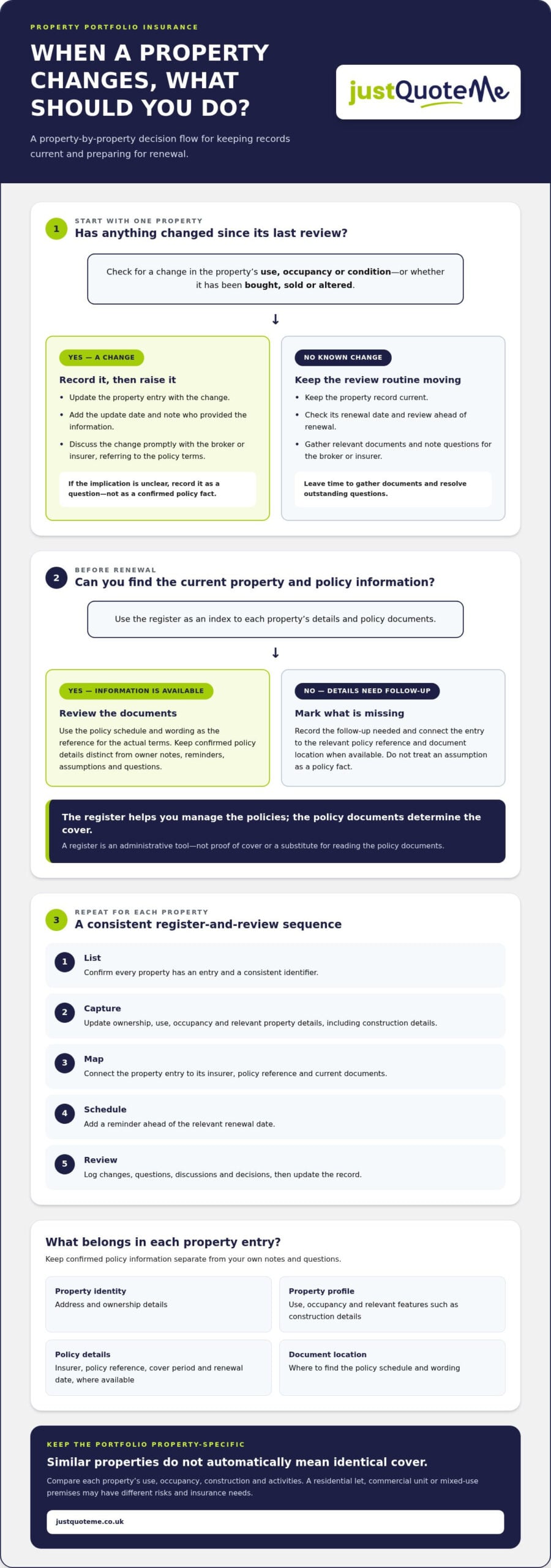
A property register is an administrative tool, not proof of cover: “The register helps you manage the policies; the policy documents determine the cover.” Use the register to find information and spot changes, then refer to each property’s schedule and wording for the actual terms. For background, Property insurance describes the broad category of cover concerned with property and its risks.
What makes a property portfolio different from a single let?
Each property has its own profile. One may be a residential let, another a commercial unit, and a third a mixed-use premises. Location, construction, occupancy and day-to-day use can all vary. A feature or activity that matters for one property may not apply to another, so information gathered for a single let shouldn’t automatically be copied across the portfolio.
For example, a change from residential letting to business use could make the old description inaccurate. Record the change and raise it with the broker or insurer, referring to the policy terms. For a property used for business, commercial property insurance is one area to discuss as part of considering appropriate cover.
Which records belong in a portfolio insurance overview?
Create one entry for each property and capture the information that helps you identify it, understand its current use and locate its insurance documents. Keep confirmed policy information separate from owner notes, reminders and questions. That distinction makes it easier to avoid treating an assumption as a policy fact.
- Property address and ownership details.
- Use and occupancy, plus relevant features such as construction details.
- Insurer and policy reference, where available.
- Cover period and renewal date, where available.
- Links or file locations for the policy schedule and wording.
Keep the register current when a property is bought, sold, altered or used differently. Add a date to updates and note who provided the information, so you can distinguish a recent confirmation from an older record. The overview then becomes a practical index for review conversations, not a substitute for reading the policy documents or confirming what they say.
Build a property-by-property insurance register and review routine
A dependable register makes insurance administration repeatable. Keep it in one central, access-controlled location, such as a secure business system, and name a person responsible for updates. If others need to contribute, agree who can edit the record and how changes are logged. This reduces the chance of relying on separate inboxes or someone’s memory when a renewal approaches.
Each portfolio record should point to the current policy documents, not try to replace them. The register is an index for administration; the policy schedule and wording remain the reference for cover. Keep confirmed details from those documents separate from owner notes, assumptions and questions. If an implication is unclear, record it for discussion rather than treating a guess as a policy fact.
Create a usable property and policy schedule
Use a consistent identifier for each property, such as a short reference that also appears in its digital folder. Record its address, ownership details, current use and occupancy, then connect the entry to the relevant insurer, policy reference, renewal date and document location. For residential lets, a residential letting insurance discussion can help frame property-specific cover questions.
Build the schedule in a format the person responsible can update without specialist software. Include a last-reviewed date and a clear status for items that need follow-up. For example, note “occupancy changed, discuss with broker” rather than deciding yourself how that change affects cover. Keep the supporting documents together, using filenames that make the property and document type easy to identify.
Set a review rhythm that catches changes
Use a repeatable sequence for each property, then apply it across the portfolio:
- List: confirm every property has an entry and a consistent identifier.
- Capture: update ownership, use, occupancy and relevant property details.
- Map: connect the entry to its policy reference and current documents.
- Schedule: add a reminder ahead of each relevant renewal date.
- Review: log changes, questions, discussions and decisions, then update the record.
Run the review ahead of each renewal, leaving time to gather documents and resolve outstanding questions. Start an additional review when ownership, occupancy, renovation or property use changes. Discuss material changes promptly with the broker or insurer, guided by the policy terms, and note when the discussion took place and what was agreed. For broader landlord cover context, see this landlord insurance guide.
Keep insurance records distinct from paperwork about financial products. GOV.UK’s guidance on property categories for personal portfolio bonds addresses a separate subject, not property insurance cover. A tidy register helps keep the relevant insurance documents and follow-up actions together without confusing them with other property-related records.
Compare property risks before deciding how cover should be arranged
Properties in one portfolio can have different uses, occupants, construction features and activities. Compare those details before deciding how cover should be arranged. A shared owner or address book doesn’t mean the same insurance arrangement will suit every building. The appropriate options depend on the information provided and the insurer’s terms, so avoid treating a familiar property type as a guarantee of standard cover.
Use a comparison to identify what needs individual consideration. It’s a discussion tool, not a substitute for the policy schedule or wording. Record what is known about each property, flag gaps and describe changes accurately. This gives you and your broker a clearer basis for considering suitable cover without assuming that one policy structure applies across the portfolio.
When a portfolio contains different property types
Residential lets and commercial premises may call for different questions about occupancy and use. For a mixed-use building, describe which parts are let as homes, which are used for business and what activities take place there. Don’t rely on a broad label such as “rental property” if it leaves out a relevant use. Residential letting insurance and commercial property insurance are useful topics to discuss when comparing residential and business premises within a portfolio.
What to compare when reviewing policy arrangements
Review each property against the same practical categories, then follow up on differences. The table helps organise that comparison; the policy wording remains the reference for the actual scope, exclusions and requirements.
| Property type | Details to compare | Questions to resolve |
|---|---|---|
| Residential let | Occupancy, use, construction details and known changes | Does the information provided still describe how the property is occupied and used? |
| Mixed-use premises | Residential and business areas, occupants, activities and alterations | Are each part’s use and relevant activities clearly described? |
| Commercial property | Business use, activities, construction details and policy period | Do the recorded details reflect the current premises and declared activities? |
For every arrangement, compare the properties insured, declared activities, policy period and any relevant conditions. Check that the details provided still match current circumstances, especially after a change in use, occupancy or construction. If a schedule or wording is unclear, note the point for discussion rather than assuming what it means.
Managing insurance for a property portfolio becomes more dependable when each property is assessed on its own facts, then reviewed alongside the rest. That approach helps reveal where information differs, where questions remain and which policy documents need closer attention before you make or renew an insurance arrangement.
Prepare for renewals and property changes without missing key details
Renewal preparation works best as a short, repeatable sequence rather than a last-minute search through emails and folders. Start early enough to check the information, identify unanswered questions and discuss changes. This helps make the conversation more organised, but it can’t guarantee renewal acceptance, uninterrupted cover or a particular outcome. Decisions depend on the circumstances and the insurer’s terms.
Changes that should trigger an insurance review
Ownership, occupancy, property use and renovation can all change the information on which an insurance arrangement is based. Add newly acquired properties to your records and mark disposed properties clearly, including the date of the transaction. For alterations or a shift in use, record what changed and when. Check the relevant policy wording for notification requirements, and discuss changes promptly with your broker or insurer in line with those terms.
Keep a change log alongside the property record. Include the date, property identifier, brief description, person who updated the information and any follow-up still outstanding. If you later need to understand why a record changed, this creates a simple history rather than leaving you to rely on memory. Record the outcome of any discussion separately from your own notes, so it’s clear what was confirmed and by whom.
What to prepare before discussing renewal
Before a renewal conversation, gather the current policy schedule and wording for each property, plus an updated property list. Then work through this sequence:
- Refresh: check each property’s ownership, use, occupancy and relevant details against current circumstances.
- Note changes: list acquisitions, disposals, renovations or other changes, with dates where known.
- Gather documents: bring together the current policy documents and any relevant property information.
- Raise questions: group unclear points by property and distinguish them from confirmed policy facts.
- Record decisions: note who discussed each point, when it was discussed and any agreed next action.
Clear preparation helps an adviser understand the portfolio without having to piece together separate records. Explain the property’s current circumstances accurately, including what has changed and what remains uncertain. An adviser can discuss options based on the information provided and available insurer terms; refer to the policy wording for the scope of cover, conditions and notification requirements.
For managing insurance for a property portfolio, treat a change as a prompt to review the relevant record, not as proof that cover has automatically changed. Keep the date and outcome of each discussion together with the property’s documents, then revisit any open questions before renewal. Organise a property portfolio insurance review to discuss property-specific information and suitable options.
Get tailored help managing insurance for your property portfolio
A broker review may be useful when your properties have different uses, occupants or insurance arrangements, or when changes have made existing records difficult to assess. An independent broker can review the information you provide and discuss relevant options for landlord and commercial property insurance. This gives you a structured conversation about the portfolio without assuming every property belongs under the same policy or that a particular outcome is guaranteed.
Just Quote Me is an FCA-authorised independent UK insurance broker with over 30 years of industry experience. It has access to a broad network of UK insurers and offers tailored advice, helping property owners consider differences across their portfolio. Any discussion of suitable options depends on the details supplied and the terms available from insurers.
How a broker can help bring the portfolio into focus
Share the property list and explain how each building is occupied and used. An adviser can use this information to identify points that may need separate consideration, clarify questions about current arrangements and discuss options for individual properties or groups of properties. The aim is to make the review more focused, not to assume one arrangement fits every risk.
For a mixed portfolio, make differences clear. A residential let, a commercial premises and a building with both residential and business use may each require a different conversation about their circumstances. A broker can discuss relevant insurance options using the information provided and available insurer terms. The policy documents remain the reference for the cover, conditions and exclusions that apply.
Choose a clear next step
Before starting a quote or advice conversation, bring together a current property list, policy schedules and renewal dates. Include any known changes, such as a new acquisition, a change in occupancy or work carried out to a building. You don’t need to resolve every uncertainty first. A clear note of what changed, when it happened and what you want to clarify can help keep the discussion organised.
- For a quote, choose Get Your Free Business Insurance Quote now.
- To discuss your circumstances with an adviser, choose Request a Call back for free Expert advice.
Managing insurance for a property portfolio is easier to approach when property details and policy records are ready to review together. Start with the information you have, highlight any gaps or changes, and use the conversation to discuss options that reflect your properties and circumstances.
Make portfolio reviews part of your routine
A useful next step is to turn your insurance records into a living process. Choose a regular point in your property management calendar to check that the information is still accurate, note anything that needs attention and keep a record of decisions. That way, managing insurance for a property portfolio becomes an ongoing part of looking after your properties, rather than a task left until renewal is close.
Start with one property if a full review feels like too much at once. Confirm its details, locate the current policy documents and note any questions. Then use the same approach across the rest of the portfolio. Small, consistent updates can make future reviews more focused and help you spot where a conversation is needed.
Ready to take the next step? Explore property insurance options for your portfolio and move forward with a clearer plan. A more organised review starts with the information you already have.
Frequently Asked Questions
Can one insurance policy cover an entire property portfolio?
A single policy may suit some portfolios, but don’t assume it will cover every property. Arrangements depend on the properties, their uses, insurer appetite and policy terms. Compare the properties and check that the policy documents identify the insured locations and activities accurately. If you’re unsure how an arrangement could apply across your portfolio, a broker can discuss suitable options using accurate information about each property.
What information should I keep for each property in my portfolio?
Keep a record of each property’s address, ownership, use, occupancy, relevant features and known changes. Where available, add the insurer, policy reference, cover dates, renewal date and location of the policy documents. A central record can help you spot missing or outdated details, but it doesn’t determine the cover. Keep it current and use the schedule and wording to check the terms that apply.
How often should I review insurance for a property portfolio?
Review the portfolio ahead of relevant renewal dates and whenever circumstances change. For managing insurance for a property portfolio, useful review prompts include acquiring or selling a building, a change in occupancy or use, and renovation work. Don’t assume a review guarantees cover or a particular outcome. Check the policy conditions for notification requirements, and discuss relevant changes promptly with your broker or insurer.
Do I need different insurance for residential and commercial properties?
Residential lets and commercial premises can involve different activities and insurance considerations, so assess each property on its circumstances. The appropriate cover depends on the building, how it’s used and the insurer’s terms. This doesn’t mean every property type needs a separate policy. Record the use accurately, then check the policy documents to see which locations and activities are insured and discuss any unclear points with a broker.
What should I do if a property’s use or occupancy changes?
Record the change, check the policy wording for notification requirements and promptly discuss the updated circumstances with your broker or insurer. A new occupant, a shift from residential to business use, or planned renovation may make existing information inaccurate. Don’t assume the current arrangement remains suitable or that a change automatically alters cover. Share what changed and when, then keep a note of the discussion and any agreed next steps.
How much does insurance for a property portfolio cost?
There’s no single price that applies to every portfolio. Insurers may assess the properties, their uses, occupancy, declared information and requested cover under their own terms. Avoid relying on a figure that doesn’t reflect your individual circumstances. An accurate property schedule can support a tailored discussion and quote by helping explain what needs insuring and how each building is used.
Is landlord insurance the same as commercial property insurance?
No, landlord insurance and commercial property insurance are distinct categories, and the relevant option depends on the property and its use. Don’t infer the scope of cover from a policy label alone. Compare the actual circumstances of each building with the insured locations and activities shown in the documents. If the wording or fit is unclear, discuss the question with a broker using accurate property details.
Ready to take the next step? Get Your Free Business Insurance Quote now or Request a Call back for free Expert advice.
