

What if the cover limit that looks generous still falls short of a client contract or the cost of putting a mistake right? If you’re asking “how much professional indemnity cover do i need”, start with the work you do and the financial loss a client could claim, rather than choosing a standard figure.
A professional body’s minimum, where one applies, may not reflect your full exposure. Equally, paying for a higher limit without checking your requirements may not be the right answer.
This guide explains how to assess potential claims, contract requirements and relevant professional or regulatory minimums. It also highlights policy details to check, including how claims-made cover and run-off protection may affect your decision. By the end, you’ll have a practical basis for comparing cover limits or seeking advice tailored to your profession and obligations.
Key Takeaways
- There’s no single limit that suits every profession; how much professional indemnity cover do i need depends on your work and potential claim exposure.
- Review client contracts for required limits and indemnity clauses before choosing a policy.
- A higher limit isn’t automatically better. Consider whether the policy scope matches the risks and obligations you need to cover.
- Use a practical checklist to assess your services, plausible client losses, professional requirements and policy wording.
- Keep a record of changing client demands and higher-consequence work, then compare cover options against your needs.
How much professional indemnity cover do you need? Start with your exposure
There’s no single professional indemnity limit that suits every professional. To answer “how much professional indemnity cover do i need”, start with the work you do, the terms you agree to and the financial consequences a client might claim if your work caused them a loss.
Your policy limit is the maximum amount available for covered claims, subject to the policy wording. The amount and circumstances covered depend on the policy, including its exclusions and any applicable conditions. A limit isn’t a promise that every claim will be paid in full, so check the wording rather than comparing figures alone. The Professional indemnity insurance overview provides general background; your own policy documents determine the cover you have.
A contract’s value is not the same as the cover limit you need: assess the plausible financial loss a claim could involve, not just the fee you charge. A modest project could still lead to a substantial claim if a client says an error had wider consequences. Equally, a high-value contract doesn’t automatically mean you need an identical limit. Consider your responsibilities and what the agreement requires.
What does a professional indemnity limit actually protect against?
Professional indemnity insurance may respond to claims alleging professional error, an omission or negligent advice that caused a client financial loss. Whether a particular allegation is covered depends on the circumstances and the policy’s wording and exclusions. Review the schedule and policy documents carefully, and don’t assume every dispute connected with your work will be covered.
For example, a client might allege that advice you provided led to a financial loss. That differs from a visitor being injured after tripping at your workplace, which is the kind of situation public liability insurance is designed to address. The two covers respond to different types of risk.
Is there a standard professional indemnity cover amount in the UK?
No universal figure reliably suits every profession or client arrangement. The work, potential consequences of an alleged mistake and contractual obligations can vary widely, so a limit suitable for one business may be inadequate or unnecessary for another.
Check each client contract for required insurance limits and relevant indemnity clauses. If you belong to a professional body or work in a regulated profession, confirm any applicable requirements directly with the current authority. Treat a stated minimum as a requirement to verify, not as automatic proof that the limit matches your full exposure. A broker can help you review your profession-specific risks and policy terms.
What determines how much professional indemnity insurance you need?
To decide how much professional indemnity cover do i need, look beyond annual turnover. Ask what financial loss could plausibly follow if a client alleges that your advice or work was incorrect, incomplete or unsuitable. The answer depends on your services, your clients and the obligations you accept.
Map the potential impact of your work. A small mistake in a report, design or recommendation could have wider consequences if a client relies on it to make decisions, or if the same deliverable is used across several projects. Consider whether one alleged error could affect multiple clients, projects or outputs. That concentration of exposure may matter as much as the size of an individual engagement.
Professional indemnity needs follow your exposure and contractual obligations, not turnover alone. Turnover can provide context, but it doesn’t show the full consequences of a claim or what a client agreement requires.
How do client contracts affect your indemnity limit?
Check each contract for a required insurance limit, liability cap, indemnity clause and any obligation to provide evidence of cover. Note whether requirements apply to a single claim or across a period, and whether the wording appears to require more than your proposed policy provides. Compare the contract with the policy before signing or renewing. If a clause is ambiguous or unusually broad, seek qualified legal or insurance advice rather than assuming it’s covered.
How does your profession change the risk assessment?
Assess what clients rely on you to deliver and the likely impact if it’s alleged to be wrong or incomplete. Advice, reports, recommendations and designs can carry different consequences depending on how clients use them. Ask what decisions or costs might follow from a mistake, and whether one issue could affect several deliverables. If you work in a regulated profession or belong to a professional body, confirm current requirements directly with the relevant authority. For regulated firms, the FCA’s PII requirements explain the regulator’s expectations where applicable.
Before choosing a limit, gather your contracts, list your main services and identify work with the greatest potential consequences. Compare the requirements you’ve found with the proposed policy limit and wording. Keep track of new clients, changed contract terms and services that could increase your exposure. An independent broker can help review those details against insurer options. You can also explore professional indemnity insurance options as you assess what may fit your work.
Is a higher professional indemnity limit always better?
No. A larger limit may provide more headroom if a covered claim is made, but it isn’t automatically the right choice. Aim to match the limit to plausible claim exposure and contractual requirements, while checking that the policy covers the work and circumstances that matter to your business.
A high headline limit cannot make excluded work covered or compensate for an unmet policy condition. Nor does it tell you how much would be available after applying the policy’s terms. Review the scope of cover, exclusions, excesses and any sub-limits alongside the main limit. If you’re weighing up how much professional indemnity cover do i need, compare the full policy structure, not just the largest figure on a quote.
What can a higher limit solve, and what can it not solve?
A higher limit can provide more financial headroom for a claim that falls within the policy’s cover. It won’t remove exclusions, extend cover to services you haven’t declared or resolve a condition you haven’t met. Check whether a sub-limit applies to a particular type of loss, and understand how the excess affects a claim. The wording matters as much as the headline amount.
How can you compare limits without choosing on price alone?
Compare each option against the same client requirements and plausible claim scenarios. Check whether the stated limit applies per claim, in aggregate across the policy period, or under another definition. Don’t assume two policies with the same headline limit work the same way. Ask the insurer or broker to clarify differences you can’t resolve from the documents.
Use a comparison like this to identify what still needs checking:
| Comparison point | What to record | Question to resolve |
|---|---|---|
| Policy limit | The limit and how it applies | Is it per claim, aggregate or defined another way? |
| Contract requirement | Required limit and relevant clauses | Does the proposed policy meet the contract terms? |
| Key wording | Exclusions, excesses, sub-limits and conditions | Could any term restrict cover for the work or scenario considered? |
| Unresolved points | Gaps or unclear definitions | Who can confirm how the wording applies? |
Test the options against realistic situations, such as an allegation about one piece of advice or an error affecting several related deliverables. Record which options appear to meet the contract, what wording could affect the outcome and what needs clarification. This helps distinguish a useful increase in protection from a higher figure that doesn’t address the exposure you’re concerned about.
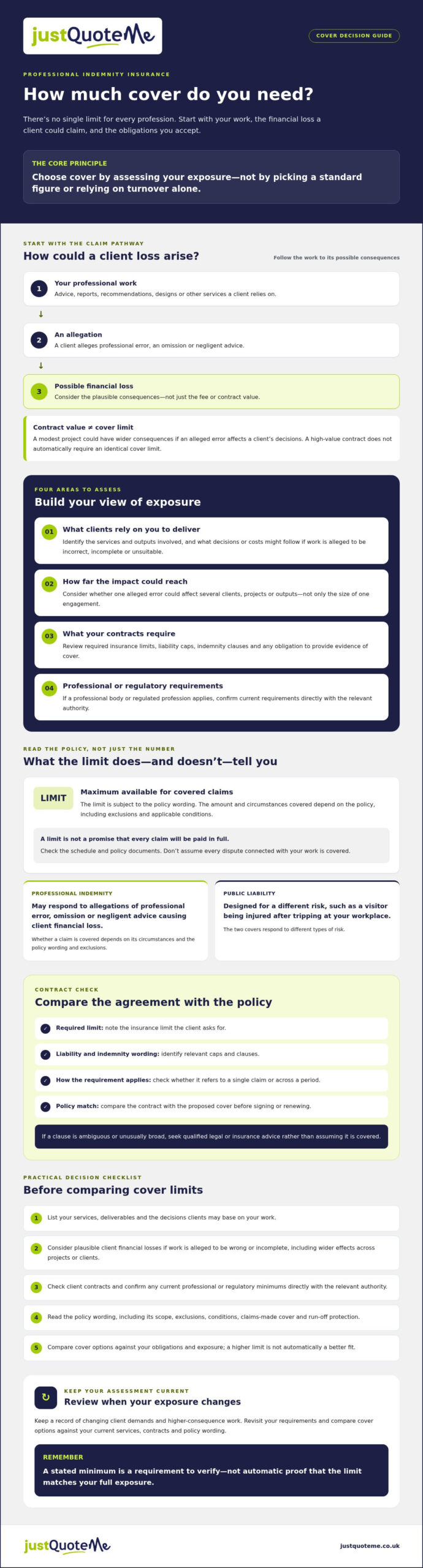
How to work out a suitable professional indemnity limit: a practical checklist
A consistent review helps you explain why a limit fits your work and spot gaps before comparing policies. Use this checklist to gather the relevant details, then confirm unclear policy terms with an insurer or broker.
- List your services and deliverables. Describe the advice, reports, designs or other work you provide, the client sectors you serve and how clients use your output. Flag services where an alleged mistake could have unusually serious consequences.
- Review contracts and client demands. Collect current agreements and note required insurance limits, indemnity clauses, liability caps and requests for evidence of cover. Record differences between clients, and flag unclear wording for qualified advice.
- Map plausible financial losses. Consider what a client might claim if your work were alleged to be wrong or incomplete. Ask whether one error could affect several projects, deliverables or clients. This is a practical exposure assessment, not a prediction of a claim.
- Check professional requirements. If a regulator or professional body applies to your work, verify its current requirements directly. Don’t assume a minimum automatically reflects your contracts or wider exposure.
- Compare policy wording, not just limits. Check how the limit applies and review relevant exclusions, excesses and conditions. Note questions about claims-made wording, the retroactive date and run-off cover, and confirm how they apply to the policy being considered.
Keep a simple record of your assessment: services, contract requirements, plausible loss scenarios, required limits and unresolved wording questions. This gives you a clear basis for deciding how much professional indemnity cover do i need, and helps make comparisons more consistent.
What information should you gather before comparing cover?
Prepare a concise description of your work, client sectors and key deliverables. Add relevant contracts and summarise each insurance or indemnity requirement. Then list questions about claims-made terms, retroactive dates and run-off cover so you can check the exact wording rather than relying on assumptions.
When should you review your professional indemnity cover?
Review your assessment when you enter a new client sector, take on materially different work or accept contracts with changed insurance terms. Revisit it if your responsibilities or potential financial exposure shift. At renewal, read the new documents and check for changes to limits, wording, exclusions and conditions instead of assuming the cover remains identical.
Getting Tailored Professional Indemnity Cover: Next Steps
You’ve assessed your services, client contracts and potential claim exposure. The next step is to compare those findings with the policy limit and wording, rather than selecting a figure in isolation. If you’re still asking “how much professional indemnity cover do i need”, a broker can help you consider your requirements alongside available insurer options.
What should you ask a broker before choosing a limit?
Take your service descriptions, relevant contracts and list of potential risks to the conversation. Ask how the proposed limit relates to your professional work and any contractual insurance requirements. Then clarify which exclusions, sub-limits, excesses and policy definitions need particular attention. These details can affect how cover responds, even where the headline limit appears suitable.
Ask specifically how the policy’s claims-made terms apply and whether its retroactive date is appropriate for your circumstances. Don’t rely on assumptions about how a term works; ask the broker or insurer to explain the wording that applies to the proposed cover. If a contract clause is unclear, consider getting qualified legal advice as well.
How can Just Quote Me help you compare your options?
Just Quote Me is an independent, FCA-authorised UK insurance broker with over 30 years of industry experience. It arranges professional indemnity insurance through a broad network of UK insurers and can provide tailored advice to help you review profession-specific exposure and policy terms.
A focused discussion can help clarify what you need to compare, including whether an option appears to address the requirements you’ve identified. It can’t guarantee a particular limit, policy wording or outcome. Be ready to explain your services, the types of clients you work with, relevant contract terms and the questions you still need answered.
Before proceeding, check that the proposed cover aligns with your work and contractual obligations, and make sure you understand the relevant policy terms. Then request a quote based on the information you’ve gathered.
Get Your Free Business Insurance Quote now
Take the next step towards a suitable limit
There’s no one-size-fits-all answer to “how much professional indemnity cover do i need”. Start with the work you do, the potential impact of an alleged error and the insurance terms your clients require. Then compare limits alongside exclusions, excesses, sub-limits and other policy wording. A higher figure alone won’t resolve a gap in cover.
Just Quote Me is an independent, FCA-authorised UK insurance broker with over 30 years of industry experience and access to a broad network of UK insurers. It arranges professional indemnity insurance and can help you consider options against your stated requirements.
Explore your insurance options, or request a business insurance quote to discuss cover against your work and contract details.
Frequently Asked Questions
How much professional indemnity cover do I need as a sole trader?
There’s no standard limit for every sole trader; how much professional indemnity cover do i need depends on your services, client contracts and the potential financial impact of an alleged error. List your work and deliverables, check clients’ insurance requirements, then consider what losses a client might claim if your work were incorrect or incomplete. Compare policy wording as well as limits, and verify any applicable professional-body requirements directly.
Is there a minimum amount of professional indemnity insurance required in the UK?
There isn’t one universal minimum that applies to every UK professional. A minimum may apply to a particular regulated profession, professional body or contractual arrangement, so check current requirements with the relevant authority or organisation. Treat any minimum as a requirement to confirm, not automatic proof that the cover is sufficient for your work. Your contracts and potential claim exposure may call for a separate assessment.
Can a client require me to have a specific professional indemnity limit?
Yes, a client may make a specified level of professional indemnity cover a condition of working with them. Read the contract for the required limit, indemnity clauses, liability caps and any request for evidence of insurance. Check how the policy limit applies and whether its wording meets the contract terms before signing or renewing. If a clause is unclear or unusually broad, seek qualified legal or insurance advice.
How much professional indemnity cover do consultants need?
Consultants should assess the type of advice they provide, how clients use it and the plausible financial consequences if it’s alleged to be wrong or incomplete. A consultant whose recommendations inform high-impact decisions may face different potential exposure from one providing lower-consequence work. Review client contracts and any relevant professional-body requirements, then compare policy limits, exclusions and conditions. There’s no single limit that suits every consultancy.
What happens if a professional indemnity claim exceeds my policy limit?
If a covered claim is greater than the applicable policy limit, the policy generally won’t pay beyond that limit, subject to its wording and how the limit applies. You may be responsible for amounts not covered by the policy, but the outcome depends on the claim, contract and circumstances. Check whether the limit applies per claim or in aggregate, and ask your insurer or broker how defence costs and any sub-limits are treated.
Does professional indemnity insurance cover past work?
It may cover claims relating to past work, but don’t assume all previous services are included. Professional indemnity policies are commonly written on a claims-made basis, so the policy in force when a claim is notified may be relevant. Check the wording, retroactive date and any continuity requirements with your insurer or broker. If you stop trading, ask whether run-off cover is available and how its terms apply to your circumstances.
