

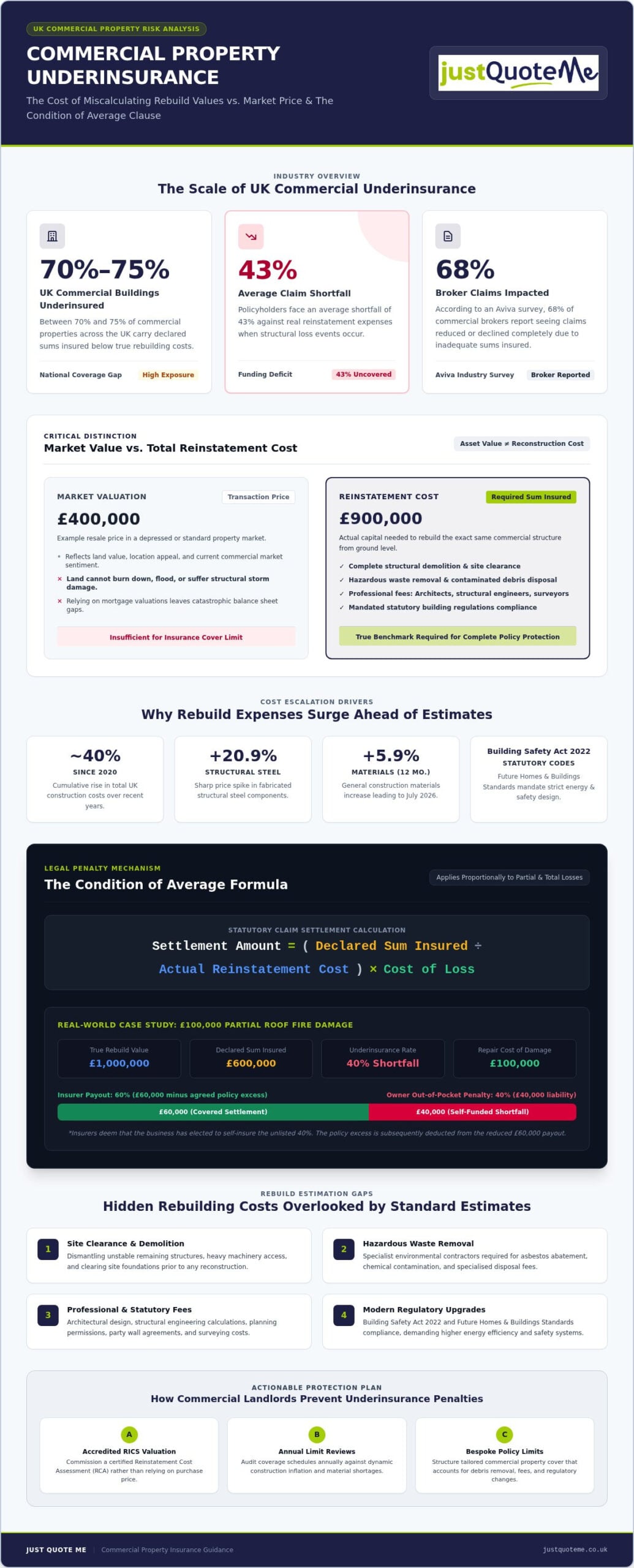
Between 70% and 75% of UK commercial properties are currently underinsured, leaving policyholders facing an average shortfall of 43% against their true rebuild costs. Overlooking the underinsurance risks for commercial property owners can turn an unexpected fire, flood, or structural failure into an immediate financial catastrophe.
It’s understandable why this happens. With cumulative UK construction costs rising nearly 40% since 2020, confusing an asset’s market value with its total reinstatement expense is an easy trap to fall into. Many property owners assume that purchase price or basic index-linking provides sufficient cover, only to discover painful deductions when filing a claim.
This guide explains precisely how commercial property underinsurance develops, how the strict Condition of Average clause penalises partial losses, and how to protect your balance sheet. You’ll learn how to calculate precise reinstatement costs that reflect current material prices and modern building regulations, ensuring your policy limits fully protect your commercial investments.
Key Takeaways
- Distinguish between resale value and true rebuilding costs to mitigate severe underinsurance risks for commercial property owners before filing a claim.
- Understand how the legal Condition of Average clause operates, which allows insurers to reduce partial and total claim settlements proportionally.
- Identify hidden rebuilding expenses that standard estimates overlook, including site clearance, hazardous waste removal, and professional architectural fees.
- Discover why standard policy index-linking often falls short and how an accredited RICS valuation maintains accurate sums insured.
- Learn how an experienced independent commercial broker structures bespoke policy limits to safeguard your commercial assets against regulatory changes and inflation.
What Is Commercial Property Underinsurance & Why It Rises?
Commercial property underinsurance occurs when the declared sum insured on your building is lower than the actual cost required to rebuild it from the ground up. Sums insured frequently lag behind real-world costs because business owners set coverage limits based on historic figures or purchase prices rather than dynamic construction market conditions.
While complete structural destruction represents the worst-case scenario, partial loss events like localised electrical fires or burst water pipes happen far more often. In these situations, insurers apply the legal Condition of average to reduce partial settlements proportionally. This mechanism triggers critical underinsurance risks for commercial property owners, leaving businesses personally liable to fund massive cash shortfalls during repairs. Structuring a tailored commercial property insurance policy ensures your business avoids these sudden financial liabilities.
The Crucial Difference Between Market Value and Rebuild Cost
Market value reflects what a buyer pays for a property, which heavily depends on location and land value. Land cannot burn down or suffer storm damage, meaning market price bears little relation to reconstruction expenses. Reinstatement value represents the total expenditure needed to rebuild the structure from ground level, including demolition, clearing debris, and hiring engineers. A commercial property in a depressed market might sell for £400,000 but require £900,000 to rebuild; relying on mortgage valuations or sales records leaves severe coverage gaps.
Why Commercial Underinsurance Has Surged Across the UK
Rebuilding costs have escalated sharply in recent years. Construction materials rose by 5.9% in the 12 months leading to July 2026, with specific components like fabricated structural steel jumping 20.9%. Supply chain bottlenecks have extended lead times on specialised components, driving up site overheads and labour expenses. Modern regulatory frameworks, including the Building Safety Act 2022 and the Future Homes and Buildings Standards, mandate enhanced energy efficiency and stringent design compliance when rebuilding. These compounding factors rapidly widen underinsurance risks for commercial property owners who fail to update their coverage schedules annually.
The Condition of Average: How Insurers Penalise Underinsurance
The Condition of Average is a standard contractual clause within UK commercial insurance policies. Insurers insert this clause to ensure businesses pay a premium that accurately reflects the true risk profile of the building. When a property is insured for less than its actual rebuilding cost, insurers deem that the owner has chosen to self-insure the remaining percentage. Consequently, any settlement payout is reduced by that exact proportion, regardless of whether the incident involves a total loss or minor structural damage.
Industry research shows that underinsurance remains one of the biggest property risks facing commercial enterprises today. According to an Aviva survey, 68% of brokers have seen claims reduced or declined entirely due to inadequate sums insured. For an organisation managing tight cash reserves, an unexpected settlement deduction creates immediate capital shortfalls that can halt core commercial operations.
Understanding the Mathematical Mechanics of the Average Clause
Loss adjusters calculate claim settlements using a transparent formula:
(Sum Insured ÷ Actual Reinstatement Cost) × Cost of Loss = Settlement Amount
This proportional reduction applies across every aspect of a claim, including debris disposal and professional fees. If your building has a true reinstatement value of £1,000,000 but you declared a sum insured of £600,000, you are underinsured by 40%. Once the insurer calculates the reduced settlement, your agreed policy excess is deducted from that final reduced sum, shrinking your financial recovery even further.
Real-World Impact: Total Loss vs Partial Damage Claims
Many owners assume Average only affects catastrophic events where the entire premises collapses. That is a dangerous misconception. If that same building suffers £100,000 worth of localised roof fire damage, the insurer pays only 60% of the repair bill (£60,000), minus your policy excess. You must fund the remaining £40,000 out of your own cash reserves.
Repair delays quickly lead to tenant disputes, missed commercial milestones, or breach of lease covenants. Mitigating these severe underinsurance risks for commercial property owners requires proactive valuation reviews. Securing an accurately structured commercial property insurance schedule ensures partial losses are covered in full. If you are uncertain whether your existing sums insured reflect current building standards, you can easily speak with a knowledgeable specialist to audit your existing policy terms.
Hidden Factors That Distort Commercial Rebuild Valuations
Rebuilding a damaged premises involves far more than simply replacing bricks, mortar, and steel. According to data from RebuildCostAssessment.com, 94% of UK commercial properties are insured for the wrong amount. This widespread error occurs because property owners often calculate rebuilding limits purely on construction materials, ignoring the substantial secondary costs required to restore a site.
A complete reinstatement valuation must account for several overlooked expenses that quickly inflate project costs:
- Demolition and site clearance: Safely bringing down unstable structures, sorting debris, and transporting waste to licensed landfill sites.
- Professional fees: Essential appointments for structural engineers, planning consultants, party wall surveyors, and architects, which typically add 10% to 15% to total project expenses.
- Statutory and planning compliance: Meeting upgraded local authority requirements, environmental mandates, and accessibility rules during reconstruction.
- External works and infrastructure: Replacing perimeter security fencing, boundary walls, paved car parks, access roads, and underground utility connections.
Overlooking these core items amplifies underinsurance risks for commercial property owners, creating large cash shortfalls when claims adjusters assess the real cost of complete site recovery.
Site Clearance, Demolition, and Environmental Regulations
Clearing a commercial site after a loss involves complex environmental processes. Older premises frequently contain hazardous substances, requiring licensed contractors to handle specialist asbestos removal and toxic waste disposal. Urban properties face additional access hurdles. Bringing heavy lifting gear into tight high-street locations requires road closures and municipal traffic management permits. For high-street retailers, securing tailored shop insurance ensures these expensive logistical line-items are included in your structural schedule.
Listed Buildings and Specialist Commercial Architectural Features
Historic and listed properties present distinct valuation challenges. UK conservation legislation mandates that listed buildings must be restored using traditional methods and authentic materials. Sourcing matching dressed stonework, lime mortars, or bespoke structural timber significantly drives up procurement costs and labour rates. Failing to account for specialist craft trades creates severe coverage gaps, leaving landlords unable to satisfy strict statutory preservation obligations.
Business Interruption and Extended Indemnity Periods
Site clearance delays and rigorous planning requirements directly lengthen rebuilding schedules. If severe structural damage occurs, negotiating permissions and sourcing materials can take months before site works even begin. In this environment, a standard 12-month business interruption indemnity period often expires long before contractors finish reconstruction. This leaves commercial landlords exposed to ongoing mortgage payments and lost rental yields while tenants relocate, compounding the structural underinsurance risks for commercial property owners.
How Commercial Landlords Can Audit and Prevent Underinsurance
Preventing coverage shortfalls requires a structured assessment rather than guesswork at policy renewal. Between 70% and 75% of UK commercial properties face underinsurance, with the average shortfall sitting at roughly 43% below actual rebuild values. Commercial landlords who rely on historic figures or automatic renewals expose their businesses to major balance-sheet disruptions.
A systematic audit process closes these gaps before a loss occurs:
- Schedule an independent assessment: Secure an on-site inspection by a qualified professional to establish a robust baseline figure.
- Track operational modifications: Log every structural enhancement, partition change, and plant addition as it happens.
- Audit policy wording: Review specific underwriter clauses regarding Average, day-one uplift percentages, and declared values.
- Review values annually: Adjust building sums insured every twelve months to reflect real-world material and labour inflation.
Following these steps systematically eliminates the primary underinsurance risks for commercial property owners and establishes clear proof of value for adjusters.
Commissioning a Reinstatement Cost Assessment (RCA)
A formal Reinstatement Cost Assessment carried out by a Royal Institution of Chartered Surveyors (RICS) accredited professional provides the only definitive baseline for your insurance schedule. The surveyor inspects the building framework, foundation requirements, site access constraints, and local authority planning obligations. Property owners should commission a fresh RCA every three years, or immediately following significant structural alterations. A documented RICS assessment provides verifiable evidence to insurers, preventing allegations of misrepresentation or disputes over declared values during a major claim.
The Limitations of Automated Index Linking
Many landlords rely entirely on automated index linking applied by insurers at each renewal. This practice often creates a false sense of security. Index linking applies a broad, national percentage increase based on general building cost metrics. It ignores sharp, localised price surges in specialised labour or sudden spikes in specific materials like structural steel. If your initial baseline figure was incorrect five years ago, compounding percentage uplifts only widen that initial deficit, leaving significant coverage gaps unaddressed.
Adjusting Cover After Property Alterations and Upgrades
Physical modifications alter reinstatement costs immediately. Adding a structural mezzanine floor, upgrading commercial HVAC systems, rewiring plant networks, or replacing double glazing with acoustic panels increases the capital required to rebuild. Landlords must notify their insurance broker during the policy term when completing these improvements rather than waiting for annual renewal.
Building works also introduce third-party liabilities during construction. Managing these dynamic liabilities requires aligning property coverage with appropriate public liability insurance to protect against contractor or visitor incidents on site. To ensure your current sums insured accurately reflect your premises and structural modifications, you can request a commercial policy review with an independent broker today.
Securing Comprehensive Commercial Property Protection with Just Quote Me
Structuring accurate building cover requires a partner who understands the realities of modern UK construction and underwriting. Since 1989, Just Quote Me has provided independent brokerage expertise across Staffordshire, the West Midlands, and nationwide. As an FCA-authorised broker with over 30 years of commercial market experience, we work directly with leading UK underwriters to create tailored policies that systematically eliminate underinsurance risks for commercial property owners.
Rather than leaving policyholders to decipher complex terms alone, an experienced broker acts as a dedicated advocate. This professional representation ensures your policy wording reflects the true cost of rebuilding, protecting your capital against catastrophic settlement deductions.
Why Independent Broker Representation Protects Your Balance Sheet
Automated online aggregators rely on simplified algorithms that treat properties as standard square footage. This rigid approach overlooks non-standard architectural features, listed building obligations, and regional labour rates. Working with an independent broker provides a comprehensive portfolio assessment. Brokers actively negotiate favourable underwriter terms, including day-one uplift provisions, which add an agreed percentage buffer above declared reinstatement values to protect against mid-term inflation.
Streamlining Your Commercial Insurance Portfolio
Managing disparate policies for individual assets creates administrative friction and increases the likelihood of critical coverage gaps. Consolidating your assets under a unified insurance schedule provides complete clarity across all operational risks:
- Core building fabric: Accurate reinstatement limits encompassing professional fees and site clearance.
- Income security: Extended business interruption indemnity periods tailored to realistic reconstruction timetables.
- Property owners liability: Robust legal defence and settlement cover for third-party site claims.
- Loss of rent: Continuous rental income protection while premises undergo structural repairs.
This coordinated approach reduces administrative burdens and ensures full compliance with commercial underwriting conditions. When property damage occurs, having specialist claims guidance ensures loss adjusters receive transparent valuation data from day one. Partnering with an established broker removes guesswork, eliminates underinsurance risks for commercial property owners, and safeguards your investments against volatile market conditions.
Protect Your Commercial Investment Against Policy Shortfalls
Market values fluctuate with property market conditions, but reinstatement expenses are dictated by dynamic material costs, skilled labour, and stringent statutory building codes. Relying on historical valuations or basic index linking exposes your balance sheet to severe Condition of Average penalties, leaving you to fund substantial repair shortfalls out of pocket. Accurately managing underinsurance risks for commercial property owners is essential to keeping your premises and rental income secure.
Since 1989, Just Quote Me has delivered FCA-authorised independent brokerage guidance backed by over 30 years of commercial market experience. By partnering with premier UK underwriters, we structure bespoke commercial property schedules, negotiate protective day-one uplifts, and eliminate hazardous clause ambiguities. Take control of your property portfolio today with Just Quote Me to ensure your assets remain fully protected against unexpected property damage.
Get Your Free Business Insurance Quote now
Request a Call back for free Expert advice
Frequently Asked Questions
What is the Condition of Average in commercial property insurance?
The Condition of Average is a standard policy clause that reduces claim payouts proportionally if a building is insured for less than its full reinstatement value. If you insure a property for 70% of its true rebuild cost, the insurer will pay only 70% of any subsequent claim, even for minor damage. Policyholders must then fund the remaining percentage from their own reserves before the standard policy excess is deducted.
Can my insurer cancel my policy if I am found to be underinsured?
Yes, an insurer can cancel your policy or declare it void if underinsurance stems from deliberate or reckless misrepresentation under the Insurance Act 2015. While honest miscalculations typically trigger proportional claim reductions via Average clauses, severe undervaluation can lead underwriters to conclude that the actual risk profile differs entirely from what was agreed. In extreme cases, they may decline the claim completely and terminate coverage immediately.
How often should commercial property owners arrange a Reinstatement Cost Assessment?
Property owners should commission a professional Reinstatement Cost Assessment (RCA) every three years to keep pace with changing market conditions. Major structural modifications, building extensions, or significant spikes in construction inflation require an immediate off-cycle valuation review. Proactively managing these assessments helps mitigate critical underinsurance risks for commercial property owners, providing documented RICS evidence that prevents underwriter disputes when settling complex building claims.
Does commercial building insurance cover site clearance and demolition costs?
Commercial building insurance typically includes site clearance, shoring up, and debris removal, but only if these expenses are factored into your declared sum insured. If your coverage limit only accounts for baseline construction materials, there may not be enough funds remaining to clear rubble, handle hazardous waste like asbestos, or pay local council road-closure fees. These ancillary expenses must be explicitly calculated within your overall reinstatement assessment.
Why is market value different from the declared reinstatement value?
Market value reflects what a buyer pays for the premises, heavily influenced by land values, economic sentiment, and geographic location. Reinstatement value measures the total expense required to demolish, clear, and rebuild the exact structure to modern regulatory standards. In regions with modest commercial real estate prices, a property’s rebuild cost often vastly exceeds its open market resale value, making sales valuations dangerous guides for insurance schedules.
Does index linking completely prevent underinsurance on commercial premises?
No, index linking does not guarantee total protection against underinsurance. Insurers apply generic national indices that track broad macroeconomic metrics, which often lag behind sharp regional increases in specialised trades or structural materials. If your opening sum insured was inaccurate years ago, percentage uplifts merely compound that error. Auditing underinsurance risks for commercial property owners through professional RICS surveys ensures your baseline figures remain grounded in factual rebuild data.
What happens to rental income coverage if my commercial property is underinsured?
Underinsuring your building can severely compromise your loss of rent protection. If reduced claim payouts stall reconstruction, tenant repairs take far longer than planned. Standard 12-month or 24-month indemnity periods can easily expire before the premises becomes tenantable again, terminating rental payouts prematurely. Commercial landlords are then left without vital rental cash flow while still needing to meet ongoing commercial mortgage obligations out of their own reserves.
