

Imagine you’ve spent weeks pitching for a major UK contract, only to have the final signature stall because the procurement team wants “immediate verification” of your cover. It’s a high-pressure moment where showing proof of insurance to clients becomes more than just a box-ticking exercise; it’s a fundamental test of your business’s legitimacy. You might find yourself staring at a forty-page policy booklet, wondering if you should send the entire document or just the one-page Employers’ Liability certificate.
We know that the distinction between a policy schedule and a certificate can be confusing, especially when the threat of a £2,500 per day fine for non-compliance exists. You shouldn’t have to feel anxious about losing a deal because of “wrong” paperwork or slow responses from an insurer. This guide is designed to remove that friction. You’ll learn exactly which documents satisfy professional requirements, how to share them efficiently, and how to use your insurance as a strategic tool to win more business.
We’ll break down the specific tiers of indemnity often required in UK tenders and explain why a simple Broker Confirmation Letter is often preferred over a full policy breakdown. By the end, you’ll have a clear, professional process for handling insurance requests with total confidence.
Key Takeaways
- Identify the specific differences between a Certificate of Insurance and a Policy Schedule to ensure you provide the correct paperwork for every contract.
- Master the professional steps for showing proof of insurance to clients to build immediate trust and prevent administrative delays during the onboarding process.
- Understand how to handle requests for higher indemnity limits and why the “Indemnity to Principals” clause is a standard requirement in UK business agreements.
- Learn how to share your documentation securely while ensuring your trading name and policy details align perfectly with client expectations.
- Discover how to use your insurance coverage as a proactive tool to demonstrate business stability and win more competitive tenders.
Why Showing Proof of Insurance to Clients is Critical for Your Business
Showing proof of insurance to clients isn’t just a hurdle to jump; it’s a foundation for a professional relationship. In the UK, clients aren’t just being difficult when they ask for your documents. They’re protecting their own assets and ensuring that you are a legitimate, responsible partner. Providing these details quickly demonstrates that your business is stable and that you take your professional obligations seriously. It’s a way to validate your standing before a single hour of work is billed.
Winning Trust and Securing Tenders
Large firms and local authorities won’t even look at a bid if it doesn’t meet their minimum requirements. Having public liability insurance ready to go establishes immediate credibility. It tells a procurement officer that you’ve already passed a broker’s vetting process and have the financial backing to handle unforeseen incidents. Instead of waiting for them to ask, include a summary of your cover in your initial pitch. This proactive approach shows you understand commercial risks and are ready to start work without administrative delays. In a competitive market, being the contractor who has their paperwork in order can be the deciding factor that wins the contract.
The Legal and Contractual Necessity
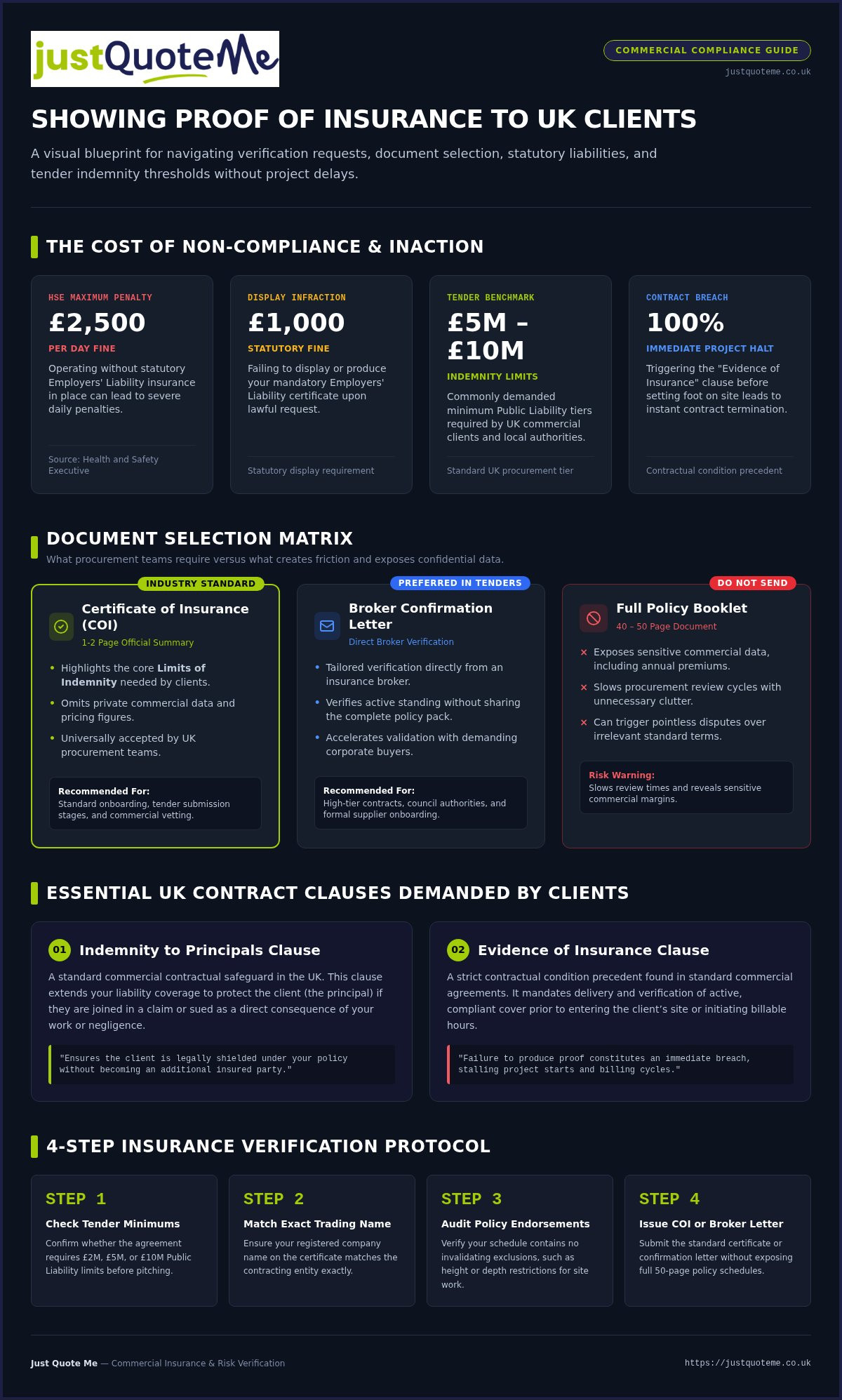
Most commercial contracts in the UK include an “Evidence of Insurance” clause. This requires you to produce valid documents before you even set foot on site. If you can’t provide proof, you’re technically in breach of contract before you’ve started. This can lead to immediate termination of the agreement or, at the very least, a complete halt in your project timeline. It’s a risk most businesses simply can’t afford to take.
Clients often demand specific indemnity limits like £5 million or £10 million. These aren’t random numbers; they reflect the potential cost of a major incident in a public or commercial space. Beyond the contract, there are statutory risks to consider. For example, failing to display a mandatory Employers’ Liability certificate can result in a £1,000 fine from the HSE. Operating without that cover entirely can cost you up to £2,500 per day in penalties. By showing proof of insurance to clients, you mitigate their risk of being held liable for your actions. The “Indemnity to Principals” clause ensures your client is protected if they’re sued because of your negligence. Providing this proof quickly accelerates the onboarding process, getting your team on-site and getting your invoices paid faster.
The Essential Documents: What Counts as Valid Proof of Insurance?
When a client asks for “your insurance,” they aren’t looking for every piece of paper your insurer ever sent you. Providing too much information can actually slow down the onboarding process and reveal sensitive commercial details, such as your annual premium. To maintain professionalism and protect your data, you need to know which specific documents carry the weight required by UK procurement teams.
The Certificate of Insurance (COI)
A Certificate of Insurance (COI) is the industry-standard summary of your active cover. It acts as a snapshot of your policy, designed specifically for the purpose of showing proof of insurance to clients without the clutter of full policy terms. You should never send your full 50-page policy wording to a client; it’s unnecessary and often contains confidential information. Instead, focus on the “Limits of Indemnity” section of the COI. This clearly states the maximum amount your insurer will pay out for a claim, which is exactly what a client needs to verify before they sign a contract. Using the COI is the most efficient way of showing proof of insurance to clients while keeping your private business details secure.
Policy Schedules vs. Summaries of Cover
While the COI is the primary document, some sophisticated clients or local authorities may ask for your Policy Schedule. This document is more detailed and outlines specific endorsements or exclusions that apply to your business. For example, if you’re working in construction, a client might check your schedule to ensure your builders insurance doesn’t have a “height limit” or “depth limit” that would invalidate your cover on their specific site. A Summary of Cover, by contrast, is often too generic for formal vetting as it doesn’t always include your unique policy number or specific business name.
To ensure your proof is valid, always check that the document includes these four key elements:
- The Insurer’s Name: A reputable UK underwriter provides immediate confidence.
- Policy Number: Essential for the client to verify the cover if needed.
- Expiry Date: The document must show the policy is currently in force.
- Trading Name: This must match the name on your contract or invoice exactly.
For complex risks or bespoke contracts, a “Broker Letter” issued on professional headed paper is often used. This letter confirms that your broker has vetted your policies against the client’s specific requirements. If you’re struggling to locate these documents, you can contact an independent broker who can provide a clean PDF version of your certificate within minutes.
How to Share Your Insurance Details Professionally and Securely
Professionalism is defined by how you handle administrative requests. When showing proof of insurance to clients, the method of delivery is just as important as the document itself. A disorganized approach suggests a disorganized business, whereas a streamlined process builds confidence before the project even starts. Following a structured workflow ensures you meet compliance standards without compromising your data security.
To maintain a high standard of professional conduct, follow these five essential steps:
- Request a clean PDF: Never send a photograph of a printed document. Ask your broker for a high-resolution PDF version of your certificate to ensure all text is legible and professional.
- Verify the business name: Ensure the name on the document matches your trading name or the name on your contract exactly. Discrepancies here are a primary cause of onboarding delays.
- Redact sensitive data: If a client insists on seeing a full schedule rather than just a certificate, redact your annual premium and bank details. This information is commercially sensitive and not required for proof of cover.
- Use secure sharing: Avoid sending documents via social media or unsecured messaging apps. Use a professional email attachment or a dedicated file-sharing portal.
- Set a renewal reminder: Don’t wait for the client to ask for updated proof. Set a calendar alert for 30 days before your policy expiry to ensure you have the new documents ready to send.
Digital vs. Physical Documentation
By 2026, the shift toward digital-first verification is absolute. Most UK procurement teams now expect PDF proof sent through vendor portals or company intranets. You should always keep a digital copy of your certificates on your smartphone. This is particularly useful for tradespeople who need to provide immediate evidence of van and tools insurance or public liability when entering restricted commercial sites. Having these files accessible in a cloud folder means you won’t be turned away from a site due to missing paperwork.
Best Practices for Emailing Insurance Proof
When you email your documents, clarity is your best tool. Use a clear file naming convention such as “YourBusinessName_Public_Liability_2026.pdf” so the recipient can file it easily. Include a brief cover note stating the policy limits and the insurer name to save the procurement officer time. If your client uses a third-party compliance platform like Constructionline or CHAS, ensure you upload the documents promptly. These platforms often provide “live” verification, and a delay in your upload can trigger automated warnings that might pause your contract payments. Taking these small steps makes showing proof of insurance to clients a frictionless part of your business operations.
Navigating Specific Client Requests: Indemnity Limits and Named Parties
Showing proof of insurance to clients often leads to follow-up questions about specific contractual clauses. While a standard certificate covers most bases, high-value tenders or public sector contracts frequently demand bespoke adjustments. Understanding these requests prevents you from agreeing to terms that could complicate your cover or increase your costs unnecessarily. It’s about finding a balance between satisfying a client’s risk department and maintaining a cost-effective insurance programme.
A common requirement in UK contracting is the “Indemnity to Principals” clause. This is a standard feature in public liability insurance that extends your policy’s protection to your client, who is the “principal” in the contract. If a third party sues your client because of work you performed, this clause ensures your insurer handles the legal costs and compensation. It’s a vital trust-building tool that most professional brokers can confirm with a single-page letter, making the onboarding process much smoother.
For consultants and service providers, showing proof of insurance to clients usually involves providing evidence of professional indemnity insurance. Clients want to know that if your advice or designs lead to a financial loss, you have the financial backing to make it right. If you need to verify your current limits against a specific tender, you can request a review of your policy to ensure you meet the criteria before you submit your bid.
When the Client Asks for More Cover
If a prospect requires a £10 million limit but your current policy only provides £2 million, don’t panic. You don’t necessarily need a brand-new policy. A broker can often arrange a mid-term adjustment to increase your limits for the duration of that specific project. Before you commit, evaluate the cost-benefit. Is the contract value high enough to justify the additional premium? While you’re reviewing your liability, check your employers liability insurance. UK law mandates a minimum of £5 million for businesses with employees, but many corporate clients expect £10 million as a baseline for their supply chain, regardless of the project size.
Named Parties and Specific Endorsements
Some clients will ask to be added as a “Named Insured” on your policy. This is a significant request that can give the client direct rights to your policy, which many insurers are reluctant to grant. A more common and safer alternative is adding them as an “Interested Party”. This acknowledges their interest in your insurance without giving them the same status as you, the policyholder. Be wary of bespoke insurance clauses in contracts that use non-standard legal language. These can sometimes create gaps where your policy doesn’t align with your contractual promises, leaving you personally liable for the difference. Always have a broker check these clauses before you sign.
How Just Quote Me Simplifies Your Insurance Documentation
When you’re showing proof of insurance to clients, you need more than just a generic PDF. You need a partner who understands that a delay in documentation can mean a lost contract. Just Quote Me is an independent UK broker with over 30 years of experience, founded in 1989. We’ve spent decades helping businesses manage administrative burdens, ensuring that your insurance is a tool for growth rather than a compliance headache. Our status as an FCA-authorised broker gives you the peace of mind that you’re receiving professional, regulated advice.
We specialise in providing tailored solutions that match specific trade requirements. Whether you need robust builders insurance or complex professional indemnity cover, we ensure your documents are accurate and contract-ready. Our rapid response for document requests means you can respond to tenders with total confidence, knowing your paperwork won’t hold you back. We provide access to a broad network of top UK underwriters, ensuring you get the right cover at a competitive price.
Personal Service vs. Automated Platforms
Generic insurance websites often leave you struggling with a chatbot when a client asks for a specific endorsement. We believe in a human-centric approach. Speaking to an expert who understands the Newcastle-under-Lyme and Stafford business landscape makes a significant difference. We don’t just provide a policy; we help you interpret the complex insurance requirements often found in high-value commercial contracts. This personal touch ensures that you aren’t just another policy number in an automated system.
Having a broker who “gets” your industry risks is invaluable. If a client asks for a mid-term adjustment or a Broker Confirmation Letter, you don’t have to navigate a call centre. You have a dedicated team ready to act. This regional expertise ensures that your cover is as local and specialised as your business itself. We manage the complex administrative burdens so you don’t have to, allowing you to focus on your core operations.
Get Your Documentation Ready Today
Don’t wait until you’re in the middle of a high-pressure bid to check your paperwork. Being proactive about your documentation is the best way to ensure you’re always tender-ready. We can review your current cover to identify any gaps that might prevent you from showing proof of insurance to clients in the future. Whether you’re a local tradesperson or a professional services firm, having your insurance details organised is a marker of quality.
Our goal is to make the administrative side of your business frictionless. By managing these complex processes for you, we free up your time to focus on delivering your services. If you want to ensure your business is fully protected and ready for its next big opportunity, take the first step now. Get Your Free Business Insurance Quote now.
Secure Your Next Contract with Confidence
Mastering the process of showing proof of insurance to clients is a simple but effective way to differentiate your business from less organized competitors. By providing clear, professional documentation like a Certificate of Insurance rather than bulky policy wordings, you demonstrate that your business is stable and ready to work. It’s about more than just compliance; it’s about building a foundation of trust that helps you secure higher-value contracts across the UK.
As an FCA-authorised independent broker with 30+ years of industry experience, Just Quote Me is here to handle the administrative heavy lifting for you. We ensure your cover is tailored to your specific trade and provide the rapid documentation you need to satisfy even the most rigorous procurement vetting. Don’t let paperwork be the reason you miss an opportunity.
If you’re ready to streamline your business protection, Get Your Free Business Insurance Quote now. For personalized support and tailored documentation, Request a Call back for free Expert advice. We look forward to helping your business thrive in 2026 and beyond.
Frequently Asked Questions
What is a Certificate of Insurance (COI)?
A Certificate of Insurance (COI) is a concise document that provides a high-level summary of your active business insurance. It acts as official evidence that you have valid coverage without disclosing sensitive financial details like your annual premium. For UK businesses, this includes the insurer’s name, policy number, and the specific limits of indemnity. It is the most professional way of showing proof of insurance to clients during the onboarding process.
Can I show a copy of my policy schedule instead of a certificate?
You can use a policy schedule, but it is often less efficient than a certificate. While a schedule contains the same core information, it also lists specific endorsements, excesses, and confidential pricing data. If a client requests a schedule to verify certain exclusions, it is best to provide a redacted version. Most brokers recommend using the certificate first, as it is designed specifically for external verification and keeps your commercial secrets protected.
Do I need to show proof of insurance before starting work?
Yes, most commercial contracts in the UK require you to provide evidence of cover before you commence work or enter a project site. Failing to do so can lead to a breach of contract or immediate suspension of your services. Beyond the legalities, having your documentation ready demonstrates that you are a responsible and organized professional. It prevents administrative delays and ensures your client’s risk management team is satisfied from day one.
What if my client asks for a higher indemnity limit than I have?
If a client requires a higher limit, such as £10 million when you currently hold £5 million, you should contact your broker immediately. We can often arrange a mid-term adjustment with your insurer to increase your limits for the duration of that specific project or for the remainder of your policy term. This is a common occurrence in UK contracting, and a professional broker can usually provide the updated certificate within a few hours.
How often should I update the proof of insurance I show to clients?
You must provide updated proof every time your policy renews, which is typically every 12 months. It is also necessary to share a new certificate if you make any significant changes to your cover, such as increasing your indemnity limits. Proactively showing proof of insurance to clients 30 days before your current policy expires builds trust and ensures there is no lapse in your approved contractor status.
Is a digital copy of my insurance valid for UK contracts?
Yes, digital PDF copies are now the industry standard for insurance verification in the United Kingdom. Physical paper certificates are rarely required, as most procurement teams and compliance platforms prefer electronic files for their records. You should ensure the PDF is a clean, high-resolution document provided directly by your broker. Keeping a copy on your smartphone allows you to provide immediate evidence if you are asked for proof while working on-site.
What is “Indemnity to Principals” on a certificate?
An “Indemnity to Principals” clause is a standard extension found in many public liability policies. It ensures that if your client is sued by a third party due to your negligence, your insurance policy will cover their legal costs and any compensation awarded. This is a critical requirement for most local authority and large corporate tenders, as it prevents the client from being financially exposed by the actions of their contractors.
Can a client verify my insurance directly with the insurer?
A client can verify your insurance, but they will typically do this through your broker rather than contacting the insurer directly. By providing your broker’s contact details, you allow the client’s compliance team to confirm that your policy is active and meets the contractual requirements. This third-party verification is part of the standard vetting process for many UK firms and provides an additional layer of security and professional transparency for the client.
