
Could a single overlooked permit or an unregistered volunteer driver ground your charity’s entire outreach programme? Most non-profit leaders agree that while providing community transport is vital, the administrative headache of finding affordable charity minibus insurance is a constant source of stress. You want to focus on your mission, but high premiums for ‘any driver’ policies and the technicalities of Section 19 permits often stand in the way.
We’re here to help you clear those hurdles with expert advice on securing bespoke cover that fits your specific needs. This guide provides a clear roadmap through the legal obligations for 2026, including age restrictions for volunteers and the latest permit fee structures. You’ll learn how to protect your drivers, whether they’re 21 or over 70, while keeping your costs manageable. We will explore everything from vehicle weight limits to the essential differences between Section 19 and Section 22 permits, ensuring your organisation stays fully compliant and ready for the road.
Key Takeaways
- Identify whether your organisation requires a Section 19 or Section 22 permit to maintain legal compliance while transporting members or the public.
- Understand how to balance ‘any driver’ flexibility with named driver discounts to secure the best value charity minibus insurance for your budget.
- Explore the benefits of consolidating multiple vehicles into a single fleet policy to simplify administration and unlock bulk pricing.
- Clarify the specific licensing and medical standards required for volunteer drivers, particularly those under 21 or over 70.
- Learn why bespoke advice from an independent broker is more effective than automated quotes for navigating complex non-profit risks.
What is Charity Minibus Insurance and Why is it Essential?
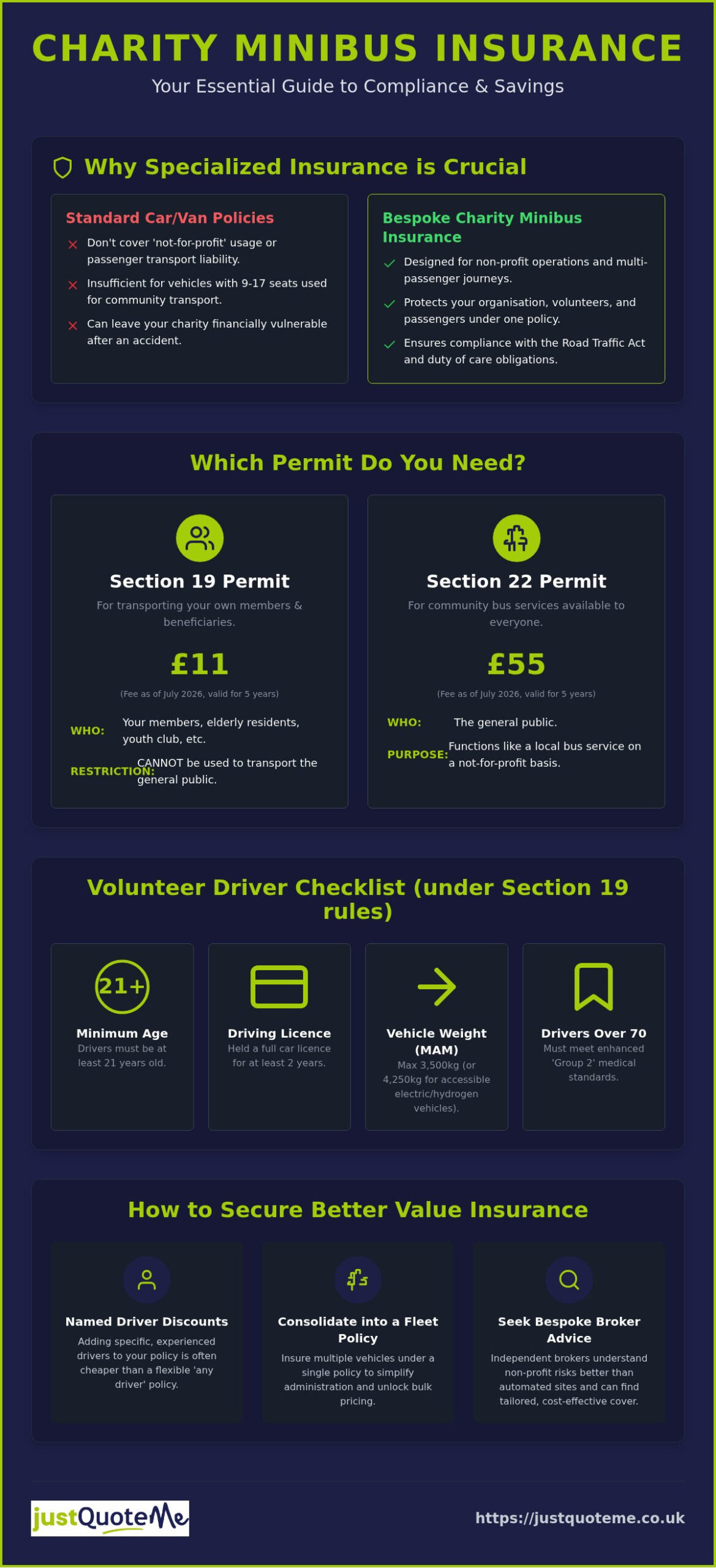
Charity minibus insurance is a specialised motor policy designed specifically for non-profit organisations that operate vehicles with 9 to 17 seats. You can’t rely on standard car or van insurance for this type of work. Those policies are built for personal use or commercial goods transport; they don’t account for the complexities of community transport or the ‘not-for-profit’ usage patterns of a volunteer group.
Transporting people changes your risk profile. You aren’t just protecting a vehicle; you’re managing the intersection of motor risk and passenger liability. A dedicated policy reflects your status as a non-commercial operator while providing the robust protection required for multi-passenger journeys. It bridges the gap between commercial fleet cover and private motor insurance, ensuring that your organisation, volunteers, and passengers are protected under a single, cohesive shield.
The Legal Requirement for Charities
The Road Traffic Act mandates insurance for any minibus used on UK roads. While Third Party Only cover is the legal baseline, it’s almost never enough for a responsible charity. You have a significant duty of care toward your passengers and the public. If an accident occurs, a basic policy might leave your organisation vulnerable to massive financial claims. Comprehensive charity minibus insurance ensures that you meet your legal obligations while protecting your volunteers and your financial stability.
Bespoke vs. Standard Policies
Standardised policies often fail because they ignore the nuances of different organisations. A youth group’s needs are vastly different from those of a care home or a community sports club. Bespoke cover allows you to tailor protection to your specific activities, whether that involves frequent short trips or occasional long-distance excursions. You shouldn’t pay for risks your organisation doesn’t face.
Getting this right involves more than just clicking a button on a comparison site. Independent brokers like Just Quote Me provide a human-centric alternative to automated systems. We use our 30 years of industry experience to navigate the market for you. Just Quote Me to access a broad network of insurers and secure a policy that matches your unique risk profile. We often recommend pairing your motor cover with Public Liability Insurance to create a complete safety net. This ensures your organisation is protected both on and off the road, giving your stakeholders the confidence they need to keep your mission moving forward.
Navigating Section 19 and Section 22 Permits
Permits are the legal foundation of non-commercial passenger transport in the UK. Without them, your organisation would likely need a full Public Service Vehicle (PSV) operator’s licence, which involves significantly higher costs and stricter regulatory oversight. A Section 19 permit is the most common choice for non-profit groups. It allows you to transport your own members or the individuals your charity supports, such as elderly residents or youth club members, provided you don’t carry the general public.
If your organisation runs a community bus service available to everyone, you’ll need a Section 22 permit instead. As of July 2026, the Traffic Commissioner has set the fee for a standard Section 19 permit at £11, while a Section 22 permit costs £55. These permits are valid for five years. It’s vital to track these expiry dates because operating without a valid permit can immediately invalidate your charity minibus insurance, leaving your organisation exposed to total financial risk in the event of a claim.
Licensing and Driver Entitlement
The primary advantage of these permits is the flexibility they offer regarding driver licensing. Under a Section 19 permit, volunteers can often drive a minibus without a specialised D1 licence test. To qualify for this exemption, drivers must be at least 21 years old and have held a full car licence for at least two years. There’s a strict weight limit to consider: the vehicle’s Maximum Authorised Mass (MAM) cannot exceed 3,500kg. This limit increases to 4,250kg if the vehicle is electric or hydrogen-powered and carries specialised accessibility equipment like ramps or lifts. Drivers over 70 must also meet ‘Group 2’ medical standards to remain eligible.
Insurance Policy Requirements for Permit Holders
Your insurance policy must explicitly acknowledge that you’re operating under permit regulations. Insurers view permit holders differently than commercial bus operators because the ‘hire or reward’ element is restricted to non-profit activities. This distinction often leads to more favourable rates, but only if the data provided is accurate. If you collect contributions for fuel or membership fees that go toward transport, this is legally considered ‘hire or reward’ and must be covered by your permit and policy.
Managing these administrative burdens shouldn’t take time away from your core mission. If you’re unsure whether your current drivers meet the 2026 weight and age requirements, you can speak with our team to ensure your cover is fully compliant with the latest Traffic Commissioner standards.
Managing Drivers: Volunteers, Age Limits, and Experience
Choosing the right driver is just as important as selecting the right vehicle. For most organisations, the “Any Driver” vs. “Named Driver” debate is the first hurdle in securing charity minibus insurance. An “Any Driver” policy offers the ultimate flexibility, allowing any qualified volunteer to step in at a moment’s notice. While this is convenient for busy charities, it often results in higher premiums. If you have a consistent team of three or four regular drivers, switching to a “Named Driver” policy can provide a significant cost saving. You trade flexibility for a more precise risk assessment by the insurer.
Driver history is another critical factor. Convictions, speeding points, or at-fault accidents within the last five years will influence your premium. You must maintain a rigorous system for licence checks. Using the DVLA’s online check code service is the most reliable way to verify a driver’s current status. Relying on a physical photocard is risky, as it won’t show recent endorsements or disqualifications. Consistent documentation is your best defence if you ever need to make a claim.
Volunteer Driver Vetting
Assessing a volunteer’s competency should go beyond a simple licence check. We recommend conducting a practical driving assessment to ensure they’re comfortable with the vehicle’s size and handling. The Minibus Driver Awareness Scheme (MiDAS) is the gold standard for this. Many insurers recognise MiDAS training as a mark of quality, which can lead to more competitive rates. For organisations operating several vehicles, a Motor Fleet Insurance policy can streamline your administration by covering multiple minibuses and drivers under a single, manageable renewal date.
Age Restrictions and Policy Excess
Drivers at either end of the age spectrum require special attention. Government regulations require drivers over 70 to meet “Group 2” medical standards to drive a minibus under a permit. While younger drivers under 25 or those over 70 often face a higher voluntary excess, this shouldn’t prevent them from contributing to your mission. Just Quote Me acts as your advocate, negotiating directly with underwriters to ensure your organisation can retain its most dedicated volunteers regardless of their age. We help you present a case based on experience and training rather than just a date of birth, ensuring your charity minibus insurance remains inclusive and affordable.
How to Secure Cheap Charity Minibus Insurance in 2026
Securing affordable charity minibus insurance requires a shift from passive renewals to active risk management. Many organisations see premiums rise each year without questioning the underlying factors, but you can influence these costs by demonstrating a commitment to safety. One of the most effective methods for reducing your annual spend is consolidating your vehicles into a single fleet policy. This approach allows insurers to apply bulk discounts that aren’t available for individual vehicles, while also simplifying your administrative workload.
Technology provides another avenue for savings. Implementing telematics or dashcams allows you to prove your drivers adhere to safe standards, which reduces the insurer’s perceived risk. You might also consider increasing your voluntary excess. By agreeing to pay a slightly higher amount in the event of a claim, you can significantly lower your upfront premium. This signals to the underwriter that you’re confident in your organisation’s driving standards and maintenance routines.
Risk Management Strategies
A structured vehicle maintenance schedule is a powerful tool for claim prevention. Regular safety checks, conducted more frequently than the legal MOT requirement, help catch mechanical issues before they lead to accidents. Secure overnight parking also plays a major role in premium calculation. If your minibus is kept in a locked compound or a well-lit, CCTV-monitored area, you’ll likely see a reduction in theft-related costs. We also recommend protecting your No Claims Discount (NCD). While this adds a small cost to your policy, it prevents a single incident from removing years of hard-earned savings.
The Power of Independent Brokerage
Bespoke cover is generally better value than off-the-shelf policies because it’s tailored to your exact usage. Automated comparison sites often default to high-risk assumptions for non-profit transport, whereas an independent broker can present your specific case to a broad network of insurers. This grants you access to broker-only schemes that provide superior protection at lower rates for your charity minibus insurance. Request a Call back for free Expert advice to discuss these cost-saving measures and ensure your organisation is getting the best possible deal for its 2026 renewal.
Why Choose Just Quote Me for Your Charity Cover?
Selecting a provider for your charity minibus insurance isn’t just about finding the lowest price on a screen. It’s about finding a partner who understands the weight of your responsibility. With over 30 years of experience in the UK market, we’ve seen how the industry has shifted and the challenges non-profits face. As an independent, FCA-authorised broker, our loyalty lies with your organisation, not the insurance companies. We work for you to find the most robust protection at a fair price by searching a broad network of top UK insurers.
We specialise in complex commercial sectors that generalist brokers often overlook. While a standard insurer might struggle with the nuances of volunteer driver age limits or permit legalities, we manage these details as part of our standard service. You won’t have to deal with the frustration of automated call centres or rigid, one-size-fits-all policies. Instead, you’ll have access to a human-centric service that prioritises your specific needs. Our team provides a steady hand in a complex market, ensuring you aren’t left exposed by administrative errors.
A Trusted Advisor for the Non-Profit Sector
We manage the entire administrative burden so you don’t have to. From setting up the initial policy to making adjustments when your volunteer pool changes, we handle the paperwork. Our goal is to find competitive pricing without sacrificing the quality of your protection. Beyond the vehicle itself, we can help you secure other essential covers, such as Employers Liability Insurance, which is legally required if your charity has even one staff member. By grouping your requirements into a bespoke package, we create a more efficient and cost-effective insurance portfolio that grows with your organisation.
Get Started with a Bespoke Quote
Transitioning from a standard ‘off-the-shelf’ policy to bespoke cover is a straightforward and frictionless process. We take the time to understand your usage patterns, driver profiles, and permit status to build a policy that actually fits your daily operations. We know the unique pressures the charity sector faces in 2026, and we’re here to provide the expert guidance you need. You can focus on your community while we manage the risks and handle the complex administrative burdens.
Securing Your Organisation’s Future on the Road
Operating community transport in 2026 requires more than just a reliable vehicle; it demands a clear understanding of Section 19 permit legalities and proactive driver management. You’ve seen how specific factors like vehicle weight limits and volunteer age requirements directly impact your risk profile. By implementing robust safety standards and choosing bespoke cover over generic options, your charity can maintain comprehensive protection without overstretching its budget.
Finding the right charity minibus insurance shouldn’t be a source of stress. As an independent, FCA-authorised broker with over 30 years of industry experience, we specialise in simplifying these complex administrative processes. We provide access to a broad network of top UK insurers to ensure you receive the most competitive and reliable protection available. We handle the technicalities so you can focus on the people who rely on your service.
Get Your Free Business Insurance Quote now
Request a Call back for free Expert advice
Your mission is vital to the community. We’re here to ensure you can continue your outreach with confidence and complete peace of mind.
Frequently Asked Questions
Is minibus insurance more expensive for charities than for businesses?
Minibus insurance isn’t necessarily more expensive for charities than for-profit businesses. In many cases, non-profit status can lead to lower rates because the vehicle isn’t being used for commercial gain. However, the need for flexible “any driver” cover to accommodate various volunteers can increase the premium. Working with an independent broker allows you to compare different insurers to find a policy that recognises your specific organisation’s usage patterns and safety record.
Do all charity minibus drivers need a D1 licence in 2026?
Not all drivers require a full D1 licence, but the rules depend on when they passed their test and the vehicle’s weight. Drivers who obtained their car licence before 1997 often have D1 entitlement automatically. For younger volunteers, Section 19 permit exemptions allow them to drive a minibus without a separate test if the vehicle meets specific weight criteria. You must verify every driver’s entitlement through the DVLA to ensure your cover remains valid.
Can we insure a minibus if our drivers are volunteers?
You can certainly insure a minibus with volunteer drivers, and this is a core feature of most charity minibus insurance policies. Insurers understand that charities rely on unpaid staff and offer “any driver” options to provide the necessary flexibility. You’ll need to ensure your volunteers meet the minimum age requirements and hold a valid licence. Providing evidence of additional training, such as MiDAS, can often help in negotiating more competitive annual premiums.
What is the difference between a Section 19 and Section 22 permit?
The difference centres on who you transport and the nature of the service provided. Section 19 permits are for organisations that only carry their own members or specific groups, such as youth clubs or elderly residents. Section 22 permits are for community bus services that are open to the general public. Each permit has different legal requirements and fee structures, so it’s vital that your insurance policy correctly reflects the specific permit your organisation holds.
Does charity minibus insurance cover European travel for group trips?
Most standard policies provide the minimum legal cover for European travel, but full comprehensive protection usually requires an optional extension. You should inform your broker before any group trips abroad to ensure your liability limits and breakdown assistance are sufficient for the countries you’ll visit. Some territories may still require specific documentation or Green Cards, so checking these details well in advance will prevent any legal issues or gaps in your protection during the journey.
How much public liability cover should a charity minibus policy include?
While motor insurance covers road accidents, many organisations choose to include at least £5 million or £10 million in public liability cover. This protects the charity if a passenger is injured while boarding or if an incident occurs that isn’t strictly a road traffic accident. The appropriate level of cover often depends on your local authority requirements or the specific needs of the vulnerable groups you support during your transport activities.
Can we protect our no-claims bonus on a charity minibus policy?
Protecting your no-claims bonus is possible and highly recommended for most charity minibus insurance policies. Paying a small additional premium ensures that a single minor claim won’t wipe out the discounts you’ve earned through years of safe driving. For organisations with multiple vehicles, we can often look at fleet-based discounts that reward your overall safety record. This helps keep your long-term costs predictable and manageable even if an unforeseen incident occurs.
What happens if we use our minibus for a profit-making event?
Using your minibus for commercial, profit-making events can invalidate both your permit and your insurance policy. Permits are strictly for non-profit use; any activity that generates a commercial profit is legally considered “hire or reward” and requires a PSV operator’s licence. If you’re unsure whether a fundraising activity crosses this line, you should consult your broker. They’ll help you determine if the event remains within the legal boundaries of your existing cover.
