

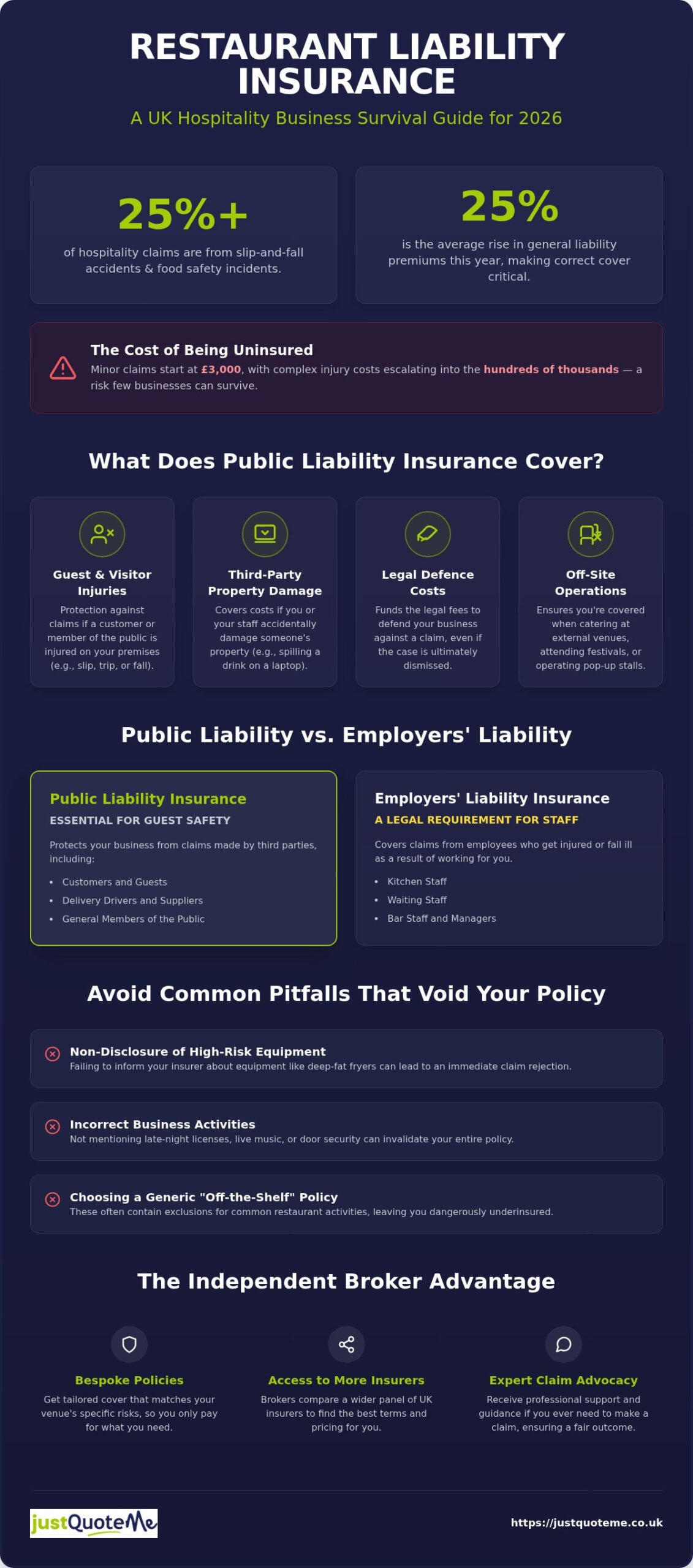
Did you know that slip-and-fall accidents and food safety incidents account for over a quarter of all hospitality claims in 2026? For a busy venue, a single spilled drink or an undeclared allergen can lead to a legal claim that threatens your entire livelihood. Securing robust public liability insurance for restaurants has become more than just a box-ticking exercise; it’s a vital survival tool in a market where general liability premiums have risen by up to 25% this year.
We know that managing a hospitality business is demanding enough without the added stress of confusing legal requirements and soaring costs. You need protection that works as hard as you do, without the fluff of generic, off-the-shelf policies. This guide provides the expert clarity you need to safeguard your future. We’ll explore essential cover levels, explain critical policy exclusions, and show you how to access local support that understands the UK hospitality landscape. You’ll gain a clear understanding of how to protect your staff, your guests, and your reputation with confidence.
Key Takeaways
- Understand the critical difference between optional cover and legal mandates, specifically why public liability insurance for restaurants is essential for guest safety while Employers Liability remains a statutory requirement.
- Identify the specific risks covered in 2026, including protection against accidental customer injuries and damage to third-party property that could otherwise lead to business-ending legal costs.
- Learn how to avoid common pitfalls such as non-disclosure regarding deep-fat fryers or late-night licenses, which can result in claim rejection or your policy being voided.
- Discover the financial and operational benefits of choosing a bespoke policy over a generic “off-the-shelf” product to ensure you only pay for the specific protections your venue needs.
- Gain insights into why partnering with an independent broker provides access to a broader panel of UK insurers and expert advocacy if you ever need to make a claim.
Why Public Liability Insurance is Essential for UK Restaurants in 2026
Operating a hospitality venue in 2026 involves managing a complex web of risks that extend far beyond the kitchen. Public liability insurance for restaurants is designed to protect your business against claims for third-party injury or property damage. If a guest trips over a loose carpet tile or a delivery driver is injured by a falling sign, your policy covers the legal costs and any subsequent compensation awards. Having public liability insurance explained by an expert clarifies that this cover is your first line of defence against allegations of negligence.
The UK hospitality landscape has shifted, with litigation trends showing a marked increase in the frequency and value of personal injury claims. While some administrative costs can be trimmed, this protection is business-critical rather than a luxury. A bespoke policy is essential because it accounts for your specific service style. A fast-casual takeaway in a busy city centre has a different risk profile than a fine-dining establishment with table service. By tailoring your public liability insurance, you ensure that every square inch of your premises is accounted for without paying for redundant features.
The Real-World Cost of Being Uninsured
The financial consequences of an uninsured claim are often terminal for small to medium enterprises. In the UK, even a minor slip-and-trip claim can result in payouts starting at £3,000, but complex injuries involving long-term care can escalate into the hundreds of thousands. Legal fees alone can bankrupt an independent restaurant before a case even reaches court. Every restaurant owner owes a legal duty of care to take reasonable steps to ensure their guests and visitors remain safe while on the premises. Without insurance, you’re forced to fund these liabilities from your own pocket, which is a risk few can afford to take.
Staffordshire Hospitality: A Local Perspective
From the bustling high streets of Stafford to the trendy bars in Newcastle-under-Lyme, the West Midlands dining scene is vibrant and diverse. However, local businesses face specific environmental and operational risks that generic online insurers often overlook. An independent broker with deep roots in the Staffordshire area understands the difference between a high-traffic urban unit and a quiet village pub. They provide a human-centric approach that prioritises regional expertise over automated algorithms. Having a partner who understands the West Midlands market means you get pragmatic advice that simplifies complex administrative burdens, allowing you to focus on your food and your guests.
What Does Restaurant Public Liability Actually Cover?
Public liability insurance for restaurants acts as a robust shield for your business, extending far beyond the common image of a guest slipping on a wet floor. While those physical accidents are a primary concern, this cover is designed to handle a wide variety of third-party interactions that could lead to financial loss. If a server accidentally knocks over a bottle of wine, damaging a guest’s expensive laptop or designer clothing, your policy steps in to cover the repair or replacement costs. These everyday mishaps can quickly become expensive without the right protection in place.
Legal defence costs are another critical component that many business owners overlook. In the UK’s increasingly litigious environment, the cost of hiring solicitors and expert witnesses can often exceed the actual compensation amount requested by a claimant. Your insurance covers these professional fees, ensuring you have access to a high-quality defence without draining your cash flow. This is particularly important for independent venues that don’t have the deep pockets of large national chains.
Modern restaurant operations often extend beyond the dining room. If you cater for weddings at external venues or set up a stall at a local festival, your risks follow you. It’s essential to verify that your policy includes cover for off-site events. Generic policies sometimes restrict protection to your registered business address, leaving you vulnerable during pop-up events or external catering contracts. To understand how these protections fit into the wider landscape of essential business insurance, you can review guidance from Companies House on the different types of cover small businesses should consider.
Food Safety and Illness Claims
Allegations of food poisoning or allergic reactions are among the most stressful situations a restaurateur can face. In 2026, the focus on allergen transparency remains a top priority following the implementation of Natasha’s Law. Your public liability insurance for restaurants provides the financial backing to handle these sensitive claims. To support your case, you must maintain rigorous health and safety records, including temperature logs and allergen checklists. From a broker’s perspective, it’s helpful to distinguish between an “incident” (a potential issue) and a “claim” (a formal demand for money). Reporting incidents early allows your insurance partner to build a stronger defence on your behalf.
The Role of Product Liability in Your Policy
For the hospitality sector, product liability is usually bundled directly with your Public Liability Insurance. This is because the food and drink you serve are technically “products.” This coverage is vital if you offer takeaway or delivery services, as it protects you once the meal leaves your premises. If a customer claims they became ill from a meal eaten at home, product liability provides the necessary protection. If you’re expanding into takeaway or delivery, it’s a good idea to check your policy wording with a specialist to ensure you have the right level of cover for these specific activities.
Public Liability vs. Employers Liability: Understanding the Difference
Many restaurant owners confuse their legal obligations with recommended protections. While public liability insurance for restaurants is considered essential for safeguarding your livelihood, Employers Liability (EL) is a non-negotiable legal requirement under UK law. EL covers your staff if they’re injured or fall ill due to their work. In contrast, Public Liability protects you against claims from anyone else who interacts with your business, such as diners, delivery drivers, or health inspectors. Understanding this distinction is vital because a gap in either could leave your personal assets at risk.
The overlap between these two covers often appears during daily service. Consider a common scenario: a waiter accidentally drops a piping hot plate of food on a customer. Even though the employee physically caused the accident, you are legally responsible through “vicarious liability.” In this instance, your Public Liability policy handles the guest’s claim for burns and ruined clothing. However, if that same waiter burned themselves while carrying the plate, the claim would fall under your Employers Liability cover. This Forbes Advisor guide provides further context on how these claims are structured for small businesses.
Legal Requirements for UK Restaurant Owners
If you employ even one person, whether they’re full-time, part-time, or a temporary seasonal worker, you must hold Employers Liability Insurance. The law requires a minimum indemnity limit of £5 million, though most insurers provide £10 million as standard. Failing to have this cover in place is a serious offence. The Health and Safety Executive (HSE) can fine your business up to £2,500 for every single day you’re uninsured. Additionally, you can be fined £1,000 for failing to display your insurance certificate or refusing to make it available to inspectors when asked.
Choosing the Right Level of Indemnity
Selecting an indemnity limit for your public liability insurance for restaurants requires careful thought. While £1 million is often the minimum entry level, it’s increasingly rare to find this sufficient in 2026. Rising inflation and higher court awards for personal injury mean that a single serious accident can quickly exceed a seven-figure limit. For venues with high footfall, late-night alcohol licenses, or multi-floor dining rooms, a limit of £5 million or £10 million is often more appropriate. You should assess your risk based on your specific restaurant type; a quiet cafe faces different exposures than a high-volume city centre bistro. We recommend reviewing these limits annually to ensure your protection keeps pace with your business growth and current economic trends.
Common Pitfalls and How to Avoid Claim Rejection
The Insurance Act 2015 requires all UK business owners to make a “fair presentation of the risk” when arranging cover. When securing public liability insurance for restaurants, the most critical step is full transparency regarding your operations. Non-disclosure is a leading cause of claim rejection. If you forget to mention a late-night alcohol license or the installation of a new deep-fat fryer, your insurer may argue that the risk they agreed to cover has fundamentally changed. Failing to disclose material information can lead to your policy being voided entirely, leaving you to face legal costs alone.
Insurance isn’t a substitute for good management. Every policy contains a “reasonable precautions” clause that requires you to take active steps to prevent accidents. If a guest slips on a spill that was left unattended for an hour despite your cleaning schedule, an insurer might argue you failed to meet these standards. Similarly, late notification of an incident can jeopardise your defence. You must inform your broker immediately after an accident occurs, even if the guest hasn’t yet made a formal claim. This allows us to gather evidence while it’s fresh, which is far more effective than trying to reconstruct events months later.
Inadequate record-keeping is another common trap. In 2026, 58% of UK SMEs remain underinsured for their top risks according to PwC research, often because they lack the documentation to support their claims. You need to maintain clear logs of staff training and floor cleaning schedules. These documents serve as physical evidence that you have met your duty of care. To ensure your documentation and cover levels are up to standard, it’s wise to consult with Just Quote Me for a professional review of your current arrangements.
Deep-Fat Fryers and Fire Safety Clauses
Kitchen fires remain a significant risk, and insurers often attach specific “fryer warranties” to your policy. These clauses mandate regular thermostat checks and strict duct cleaning protocols. If a fire occurs and you cannot produce a certificate proving your extraction system was professionally cleaned, your insurer may refuse to pay. Professional extraction cleaning should be conducted at least every six months; however, high-volume venues may require quarterly visits to remain compliant with insurer requirements. These specific conditions are not optional; they are essential prerequisites for a valid claim.
The Importance of Risk Assessments
A documented risk assessment is your strongest legal defence in a liability claim. It proves that you have identified potential hazards and implemented controls to mitigate them. Venues looking for Restaurant Insurance in Birmingham must ensure their assessments reflect current 2026 standards for kitchen safety and front-of-house hazards. This includes addressing newer risks such as lithium-ion battery charging for delivery ebikes or updated allergen separation protocols. Regularly updating these assessments demonstrates a proactive attitude toward safety that both insurers and courts look upon favourably.
Why Use an Independent Broker Like Just Quote Me?
Choosing public liability insurance for restaurants shouldn’t be a gamble with an automated engine. As an independent, FCA-authorised broker, we provide access to a wide panel of top UK insurers. This means we aren’t tied to a single provider’s limitations. Instead, we compare options across the market to find the most competitive rates and robust terms for your specific venue. We focus on bespoke policy tailoring, ensuring you only pay for the protection your business actually needs without the weight of unnecessary extras.
The “Just Quote Me” advantage is built on over 30 years of industry experience. We’ve spent three decades helping hospitality clients manage complex administrative burdens and navigate the intricacies of the claims process. Whether you operate a high-traffic city bistro or a quiet village tea room, your risks are unique. We provide a steady hand in a complex market, offering personalised support from our Staffordshire base. You won’t deal with impersonal call centres; you’ll speak directly to experts who understand the West Midlands hospitality landscape.
Human Expertise vs. Automated Algorithms
Automated quote engines often miss the subtle details that define a unique restaurant business. A computer algorithm might not grasp the specific risks associated with your late-night alcohol license or the structural nuances of a historic building. We take the time to explain the fine print in plain English, ensuring you aren’t caught out by hidden exclusions. If you need to make a claim, we act as your dedicated advocate. We fight your corner to ensure a fair and fast resolution, providing the human-centric alternative that automated systems simply cannot match.
Get Your Bespoke Quote Today
Securing comprehensive public liability insurance doesn’t have to be a chore. Our process is designed for maximum efficiency, moving you quickly from an initial inquiry to total peace of mind. We invite local business owners in Stone, Stafford, and across the UK to reach out for a consultation. Our long-standing reputation is built on honest communication and regional expertise. To protect your livelihood with a policy that reflects the true scale of your operations, Just Quote Me today and let us handle the complexities while you focus on your guests.
Securing Your Restaurant’s Future in 2026
Protecting your livelihood in a competitive market requires a proactive approach to risk management. As we’ve explored, the right public liability insurance for restaurants does more than just cover accidents; it provides the legal and financial foundation for your business to grow. By choosing a policy that accounts for your specific layout and service style, you avoid the trap of generic cover that leaves you vulnerable to expensive claim rejections.
We understand the administrative burdens of running a busy kitchen and front-of-house. Our role is to simplify these complex processes, giving you total peace of mind that your assets are protected by an FCA-authorised broker. Whether you’re a local independent or part of a growing regional group, expert support is just a click away. We pride ourselves on being a human-centric partner in a market often dominated by automated systems.
Don’t leave your restaurant’s survival to chance. Get Your Free Business Insurance Quote now to see how we can tailor your protection. If you have specific questions about your current policy or need guidance on indemnity levels, Request a Call back for free Expert advice from our knowledgeable team. We’re ready to help you safeguard your future with confidence.
Frequently Asked Questions
Is public liability insurance a legal requirement for restaurants?
No, public liability insurance isn’t a legal requirement in the UK, but it’s effectively essential for operation. Most commercial landlords and local authorities will require you to hold a minimum level of cover before you can sign a lease or trade in public spaces. Without it, your business is personally liable for any compensation awards and legal fees, which can lead to insolvency after just one major incident.
Does restaurant insurance cover food poisoning claims?
Yes, most comprehensive policies include cover for allegations of food poisoning or allergic reactions. This protection usually falls under the product liability portion of your policy, which is typically bundled with public liability insurance for restaurants. It covers legal defence costs and compensation if a guest becomes ill after consuming your food or drink, provided you’ve followed required health and safety protocols.
How much does public liability insurance for a restaurant cost in 2026?
The cost of your premium depends on several specific variables rather than a flat industry rate. Insurers look at your annual turnover, the location of your premises, your previous claims history, and the specific types of food you serve. High-risk activities, such as late-night trading or using deep-fat fryers, will also influence the final figure. We recommend requesting a bespoke quote to ensure you’re paying a fair price for your specific risk level.
What is the difference between public liability and product liability for takeaways?
Public liability covers accidents that happen on your physical premises, such as a customer slipping on a wet floor. Product liability is specifically designed to protect you against claims arising from the food and drink you serve once it has been handed over to the customer. For takeaways, this is vital as it covers incidents that occur after the meal has left your shop, including delivery-related food safety issues.
Are delivery drivers covered under my restaurant’s public liability policy?
Coverage for delivery drivers depends entirely on their employment status and your specific policy wording. If they are direct employees, their actions are generally covered under your liability insurance. However, if you use third-party platforms or independent contractors, those individuals usually need their own separate insurance. It’s vital to clarify this with your broker to ensure there are no gaps in your protection during the delivery process.
What happens if I forget to mention my restaurant has a dance floor?
Forgetting to mention a dance floor is a form of non-disclosure that could lead to a rejected claim. A dance floor significantly increases the risk of slips, trips, and falls, which changes your business’s risk profile. If an accident occurs in that area and it wasn’t disclosed, your insurer might void the policy or refuse to pay the claim. Always update your broker about any changes to your layout or service style.
Does public liability insurance cover accidental damage to my own kitchen equipment?
No, public liability insurance for restaurants only covers damage to third-party property or injuries to non-employees. It does not provide any protection for your own kitchen equipment, furniture, or stock. To safeguard your own assets against fire, theft, or accidental damage, you need to include commercial property or contents insurance as part of your wider insurance package. This ensures your physical tools are protected alongside your legal liabilities.
Can I get public liability for a pop-up restaurant or food stall?
Yes, you can secure public liability for temporary setups like pop-up restaurants or food stalls. Many insurers offer short-term policies specifically designed for events or seasonal trading. These policies provide the same essential protections as a permanent restaurant policy but are tailored to the unique risks of mobile catering and temporary locations. This is often a mandatory requirement for booking pitches at festivals or local markets across the UK.
