

Did you know that your standard home insurance policy could become effectively void the moment a sledgehammer hits a wall? Many UK homeowners assume their existing cover protects them during a build, but most standard policies only account for minor works under £20,000. With the median renovation spend now reaching £21,440 in 2026, relying on basic cover is a gamble that could leave you facing total financial loss if a structural collapse occurs. Securing dedicated renovation insurance uk is the only way to bridge this gap and ensure your equity remains protected while the structure is vulnerable.
We understand the stress of managing contractors and the worry of leaving a property unoccupied during construction. Whether you are sourcing professionals through Trade-Hive or local recommendations, you want total peace of mind that your investment is secure from theft, fire, or accidental damage. This guide provides a clear roadmap for navigating the complexities of building works insurance. You’ll learn how to distinguish between owner and contractor responsibilities, understand the implications of the latest Building Safety Act regulations, and discover how to choose a policy that offers robust protection. By the end of this article, you’ll have the confidence to manage your 2026 project with complete security.
Key Takeaways
- Learn why standard home insurance policies often become void during major building works and how the “Duty of Disclosure” protects your right to claim.
- Understand the essential components of renovation insurance uk, including specialized protection for the existing structure and the new building works.
- Discover the critical differences between your contractor’s liability and your own project-specific policy to ensure there are no gaps in your legal protection.
- Identify the key factors that influence your 2026 insurance premiums, from the total project value to the planned duration of the build.
- Find out how to secure a bespoke insurance solution that provides total peace of mind while your property is under construction or left unoccupied.
Why Standard Home Insurance Isn’t Enough for Your UK Renovation
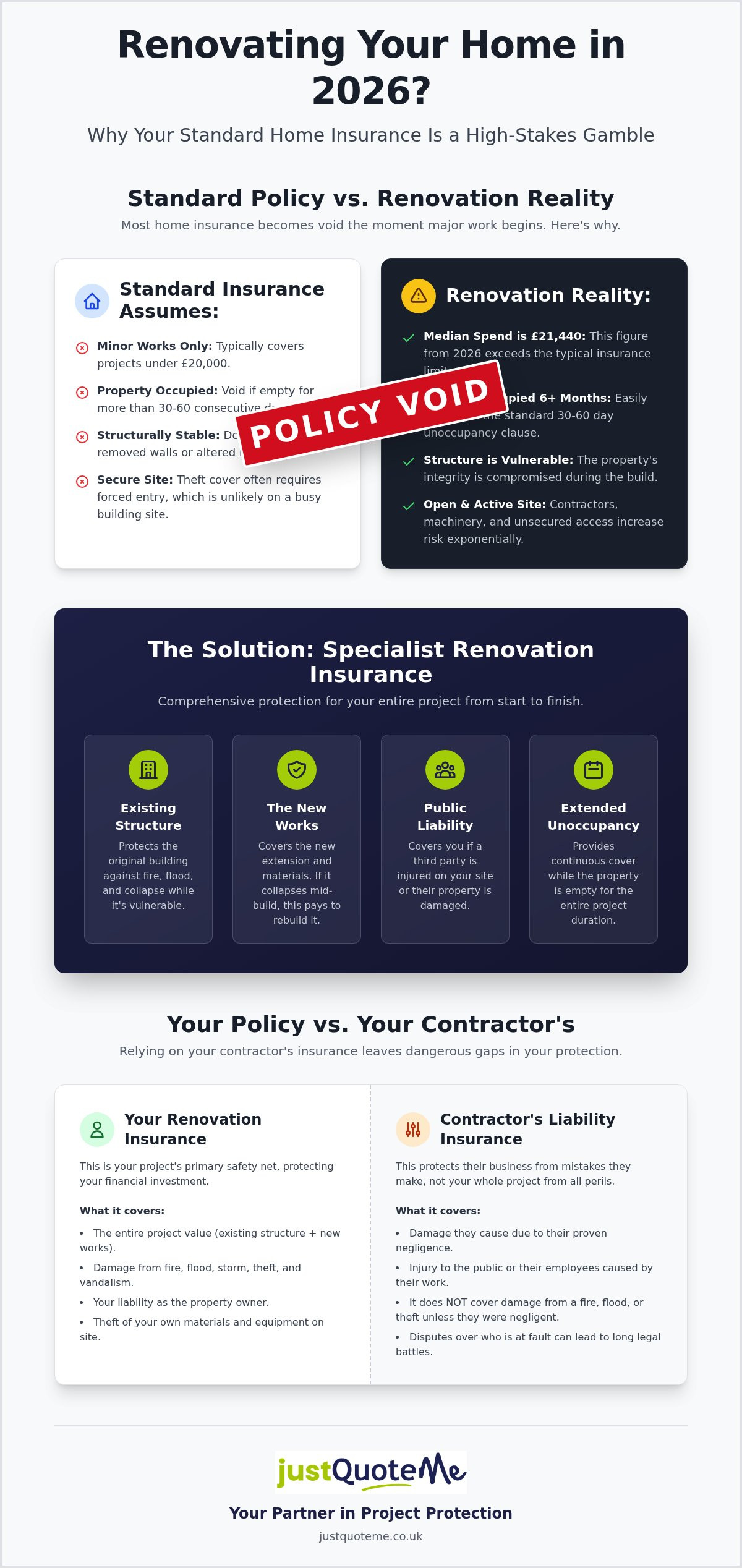
Many homeowners believe their existing buildings and contents policy provides a safety net during a build. In reality, standard home insurance is designed for properties in a finished, lived-in state. Once you introduce contractors, heavy machinery, and structural instability, the risk profile shifts beyond what a typical underwriter is willing to accept. This is where renovation insurance uk becomes essential. It acts as a specialized bridge, covering the unique hazards of a construction site while maintaining protection for the original building.
A critical concept within the UK insurance market is the “Duty of Disclosure.” You’re legally obligated to inform your insurer of any material changes to the property. Failing to mention a new extension or a loft conversion doesn’t just risk a rejected claim for the new work; it could void your entire policy. If a fire breaks out in the original kitchen while builders are working on the back of the house, and you haven’t disclosed the project, your insurer may refuse to pay out entirely.
Standard policies also contain specific exclusions that trigger the moment work begins. Most will not cover theft unless there’s clear evidence of forced and violent entry. In a busy site where doors are often left unlocked or windows are removed, this leaves you exposed. Additionally, accidental damage caused by tradesmen is almost universally excluded from personal home insurance. While you might expect your contractor’s builders insurance to cover these mishaps, relying on their policy alone is a high-risk strategy that often leads to legal disputes.
The Structural Alteration Trap
The definition of “renovation” varies wildly between insurers. Simple cosmetic updates like painting or fitting a new carpet rarely require specialized cover. However, the moment you remove a load-bearing wall or alter the roofline, you’ve entered the structural alteration trap. Underwriters view these changes as high-risk because they compromise the integrity of the building. Without specific renovation cover, you may find yourself with “partial cover,” where the insurer protects the existing walls but excludes any damage resulting from the new works.
Property Unoccupancy Rules in 2026
One of the biggest traps for long-term projects is the unoccupancy clause. Most UK home insurance policies only permit a property to be empty for 30 or 60 consecutive days. Given that the average full house renovation in 2026 can take six months or longer, this limit is easily exceeded. Renovation insurance extends this protection, though it often comes with strict security requirements. You may be required to inspect the site every 14 days and ensure all utilities are turned off to prevent water damage or electrical fires while the site is vacant.
If you are planning to vacate the property and need to move your furniture into storage to protect it from dust and damage during the build, you can find out more about professional removal services from AMS Removals.
Key Components of Renovation Insurance: What is Actually Covered?
Understanding what a specialist renovation insurance policy actually includes is vital for any project. It’s more than just a safety net; it’s a comprehensive shield for your capital. When you secure renovation insurance uk, you’re buying a bundle of specific protections. The most fundamental part is Existing Structure Cover. This protects the original walls, roof, and foundations against catastrophic events like fire, flood, or storm damage while the building is vulnerable. Simultaneously, The Works section of your policy covers the new parts of the building. If a half-finished extension collapses during a gale, this is the component that pays for the rebuild.
Beyond the bricks and mortar, you must consider the legal risks. Property Owner Liability is often overlooked but remains essential. If an accident occurs on your land, the legal responsibility often rests with you as the property owner. Even if you’ve hired a professional firm, you could still be named in a lawsuit if a third party is harmed.
Public Liability for Homeowners
You’re legally liable for accidents on your property. Integrating public liability insurance into your renovation plan is a non-negotiable step for 2026. Consider a scenario where a passerby is injured by falling scaffolding or a neighbor’s car is damaged by debris. Without specific liability cover for the project, you could be personally responsible for thousands of pounds in legal fees and compensation. Many homeowners mistakenly assume their builder’s policy covers everything. However, if the builder’s insurance has lapsed or is insufficient, the claim will inevitably land at your door.
Managing these risks requires a nuanced approach. If you’re unsure about the specific limits your project needs, you can speak with a specialist broker to tailor your coverage.
Covering Materials on Site
A renovation site is a magnet for theft. High-value items like boilers, copper piping, and luxury kitchen fixtures are often delivered days before installation. Materials and Plant cover ensures these expensive supplies are protected from theft or damage while they sit in storage or on-site. It’s important to remember that your builder’s tools aren’t usually covered by your renovation insurance uk. Contractors are responsible for their own equipment, but once a kitchen island or a pallet of timber is delivered to your address, the financial risk often shifts to you. Ensuring these materials are insured during transit and while stored on-site prevents a single theft from derailing your entire budget.
Renovation Insurance vs. Contractors All Risk: Which Do You Need?
A common pitfall for UK property owners is assuming that a builder’s public liability policy is a substitute for comprehensive renovation insurance uk. While these products seem similar, they serve entirely different purposes. A builder’s insurance protects the contractor against claims of negligence; it doesn’t necessarily protect your property from damage where no fault is found. For larger developments or complex structural projects, contractors all risk insurance offers a more robust framework, covering the entire project cost and existing structures on an “all risks” basis.
According to the British Insurance Brokers’ Association (BIBA), relying solely on a contractor’s cover is a high-risk strategy. If your builder goes out of business mid-project or their policy has expired without your knowledge, you’re left with zero protection. Project-specific insurance puts the control back in your hands, ensuring the policy remains active regardless of the contractor’s status.
The Limits of Builder Liability
Builders insurance is primarily a liability product. It only triggers a payout if the contractor is proven to be legally negligent. This creates a significant gap for “Acts of God” or accidental events. For instance, if a violent storm causes a partial collapse of an exposed wall during the build, and the contractor followed all safety protocols, their insurance likely won’t pay out. You need a policy that covers the physical assets of the build itself, not just the builder’s mistakes. This ensures that if the unexpected happens, you have the funds to clear the site and start again without a legal battle over who is to blame.
Benefits of Joint Names Insurance
In the UK renovation market, a “Joint Names” policy is frequently considered the gold standard. This legal arrangement lists both the homeowner and the main contractor on the same policy. It effectively prevents the insurance company from suing the contractor to recover costs after a claim, which simplifies the resolution process. This unified approach is often a mandatory requirement for mortgage lenders. If you’re using a loan to fund your extension, your bank will likely insist on seeing a policy that protects their interest in the property. Listing both parties ensures that all stakeholders are protected under one umbrella, preventing delays and reducing the administrative burden on you as the project manager.
Calculating the Risk: Factors That Influence Your Premium in 2026
Underwriters use a specific set of criteria to determine the cost of renovation insurance uk. The most significant factor is the total “sum insured.” This isn’t just the builder’s quote for the new extension; it’s the combined value of the existing structure and the projected cost of the works. If you’re renovating a £400,000 home with a £100,000 build budget, the insurer views the total risk as £500,000. Because standard policies often cap renovation cover at £20,000, any project exceeding this threshold requires a recalculated premium based on this total exposure.
Duration also plays a critical role in pricing. Most UK brokers offer policies in six-month blocks, which has become the industry standard. While you might expect to finish in four months, 2026 market data suggests that labor shortages often push timelines back. It’s usually more cost-effective to buy a six-month policy upfront than to pay for expensive monthly extensions later. Regional location matters too. Properties in Staffordshire and the West Midlands may face different risk profiles regarding accessibility for emergency services or local crime rates compared to other regions, which we factor into every bespoke quote.
Structural Complexity and Risk
The type of work dictates the premium more than almost any other factor. A loft conversion is generally seen as lower risk than a basement excavation. Deep excavations carry a high probability of structural movement, which underwriters price accordingly. If your project involves working at height, such as roof replacements or multi-storey extensions, expect this to be reflected in the quote. You should also verify that your architects and structural engineers carry their own professional indemnity insurance. This ensures that if a design flaw causes a collapse, their policy handles the liability rather than your renovation cover.
Site Security and Mitigation
You can actively lower your premiums by demonstrating proactive risk management. Perimeter fencing and monitored CCTV systems are strong signals to insurers that you’re protecting the site from theft. Site cleanliness is another factor; a tidy site reduces the chance of trips or fires. If your builders use blowtorches or welding equipment, insurers will insist on “Hot Works” permits. These permits require specific fire safety protocols to be met before work starts. Implementing these measures doesn’t just keep you safe; it makes your project more attractive to top-tier underwriters. To get a tailored price for your specific project, get a bespoke insurance quote from our expert team.
Securing Your Project with Just Quote Me: Bespoke Protection
Choosing the right partner for renovation insurance uk is just as critical as selecting your lead architect. Just Quote Me brings over 30 years of industry experience to your construction project, providing the steady hand needed in a complex market. We aren’t a faceless comparison site that relies on rigid, automated algorithms. Instead, we act as an independent broker with access to a broad network of the UK’s top insurers. This independence allows us to find bespoke solutions that generic systems often overlook. For homeowners in Staffordshire and the West Midlands, we provide regional expertise from a team that understands local property values and construction risks. We manage the complex administrative burdens of securing builders insurance so you can focus entirely on your build.
Expert Advice for Complex Projects
Complex renovations require more than a standard tick-box exercise. Whether you’re planning a high-value extension or a complete restoration, we provide access to a specialized panel of underwriters. This ensures you receive competitive rates even for high-risk works like structural alterations or listed building repairs. For self-build enthusiasts who are managing their own sites, we can tailor tradesman insurance packages to cover specific phases of the work. Our approach remains human-centric. You won’t be stuck in a loop with a chatbot. You’ll speak directly to an expert who explains the nuances of your policy in plain, honest language. We believe that professional restraint and clarity build more trust than hyperbolic marketing speak.
Ready to Protect Your Home?
Timing is everything when protecting a site. You should engage with a broker long before the first brick is moved or the first skip arrives on your driveway. Securing your renovation insurance uk early prevents dangerous gaps in cover that arise if your standard insurer cancels your policy mid-build. Getting started is straightforward. We offer a frictionless experience designed to move you quickly from inquiry to a firm quote. Our goal is to provide enough detail to build your confidence without overwhelming you with unnecessary technical jargon. Just Quote Me to secure the most competitive rates and protect your investment with a trusted advisor who understands the UK construction sector inside out.
Get Your Free Business Insurance Quote now
Secure Your Property Investment for 2026
Navigating a renovation isn’t easy, and it shouldn’t be done under the looming fear of an uninsured loss. Relying on standard home insurance or assuming your builder’s policy covers every eventuality is a significant risk that could leave your equity exposed. Protecting your project with dedicated renovation insurance uk ensures that both the existing structure and your new works are shielded from the unexpected, from structural failure to site theft. Whether you are planning a simple loft conversion or a complex basement excavation, having the right legal and financial protections in place is non-negotiable. Just Quote Me brings 30+ years of industry experience and specialist construction sector knowledge to every project. As an FCA authorised independent broker, we focus on providing bespoke solutions that fit your specific build scale and regional requirements. We handle the administrative complexities so you can focus on the transformation of your home. Start your build with total peace of mind knowing your investment is secure.
Get Your Free Business Insurance Quote now
Request a Call back for free Expert advice
Frequently Asked Questions
Do I need renovation insurance for a small kitchen refit?
You usually don’t need specialist cover for minor cosmetic updates. Most standard UK home insurance policies allow for small scale works, often up to a value of £20,000, without changing your terms. However, you must still disclose the project to your insurer. If the refit involves structural changes, such as removing a wall to create an open plan space, you’ll likely need to switch to a dedicated renovation policy.
What happens if my builder doesn’t have enough insurance?
If your builder’s insurance is insufficient, you face significant personal financial risk. Should a major accident occur that exceeds their public liability limit, the legal claim will often be directed at you as the property owner. Dedicated renovation insurance uk acts as a secondary layer of protection. It ensures that your investment remains secure even if your contractor’s policy proves inadequate, has lapsed, or doesn’t cover the specific damage caused.
Can I get renovation insurance if my property is already empty?
Yes, specialist renovation policies are specifically designed for unoccupied properties. Standard home insurance typically becomes invalid if a property is left empty for more than 30 or 60 consecutive days. Renovation cover accounts for this vacancy, providing protection while the site is under construction. You’ll simply need to comply with specific security conditions, such as regular site inspections and ensuring the property is properly secured against intruders or weather damage.
Does renovation insurance cover structural collapse?
Structural collapse is one of the primary reasons homeowners invest in this specialized cover. Standard policies almost always exclude damage resulting from structural alterations or building works. Renovation insurance is built to bridge this gap. It protects both the original building and the new works if the structure fails during the project, provided the cause is a covered peril. This gives you essential peace of mind when undertaking high risk structural changes.
How much does renovation insurance cost in the UK?
The cost of renovation insurance uk is determined by the unique risk profile of your specific project. Underwriters calculate the premium based on the total sum insured, which includes the rebuild value of the existing home plus the cost of the new works. Other factors include the project duration and the complexity of the build, such as basement excavations. We provide bespoke quotes tailored to your project’s scale to ensure you aren’t overpaying for cover.
Is public liability included in renovation insurance?
Public liability is a standard and essential component of most renovation policies. It protects you against legal claims if a third party is injured or their property is damaged because of your building project. This is vital because, as the property owner, you can be held legally responsible for accidents on your site. Even if your builder has their own liability insurance, having your own project specific cover ensures you are fully protected against legal costs.
What is the difference between refurbishment and renovation insurance?
Refurbishment typically refers to cosmetic work like installing a new bathroom, rewiring, or decorating. Renovation usually implies more significant structural changes, such as extensions or loft conversions. While the terms are often used interchangeably, insurers distinguish between them to assess risk. Projects involving structural alterations are viewed as higher risk and require more robust coverage than a simple refurbishment, which might only require a minor adjustment to a standard home policy.
Will my mortgage lender require specific renovation cover?
Most UK mortgage lenders will mandate that you have adequate insurance in place before work begins. Since the property acts as security for their loan, they want to ensure its value is protected during high risk construction phases. Lenders often specify that the policy must be in “Joint Names” with the contractor. This protects the lender’s interest and ensures that the funds are available to repair the property if a major incident occurs during the build.
