

Would your current policy survive a legal challenge if a split-second physical intervention was flagged as an “intentional act” by an underwriter? For many in the security sector, the reality of close protection insurance is a mix of high premiums and the nagging fear that a claim might be rejected when it matters most. You’re operating in an environment where the average industry claim has reached £23,884, and your clients expect more than just a basic certificate of cover. They want the certainty that you’re protected against every eventuality, from London details to complex international assignments.
It’s understandable to feel frustrated by the complexity of territory limits and the fine print of liability clauses. This guide helps you master these intricacies to ensure your business stays fully protected against high-stakes risks. We’ll break down the 2026 SIA standards and explain how to secure comprehensive legal protection that meets the demands of high-end contracts. By the end, you’ll have the peace of mind to focus on your duty, knowing your professional liability is handled with precision and care.
Key Takeaways
- Understand why standard liability policies often exclude “intentional acts,” leaving your business exposed during physical interventions.
- Identify the “Big Three” pillars of liability that protect your personnel, your clients’ assets, and the professional advice you provide.
- Learn how to calibrate your close protection insurance for international assignments, including specific territory limits for the EU and worldwide travel.
- Master the critical differences between use of force, wrongful arrest, and efficacy clauses to ensure your policy performs during a high-stakes claim.
- Discover why partnering with an independent broker offers a tactical advantage over automated quote engines when securing bespoke security cover.
Close Protection Insurance: Why Standard Cover Isn’t Enough
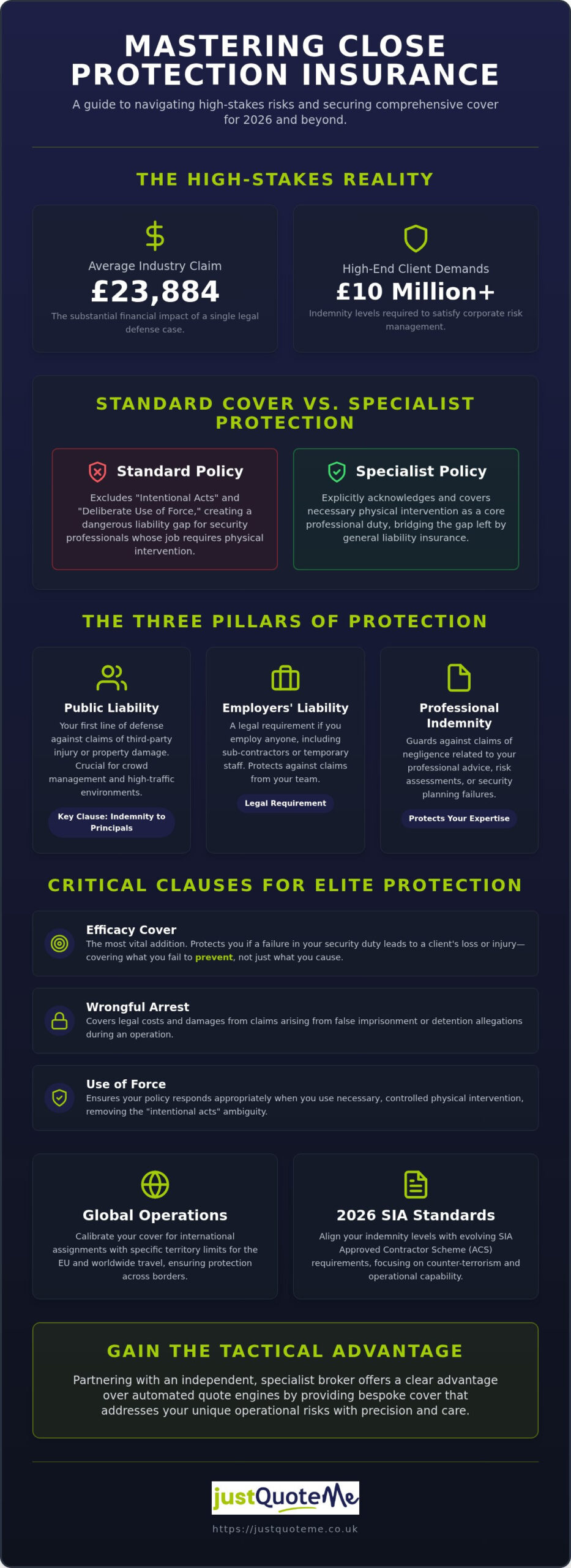
Close protection insurance is a specialised suite of covers designed to address the unique legal, physical, and financial risks inherent in the private security industry. While a standard business policy might suffice for a retail shop, it often fails the moment a security professional has to intervene physically. Most general liability policies contain strict exclusions for “intentional acts” or the “deliberate use of force.” In your line of work, physical intervention isn’t an accident; it’s a controlled response to a threat. If your policy doesn’t explicitly account for this, you could find yourself personally liable for legal fees and damages.
General liability policies often treat “intentional acts” as a deal-breaker. In the security world, this is a dangerous oversight. If you have to restrain an individual to protect your principal, that is an intentional act. If your insurer classifies it as such under a standard policy, they may refuse to pay out. Specialist security insurance bridges this gap by acknowledging that your professional duties involve necessary physical intervention.
The Security Industry Authority (SIA) sets the bar for professional standards, but holding a licence is only the first step. In 2026, both individual contractors and large firms need to ensure their indemnity levels align with the evolving SIA Approved Contractor Scheme (ACS) requirements. These standards increasingly focus on operational capability and counter-terrorism awareness, making specific close protection insurance a prerequisite for high-tier contract compliance.
The High-Stakes Nature of Private Security
There’s a significant gap between “standard security” risks and the duties of a close protection officer. High-net-worth clients and corporate entities don’t just hire you for your presence; they hire you for your ability to manage high-stakes liability. These clients often demand specific indemnity levels, sometimes exceeding £10 million, to satisfy their own risk management protocols. With the average security guard insurance claim reaching £23,884 in 2026, the financial impact of a single legal defense case is substantial. Without bespoke cover, these costs can easily bankrupt a smaller agency or an independent contractor.
Core Components of a Professional Policy
A robust insurance package should go beyond basic Public Liability. You also need to consider how different covers interact to create a complete safety net:
- Public Liability: Covers injury to third parties or damage to property during your operations.
- Employers Liability: A legal requirement if you employ others, even on a sub-contracted or temporary basis.
- Professional Indemnity: Protects you against claims of negligence regarding your professional advice, risk assessments, or security planning.
One of the most critical additions for any security firm is “efficacy cover.” Efficacy cover ensures you’re protected if your failure to perform a specific security duty results in a client suffering a loss or injury. Without this specific clause, a standard policy might only cover you if you *cause* damage, rather than if you fail to *prevent* it.
The “Big Three” Pillars of Close Protection Liability
Effective close protection insurance relies on three distinct layers of coverage that work in tandem to create a comprehensive safety net. While one policy might protect your physical actions, another guards your professional reputation and your legal obligations to your team. Most high-end contracts in 2026 now stipulate a minimum of £5 million or £10 million in indemnity to ensure adequate protection against catastrophic loss. Standard public liability insurance for security companies in the UK often starts at £1 million, but for close protection, these limits are usually scaled upward to meet the specific demands of corporate or high-net-worth clients.
Public Liability for Close Protection
Public liability is your first line of defense against claims involving third-party injury or property damage. For a CPO, vulnerability often peaks during crowd management or when operating in high-traffic environments where a principal’s movement might inadvertently cause harm to a bystander. Including an “indemnity to principals” clause is vital; it ensures your protection extends to the client if they’re held liable for your actions during an operation. Many international guidelines for professional liability for security agencies emphasize this as a non-negotiable standard for operational safety. You can find more detail on how this covers third-party risks by visiting our Public Liability Insurance page.
Employers Liability for Security Firms
If you run a firm that utilizes sub-contractors or employees, Employers Liability Insurance is a legal mandate in the UK. This cover is essential because close protection staff face significant physical risks that aren’t present in other sectors. In the UK, employer’s liability is typically set at a £10 million limit. If a team member is injured while performing protective duties, this policy covers the resulting legal costs and compensation. Failing to have this in place isn’t just a risk; it’s a criminal offense that can lead to severe daily fines for your business.
Professional Indemnity: Protecting Your Expertise
While public liability covers physical incidents, Professional Indemnity Insurance protects your intellectual output. This includes your risk assessments, security planning, and consultancy advice. Professional Indemnity is a core part of comprehensive close protection insurance because it covers the “brain” of your operation. If a client suffers a loss because they followed your flawed security strategy, they may sue for professional negligence. High PI limits are particularly crucial for surveillance operations where a breach of privacy or a tactical error could lead to significant financial repercussions. if you need to clarify which limits your specific contract requires, you can speak with a security broker to get tailored advice.
Addressing Critical Risks: Use of Force, Wrongful Arrest, and Efficacy
Operating in high-risk environments means your actions are often deliberate and tactical rather than accidental. This creates a significant hurdle with standard liability policies, which typically exclude “intentional acts.” In the context of close protection insurance, this exclusion is a critical failure point. If you must use physical intervention to extract a principal from a threat, an underwriter might argue the act was intentional and refuse the claim. To avoid this, your policy must be explicitly endorsed to cover the deliberate use of force, ensuring that a justified response isn’t disqualified as an unprovoked assault.
Efficacy and “Failure to Perform” clauses are equally vital in 2026. While standard public liability covers you if you cause damage, efficacy cover protects you if you fail to prevent it. If a breach in your security perimeter leads to a client’s injury or loss, efficacy cover is what stands between your firm and a devastating negligence claim. This protection must align perfectly with your specific Rules of Engagement (ROE). If your operational reality involves higher risk than your policy describes, you leave yourself exposed to rejected claims.
Navigating Use of Force Claims
The legal distinction between a justified physical intervention and a criminal assault often hinges on documentation and proof of training. Your insurance must include specific wording for “deliberate acts” to reflect the reality of modern bodyguarding. Detailed SIA training records serve as vital evidence to support insurance claims by proving that physical interventions were conducted within legal and professional guidelines. Following the Official SIA Licence Application Guidance ensures you have the foundational credentials that underwriters require before they will even consider covering high-risk physical intervention scenarios.
Wrongful Arrest and Slander Coverage
Security teams are frequently vulnerable to claims of illegal detention or false imprisonment. Even a brief delay of an individual can lead to a lawsuit if that person feels their civil liberties were compromised. Close protection insurance should include specific provisions for wrongful arrest and slander to protect both your finances and your professional reputation. In modern insurance terms, “Personal Injury” coverage often extends beyond physical harm to include psychological damage, libel, or libelous statements made during an incident. This ensures that even if a physical confrontation never occurs, your business is protected against the legal fallout of a verbal or procedural dispute.
Ensuring these covers are in place allows you to operate with confidence. When your policy matches your ROE, you don’t have to second-guess your training in a crisis. If you are unsure whether your current wording covers these specific scenarios, it’s worth reviewing your documents with a specialist who understands the nuances of the security sector.
Bespoke Considerations: International Travel and Niche Services
Close protection insurance must be as mobile as the principals you protect. If your operations extend beyond the UK, your policy needs to reflect those geographical boundaries precisely. Underwriters typically categorise territory limits into three tiers: UK-only, European, and Worldwide. It’s common to see “Worldwide excluding USA and Canada” as a standard offering, primarily because the legal costs in North America are significantly higher. If your contract involves travel to these regions, you must ensure your policy is explicitly extended to avoid a total loss of cover during the assignment.
Global Deployment and Territory Extensions
When working internationally, standard exclusions for “War and Terrorism” can leave a team exposed in volatile regions. These clauses are often non-negotiable in basic policies, but they can be managed through specialist extensions for hostile environments. You should also verify if your policy includes medical evacuation and repatriation cover. If a team member is injured in a remote location, the costs of a private medevac can reach six figures. Ensuring these provisions are in place is a tactical necessity for any firm operating outside of stable jurisdictions.
Specialist Security Services
Many modern close protection roles overlap with technical niche services. For example, if your team performs technical surveillance counter-measures (TSCM) or physical security sweeps, you might find yourself in unconventional positions. If these sweeps involve accessing rooftops, gantries, or elevator shafts, you should consider Working at Height Insurance to bridge the gap in your standard liability cover.
Surveillance and private investigation work also introduce GDPR and privacy breach risks. In 2026, lawsuits for “invasion of privacy” or data mismanagement are becoming more frequent. Your professional indemnity needs to be robust enough to cover the legal defense costs associated with these civil claims. Similarly, if your service includes chauffeuring high-value individuals, integrating your motor fleet insurance with your personal protection policy ensures there are no gaps in cover during transit. This prevents the “grey area” disputes that often arise between separate motor and liability insurers after a road incident.
Maritime security adds another layer of complexity. Anti-piracy work and transit protection in international waters require bespoke wording that addresses maritime law and the specific risks of armed or unarmed intervention at sea. These are not standard features and must be negotiated individually. Managing these diverse risks requires a partner who understands the nuances of global security work. You can get a bespoke security insurance quote today to ensure your international operations are fully protected.
How to Secure a Bespoke Close Protection Quote in 2026
Using automated quote engines for high-stakes security work is a gamble. These platforms use rigid algorithms that often can’t distinguish between a residential patrol and high-risk close protection insurance. If the system doesn’t understand your specific operational environment, it will either overprice the risk or, worse, provide a policy with hidden exclusions that leave you exposed during a claim. Algorithms don’t understand risk. Only people do.
The Broker Advantage: Human Expertise vs. Algorithms
At Just Quote Me, we operate as a human-centric alternative to these automated systems. With over 30 years of experience, we navigate the UK market by negotiating directly with a panel of specialist underwriters who understand the nuances of CPO work. This is particularly valuable for firms in Staffordshire and the West Midlands, where our regional expertise allows us to provide a more personalised service than impersonal national providers. We also manage mid-term adjustments, ensuring your cover stays compliant as you take on new contracts with different liability requirements.
Next Steps for Your Security Business
Securing the best premiums for close protection insurance requires more than just filling out a form. You should prepare a detailed risk assessment and a professional CV highlighting your team’s specific training and operational history. Showing an underwriter that you have robust protocols for use of force and efficacy makes your business a more attractive risk. We know the market. We can help you present your business in the best light. Before your next renewal, take the following steps:
- Review your current policy for “efficacy” and “use of force” gaps.
- Prepare your training certifications and operational logs for review.
- Consult with a broker who understands the 2026 SIA standards.
Ready to ensure your business is fully protected? Get Your Free Business Insurance Quote now to see how we can tailor a policy to your exact needs. If you prefer a more personal approach or have complex questions about international territory limits, Request a Call back for free Expert advice from our dedicated team.
Future-Proofing Your Security Operations
Operating in the high-stakes world of private security requires more than just physical skill; it demands a strategic approach to risk management. As we’ve explored, ensuring your policy addresses the “intentional act” dilemma and provides robust efficacy cover is the difference between a protected business and a vulnerable one. By aligning your close protection insurance with your specific rules of engagement and geographical reach, you build a foundation of reliability that high-net-worth and corporate clients demand in 2026.
While professional liability is the priority for your business, personal financial security shouldn’t be overlooked. For individuals working in these high-stakes environments, Special Risk Term provides an essential service by securing life insurance for those in hazardous occupations who are often rated or declined by traditional providers.
Just Quote Me provides the steady hand you need in this complex market. Our team acts as a trusted advisor, managing administrative burdens so you can focus on your duty. With over 30 years of experience as an FCA-authorised independent broker, we offer bespoke solutions that automated systems simply can’t match. We understand the nuances of the security sector and are committed to simplifying your insurance journey with professional restraint and honesty.
Get Your Free Business Insurance Quote now
Request a Call back for free Expert advice
Frequently Asked Questions
Is close protection insurance a legal requirement in the UK?
Employers Liability insurance is a legal mandate if you hire staff or sub-contractors. While Public Liability isn’t a statutory requirement for all, it’s virtually impossible to win high-end contracts or maintain SIA Approved Contractor status without it. Most clients expect at least £5 million in cover to protect against third-party risks during an operation.
Does my policy cover me if I work outside the UK?
Coverage depends on your specific territory limits. Standard policies usually cover the UK or EU, but worldwide extensions are necessary for international details. If your work involves travel to the USA or Canada, you must inform Just Quote Me, as these jurisdictions require specialised underwriting due to significantly higher legal costs.
What is efficacy cover and why do I need it for security work?
Efficacy cover protects you against claims where you failed to prevent an incident. While standard liability covers you if you cause damage, efficacy is vital for security work because it addresses the failure to provide the promised protection. This is often the most important clause in close protection insurance for 2026 contracts.
Can I get insurance if I use physical intervention in my role?
Yes, but your policy must explicitly include “deliberate acts” or “use of force” wording. Standard business insurance typically excludes intentional physical contact, which can lead to rejected claims. We ensure your policy is tailored to cover justified physical intervention, provided it aligns with your training and legal use-of-force guidelines.
How much does close protection insurance typically cost?
Minimum premiums for combined security liability schemes typically start around £1,500 plus fees. The final cost depends on factors like your turnover, the number of officers on the team, and whether you operate in high-risk international territories. Specialist brokers can often secure better rates by presenting your risk management protocols to underwriters.
Does the policy cover my equipment, like radios and body armour?
Liability insurance usually only covers third-party damage or injury. To protect your radios, body armour, and surveillance equipment, you need to add “All Risks” or “Business Contents” cover to your policy. This ensures you’re reimbursed if your essential kit is lost, stolen, or damaged during an operation or while in transit.
What happens if a client sues me for professional negligence?
Your Professional Indemnity cover will handle the legal defense and any resulting damages awarded to the client. This is crucial if a client claims your security advice or risk assessment was negligent, leading to a financial loss. It protects your business capital and personal assets from being drained by expensive litigation.
