
If you import goods from overseas to sell online, you aren’t just a distributor in the eyes of the law; you are the manufacturer. This legal shift means that if a faulty product causes harm, the responsibility rests squarely on your shoulders, not a factory located thousands of miles away. It’s natural to feel overwhelmed by the complex insurance mandates from platforms like Amazon and Walmart, especially when your personal assets are at risk. Finding the right product liability insurance for e-commerce seller needs shouldn’t feel like a legal maze.
Master the complexities of product liability and secure the right protection for your online business with our expert buying guide. We understand that you need to meet strict platform requirements, such as Amazon’s $1 million coverage threshold, while managing the unique risks of global sourcing. This guide explores the essential coverage types for 2026, explains why importers face heightened liability, and provides a clear path to securing a bespoke policy that fits your specific business model. By the end, you’ll have the confidence to grow your brand knowing your assets are fully protected.
Key Takeaways
- Understand why product liability is essential for protecting your personal assets against claims of injury or property damage caused by the items you sell.
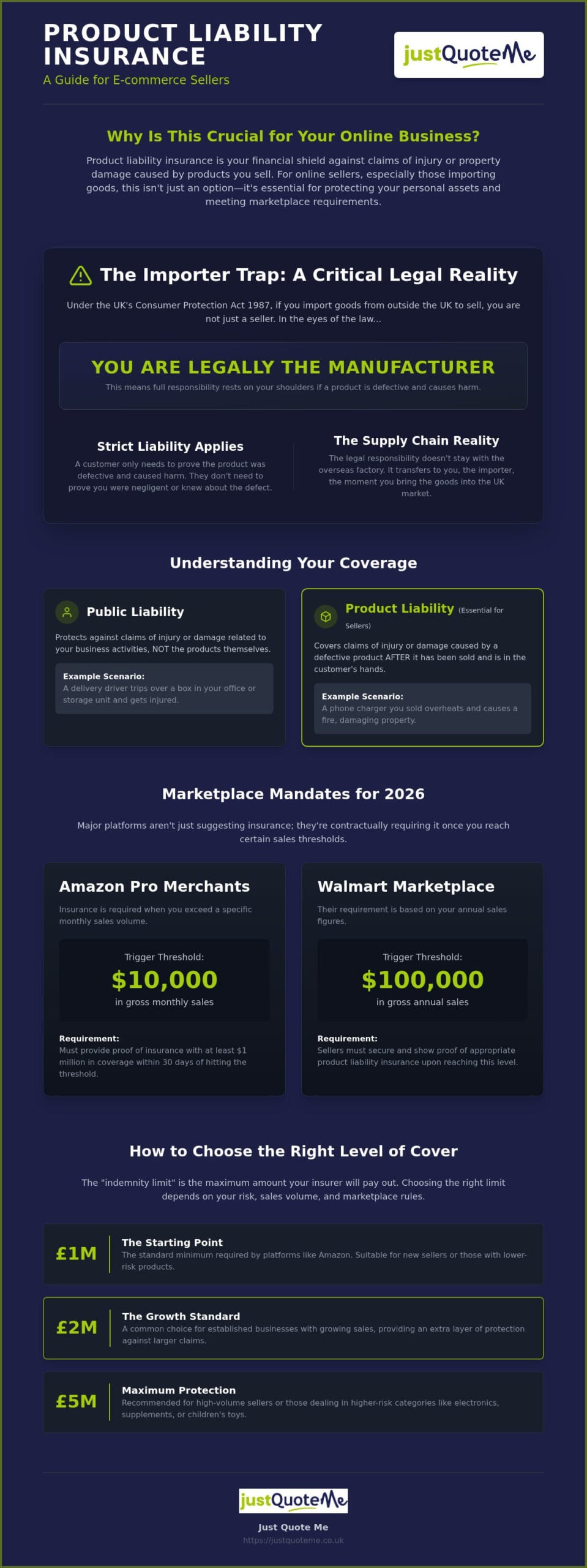
- Learn why importing goods from outside the UK places the same legal responsibilities on your business as a manufacturer under the Consumer Protection Act.
- Navigate the 2026 insurance mandates for major marketplaces, including the specific sales thresholds that trigger compulsory coverage for Amazon Pro Merchants.
- Discover how to calculate the correct indemnity limit for your product liability insurance for e-commerce seller requirements, ranging from £1 million to £5 million.
- Find out how a bespoke approach from a specialist broker simplifies the administrative burden while ensuring your policy meets specific platform standards.
What is Product Liability Insurance for E-commerce Sellers?
In the UK, product liability is the area of law that dictates who is responsible when a consumer is harmed by a defective item. For an online business, product liability insurance for e-commerce seller protection acts as a shield against claims involving personal injury or property damage. If a product you sold causes a house fire due to a faulty battery or leads to a severe allergic reaction because of a missing label, you are the one the legal system looks to for compensation. This insurance covers the legal costs of defending your business and the eventual settlement if you’re found liable.
The 2026 e-commerce landscape is more complex than ever. With global supply chains becoming the norm, the distance between the factory and the final customer has grown, but the legal responsibility has stayed local. Common claims often involve items you might consider low risk. For instance, a simple phone charger that overheats and causes a fire, a toy with a small part that becomes a choking hazard, or a dietary supplement that causes an undisclosed adverse reaction can all lead to six-figure lawsuits. Without a robust policy, these claims can easily bankrupt a growing online store.
The Difference Between Public and Product Liability
It’s easy to confuse these two types of cover, but they serve very different purposes. Public Liability Insurance generally protects you against claims of injury or damage that happen in connection with your business activities or on your premises. If a delivery driver trips over a box in your home office, that’s a public liability issue. However, once a product is sold and leaves your possession, it falls under product liability. This “after-sale” protection is the most critical element for e-commerce sellers because your primary risk isn’t who visits your office; it’s the thousands of items you’ve sent out into the world. Most specialist e-commerce policies bundle these together to ensure there are no gaps in your protection.
Is Product Liability Insurance a Legal Requirement?
Unlike Employers Liability Insurance, which is a statutory requirement if you have staff, product liability isn’t strictly required by UK law. However, it’s effectively mandatory for most professional sellers due to contractual obligations. Major platforms have strict rules. For example, Amazon requires sellers to provide proof of insurance within 30 days of hitting $10,000 in monthly gross proceeds. Walmart Marketplace sets its threshold at $100,000 in annual sales. Even if you don’t use these platforms, the financial risk of going uninsured is immense. In a litigious market, a single faulty batch of products could result in multiple claims that target your personal assets if your business isn’t properly protected.
The Importer Trap: Why Your Business Model Dictates Your Risk
Many online entrepreneurs believe they are shielded from lawsuits because they don’t physically manufacture the products they sell. This is a dangerous misconception. Under the Consumer Protection Act 1987, if you import goods from outside the United Kingdom, you are legally treated as the manufacturer. This means that in a courtroom, you hold the same level of responsibility as the factory that actually produced the item. While seeking common kinds of business insurance is a standard step for any startup, e-commerce sellers must look deeper into how their sourcing affects their legal standing.
The legal principle of “Strict Liability” is at the heart of this risk. Unlike other areas of law where a claimant must prove you were negligent, strict liability only requires the claimant to prove that the product was defective and that it caused them harm. They don’t need to show that you knew about the defect or that you failed to check the item. If you brought the product into the UK market, the buck stops with you. Identifying who is the “Producer” versus the “Seller” is a critical step in setting up your business correctly. Getting a policy that reflects your actual business model is vital; you can consult with our team to ensure your coverage matches your supply chain reality.
Insurance for Dropshippers
Dropshipping is often marketed as a low-risk business model, but from a liability perspective, it carries significant weight. Even if you never touch the product or store it in a warehouse, you remain the “contractual seller” in the eyes of the consumer. If an item dropshipped from an overseas supplier causes an injury, the customer will sue the person they paid: you. Finding specific product liability insurance for e-commerce seller needs is essential for dropshippers to ensure their policy explicitly covers items dispatched directly from third-party suppliers.
White-Labeling and Re-branding Risks
Placing your own logo on a generic product is a popular way to build a brand, but it also shifts 100% of the liability to your business. By “holding yourself out” as the manufacturer through branding, you waive the ability to pass the blame to the original factory. You must verify that your suppliers hold valid testing certifications, such as UKCA or CE marks, to ensure the products meet safety standards. Under the Consumer Protection Act, re-branders face strict liability for any defects because the law views the brand owner as the primary producer of the goods. This makes having the right product liability insurance for e-commerce seller protection a non-negotiable part of your brand-building strategy.
- Supply Chain Transparency: Always document your original sources and keep copies of safety certificates.
- Contractual Indemnity: Where possible, ensure your supplier contracts include clauses that protect you, though these are often difficult to enforce with overseas factories.
- Batch Tracking: Maintain records of batch numbers to limit the scope of a potential recall.
Platform Requirements: Amazon, Etsy, and eBay Insurance in 2026
Major e-commerce platforms operate as marketplaces, not manufacturers. To protect their own interests, they increasingly shift the burden of liability onto the individual seller. While these platforms provide the digital storefront, they don’t provide a safety net for your personal assets. Obtaining e-commerce business insurance has transitioned from a recommendation to a strict requirement for high-volume sellers. If you fail to provide a valid Certificate of Insurance (COI) when prompted, platforms can and will freeze your disbursements or suspend your account entirely.
Amazon remains the most rigorous in its enforcement. As of July 2026, Amazon requires Pro Merchants to carry product liability insurance once they reach $10,000 in monthly gross proceeds. Once you hit this threshold, you have exactly 30 days to upload proof of coverage. The policy must provide at least $1 million in coverage per occurrence and in the aggregate. Providing the correct product liability insurance for e-commerce seller documentation is a precise task; the COI must explicitly name “Amazon.com Services LLC and its affiliates and assignees” as an additional insured to be accepted by their verification teams.
Amazon Insurance Accelerator and External Policies
Amazon offers an “Insurance Accelerator” to help sellers find coverage, but these off-the-shelf options aren’t always the most cost-effective or comprehensive for UK-based businesses. An independent broker can often secure a bespoke policy that offers better value while ensuring you meet the “Additional Insured” clause requirements. A critical factor for UK sellers is geographic reach. If you sell to customers in the USA or Canada, your policy must specifically include North American coverage. Many standard UK policies exclude these regions due to their high litigation costs, so you must verify this detail to remain compliant with Amazon’s global terms.
Etsy and eBay: Liability for Handmade and Vintage Goods
As of July 2026, platforms like Etsy, eBay, and Shopify do not have a formal insurance mandate for their sellers. However, the lack of a requirement doesn’t mean you lack risk. Handmade sellers face unique dangers regarding material toxicity, small-part durability, and flammable fabrics. If you sell vintage goods, the risk is even more complex because the original manufacturer may no longer exist, leaving you as the sole target for legal action. You shouldn’t rely on a standard home insurance policy. Most domestic providers exclude business activities and product-related claims, meaning a single lawsuit could leave you personally liable for damages. Secure a professional policy to ensure your business remains resilient as these platforms evolve their seller protection policies.
- Submission Tip: Ensure the name on your insurance policy matches your legal entity name on the platform exactly.
- Threshold Monitoring: Don’t wait until you hit the $10,000 mark to start shopping; the 30-day window for Amazon compliance is tight.
- Coverage Limits: While $1 million is the Amazon minimum, high-risk categories like electronics or toys often require higher indemnity levels.
Buying Guide: How to Choose the Right Level of Cover
Choosing the right level of product liability insurance for e-commerce seller needs involves more than just meeting platform minimums. While Amazon might only require a £1 million limit, your actual exposure could be much higher. Common indemnity limits are £1 million, £2 million, or £5 million. If you sell high-volume items or products with the potential for serious injury, opting for a higher limit is a pragmatic decision. You should also consider “Product Recall” cover as an optional extra. This helps manage the significant logistical and financial costs of pulling a dangerous batch of items from the market.
Several factors influence your premium. Your annual turnover is a primary indicator of risk volume. The destination of your sales also matters; selling to the US or Canada typically increases costs due to higher legal fees. Finally, the nature of the product itself is the biggest driver. Understanding the difference between “Claims-Made” and “Claims-Occurring” policies is vital. A “Claims-Occurring” policy covers you for incidents that happen during the policy period, regardless of when the claim is filed. Conversely, a “Claims-Made” policy only covers claims filed while the policy is active. Given that product issues can take years to surface, this distinction is critical for long-term security.
Assessing Your Product Risk Profile
Essential Policy Add-ons for E-commerce
In 2026, a digital storefront is as vulnerable as a physical one. Integrating Cyber Insurance protects you against data breaches and the financial fallout of website downtime. You should also consider Stock and Goods in Transit cover to protect your inventory from the moment it leaves the supplier until it reaches the customer. Business Interruption cover is another essential consideration. It provides a financial cushion if your supply chain is disrupted, such as a major fire at your primary manufacturer’s facility. To find a policy that balances cost with comprehensive protection for your product liability insurance for e-commerce seller requirements, you can get a tailored quote from our expert team today.
Securing Your E-commerce Future with Just Quote Me
Choosing the right product liability insurance for e-commerce seller needs shouldn’t be left to a generic algorithm. While comparison sites offer speed, they often lack the depth required to understand a complex online business model. A bot won’t ask about your specific sourcing in East Asia or the nuances of your white-labeling agreements. Just Quote Me provides a human-centric alternative, where 30 years of industry experience acts as your primary safeguard against administrative errors and coverage gaps. We pride ourselves on being a steady hand in a complex market, managing the heavy lifting so you don’t have to.
Our team takes a pragmatic approach to your protection. We understand that as your turnover grows, your risk profile shifts. We don’t just provide a policy; we build a partnership that evolves alongside your storefront. For sellers based in Staffordshire and the West Midlands, we offer the accessibility of a local service provider backed by the authority of an established independent broker. This regional expertise ensures we understand the specific challenges facing UK businesses in a global marketplace. It’s about more than just a certificate; it’s about having an advisor who knows your sector inside out.
Bespoke Solutions vs. Off-the-Shelf Policies
The danger of “automatic” quotes is that they often leave significant gaps in your coverage. Generic options might satisfy a platform’s basic checklist but fail when a real claim arises. We negotiate directly with a broad network of top UK insurers on your behalf. This allows us to secure terms that reflect your actual operational risks rather than a generalized industry average. Read more about our approach to Business Insurance to see how we tailor our services to different professional sectors.
Get Started with Expert Advice
Our process is designed for efficiency and clarity. From your initial enquiry to securing full cover, we manage the administrative burden so you can focus on scaling your brand. Our 30 years of experience means we’ve seen every type of claim, from minor property damage to complex international litigation. Just Quote Me and secure your business with the confidence that only expert advice can provide. We make the transition from inquiry to action seamless and logical.
Protect Your Assets and Scale with Confidence
As the e-commerce landscape evolves in 2026, the legal burden on sellers has never been higher. Whether you are navigating the importer trap under the Consumer Protection Act or meeting the strict $10,000 monthly threshold for Amazon, the right coverage is your business’s most vital asset. Relying on automated quotes can leave your personal assets exposed to long-tail risks that only a human expert can identify. Securing the correct product liability insurance for e-commerce seller needs ensures that a single faulty batch won’t derail years of hard work.
Just Quote Me brings over 30 years of brokerage experience to the table. As an FCA-authorised and independent firm, we focus on providing straightforward, reliable advice that simplifies the complex administrative burdens of online retail. Don’t leave your future to chance when you can access tailored protection designed specifically for your niche. Your growth deserves a partner who understands the nuances of the digital market. We are here to help you build a resilient e-commerce brand today. Visit Just Quote Me to see how we can support your journey.
Get Your Free Business Insurance Quote now
Request a Call back for free Expert advice
Frequently Asked Questions
Do I need product liability insurance if I sell through Amazon FBA?
Yes, you definitely need it. Amazon FBA is a fulfillment service that handles storage and shipping, but it doesn’t assume your legal liability for the products themselves. Once your monthly gross proceeds reach $10,000, Amazon requires proof of a valid policy. Failing to provide this within 30 days can lead to account suspension or held disbursements.
What happens if a customer is injured by a product I imported from China?
Under UK law, you are legally treated as the manufacturer if you import goods from outside the United Kingdom. If a customer is injured, they’ll file a claim against your business rather than the overseas factory. This makes having robust product liability insurance for e-commerce seller protection essential to cover legal defense fees and potential compensation payouts.
How much does product liability insurance cost for a UK e-commerce startup?
Premiums are calculated based on several specific factors rather than a flat rate. Insurers look at your annual turnover, the types of products you sell, and where your customers are located. High-risk items like electronics or baby products will naturally command higher premiums than books or stationery. Working with a specialist broker helps you find a bespoke rate that fits your startup’s budget.
Does my policy cover me for sales made to customers in the USA?
Coverage for the USA and Canada is usually excluded from standard UK policies unless specifically requested. These regions are considered high-risk due to their litigious legal environments and high settlement costs. If you sell to North American customers, you must ensure your broker adds a territorial extension to your policy to remain fully protected and platform-compliant.
Can I get product liability insurance if I am a sole trader?
Yes, sole traders can and should obtain this insurance. Because you and your business are the same legal entity, your personal assets are directly at risk if a claim is made against you. Specialist product liability insurance for e-commerce seller coverage provides a vital safety net that protects your home and savings from the financial fallout of a product-related lawsuit.
What is a product recall extension and do I need it?
A product recall extension covers the logistical costs of removing dangerous or defective items from the market. This includes expenses for customer notifications, shipping, and disposal of the faulty goods. If you sell batches of items where a single defect could affect hundreds of customers, this extension is a pragmatic addition to your core policy.
Will my home insurance cover my e-commerce stock and liability?
Standard home insurance policies almost always exclude business-related stock and liability claims. If you run your business from home, you shouldn’t assume your domestic provider will cover a fire caused by your inventory or a claim resulting from a product you sold. You need a dedicated commercial policy to ensure your business activities are properly recognized and protected.
How do I prove to Etsy or Amazon that I have valid insurance?
You prove your coverage by providing a Certificate of Insurance (COI) issued by your broker. For Amazon specifically, the certificate must name “Amazon.com Services LLC and its affiliates and assignees” as an additional insured. It’s critical that the business name on your policy matches the legal entity name on your seller account exactly to avoid verification delays.
