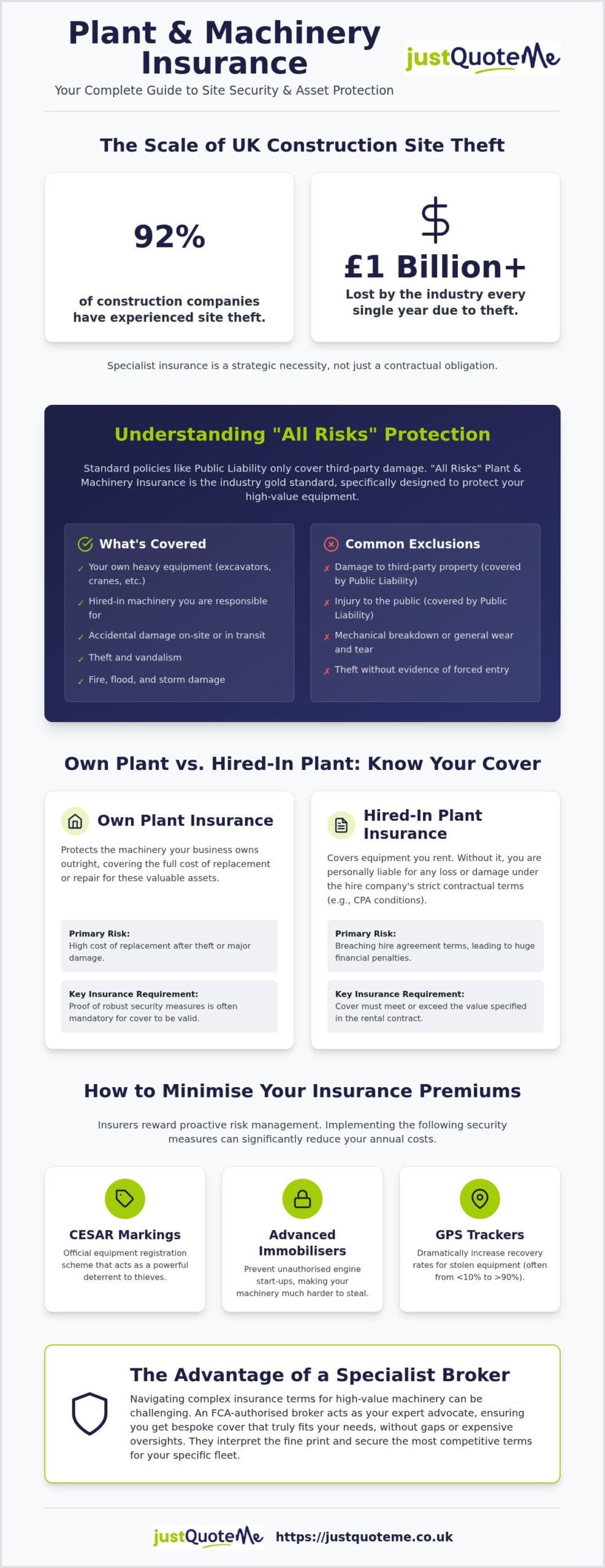
Did you know that 92% of UK construction companies have experienced site theft, contributing to an industry-wide loss of over £1 billion every year? It’s a sobering figure. This data highlights why securing the right plant and machinery insurance is a strategic necessity rather than just a box-ticking exercise. Whether you’re struggling to understand complex CPA contract obligations or facing high premiums for specialized equipment, the pressure to protect your assets while keeping projects on track is immense.
We agree that navigating these administrative burdens shouldn’t take you away from the job at hand. This guide will help you master the nuances of both own plant and hired-in equipment cover, ensuring you gain comprehensive “All Risks” protection. We will explore the latest 2026 safety regulations, explain how to ensure contract compliance, and show you how to access competitive premiums. Simply Just Quote Me to move from confusion to complete site security with expert, human-led advice tailored to your specific fleet and regional requirements.
Key Takeaways
- Learn how specialist plant and machinery insurance provides the specific “All Risks” protection that standard liability policies often exclude for heavy equipment.
- Differentiate between own plant and hired-in cover to ensure you meet strict CPA contract requirements and avoid personal liability for rented machinery.
- Discover how to reduce your annual premiums by integrating CESAR markings and advanced immobilisers into your site security strategy.
- Gain expert insight into navigating geographical limits, ensuring your assets are protected whether they are on-site, in transit, or in secure storage.
- Understand the advantage of using an FCA-authorised broker to interpret complex insurance terms and secure bespoke terms for high-value or niche machinery.
Understanding Plant and Machinery Insurance: A 2026 Overview
Plant and machinery insurance is a specialist form of protection designed to cover the high-value assets that drive the UK construction and industrial sectors. While standard policies might cover small hand tools, this specific insurance is built for heavy equipment such as excavators, cranes, generators, and site dumpers. It provides the financial safety net required to repair or replace vital hardware when accidents, theft, or mechanical failures occur.
A common misconception among contractors is that their public liability insurance provides sufficient protection for their equipment; in reality, liability insurance only covers your legal responsibility for damage to third-party property or injury to the public. It won’t pay a penny if your own bulldozer is vandalised or your hired-in crane collapses. For comprehensive protection, “All Risks” plant and machinery insurance is the industry gold standard in 2026, offering a much broader scope of cover that includes accidental damage and theft.
In the UK, having this cover isn’t just a matter of good practice; it’s often a commercial necessity. Most main contractors and local authorities won’t allow a sub-contractor on-site without proof of plant insurance. This type of cover is closely related to Boiler and machinery insurance, which specifically addresses the risks of equipment breakdown and the subsequent business interruption that follows.
Who Needs Specialist Machinery Cover?
Any business that relies on heavy equipment to complete their work requires this specialist protection. This includes:
- Construction firms: Companies managing large-scale projects where heavy plant is stationed on-site for months.
- Tradespeople: Landscapers, groundworkers, or builders using mini-diggers and small excavators.
- Manufacturing businesses: Facilities with heavy, fixed machinery installations that are essential for production.
Beyond securing your equipment, efficient project management also involves accurate logistics. For example, when estimating the waste removal needs for a construction site, using a resource like skiphirecalculator.com can help you determine the most appropriate skip size for your project’s debris.
Fixed vs. Mobile Plant: What is the Difference?
Own Plant vs. Hired-In Plant: Which Cover Do You Need?
Deciding between owning your equipment or hiring it in depends on your project frequency and available capital. If you are looking to purchase new equipment, TMS Finance provides the tailored commercial funding required to grow your fleet. For many UK firms, the answer is often “both.” Understanding the distinction is vital because the legal liabilities differ significantly. Plant and machinery insurance must be structured to reflect these different ownership models to avoid gaps in protection that could lead to devastating financial losses.
Own plant refers to any machinery your business legally owns. This is an asset on your balance sheet. Hired-in plant is equipment you rent from a third party for a specific duration. While hiring offers flexibility, it comes with strict contractual obligations. A combined policy is frequently the most efficient route for growing firms. It simplifies administration by covering your entire fleet and any temporary rentals under a single annual premium, often proving more cost-effective than arranging separate short-term covers for every hire.
Owning your machinery means you bear the full brunt of depreciation and maintenance costs. The most significant threat, however, is the high cost of replacement following theft or vandalism. With recovery rates for stolen equipment often sitting below 10% if trackers aren’t fitted, insurers in 2026 have made specific security measures mandatory. To maintain valid plant and machinery insurance, you’ll likely need to demonstrate the use of GPS trackers, immobilisers, and CESAR markings. These aren’t just suggestions; they’re essential requirements to protect your capital investment.
The Reality of Hiring Under CPA Conditions
Many contractors mistakenly believe the hire company’s insurance covers them. In reality, most agreements are signed under the CPA Model Conditions for the Hiring of Plant. These terms state that you, the hirer, are responsible for the machine from the moment it’s delivered until the moment it’s collected. If a mini-digger is stolen from your site overnight, you’re liable for its total replacement value and potentially the hire company’s loss of revenue while they source a replacement.
While some hire firms offer “insurance waivers,” these often have high excesses or restrictive exclusions. Arranging your own independent cover ensures the policy matches the specific value of the equipment you’re using. If you aren’t sure which ownership model fits your upcoming project, you can speak with a specialist broker to compare the costs of annual versus short-term protection.
What Does “All Risks” Plant Insurance Cover?
“All Risks” is a term often misunderstood in the industry. It doesn’t literally mean every possible event is covered, but it’s the most comprehensive level of plant and machinery insurance available. It functions on an “exclusion basis,” meaning any damage is covered unless the policy specifically lists it as an exclusion. Common covered events include accidental damage on-site, fire, theft, and malicious damage. This provides a robust safety net for the unpredictable nature of UK construction sites.
Geographical limits are a critical part of this coverage. Your policy should protect your equipment in three main scenarios: while it’s active on the project site, while it’s being moved between locations, and while it’s resting in off-site storage during the off-season or between contracts. Without these extensions, a machine stolen from a storage yard or damaged on a trailer might leave you facing a total loss.
However, even “All Risks” has its boundaries. Standard policies exclude wear and tear, gradual rust, and internal mechanical or electrical breakdowns. If a hydraulic pump simply fails due to age or poor maintenance, that’s considered a business running cost rather than an insurance claim. Distinguishing between a sudden accident and gradual deterioration is key to managing your expectations during the claims process.
Protecting Your Cash Flow: Continuing Hire Charges
You are still required to pay daily hire fees to the rental company even while a machine is sitting idle in a workshop being repaired. This hidden cost can bankrupt a small project without the right insurance. If an expensive piece of plant is out of action for six weeks, the continuing hire charges can often exceed the actual cost of the repair itself. We help you negotiate higher limits for these charges, ensuring your cash flow remains stable even during a lengthy claim process.
Goods In Transit and Site Recovery
Machinery is often at its most vulnerable when it’s being transported. Whether you’re moving a mini-digger on a trailer or driving a telehandler between local sites, you need to ensure your plant and machinery insurance extends to cover these movements. Additionally, site recovery costs are a vital inclusion. If a machine becomes “bogged down” in soft ground or overturns, the specialist recovery fees to right the vehicle can cost thousands. For many firms, integrating this into a broader Contractors All Risk insurance policy provides the most robust level of project-wide protection.
Get Your Free Business Insurance Quote now
Request a Call back for free Expert advice
How to Minimise Your Machinery Insurance Premiums
Securing competitive rates for plant and machinery insurance requires a proactive approach to risk management. Underwriters in 2026 don’t just look at the value of your equipment; they scrutinise how likely it is to be stolen or damaged. By implementing robust physical and digital security measures, you demonstrate to insurers that your business is a lower risk, which directly translates to lower annual premiums. This is especially true for businesses operating under strict CPA conditions, where the liability for hired-in assets is total and immediate.
Physical site security remains the foundation of premium reduction. High-quality perimeter fencing, motion-activated CCTV, and secure overnight storage are basic requirements that many insurers reward with reduced rates. Additionally, choosing a higher voluntary excess can significantly cut your upfront costs. If your business is financially stable enough to cover a higher excess in the event of a claim, your annual premium will drop accordingly. You might also consider bundling your cover with other products like builders insurance or commercial fleet policies to unlock multi-policy discounts.
Security and Technology for 2026
Modern insurers increasingly value telematics data. GPS trackers don’t just help with recovery; they provide usage data that can prove your machines aren’t being used in high-risk environments or during unauthorised hours. Using Thatcham-approved security devices and CESAR markings is often a mandatory condition for high-value plant. However, the most effective deterrent is still “out of sight” storage. Keeping machinery in a locked, indoor facility rather than an open site overnight is the single biggest factor in lowering theft-related premiums.
The Broker Advantage
Generic online quote forms often fail to capture the nuances of your specific operation. We bypass the automated algorithms to access “broker-only” rates from a dedicated panel of UK underwriters. A professional risk assessment allows us to highlight your specific security investments, which a standard bot would ignore. This human-centric approach ensures you aren’t overpaying for generic cover that doesn’t fit your actual site conditions. You can compare plant insurance rates with our expert team to find a bespoke solution that protects your bottom line.
Get Your Free Business Insurance Quote now
Request a Call back for free Expert advice
Why a Bespoke Broker Approach is Best for Plant Insurance
Automated systems are efficient for simple, high-volume insurance, but they often struggle with the technicalities of heavy industry. When you’re managing a fleet worth hundreds of thousands of pounds, a “one-size-fits-all” algorithm isn’t enough. Just Quote Me brings over 30 years of human expertise to the table, providing a level of scrutiny that automated quote bots simply can’t match. We don’t just look at the machine; we look at the environment it operates in and the contracts that govern its use.
One of the primary benefits of working with an independent broker is our ability to interpret complex contract terms. Whether you’re navigating CPA hire conditions or specific JCT project requirements, we ensure your plant and machinery insurance is fully compliant with your legal obligations. We handle the ongoing policy administration and mid-term adjustments, allowing your cover to flex as you add new equipment or take on larger projects. This proactive management prevents the risk of “under-insurance,” which is a common pitfall when businesses grow faster than their paperwork.
Tailored Protection for Complex Projects
Managing insurance for specialized machinery like piling rigs or heavy cranes requires a deep understanding of niche markets. These assets often have unique risk profiles that standard insurers avoid. We work with a broad network of UK underwriters to secure bespoke terms for high-value equipment that automated systems would typically reject. As your business evolves from a sole trader to a large firm, we ensure your policy remains fit for purpose. Get Your Free Business Insurance Quote now to secure your 2026 equipment with a policy that actually fits your operational reality.
Claims Advocacy and Support
A broker’s role is most critical when things go wrong on-site. If a machine is damaged or stolen, we act as your dedicated claims advocate. We fight your corner with insurers to ensure the process moves quickly and the settlement is fair. By managing the administrative burden of a claim, we help minimize your business downtime and protect your project timelines. Having a local Staffordshire partner means you have a steady hand nearby who knows your industry and understands the specific regional challenges facing West Midlands firms. This human-centric approach turns a complex administrative burden into a manageable, reliable process.
Get Your Free Business Insurance Quote now
Request a Call back for free Expert advice
Securing Your Assets for a Productive 2026
Protecting your heavy equipment requires more than a standard policy; it demands a strategy that accounts for CPA hire conditions and the rising risks of site theft. By choosing “All Risks” protection and implementing modern security standards like CESAR markings, you safeguard your cash flow against unexpected downtime and hidden costs like continuing hire charges. Managing these complexities shouldn’t be your burden to carry alone.
Just Quote Me acts as your steady hand in the market, drawing on over 30 years of industry experience to provide expert advice on contractual liability. As an independent, FCA-authorised broker, we provide access to a broad network of top UK insurers, ensuring you get bespoke plant and machinery insurance that fits your specific project needs in Staffordshire and the West Midlands. You can learn more about our independent broker services or speak directly with our team to review your current site risks. It’s time to build with confidence knowing your machinery is in safe hands.
Get Your Free Business Insurance Quote now
Request a Call back for free Expert advice
Frequently Asked Questions
Is plant and machinery insurance a legal requirement in the UK?
It isn’t a legal statutory requirement like road insurance, but it is a commercial must for the modern contractor. Contracts for major projects or local authority works usually mandate proof of cover before you are permitted on-site. Without it, your business is exposed to the full cost of replacing heavy assets, which can easily exceed £50,000 for a single machine, creating a risk that few firms can afford to carry.
What is the difference between “Own Plant” and “Hired-In Plant” cover?
Own plant cover protects machinery that belongs to your business and is listed on your balance sheet. Hired-in plant cover is specifically for equipment rented from a third party for a set duration. This distinction is vital because hire agreements usually hold you liable for the machine’s full replacement value from delivery to collection, making you responsible for its safety even when it is not in use.
Does my policy cover me if I hire out my own machinery to others?
Standard policies usually exclude machinery when it is hired out for reward to other companies. If you lend or rent your equipment to other firms, you need a specific extension to ensure your assets remain protected while under someone else’s control. We can help you adjust your policy to include this specific type of commercial activity, ensuring your equipment is covered regardless of whose site it is currently located on.
What are CPA conditions and how do they affect my insurance?
The Construction Plant-hire Association (CPA) sets standard terms that legally transfer the risk of loss or damage from the owner to the hirer. Under these conditions, you are responsible for the machine 24/7 from the moment it arrives on your site. Your insurance must be specifically aligned with these terms to prevent significant out-of-pocket expenses if a rented machine is vandalised or stolen while under your care.
Are continuing hire charges included in a standard policy?
These charges aren’t always standard, so checking your policy schedule for this specific extension is essential. If a hired machine is damaged, you still have to pay the daily rental fees until it’s repaired or replaced. We recommend including a specific limit for continuing hire charges to ensure your project’s cash flow isn’t drained by the high costs of equipment that is sitting idle in a workshop.
Does plant insurance cover tools and equipment left in a van overnight?
No, these policies focus on heavy plant like excavators, cranes, or dumpers rather than small handheld items. Hand tools left in a van usually require “tools in transit” cover as a separate policy or add-on. Most insurers also demand specific security measures, such as Thatcham-approved locks or secure overnight parking, before they will provide protection for smaller equipment and handheld tools kept in a vehicle.
Can I get short-term plant hire insurance for a single week?
You can certainly secure cover for a single week or a specific short-term project. This is a common choice for sole traders or small businesses with infrequent rental needs. However, if you hire machinery more than three times a year, an annual plant and machinery insurance policy is typically more cost-effective and reduces the administrative burden of arranging separate cover and documentation for every individual job.
