

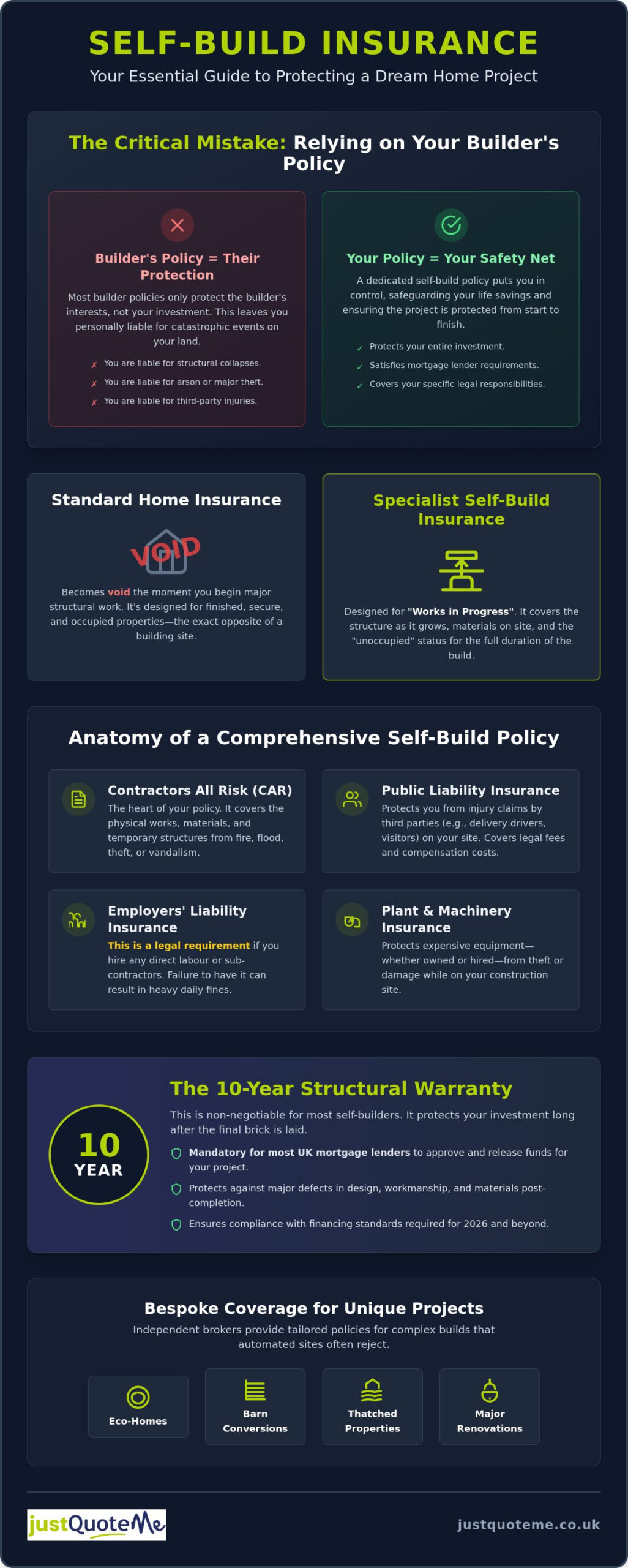
You might think your contractor’s policy covers your entire site, but relying on their paperwork is one of the most expensive mistakes a homeowner can make. Most builder policies only protect the builder’s interests, leaving you personally liable for structural collapses, arson, or injuries that occur on your land. Choosing the right Self build Insurance is about more than ticking a box; it’s about building a safety net that protects your life savings before the first brick is even laid.
We understand that the transition from dreaming about a design to managing a live construction site is daunting. You’re likely facing pressure from mortgage lenders to have specific cover in place while worrying about the legalities of site safety. This guide clarifies the confusion. You’ll discover exactly which protections you need to satisfy UK lenders, comply with the latest JCT 2024 contract standards, and secure the 10-year structural warranty that’s mandatory for most financing in 2026. We’ll show you how to safeguard your investment from start to finish, ensuring that a single theft or accident doesn’t end your project prematurely.
Key Takeaways
- Understand why standard home insurance becomes void the moment structural work begins and why specialist Self build Insurance is mandatory for project safety.
- Identify the legal necessity of Employers Liability insurance and how Public Liability protects you from third-party injury claims on your site.
- Learn why relying on a contractor’s policy is a high-risk strategy and how to protect your investment if a builder goes bust.
- Discover why UK mortgage lenders require a 10-year structural warranty and how to ensure your policy meets current 2026 standards.
- See how independent brokers provide bespoke coverage for unique projects like eco-homes or thatched properties that automated sites often reject.
What is Self Build Insurance and Why is it Vital in 2026?
At its core, Self build Insurance is a specialist protection package designed specifically for individuals who are creating their own homes from scratch. Whether you are tackling a ground-up new build, a barn conversion, or a major renovation, this insurance covers the unique risks that standard home policies simply aren’t built to handle. Before you start digging foundations, it’s helpful to understand What is a Self-Build? and why the insurance requirements differ so drastically from a finished property.
The construction market in 2026 presents specific challenges. While inflationary pressures on materials have eased slightly compared to previous years, replacement costs remain high. If a fire or structural collapse occurs mid-build, the cost to clear the site and restart can exceed your original budget. Under-insurance is a critical risk right now. Without a dedicated policy, you could find yourself facing a massive financial deficit that halts your project permanently.
You must also realize that standard home insurance becomes void the moment you begin major structural work. These traditional policies are based on the assumption that a property is finished, secure, and lived in. A building site is the opposite. It’s a high-risk environment filled with expensive machinery, raw materials, and potential hazards that standard insurers won’t touch. This is where “Site Insurance” comes in, acting as an umbrella that covers everything from the physical structure to the tools and materials stored on the land.
Self-Build vs. Standard Buildings Insurance
The primary difference lies in “Works in Progress” coverage. Standard buildings insurance protects a completed structure. In contrast, Self build Insurance protects the house as it grows. It covers the bricks, timber, and glass before they are even installed. It also addresses the “unoccupied” status of the site. Most standard policies lapse if a house is empty for more than 30 days. Since most self-builds take months or years to complete, you need a policy that anticipates the property being empty or under construction for long periods.
Is Self Build Insurance a Legal Requirement?
The answer depends on how you define “requirement.” While the government doesn’t legally force you to insure the building itself, you are legally required to have Employers Liability Insurance if you hire any direct labour or sub-contractors. Failure to have this can result in heavy daily fines.
Beyond the law, your mortgage lender will almost certainly make site insurance a condition of your loan. They won’t release funds without proof that their investment is protected against fire, theft, and weather damage. Additionally, the Health and Safety Executive (HSE) expects site owners to maintain “reasonable care” standards. Having a robust contractors all risks insurance policy helps demonstrate that you are managing these risks professionally and legally.
The Core Components of a Comprehensive Self-Build Policy
A robust policy isn’t a single product but a collection of specific protections. Choosing the right Self-build insurance means assembling these components to fit your project’s unique footprint. While every build is different, a comprehensive policy typically includes several non-negotiable layers of cover that protect you from the ground up.
- Contractors All Risk (CAR): This is the heart of your policy. It covers the physical works, materials, and temporary structures like site huts or toilets against damage from fire, flood, or vandalism. You can find more details on contractors all risks insurance to see how it protects your primary investment throughout the construction phase.
- Plant and Machinery: Whether you own your digger or are hiring in scaffolding, plant and machinery insurance protects this expensive equipment from theft or damage while on-site.
Public Liability and Third-Party Risks
Imagine a delivery driver trips over a loose piece of timber on your driveway and sustains a serious injury. Since you own the site, you are responsible for their welfare. Public Liability Insurance covers the legal costs and compensation awards resulting from injury or property damage to third parties. Most lenders and contractors expect a minimum of £2 million in cover, though £5 million is increasingly common for larger projects to ensure total security against high-value claims.
Employers Liability for Direct Labour
Many self-builders don’t realize that hiring a friend for a weekend or using casual labour makes them an employer in the eyes of the law. Employers Liability Insurance is a strict legal requirement if you have anyone working under your direction. The minimum legal cover is £5 million. If you’re found without it, the Health and Safety Executive can issue fines of up to £2,500 for every single day you were uninsured. It’s a risk that simply isn’t worth taking for any project manager.
Protecting Your Assets: Tools and Materials
Theft remains a significant concern for construction sites in 2026. High-value materials like copper piping and timber are frequent targets for thieves. Your Self build Insurance should also account for “Transit Risks,” protecting materials from the moment they leave the supplier until they are securely fitted in your new home. For those keeping mobile assets on site, integrating van and tools insurance provides an extra layer of protection for the equipment you use every day. If you aren’t sure which specific limits your project needs, speaking with an independent broker can help clarify your requirements before you start the build.
The “My Builder is Covered” Myth: Why You Need Your Own Policy
One of the most frequent errors we see is the assumption that a contractor’s existing policy provides enough protection for the homeowner. While your builder likely has builders insurance, that policy is designed to protect their business, not your life savings. If a disaster occurs, their insurer may only pay out for the builder’s specific losses, such as their tools or their legal liability for negligence. This leaves you, the property owner, exposed to the full cost of rebuilding if the cause of the damage isn’t clearly the builder’s fault.
There is also the risk of the builder going bust. If your contractor enters liquidation mid-project, their insurance usually lapses immediately. Without your own Self build Insurance, you’d be left with an uninsured, half-finished shell that no other contractor will touch. To avoid this, most lenders require policies to be in “Joint Names.” This ensures that your financial interest is legally recognized by the insurer, allowing you to settle claims directly regardless of the builder’s status.
You must also consider vicarious liability. As the site owner, you can be held legally responsible for accidents or damage caused by your contractors. If a sub-contractor accidentally damages a neighboring property, the neighbor may pursue a claim against you as the primary developer. Your own policy acts as a vital shield in these scenarios, providing the legal defense and compensation funds needed to resolve such disputes without draining your project budget.
To further reduce these risks, it’s crucial to partner with experienced professionals for your project. We are a trusted plumbing & Heating company providing reliable, high-quality services across London and Kent.
Contractors All Risk Insurance Explained
This cover bridges the gap between individual sub-contractors’ policies and the total value of your project. Relying on multiple sub-contractors to maintain their own valid insurance is a logistical nightmare. A CAR policy provides a single, overarching layer of protection for the entire works, materials, and temporary structures. It ensures that if something goes wrong, there is no finger-pointing between different insurers; the project is covered as a whole, regardless of which trade was on-site at the time.
Managing Specialist Risks
Standard contractor policies often contain hidden exclusions for high-risk activities. For instance, working at height or the use of heat, such as welding or grinding, are common causes of site fires and injuries. If your builder’s policy excludes these and an accident happens, you are the one left with the bill. Dedicated Self build Insurance allows you to declare these risks upfront, ensuring that every phase of the construction is fully protected under a policy tailored to your specific build requirements.
Structural Warranties: Protecting Your Investment for 10 Years
While Self build Insurance protects your project while it’s under construction, a structural warranty provides security for a decade after the keys are handed over. Often referred to as Latent Defects Insurance, this policy covers major structural failures resulting from faults in design, materials, or workmanship. It’s the final piece of the protection puzzle, ensuring that if your foundations fail or load-bearing walls crack five years after completion, the cost of repair doesn’t fall on your shoulders.
Many first-time builders confuse a Building Control completion certificate with a structural warranty. They aren’t the same. A Building Control certificate simply confirms that the house met minimum building regulations at the time of inspection. It offers no financial protection if a structural defect appears later. In contrast, a warranty is an insurance policy that pays for repairs. You must arrange this cover before you start digging foundations. Trying to obtain a “Retrospective Warranty” after the build has progressed is significantly more expensive and often requires intrusive, costly site investigations to prove the quality of the hidden work.
Site Insurance vs. Structural Warranty
It helps to view these as two distinct phases of protection. Site insurance, such as contractors all risks insurance, covers the “active” risks during the build like fire, theft, and public liability. A structural warranty covers the “passive” risks that only become apparent once the building is settled and lived in. A comprehensive strategy for Self build Insurance requires both to ensure there are no gaps in your protection from day one through to year ten.
Mortgage Lender Requirements in 2026
In 2026, UK mortgage lenders have become stricter than ever regarding structural protection. The Council of Mortgage Lenders (now part of UK Finance) maintains a list of approved warranty providers that meet specific standards. Without an approved 10-year warranty, high-street lenders will simply refuse to release funds for a self-build mortgage or a subsequent remortgage. This makes the warranty essential not just for your peace of mind, but for the fundamental liquidity of your asset.
While some builders used to rely on “Architects Certificates” (Professional Consultants’ Certificates), these are increasingly rejected by modern lenders because they only provide cover if you can prove the architect was negligent. A structural warranty is “first-party” cover, meaning it pays out regardless of who was at fault. This guaranteed protection significantly increases the resale value of your home, as any future buyer’s lender will also require proof of a valid warranty. If you need help navigating the specific requirements of your lender, get expert advice on structural warranties today.
Securing Your Self-Build Project with Just Quote Me
Choosing the right Self build Insurance shouldn’t feel like another administrative burden on your project list. At Just Quote Me, we act as your independent partner, leveraging over 30 years of industry experience to navigate the complexities of construction risk. Unlike automated comparison sites that rely on rigid algorithms, we provide access to a broad network of top UK insurers. This independence allows us to find the most competitive rates and comprehensive terms that a single provider simply cannot offer.
Our expertise is particularly valuable for projects that fall outside the standard “brick and block” category. If you are building an eco-home, a timber-frame property, or a house with a thatched roof in Staffordshire or the West Midlands, you need a broker who understands regional construction nuances. We specialize in tailoring policies for these unique builds, ensuring that specialist materials and non-standard methods are fully protected without the high premiums often associated with specialist insurers. We manage the complex administrative burdens so you can focus on the physical build.
The Benefit of Bespoke Advice
We don’t just sell policies; we review the framework of your project. If you are using JCT or FMB contracts, your insurance must align perfectly with the liability clauses stated in those agreements. We provide professional-grade builders insurance support to ensure your site insurance, liability cover, and warranty requirements work in harmony. This proactive approach eliminates the risk of “double insuring” or, worse, discovering a gap in cover when you need to make a claim. We pride ourselves on being a human-centric alternative to automated systems, offering a steady hand in a complex market.
Next Steps: From Quote to Completion
To simplify the process of securing Self build Insurance, you’ll need your estimated reinstatement costs, project duration, and construction details ready. We understand that self-build timelines often slip due to weather or supply chain issues. We make it easy to adjust your policy as the project evolves, providing a flexible service that accommodates changes in your schedule. Our goal is to provide a personalized and frictionless experience from the first quote through to the final completion certificate.
Start Your Project with Confidence
Building your own home is a monumental achievement, but it shouldn’t be a financial gamble. We’ve explored why relying on a contractor’s cover is a significant risk and how a 10-year structural warranty keeps your property a liquid, mortgageable asset. Securing comprehensive Self build Insurance is the most critical step you can take to protect your life savings before the first shovel hits the ground. By addressing these risks early, you ensure that unexpected site accidents or structural defects don’t halt your progress.
As an FCA-authorised firm with over 30 years of industry experience, Just Quote Me provides the specialist knowledge needed to navigate complex UK construction risks. We offer independent, bespoke advice that automated systems simply can’t match. Whether you’re planning a traditional build or a unique eco-home, we simplify the administrative burden so you can focus on the craftsmanship. Our team is ready to help you build a safety net as strong as your new foundations.
Take the next step toward a secure build:
Get Your Free Business Insurance Quote now
Request a Call back for free Expert advice
Your vision deserves a partner who understands the stakes. Let’s ensure your project is protected from start to finish.
Frequently Asked Questions
Do I need self-build insurance if I already have home insurance?
Standard home insurance policies are typically voided the moment major structural work begins. Traditional providers design their products for finished, occupied properties rather than active construction sites. A dedicated policy is necessary to cover specific high-risk scenarios such as site theft, arson, or structural collapse during the building process. This ensures you remain protected throughout the transition from a plot of land to a completed home.
Is my builder’s insurance enough to cover my self-build project?
No, a builder’s insurance is rarely sufficient because it primarily protects the contractor’s business interests rather than your investment. If your builder goes into liquidation or lets their policy lapse, you could be left with an uninsured site and no financial recourse. Holding your own policy ensures you have direct control over claims and guarantees that your mortgage lender’s specific requirements are fully satisfied.
What is the difference between site insurance and a structural warranty?
Site insurance provides protection during the active construction phase, while a structural warranty covers the property for ten years after completion. Site insurance addresses immediate risks like fire, theft, and public liability on the building plot. In contrast, a structural warranty, often called latent defects insurance, protects against long-term failures in design or materials that may only become apparent years after you have moved in.
How much does self-build insurance cost in the UK?
The cost of Self build Insurance is typically determined by the total value of the project and the specific construction methods used. Insurers also consider the duration of the build and the level of public liability cover you require. While premiums vary, this investment is a small fraction of the total project cost and provides essential protection against financial losses that could otherwise bankrupt a homeowner.
Can I get self-build insurance if I am doing the work myself?
You can still obtain cover if you are doing the work yourself, but you must declare your DIY status to your broker. Insurers need to understand who is managing the site to assess risk levels accurately. Even if you are tackling the majority of the work, you must ensure you have Employers Liability cover in place if any friends or casual labourers assist you at any stage.
Does self-build insurance cover my tools and plant machinery?
Most comprehensive policies include cover for both owned and hired-in equipment as standard or optional add-ons. This protects expensive assets like diggers, mixers, and scaffolding from theft or damage while they are on your site. Given the high cost of machinery in 2026, it is vital to ensure your policy limits reflect the current replacement value of all tools and plant used during the build.
What happens to my self-build insurance once the house is finished?
Once your home is finished and you receive a completion certificate, you should switch to a standard residential buildings policy. Self build Insurance is designed specifically for the risks of a construction site and is no longer appropriate once the property is occupied. At this stage, your 10-year structural warranty will remain in effect to cover major defects, while your new home insurance handles everyday risks like fire or flood.
Do I need employers liability insurance for casual labour or friends helping out?
You are legally required to have Employers Liability insurance if anyone works under your direction, including friends or casual help. Even if you aren’t paying them, the law considers you an employer if you are supervising their work on-site. Without this cover, you could face fines of £2,500 for each day you are uninsured, making it one of the most critical legal protections for any self-builder.
