

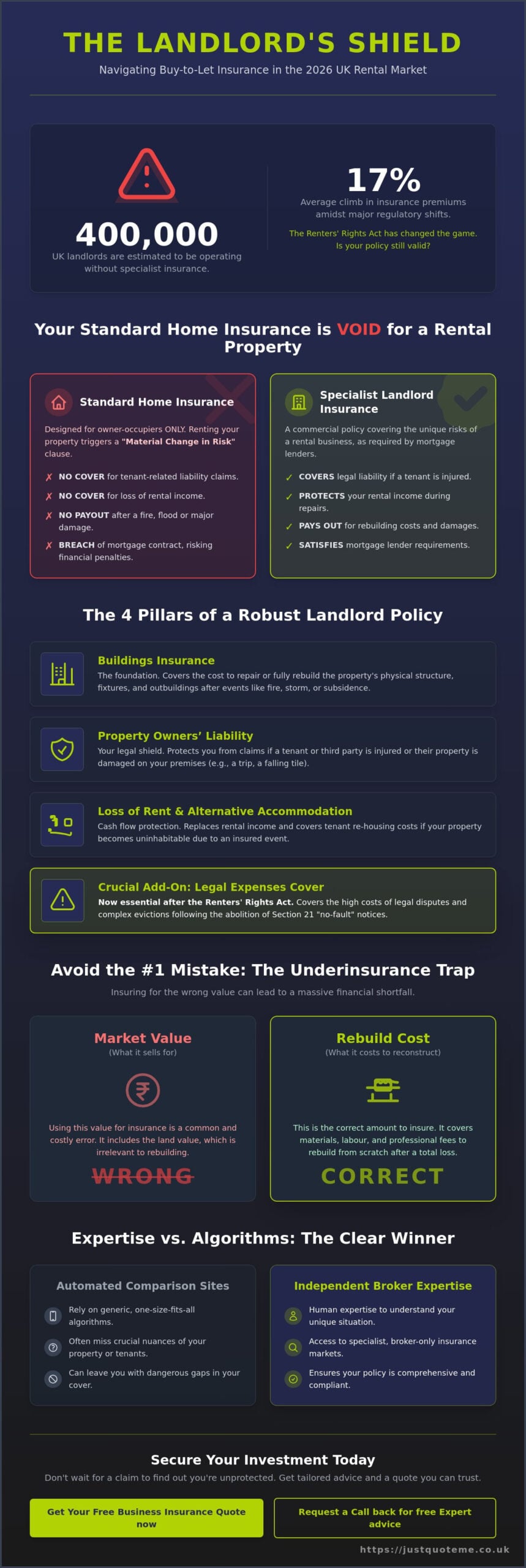
An estimated 400,000 UK landlords currently operate without specialist insurance, leaving their properties vulnerable during the most significant regulatory shift in a generation. With the Renters’ Rights Act now in full force, securing an accurate buy to let building insurance quote is no longer just a mortgage requirement; it’s a vital shield against the complexities of the 2026 rental market. You’ve likely noticed premiums climbing by an average of 17% while trying to digest new rules on periodic tenancies and the abolition of Section 21 evictions.
It’s understandable to feel concerned about whether your current policy still stands up to these changes or if a hidden clause might lead to a rejected claim. We promise to help you secure your investment with expert-backed coverage tailored to today’s specific legal landscape. In this guide, we’ll explore the median costs for various property types, explain how to avoid underinsurance, and provide a streamlined path to a quote that offers genuine peace of mind. We focus on specialized knowledge to ensure you aren’t left exposed by generic, automated policies.
Get Your Free Business Insurance Quote now
Request a Call back for free Expert advice
Key Takeaways
- Understand why standard home insurance policies fail to protect rental assets and how a “material change in risk” can lead to rejected claims.
- Discover how to secure a buy to let building insurance quote that accurately reflects 2026 premiums while avoiding common underinsurance pitfalls.
- Learn the critical difference between market value and rebuild cost to ensure your policy payout covers the actual expense of a total loss.
- Identify how specific tenant profiles and regional risks, such as flood zones or local crime rates, directly impact your annual insurance costs.
- Find out why human expertise and access to specialist markets outperform automated algorithms when insuring non-standard or complex properties.
Why Your Standard Home Insurance Won’t Cover a Buy-to-Let Property
Managing a Buy-to-let property is a commercial enterprise, not a domestic hobby. Because the property is occupied by third parties for profit, insurers classify it as a specialist commercial risk product. A standard home insurance policy is designed for owner-occupiers; it doesn’t account for the unique liabilities associated with tenants, such as accidental damage by residents or the legal costs of eviction. When you request a buy to let building insurance quote, you’re looking for a product that covers these specific professional exposures that domestic policies ignore.
Insurance is built on the principle of full disclosure. If you move out of your home and rent it to tenants without informing your provider, you’ve triggered a “Material Change in Risk” clause. This action effectively invalidates your cover. In the event of a fire or flood, an insurer can legally refuse to pay out because the risk profile they originally agreed to cover has fundamentally changed. Most domestic policies explicitly exclude business activities, and letting a property is exactly that.
Mortgage lenders are equally strict about your choice of protection. Before releasing funds for a purchase, lenders require proof of specialist landlord insurance. They need to know their security is protected by a policy that understands the nuances of the rental market. Standard home insurance won’t satisfy these conditions. Failing to maintain the correct cover could put you in breach of your mortgage contract, leading to immediate financial penalties or even the calling in of the loan.
The Legal and Financial Risks of Improper Cover
Using the wrong policy creates a dangerous financial gap. If a tenant is injured due to a loose floorboard and sues for damages, a domestic policy won’t provide the Property Owners’ Liability cover you need. You could be held personally liable for thousands of pounds in legal fees and compensation. Additionally, a total claim rejection after a major incident doesn’t just lose you the building; it leaves you with a mortgage debt on a property that no longer exists, potentially destroying your credit rating for years.
2026 Regulatory Impacts on Landlord Insurance
The Renters’ Rights Act 2026 has fundamentally changed the landlord-tenant relationship. With the abolition of Section 21 “no-fault” evictions, legal disputes are becoming more complex and time-consuming. This makes specialized legal expenses cover a core part of any modern buy to let building insurance quote. New safety standards introduced in May 2026 are also now prerequisites for valid claims. Under 2026 UK law, a landlord’s legal duty of care requires proactive maintenance and strict adherence to the latest safety certifications to ensure the property remains fit for human habitation throughout the tenancy.
Get Your Free Business Insurance Quote now
Request a Call back for free Expert advice
Calculating Your Buy to Let Building Insurance Quote: Core Coverages
Securing a precise buy to let building insurance quote requires more than just knowing your property’s address. You must evaluate four critical pillars of protection to avoid financial exposure during a claim. Buildings insurance forms the foundation; it protects the physical structure, including outbuildings like garages and permanent fixtures such as fitted bathrooms. It’s designed to cover the cost of repair or a full rebuild following events like fire, storm, or subsidence.
Property Owners’ Liability is equally vital. This coverage protects you against claims for third-party injury or property damage occurring on your premises. Whether it’s a loose roof tile hitting a passerby or a tenant tripping on uneven flooring, this protection is essential for meeting official landlord responsibilities. In 2026, legal costs and compensation awards continue to rise, making high-limit liability cover a non-negotiable part of a robust quote.
Cash flow protection is the final piece of the puzzle. Loss of Rent cover ensures you still receive your rental income if the property becomes uninhabitable due to an insured event. Simultaneously, Alternative Accommodation cover handles the cost of re-housing your tenants while repairs are underway. These features prevent a physical disaster from becoming a total financial collapse. You can find more details on how these elements combine by exploring our professional landlord insurance options.
Buildings vs. Landlord Contents Insurance
Many landlords confuse “buildings” with “contents.” In the insurance world, anything you wouldn’t take with you if you moved, such as fitted kitchens or sinks, usually falls under buildings. However, even unfurnished lets often require a small amount of contents cover for items like carpets, curtains, and white goods. Ensuring these are included in your residential letting insurance avoids disputes during the claims process.
Property Owners’ Liability: The £2m vs. £5m Debate
While a £2 million limit is the standard baseline for most UK landlords, it isn’t always sufficient. Local authorities often demand a £5 million limit for social housing contracts, and many blocks of flats require higher thresholds due to the increased risk of multi-property damage. As we move through 2026, the complexity of liability claims means that opting for the higher £5 million limit provides a much safer buffer against escalating legal fees and medical inflation.
Get Your Free Business Insurance Quote now
Request a Call back for free Expert advice
Key Factors That Influence Your Landlord Insurance Premiums in 2026
Understanding what drives the final price of your buy to let building insurance quote is essential for managing your portfolio’s overheads. While core coverages provide the safety net, several variables dictate how an insurer perceives your risk level. Property age is a primary driver. Research from May 2026 shows that Victorian properties built between 1850 and 1899 are 81% more expensive to insure than those built in the 1990s. This price gap, often moving from £234 to £424 annually, reflects the higher costs of specialized materials and traditional building methods required for older structures.
Claims history also plays a decisive role. If you’ve experienced an “escape of water” incident or a fire in the last three years, insurers will likely increase your premium to account for the perceived likelihood of future issues. Construction type is equally significant. While terraced houses account for 49% of all quotes in the UK, properties with non-standard features like timber frames or thatched roofs require bespoke underwriting. These structures don’t fit the standard “brick and tile” mold, meaning they often fall outside the appetite of automated comparison sites.
Tenant Types and Their Risk Weighting
The profile of your residents fundamentally changes your risk weighting. Student lets and professional sharers often command higher premiums because of the increased footfall and wear on the building. With the first phase of the Renters’ Rights Act 2026 now in effect, landlords can no longer refuse tenants based on benefit status or having children. This shift means insurers are recalibrating their models to focus more on property maintenance and tenant vetting processes. Housing in Multiple Occupation (HMOs) remains the highest risk category, requiring specific liability protections that standard policies simply don’t offer.
Regional Variations in the UK Rental Market
Location remains a cornerstone of any insurance calculation. Insurers analyze postcode-specific data, looking at flood risks and local crime statistics to determine their rates. For our clients in Staffordshire, we see distinct differences between the quiet residential streets of Stone and the busier urban center of Stafford. If you manage a mixed-use property or a larger portfolio, you might find that commercial property insurance offers more flexibility than individual residential policies. Our local expertise allows us to navigate these regional nuances, ensuring your quote reflects the reality of your specific street, not just a broad national average.
Get Your Free Business Insurance Quote now
Request a Call back for free Expert advice
Avoiding the Underinsurance Trap: Getting an Accurate Quote
Basing your buy to let building insurance quote on the market value of your property is a common mistake that can lead to financial ruin. Market value includes the value of the land and location desirability, whereas insurers only care about the cost to reconstruct the building from scratch. In 2026, higher labor and material costs have pushed rebuild figures significantly higher than in previous years. To get an accurate figure, we recommend using the BCIS Rebuild Cost Calculator, which provides up-to-date data on construction prices. Your quote must also account for professional fees, such as architects and surveyors, along with the substantial cost of debris removal after a major incident like a fire or flood.
It’s easy to overlook these “soft costs,” but they can add 10% to 15% to your total rebuild bill. If your policy doesn’t reflect these expenses, you’ll be forced to pay them out of your own pocket. Our team focuses on specialized knowledge to help you calculate these figures correctly, ensuring your investment remains secure regardless of market fluctuations. We prioritize accuracy over the fastest possible quote because a cheap policy that doesn’t pay out is the most expensive mistake you can make.
The Danger of the “Condition of Average”
Most policies include a “Condition of Average” clause to prevent underinsurance. This clause allows insurers to reduce your payout proportionally if the sum insured is less than the actual rebuild cost at the time of the loss. If a £200,000 property is insured for only £150,000, the insurer will only pay out £7,500 on a £10,000 claim. Many landlords don’t realize this applies even to small, partial claims, not just total losses. With material inflation rising by 17% in some sectors over the last year, regular valuation reviews are critical to ensure your coverage remains adequate and your investment is fully protected.
Optional Add-ons That Save You Money
While core cover handles the structure, optional extras provide specific protection for the 2026 market. Accidental damage cover is often worth the extra premium if you have “DIY-happy” tenants or residents who might cause unintentional harm to fixtures. Malicious damage by tenants protects you against intentional vandalism, which is rarely covered by standard buildings insurance. Given the court delays and the abolition of Section 21 evictions in 2026, legal expenses cover is also a vital addition for navigating the complex court system during rent arrears disputes. This add-on provides the financial support needed to handle legal fees that would otherwise come directly out of your profit margin.
Secure your portfolio with a bespoke landlord insurance policy that reflects today’s rebuild realities. We take the time to understand your specific property rather than relying on broad estimates that could leave you exposed. Our human-centric approach ensures your quote is calibrated for the current economic environment.
Get Your Free Business Insurance Quote now
Request a Call back for free Expert advice
Bespoke Quotes vs. Comparison Sites: Why an Independent Broker Wins
Algorithms are designed for speed, not for the complex realities of the 2026 rental market. While a comparison site can generate a buy to let building insurance quote in seconds, it often relies on broad assumptions that don’t account for your specific property risks. An independent broker brings a human element to the process, using decades of industry experience to identify gaps that automated systems miss. This personalized risk assessment ensures you aren’t paying for unnecessary extras while confirming that your core protections are robust enough to satisfy both mortgage lenders and legal requirements.
Specialist markets are another area where brokers hold a significant advantage. Aggregators often reject non-standard properties, such as those with thatched roofs or certain HMO configurations, because they don’t fit into a standard checkbox. We have access to specialist insurance panels that understand these unique risks, allowing us to secure cover for properties that comparison sites simply can’t handle. Beyond the initial purchase, a broker acts as your advocate during the claims process. If the worst happens, you won’t be stuck in an automated phone queue; you’ll have a dedicated partner to help manage the administrative burden and push for a fair settlement.
Just Quote Me: Your Staffordshire Insurance Partner
We take pride in our deep roots across the region, offering localized expertise to landlords in Stone, Stafford, and Newcastle-under-Lyme. Our team understands the specific property trends and risks unique to Staffordshire, providing a level of service that national call centers can’t match. Through our “Direct Underwriting” access to top-tier UK insurance panels, we can often secure competitive terms that aren’t available on the open market. We also manage the entire renewal process for you, reviewing your landlord insurance annually to ensure it remains aligned with current rebuild costs and regulatory changes.
Get Started with Your 2026 Quote
To transition from a generic estimate to a bespoke policy, you’ll need a few key details ready. Ensure you have an accurate rebuild cost based on 2026 material prices, details of your tenant profiles, and a list of security measures currently in place at the property. Having this information allows us to refine your buy to let building insurance quote for maximum accuracy. If you also manage commercial spaces, we can integrate your requirements into a broader commercial property insurance strategy to streamline your portfolio management.
Get Your Free Business Insurance Quote now
Request a Call back for free Expert advice
Future-Proof Your Property Portfolio Today
Navigating the 2026 rental market requires more than just a passing interest in legislation; it demands a professional approach to risk management. By moving away from generic comparison sites and focusing on accurate rebuild costs, you protect your investment from the “Condition of Average” and the rising costs of construction materials. A precise buy to let building insurance quote ensures that your coverage meets the strict requirements of mortgage lenders while providing a robust safety net for your rental income.
As an FCA Authorised Broker with over 30 years of industry experience, we provide a steady hand in a complex market. Our access to a top-tier UK insurer network allows us to tailor policies that automated systems simply can’t match. Don’t leave your financial security to chance when expert advice is just a click away. We are here to manage the administrative burdens so you can focus on growing your portfolio with confidence. Secure your investment today by choosing Just Quote Me as your specialist insurance partner.
Get Your Free Business Insurance Quote now
Request a Call back for free Expert advice
Frequently Asked Questions
Is buy-to-let building insurance a legal requirement in the UK?
No, landlord insurance isn’t a legal requirement under UK law, but it’s almost always a mandatory condition of a buy-to-let mortgage. Lenders require this protection to secure their financial interest in the property. Operating without a specialist policy could result in a breach of your mortgage contract and leaves you personally liable for total rebuild costs if a disaster occurs.
Does landlord insurance cover my tenants’ personal belongings?
No, your policy won’t cover a tenant’s personal items such as furniture, electronics, or clothing. It is the tenant’s responsibility to take out their own contents insurance for their possessions. Your insurance focuses on the building itself and any fixtures or white goods that you own and provide as part of the tenancy agreement.
How does the Renters’ Rights Act 2026 affect my building insurance?
The Renters’ Rights Act 2026 makes legal expenses and rent guarantee cover more critical than ever. Since Section 21 evictions are now abolished, legal disputes over possession are often more complex and time-consuming. You should ensure your buy to let building insurance quote includes adequate legal protection to navigate these new regulatory hurdles and protect your rental income during disputes.
Can I get a buy-to-let building insurance quote for an unoccupied property?
Yes, you can get a quote for a vacant property, but you must disclose the vacancy to your insurer immediately. Standard landlord policies typically restrict or remove cover if a property is left empty for more than 30 or 60 consecutive days. Specialist “unoccupied property” cover is required to maintain protection during long renovation periods or between tenancies.
What is the difference between buildings insurance and property owners’ liability?
Buildings insurance covers the physical structure and permanent fixtures against damage from events like fire, storm, or flood. Property owners’ liability is a separate but essential component that protects you against legal claims if a tenant or visitor is injured on your premises. While buildings insurance protects your asset, liability cover protects your personal and business finances from compensation claims.
How much does buy-to-let building insurance cost on average in 2026?
The median cost for landlord insurance in the UK in 2026 is £284.75 for a standard policy. However, your specific buy to let building insurance quote will depend on several variables, including the property’s age, location, and tenant type. For example, Victorian properties often cost significantly more to insure than modern homes due to higher rebuild complexities.
Can I insure multiple rental properties under one landlord policy?
Yes, you can consolidate your entire portfolio under a single multi-property landlord policy. This approach simplifies your administration by providing one renewal date and a single set of policy documents. It is often a more efficient way to manage a growing portfolio than maintaining individual policies for every separate address.
Do I need accidental damage cover for a buy-to-let property?
Accidental damage cover is an optional extra, but it’s highly recommended for landlords. It provides protection for unintentional harm to the building, such as a tenant accidentally drilling through a pipe or damaging a fitted bathroom suite. Without this add-on, your insurer may only pay out for “defined perils” like fire or theft, leaving you to fund accidental repairs yourself.
Get Your Free Business Insurance Quote now
Request a Call back for free Expert advice
