

Did you know that most standard landlord policies effectively stop protecting your building after it has been empty for just 30 consecutive days? It’s a common trap that leaves many UK property owners exposed to significant financial loss. You likely already know that an empty building attracts more than just dust; it attracts higher premiums and increasingly strict inspection requirements. The fear of a claim being rejected due to a minor oversight in the fine print is a stress you simply don’t need when managing a vacancy.
Securing reliable unoccupied property insurance for landlords doesn’t have to be a bureaucratic nightmare. As an FCA-regulated broker, we’re here to help you secure comprehensive cover that specifically includes protection against vandalism and squatters. This 2026 guide simplifies the process, offering expert advice on how to find cost-effective policies with flexible 3, 6, or 12-month terms. We’ll explore the essential steps to maintaining compliance and ensuring your investment remains protected, no matter how long the property stays vacant.
Key Takeaways
- Learn why the standard 30-day unoccupancy clause often leaves vacant buildings unprotected and how to identify the exact moment your risk profile changes.
- Discover the essential core protections required for empty premises, including FLEA cover and the critical importance of Property Owner’s Liability.
- Navigate the specific compliance steps and inspection regimes necessary to secure valid unoccupied property insurance for landlords without compromising your claim.
- Understand the differing security requirements between residential and commercial assets to ensure your vacant site meets specialist underwriting standards.
- Explore how a dedicated UK broker provides access to bespoke, non-standard cover that automated comparison sites simply cannot offer.
The 30-Day Trigger: Why Standard Landlord Insurance Fails for Empty Properties
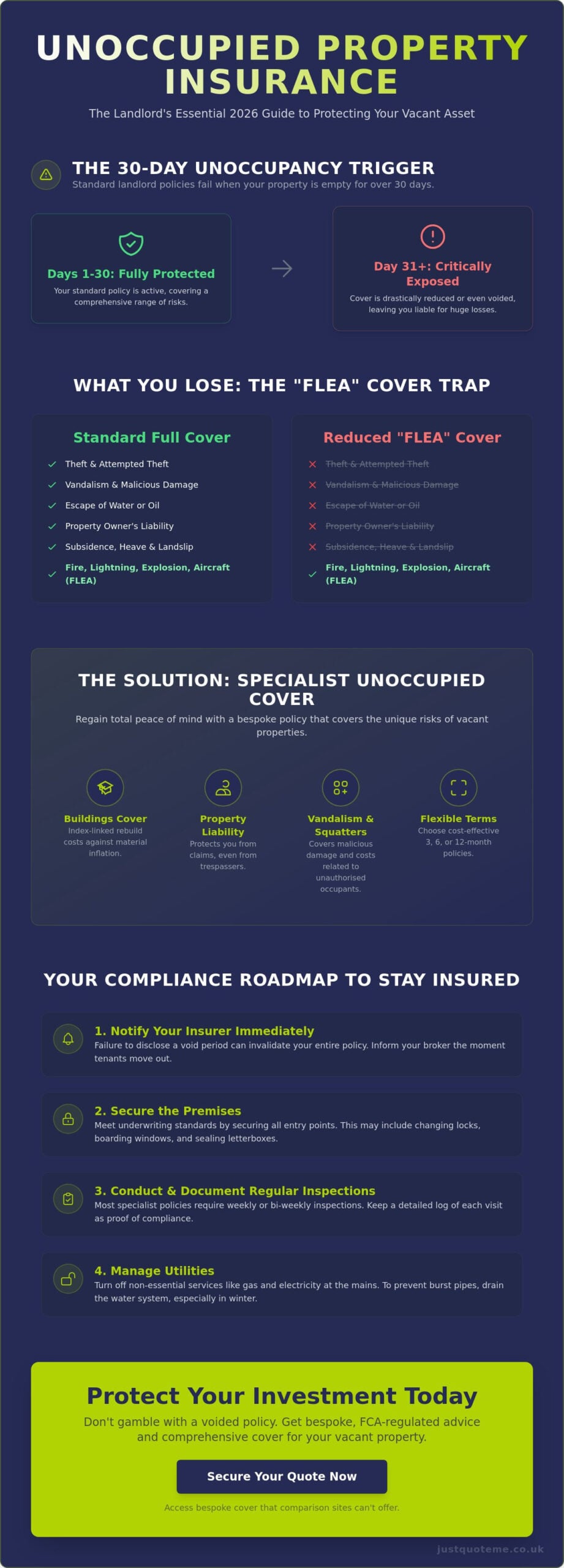
Most residential letting insurance policies include a restrictive clause that activates when a property sits empty for a set period. This is typically the 30-day trigger, though some providers extend it to 60 days. While your building might feel secure, insurers view it as a high-risk asset the moment the last tenant hands back the keys. Data from UK Fire and Rescue Services indicates that arson accounts for nearly 45% of fires in empty buildings. Without a resident to spot a burst pipe or a forced window, a minor issue quickly turns into a £20,000 restoration project.
Standard policies often reduce cover to “FLEA” only (Fire, Lightning, Explosion, and Aircraft) once this limit passes. This means you lose protection against theft, malicious damage, and escape of water. It’s also vital to distinguish between “unoccupied” and “vacant” status. An unoccupied property is generally ready for inhabitants and contains furniture, while a vacant property is stripped of contents. Specialist unoccupied property insurance for landlords bridges this gap, ensuring full protection remains in place regardless of the building’s furniture levels or inhabitant status.
The unoccupancy limit is the specific duration after which standard cover expires.
Common Scenarios Requiring Specialist Unoccupied Cover
Tenant turnover is the most frequent cause for a gap in cover. Industry data from 2023 shows the average UK void period sits at 22 days, but regional fluctuations or unexpected repair needs can easily push this past the 30-day mark. Structural renovations or significant redecoration projects also frequently exceed standard timeframes. Additionally, properties held in probate often remain empty for 6 to 12 months while legalities are settled, making specialist unoccupied property insurance for landlords a necessity to protect the estate’s value.
The Legal and Financial Risks of Non-Disclosure
Failing to notify your insurer about a void period is a gamble that rarely pays off. This “silent” unoccupancy can void your entire buildings insurance policy, leaving you to foot the bill for total losses out of your own pocket. You also face significant legal risks under the Occupiers’ Liability Act 1984. You owe a duty of care even to people who enter the property without permission. If a trespasser is injured on your empty site due to poor maintenance, you could be held personally liable for damages without the safety net of active public liability protection.
Core Protections: What Unoccupied Property Insurance Covers for Landlords
Standard landlord policies typically reduce coverage to the absolute minimum once a property sits empty for more than 30 consecutive days. Specialist unoccupied property insurance for landlords restores essential protections that disappear under a standard contract. The baseline for any policy is “FLEA” coverage. This protects the structure against Fire, Lightning, Explosion, and Aircraft impact. While these seem like “worst-case” scenarios, they represent the highest potential financial loss for a property owner.
Beyond the basics, a robust policy addresses the unique vulnerabilities of a vacant site. Vandalism and malicious damage are primary concerns. Statistics from 2024 indicate that vacant residential properties are nearly twice as likely to be targeted for arson or metal theft compared to occupied homes. Your policy should cover the costs of repairing damage from forced entry or the removal of graffiti to maintain the building’s market value.
Buildings and Contents: Protecting the Physical Asset
Rebuild costs fluctuate constantly. By 2026, construction material inflation is expected to remain a factor in insurance valuations. It’s vital that your buildings cover is index-linked to ensure the payout matches current labor and material prices in the UK. This section also protects contents left behind during a tenant void, such as white goods, carpets, or furniture. If you’re using the vacancy to perform upgrades, you should consider contractors all risk insurance to protect the works in progress and any plant machinery on the premises.
Liability and Legal Expenses
Public liability doesn’t stop being a requirement just because the house is empty. Property Owner’s Liability protects you if a member of the public, a delivery driver, or even a trespasser is injured on your property. A loose roof tile or a crumbling garden wall can lead to personal injury claims exceeding £2 million. Specialist policies also provide legal expenses cover for specific vacant-property headaches:
- Costs for the legal eviction of squatters.
- Expenses related to clearing fly-tipping from your land.
- Legal defense if a fire or leak on your site spreads to and damages a neighbouring property.
Water damage remains the most frequent cause of claims for empty buildings. Trace and Access cover is a critical addition. It pays for the costs involved in locating a hidden leak, such as removing floorboards or tiling, rather than just the pipe repair itself. Without this, the cost of finding a single burst pipe in a large house can run into thousands of pounds. If you aren’t sure which level of “peril” coverage you need, you can get a quick specialist quote to see the options available for your specific postcode.
Residential vs. Commercial: Assessing Your Specific Risk Profile
An empty one-bedroom flat in a secure block carries a different risk profile than a vacant high-street shop in a busy town centre. While the flat faces risks like burst pipes or undetected leaks, a commercial unit is more susceptible to arson, glass breakage, and fly-tipping. Insurers recognise this disparity. Consequently, unoccupied property insurance for landlords of commercial assets often involves more stringent security requirements. You might be asked to install 5-lever mortice deadlocks, internal window bars, or monitored alarm systems that report directly to a central station.
Location plays a decisive role in your premium calculation. A property in a high-crime urban postcode will naturally cost more to insure than a similar building in a quiet part of rural Staffordshire. However, rural properties face their own challenges, such as delayed response times from emergency services. At Just Quote Me, we specialise in mixed-use buildings. If you have a property with a vacant shop on the ground floor and a residential void above, we provide a single, cohesive policy. This avoids the administrative headache of managing two separate providers for the same address.
- Commercial Voids: Higher risk of vandalism and theft of copper piping or fixtures.
- Residential Voids: Higher risk of “silent” damage like mould growth or slow water leaks.
- Security Standards: Commercial policies often mandate weekly site inspections recorded in a formal log.
Commercial Property Voids in the West Midlands
Retail units in Newcastle-under-Lyme or Stone often sit empty during tenant transitions. If your business undergoes a temporary closure, you might be able to use shop insurance extensions to maintain coverage for a short period. For more complex risks like nightclub insurance or unoccupied pubs, the focus shifts to preventing unauthorised entry and fire safety. These high-risk environments require specialist oversight to ensure the policy remains valid during the void period, as standard commercial cover often lapses after 30 days of inactivity.
Student Housing and Seasonal Voids
Staffordshire’s high density of student HMOs creates a predictable “summer gap” where buildings sit empty for 8 to 12 weeks. Most standard policies include a “days unoccupied” limit, often set at 30 or 60 days. If your property is empty for exactly 90 days between academic years, you need specific unoccupied property insurance for landlords to bridge that gap. We offer flexible policy durations, including 3-month, 6-month, and annual options. This flexibility ensures you don’t pay for a full year of specialist cover when you only need it for a single season.
The Compliance Roadmap: Essential Steps to Protect Your Vacant Investment
Securing unoccupied property insurance for landlords is only the first step in protecting your asset. Coverage is rarely unconditional. Most UK insurers stipulate a strict set of “warranties” or conditions that you must follow to keep the policy valid. If you fail to meet these, even a legitimate claim for fire or flood could be rejected. Compliance is about proving you’ve taken reasonable steps to prevent loss while the building sits empty.
You’ve got a choice between two main strategies for utility management during the winter months. Landlords can either perform a full “drain down,” where the water system is professionally emptied and the stopcock turned off, or maintain a “constant heat” regime. If you choose the latter, insurers typically require the thermostat to remain at a minimum of 15 degrees Celsius 24/7. This prevents pipes from freezing and bursting, a risk that cost UK insurers an average of £2.5 million per day in 2023 according to ABI data.
- Letterbox Seals: Fit a metal internal cover or seal the letterbox entirely to prevent arson or “key fishing.”
- External Maintenance: Keep the garden tidy and remove junk mail. A property that looks abandoned is a prime target for fly-tipping and squatters.
- Timed Lighting: Use smart bulbs or traditional plug-in timers to simulate occupancy during evening hours.
Meeting Insurer Inspection Requirements
Most policies require a physical inspection of the premises every 7 or 14 days. You must maintain a verifiable paper trail for these visits. A simple notebook won’t always suffice in 2026; many specialist brokers now recommend digital logs with time-stamped photos. During each visit, you should check the roof for slipped tiles after storms, look for signs of damp or forced entry, and ensure all perimeter fences are intact. If you spot a maintenance issue, you’re expected to fix it within a specific window, often 48 to 72 hours, to preserve your cover.
Security Standards and Physical Protections
Standard door locks aren’t enough for a vacant building. Insurers generally demand 5-lever mortice deadlocks conforming to BS3621 on all external doors and key-operated bolts on all opening windows. By 2026, the integration of smart security has become a standard policy recommendation. Using Wi-Fi-enabled cameras or battery-powered motion sensors provides real-time alerts to your smartphone, allowing for a faster response than a weekly visit might provide.
The most common reason for denied theft claims is “unforced entry.” If a burglar enters through an unlocked window or a door with a sub-standard lock, the insurer will likely argue that you didn’t take “reasonable care.” This makes the physical hardware of your property just as important as the paperwork in your filing cabinet.
Don’t leave your investment to chance. Get a fast, professional quote for your residential letting insurance and ensure your vacant property meets the highest compliance standards.
Securing Bespoke Cover: The Just Quote Me Advantage for UK Landlords
Comparison sites work well for standard home policies, but they usually fail when a building sits empty. Algorithms rely on rigid “yes or no” data points that can’t understand why a property is vacant or the specific security measures you’ve put in place. This is where a broker provides a distinct advantage. At Just Quote Me, we’ve spent 30 years in the Staffordshire insurance market building relationships with specialist underwriters. These experts often avoid comparison websites entirely, preferring to work with brokers who understand the nuances of unoccupied property insurance for landlords.
Our team focuses on tailoring your policy so you don’t pay for unnecessary extras. If your property is empty for a short three-month renovation, you shouldn’t be forced into a restrictive 12-month standard contract. We negotiate directly with underwriters to ensure the cover matches your specific timeline and risk profile. This human-centric approach ensures that non-standard risks, such as properties in probate or those undergoing major structural changes, get the protection they actually need without the corporate bloat.
How Just Quote Me Simplifies Your Search
We take a no-nonsense approach to the insurance market. Instead of you filling out dozens of identical forms, we handle the heavy lifting of policy administration and setup. We’ll compare the fine print to ensure there are no hidden security requirements that could void a claim later. If you plan to transition back to a standard let, we provide expert advice on combining your vacant cover with broader landlord insurance. This creates a seamless switch once new tenants move in, saving you from the stress of managing multiple renewal dates.
Get Your Tailored Quote Today
Getting a quote is straightforward and efficient. We’ll just need the property postcode, the reason for the vacancy, and a quick summary of your existing security measures like window locks or alarms. Finding the right unoccupied property insurance for landlords shouldn’t be a hurdle to your investment goals. Our team supports you through the entire process, including any potential claims, to ensure a fair and fast resolution.
Our experience in the UK market means we know exactly which underwriters are currently offering the most competitive premiums for your specific postcode. Don’t leave your investment to the mercy of a faceless algorithm. Just Quote Me today for the peace of mind that comes with three decades of local, professional expertise.
Protect Your Portfolio During Vacancy Periods
Leaving a property empty shouldn’t mean leaving your finances exposed. As we move through 2026, the 30-day vacancy trigger remains the most frequent reason for claim denials on standard policies. Specialist unoccupied property insurance for landlords bridges this gap by providing essential cover against risks like arson, theft, and escape of water while your asset is between tenancies or undergoing renovation. Maintaining a strict inspection log is a key compliance step that keeps your protection active and your investment secure.
JustQuoteMe offers a straightforward way to secure the coverage you need without the usual complexity. We are FCA Authorised and Regulated, bringing over 30 years of industry experience to every quote. Our UK-based support team understands the nuances of the local market and provides the specialist advice required for both residential and commercial risks. We handle the heavy lifting so you can focus on finding your next tenant or completing your project. Take the first step toward a more secure investment today.
Get a Tailored Unoccupied Property Insurance Quote
Your property represents a significant financial commitment, and we’re here to help you defend it with confidence and clarity.
Frequently Asked Questions
Is unoccupied property insurance more expensive than standard landlord insurance?
Yes, unoccupied property insurance for landlords typically costs more because empty buildings face higher risks of vandalism, theft, and undetected maintenance issues. Industry data suggests premiums can increase by 50% to 100% compared to standard occupied policies. This reflects the reality that a minor pipe burst can cause over £10,000 in damage if left for a week, whereas an occupied home would see the issue immediately.
How often do I need to inspect my empty property to stay covered?
Most UK insurers require a physical inspection every 7 or 14 days to maintain valid coverage. You must keep a written log of these visits, noting the date, time, and any specific actions taken. Failing to meet this condition often voids a claim if an incident occurs. We recommend checking windows, doors, and utility points during every visit to satisfy your policy requirements.
Do I need to turn off the water and gas if the property is empty?
Yes, insurers generally require you to turn off the water at the stopcock and drain the system unless the heating is left on at a minimum of 15 degrees Celsius. This escape of water clause is a standard requirement between the months of November and March. Turning off the gas is also a common safety mandate to prevent fire risks while the building is unattended.
Can I get unoccupied property insurance for just 3 months?
You can secure short-term unoccupied property insurance for landlords in 3, 6, or 9 month blocks. This flexibility helps if you’re between tenancies or waiting for a property sale to complete. While these policies offer the protection you need, the pro-rata cost is often higher than an annual policy. It’s a pragmatic choice for landlords who don’t want to pay for a full year of specialized cover.
Does unoccupied insurance cover damage caused by tradesmen during renovations?
Standard unoccupied policies rarely cover damage caused by tradesmen or structural work. If you’re renovating, you need specific property renovation insurance to protect against accidental damage or public liability issues involving contractors. Most basic policies exclude work in progress risks. Always check your schedule to see if you have Level 1, 2, or 3 cover, as this determines what building works are permitted.
What happens if I forget to tell my insurer the property is empty?
Your insurance policy will likely become void if you fail to notify your provider that the property has been empty for more than 30 consecutive days. Most standard landlord policies include a 30-day limit clause. If a fire or flood occurs on day 31 and you haven’t updated your status, the insurer can legally refuse to pay the claim. It’s vital to update your records immediately when a tenant leaves.
Are squatters covered under a standard unoccupied property policy?
Squatter protection isn’t always included in basic policies that only cover fire, lightning, explosion, and aircraft. You typically need a Full Perils policy to cover the costs of legal eviction and any malicious damage caused by illegal occupants. Data from the Ministry of Justice shows that evicting squatters can take weeks, so having the right legal expenses cover included in your policy is a sensible safeguard.
What is the difference between unoccupied and vacant in insurance terms?
Unoccupied means the property is ready for habitancy with furniture inside, while vacant means the building is completely empty of belongings. Insurers view vacant properties as a higher risk because they’re more attractive to vandals and thieves. Understanding this distinction is crucial when you Just Quote Me for your next policy, as it ensures your level of protection matches the actual state of the building.
