
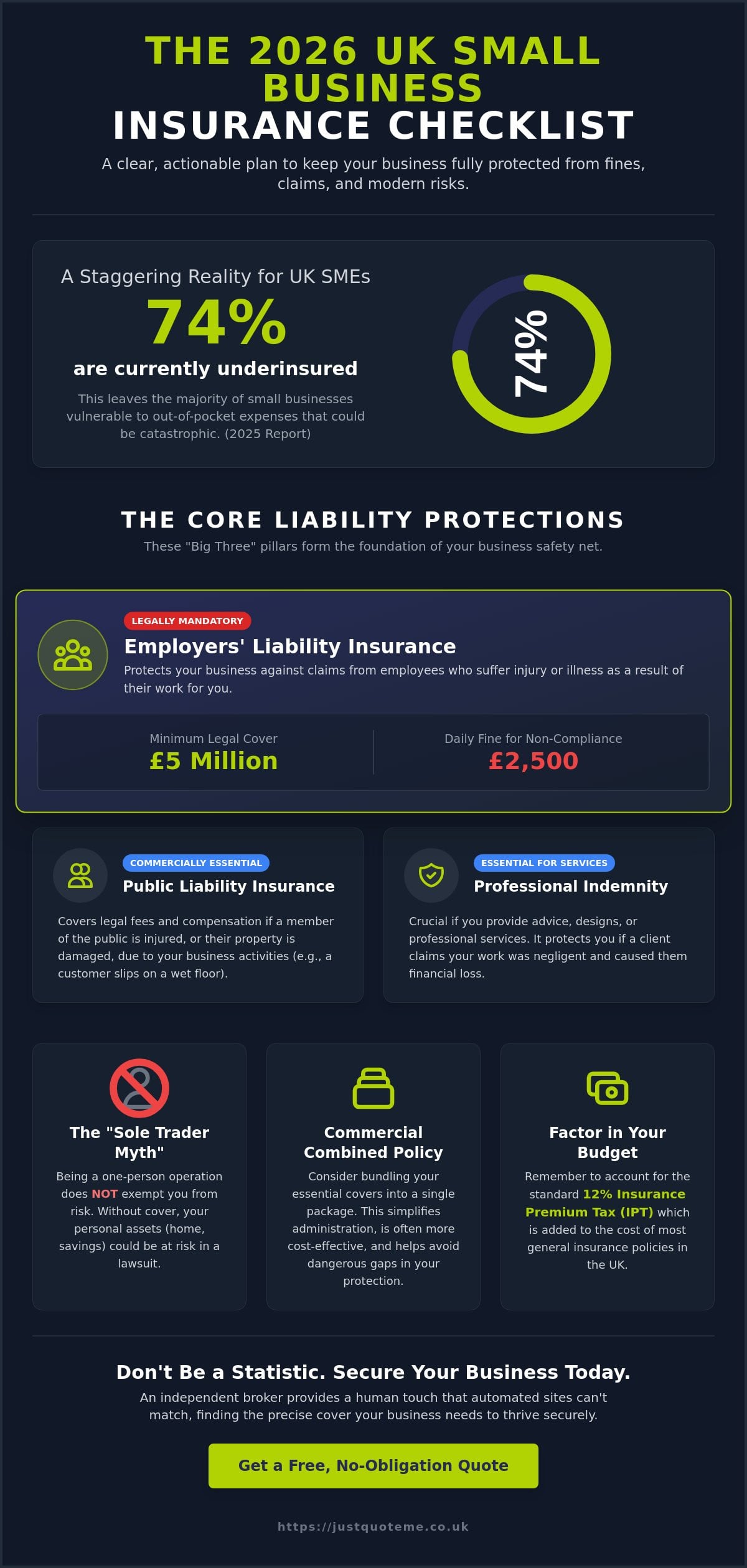
Did you know that a 2025 report revealed 74% of UK small and medium-sized enterprises are currently underinsured? It is a staggering figure that highlights just how easy it is to miss a critical detail when you are busy running a company. We understand that the distinction between mandatory legal requirements and recommended covers often feels intentionally confusing. You want to protect your assets, but the fear of a rejected claim or a £2,500 daily fine for non-compliance can make the search for coverage feel like a minefield.
You deserve a straightforward way to secure your future. This guide provides a definitive checklist for small business insurance uk in 2026, moving beyond generic algorithms to offer a tailored look at what your specific trade requires. We will break down the £5 million legal minimums for employers’ liability, explain how the 12% standard Insurance Premium Tax affects your budget, and show you exactly how to build a robust safety net that stands up to scrutiny. By the end of this article, you will have a clear, actionable plan to keep your business fully protected.
Key Takeaways
- Identify the specific legal requirements for your staff to avoid heavy daily fines and stay compliant with UK law.
- Build a comprehensive small business insurance uk checklist that balances essential liability covers with modern protections like cyber security.
- Learn how to conduct a simple risk assessment tailored to your specific sector and daily business interactions.
- Discover the key information you need to provide for a quote that offers real protection rather than just the lowest price.
- Understand the difference between mandatory and recommended covers to ensure your personal and business assets remain secure.
Small Business Insurance in the UK: Why It Matters in 2026
Small business insurance uk isn’t a one-size-fits-all product you buy off a shelf. Think of it as a bespoke safety net, woven from different strands of liability and asset protection tailored to your unique trade. In 2026, the landscape of risk has shifted significantly. While physical incidents like a customer tripping over a cable are still common, digital threats and complex supply chain liabilities have become primary concerns for every high street shop and home-based consultant alike.
Operating without this safety net carries severe financial weight. If a claim is made against you, the costs aren’t just the final settlement; you’ll face legal fees that can escalate rapidly. According to 2025 data, approximately 74% of UK SMEs are currently underinsured, leaving them vulnerable to sudden out-of-pocket expenses that can bankrupt a growing company. This vulnerability is explained well in this UK Insurance Market Overview, which highlights how the industry adapts to these growing economic pressures. Beyond civil claims, failing to meet legal requirements, such as employers’ liability, can result in fines of up to £2,500 for every single day you operate without cover.
We often encounter the “Sole Trader Myth” among new entrepreneurs. This is the dangerous belief that being a one-person operation or working from a home office exempts you from significant risk. It’s simply not true. Without the right protection, your personal assets, including your home and savings, could be at risk if a client sues for professional negligence or an accidental injury occurs on your premises. Professional cover draws a clear line between your business liabilities and your personal life.
The Role of an Independent Insurance Broker
We’ve spent over 30 years acting as a steady hand for business owners across the country. Unlike a direct insurer that only sells its own limited products, an independent broker acts as your advocate. We have access to a vast network of underwriters, meaning we can shop around to find the exact cover you need at the right price. It’s a human-centric approach that avoids the faceless, automated algorithms of big comparison sites. We provide a personal touch that ensures your policy actually works when you need to make a claim.
Understanding the 2026 Regulatory Environment
The regulatory environment in 2026 is strictly governed by the Financial Conduct Authority (FCA), which ensures you are treated fairly and that insurers remain solvent. Recent trends show that generic, “off-the-shelf” policies are increasingly failing to keep up with modern business needs. Whether you require public liability insurance or professional indemnity insurance, a bespoke approach is now the standard for those who want real security. It’s about precision; your policy should reflect the specific risks of your daily activities, not a generic industry average.
Get Your Free Business Insurance Quote now.
Request a Call back for free Expert advice.
The Essential 2026 Small Business Insurance Checklist
Building your protection starts with the “Big Three”. These are the primary pillars of small business insurance uk that every owner should evaluate before they open their doors. While you can purchase these covers individually, we often recommend a “Commercial Combined” policy. This approach bundles your liabilities and asset protections into a single, efficient package, which simplifies your administration and ensures there are no overlapping gaps in your coverage.
Core Liability Protections
Public Liability Insurance acts as your first line of defence. It’s designed to cover legal fees and compensation costs if a member of the public is injured or their property is damaged because of your business activities. If you provide advice, designs, or professional services, Professional Indemnity Insurance is non-negotiable. It protects you if a client claims your work was negligent or caused them a significant financial loss. Finally, you must consider Mandatory Business Insurance requirements. If you employ anyone, Employers’ Liability Insurance is a legal necessity in the UK, carrying a minimum cover requirement of £5 million.
Protecting Your Digital and Physical Assets
In 2026, your data is often as valuable as your physical stock. The 2025 Cyber Security Breaches Survey revealed that only 45% of UK businesses have invested in Cyber Liability Insurance, yet digital threats remain a top risk for SMEs. A robust policy helps you manage the fallout from data breaches and ransomware attacks. For physical premises, Shop Insurance or commercial property cover protects your building and its contents from fire, theft, or flood. If your business operates from a dedicated workspace, a comprehensive office insurance policy ensures your equipment, employees, and premises are fully protected against risks that generic covers often overlook. If your business is mobile, ensuring you have van and tools insurance is vital to keep you on the road and working if your equipment is stolen or damaged.
Don’t forget the niche items that keep your specific trade running. For construction and agricultural sectors, plant and machinery insurance covers the heavy equipment that general policies often exclude. If you sell physical goods, you should also ensure your package includes Product Liability to cover injuries caused by items you’ve supplied. Finding the right balance between these various covers doesn’t have to be a headache when you work with a specialist UK broker who understands your industry inside out.
Get Your Free Business Insurance Quote now.
Request a Call back for free Expert advice.
Legal Requirements vs. Commercial Sense: What Is Mandatory?
Understanding the difference between a legal obligation and a commercial necessity is the first step in streamlining your small business insurance uk costs. While many covers are highly recommended, the UK government only mandates a few specific types by law. However, don’t let the word “optional” fool you. In many sectors, failing to hold “non-mandatory” cover like public liability will simply mean you can’t win contracts or join professional trade bodies. You should view your insurance as a dual-purpose tool: one part keeps you out of court, and the other part keeps you in business.
Employers’ Liability: The Legal Must-Have
If you have even one employee, you must hold Employers’ Liability Insurance. The law defines an employee broadly; it includes full-time staff, part-time workers, volunteers, and even students on work placements. Under the 1969 Act, you’re legally required to have at least £5 million in cover, though most insurers provide £10 million as a standard. The consequences of skipping this are severe. The Health and Safety Executive (HSE) can fine your business up to £2,500 for every single day you’re not properly insured. You can verify your specific requirements through a UK government-backed guide to business insurance to ensure your startup remains compliant from day one.
Industry-Specific Mandatory Covers
Some trades face additional legal or regulatory hurdles. If your business involves handling customer vehicles, commercial motor insurance is a strict legal requirement. Similarly, if you work in the private security sector, holding Security Insurance is often a prerequisite for SIA licensing and client trust. For regulated professionals like solicitors or accountants, Professional Indemnity Insurance isn’t just a good idea; it’s a mandatory requirement set by regulatory bodies. These organisations often specify minimum cover levels, such as £2 million or £3 million, to protect the public and ensure professional standards are met.
Then there’s “commercial sense.” You might not be legally required to have public liability insurance, but try working for a local authority or a large corporation without it. They’ll almost certainly demand proof of cover, often at a £5 million or £10 million limit, before you can even step onto their site. In these cases, the mandate is contractual rather than legal, but the result is the same: no insurance, no business. Protecting your personal and business assets means looking beyond what the law requires and considering what your clients expect.
Get Your Free Business Insurance Quote now.
Request a Call back for free Expert advice.
Assessing Your Risk Profile: A Sector-by-Sector Guide
Risk isn’t a generic concept that applies equally to every shop or office. It’s highly localized and trade-specific. A small cafe in Stone faces daily risks related to hot spills and food hygiene, whereas a builder in Staffordshire deals with structural liabilities and site safety. To understand your small business insurance uk needs, you must conduct a basic risk assessment. This doesn’t need to be a complex document, but it does require you to answer three fundamental questions:
- Who do I interact with? If you have physical contact with the public, your liability needs are high. If you only deal with digital clients, professional indemnity is your priority.
- What assets do I own? Consider everything from your building and stock to your laptops and customer data.
- Where do I work? Risks change whether you are based in a fixed shop, a home office, or moving between different construction sites.
Construction, Trades, and Manual Labour
Manual trades require a more rugged form of protection that accounts for the physical nature of the work. For many, Tradesman Insurance serves as the foundation, but it often needs to be supplemented with specialist extensions. If your work involves working at height, your policy must explicitly cover the increased risk of falls and falling objects, as standard policies often have height limits. We also recommend Contractors All Risk Insurance for those managing larger projects. This covers the work in progress, such as a half-finished extension, against fire, theft, or vandalism. Don’t overlook your physical tools; plant and machinery insurance is essential for protecting the heavy-duty gear that keeps your business operational.
Retail, Hospitality, and Professional Services
The hospitality sector faces a completely different set of challenges. For instance, Thatched Pubs require specialist fire risk assessments and bespoke coverage due to their unique construction materials. Similarly, Nightclubs deal with high-volume public interaction and late-night security risks that require a steady hand to insure correctly. If you run Hotels and Guest Houses, your focus shifts toward guest safety and business interruption cover. For Restaurants, food hygiene and public safety are the primary concerns. Beyond the frontline, management teams should consider Directors and Officers Insurance to protect against personal liability for corporate decisions made on behalf of the company.
Each sector has “hidden” risks that a generic online form might miss. This is where a specialist broker adds value by identifying the gaps before they become expensive problems. You can speak to our team today to ensure your risk profile is accurately mapped and your business is fully protected.
Get Your Free Business Insurance Quote now.
Request a Call back for free Expert advice.
How to Get the Best Small Business Insurance Quote
Securing the right small business insurance uk package shouldn’t be a race to the bottom on price. While automated comparison engines promise a quote in minutes, they often rely on generic assumptions that leave your specific risks exposed. To get an accurate, reliable quote, you need to have your business data ready. This includes your projected annual turnover, exact staff numbers, and a detailed description of your daily activities. Precision at this stage prevents the “cheapest” policy from becoming the most expensive mistake you ever make when a claim is eventually rejected due to inaccurate information.
We believe in the value of an independent broker over a faceless algorithm. A broker doesn’t just look at one restricted panel; they compare the whole market to find a bespoke fit for your trade. This personal touch is essential in 2026, as business risks become more complex and digital threats rise. We act as your advocate, ensuring that the fine print actually supports your business rather than hiding exclusions that could lead to financial ruin. Reliability is our priority, and it starts with a quote that reflects the reality of your operations.
Avoiding Common Quoting Mistakes
One of the most frequent errors we see is underestimating turnover or staff numbers to save on premiums. If you underestimate your figures by a significant margin, such as 25%, an insurer may apply the “principle of average” and only pay out a fraction of your claim. You must also disclose all previous claims and any high-risk activities, such as working with heat or at extreme heights. Our brand name, Just Quote Me, is more than a catchy phrase; it’s a promise of efficiency and honesty. We do the heavy lifting to ensure your data is presented correctly to underwriters from the start.
Next Steps for Your Business Protection
You now have a comprehensive checklist to manage the 2026 insurance landscape. From the legal mandates of employers’ liability to the commercial necessity of professional indemnity, the path to protection is clear. Don’t wait for a disaster to strike before reviewing your coverage. A proactive approach today saves your assets, your reputation, and your peace of mind tomorrow. Whether you are a sole trader or a growing firm with a fleet of vehicles, expert advice is only a click away.
Get Your Free Business Insurance Quote now.
Request a Call back for free Expert advice.
Securing Your Business Future Today
You now have the tools to navigate the complexities of small business insurance uk with confidence. By prioritizing legal mandates like employers’ liability and mapping out your sector-specific risks, you’ve moved ahead of the 74% of SMEs currently operating with insufficient cover. Protecting your assets isn’t just about ticking boxes; it’s about building a foundation that allows you to focus on growth without the constant fear of a rejected claim.
As an FCA Authorised and Regulated independent brokerage, we bring over 30 years of industry experience to your side. We don’t rely on automated algorithms; we provide a personal touch and direct access to top UK insurers to ensure your policy is truly bespoke. You can partner with an expert advisor who understands the nuances of your trade and does the heavy lifting for you. Take the final step in your protection plan today. We are here to make the process simple, quick, and reliable.
Get Your Free Business Insurance Quote now.
Request a Call back for free Expert advice.
Frequently Asked Questions
What is the most important insurance for a small business in the UK?
Employers’ liability insurance is the most critical cover because it is a legal requirement for almost every business with staff. Following this, public liability is essential for any firm that interacts with the public or visits client sites. These two protections form the core of most small business insurance uk packages, shielding you from both government fines and significant compensation claims.
How much does small business insurance cost on average in 2026?
While premiums depend on your specific trade, average public liability insurance costs around £118 per year. For employers’ liability, low-risk office roles start at approximately £60 annually, while manual labor roles can exceed £200 per employee. These figures include the 12% standard Insurance Premium Tax. Your final cost is determined by your turnover, staff numbers, and previous claims history.
Is public liability insurance a legal requirement for UK sole traders?
No, public liability insurance is not mandated by UK law for sole traders. However, it is often a contractual requirement; most clients and local authorities will refuse to hire you unless you provide proof of cover. It serves as a vital safety net that protects your personal assets if a third party suffers an injury or property damage due to your work activities.
Can I run a business from home without specialist insurance?
You can, but your standard residential home insurance likely excludes business use, equipment, and professional visitors. If a client trips in your hallway or your business stock is damaged in a fire, a standard home policy will probably reject the claim. You need a specific home-based small business insurance uk policy or a tailored extension to ensure your professional risks are fully covered.
What happens if I don’t have employers’ liability insurance?
The Health and Safety Executive can fine your business up to £2,500 for every single day you operate without the correct cover. Beyond these daily penalties, you would be personally liable for all legal fees and compensation if an employee is injured or falls ill because of their work. This applies to full-time staff, part-time workers, and even volunteers or students on placement.
How do I know if I need professional indemnity insurance?
You need professional indemnity insurance if your business provides advice, designs, or professional services to clients. This cover protects you if a client claims your work was negligent or caused them a financial loss. Many regulatory bodies, such as those for accountants and solicitors, mandate minimum cover levels of at least £2 million to maintain your professional standing.
Are insurance premiums tax-deductible for UK small businesses?
Yes, business insurance premiums are generally considered an allowable expense by HMRC. You can deduct the cost of your premiums from your turnover when calculating your taxable profit, which reduces your overall tax bill. This applies to all standard commercial covers, including public liability, professional indemnity, and office insurance for your business premises.
Can I change my business insurance policy mid-term?
Yes, you can update your policy at any time to reflect changes in your business, such as hiring new staff or moving premises. It is vital to inform your broker of these changes immediately to ensure your cover remains valid. Adjusting your policy mid-term prevents you from becoming underinsured, which currently affects approximately 74% of UK small and medium-sized enterprises.
Get Your Free Business Insurance Quote now.
Request a Call back for free Expert advice.
