
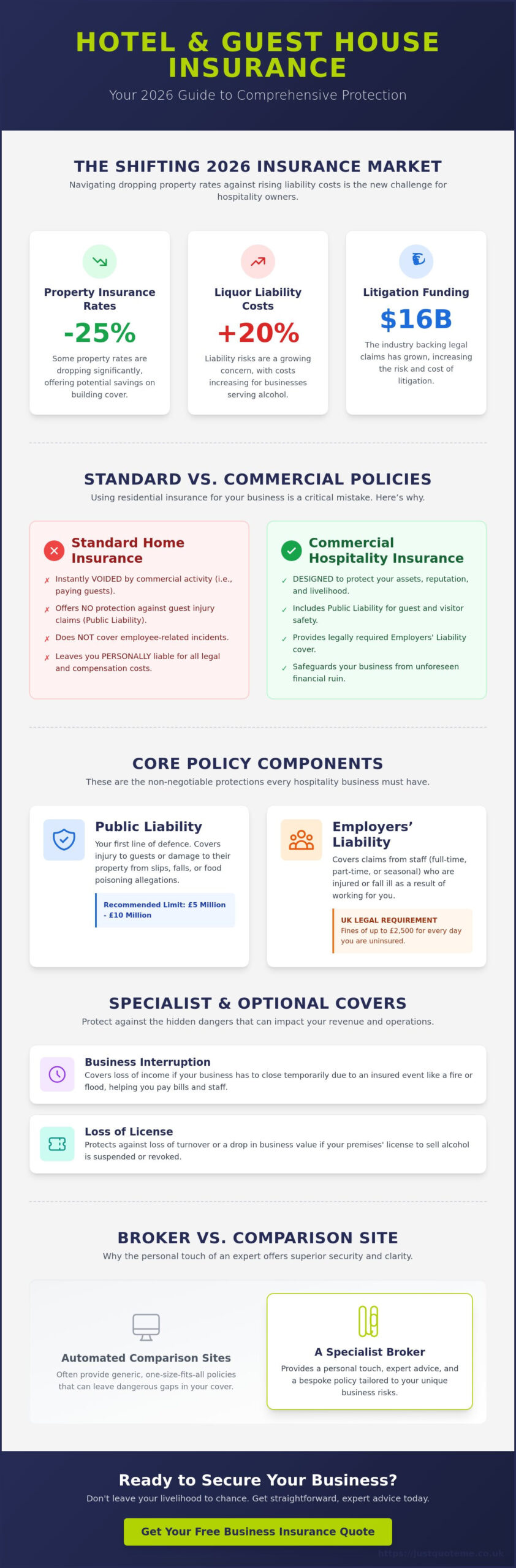
Did you know that while some property insurance rates are dropping by over 25% in 2026, liquor liability costs jumped by 20% at the end of 2025? Securing the right hotel and guest house insurance has become a balancing act between these shifting property markets and rising liability risks. You’ve likely felt the sting of high renewal premiums and the headache of trying to figure out which legal requirements are mandatory. It’s worrying to think a single line of fine print could lead to a rejected claim. We believe insurance should be straightforward, not stressful.
We’ll show you how to protect your hospitality business with bespoke coverage that handles everything from public liability to property damage. This guide explains how to navigate a market where litigation funding has reached $16 billion, ensuring your policy is robust enough to stand up to scrutiny. You’ll learn how to stay compliant with UK law while securing a policy that grows with your business. We’ve simplified the technical details so you can get back to your guests with total peace of mind.
Get Your Free Business Insurance Quote now.
Request a Call back for free Expert advice.
Key Takeaways
- Understand why standard residential insurance is insufficient for hospitality and how a dedicated commercial policy protects your livelihood.
- Identify the essential legal requirements and core protections included in comprehensive hotel and guest house insurance.
- Learn how to safeguard your revenue against unforeseen events with specialist covers like Business Interruption and Loss of License.
- Discover practical risk management strategies, such as safety audits and security upgrades, that can help reduce your insurance costs.
- See why the personal touch of an expert broker offers superior security and clarity compared to automated comparison sites.
Understanding Hotel and Guest House Insurance: Why Standard Cover Isn’t Enough
A comprehensive hotel and guest house insurance policy isn’t just a single product. It’s a multi-risk commercial framework designed to shield your assets, your reputation, and your legal standing. Many new owners mistakenly assume their existing residential home insurance will suffice, especially if they only let out a few rooms. This is a dangerous misconception. The moment you accept money from a guest, you’ve transitioned from a private dwelling to a commercial enterprise. Most standard home insurers will void a policy immediately if they discover business activity they haven’t approved.
Understanding Property Insurance Basics helps clarify why this happens. While a standard policy covers fire or theft in a private setting, the presence of paying guests introduces significantly higher risks. From increased footfall to the use of commercial kitchen equipment, the risk profile shifts. In 2026, the UK hospitality sector faces more scrutiny than ever. Bespoke cover ensures that if a guest causes accidental damage or a fire, you aren’t left footing a massive bill because your residential policy was deemed invalid.
The Legal Reality of Running a Hospitality Business
Operating a business in the UK carries heavy legal weight. If you employ even one person, perhaps a part-time cleaner or a seasonal waiter, you’re legally required to have Employers’ Liability Insurance. Without it, you could face fines of up to £2,500 for every single day you’re uninsured. Beyond staffing, you owe a strict duty of care to every person who enters your premises. Under the Occupiers’ Liability Act 1957, you’re responsible for their safety. Failing to have a robust commercial policy means you’re personally liable for legal fees and compensation that can easily reach six figures.
B&B vs. Guest House vs. Hotel: Which Policy Fits?
The distinction between these business types usually comes down to scale and service. For most insurers, a B&B is a private home with fewer than 6 guest rooms where the owner lives on-site. Once you exceed this room count or hire professional staff, you’ve moved into guest house or hotel territory. This change dictates the complexity of your hotel and guest house insurance. You must also consider unoccupancy. If your property closes for more than 30 consecutive days during the winter, standard cover might be restricted unless you’ve specifically negotiated terms for seasonal closures. If you also rent out any properties separately, it’s worth understanding how landlord insurance in 2026 differs from commercial hospitality cover to ensure you have the right protection in place for each asset.
Get Your Free Business Insurance Quote now.
Request a Call back for free Expert advice.
The Core Components: Must-Have Protection for Your Business
Building a solid foundation for your hotel and guest house insurance requires more than just ticking boxes. It’s about understanding the specific threats your property faces every day. A boutique hotel in a city centre has different needs than a rural guest house, but both require a core set of protections to remain viable. These components work together to ensure that a single accident doesn’t lead to financial ruin.
Public Liability: Protecting Against the Unexpected
Public liability is your first line of defence. It covers you if a guest or visitor is injured or their property is damaged while on your premises. Common claims in the hospitality sector include slips on wet floors or trips over loose carpets. In some cases, food poisoning allegations can also arise. Given that the litigation funding industry has grown to $16 billion as of 2026, the cost of defending a claim is higher than ever. While £2 million used to be standard, many modern policies now recommend £5 million or £10 million indemnity limits. Implementing proactive Risk Management Strategies can help document your safety protocols, making it easier to defend against claims. You can learn more about how this works on our Public Liability Insurance page.
Employers’ Liability: Your Legal Obligation
If you have even one part-time staff member, Employers’ Liability Insurance is a legal requirement. This isn’t just for full-time employees; it covers seasonal workers, cleaners, and even family members who help out. The law mandates a minimum of £5 million in cover, though most reputable insurers provide £10 million as standard. This protection ensures that if a staff member is injured while working, perhaps from a kitchen burn or a back injury while moving luggage, the policy handles the compensation and legal costs. It’s a non-negotiable part of your business structure.
Commercial Property and Asset Protection
Protecting your physical assets involves more than just the roof over your head. You need to distinguish between the building structure and the high-value contents inside. This includes everything from commercial kitchen equipment to the fine linens in your guest rooms. It’s also vital to include ‘Guest Effects’ cover, which protects your guests’ belongings, like laptops or jewellery, while they stay with you. Standard policies often cover perils like fire or flood, but you should ensure your hotel and guest house insurance includes accidental damage for those inevitable spills or breakages. For a deeper look at protecting your premises, read our Commercial Property Insurance Guide. If you’re unsure which limits are right for your specific room count, it’s worth speaking with a specialist broker to tailor your policy.
Get Your Free Business Insurance Quote now.
Request a Call back for free Expert advice.
Specialist Risks: The Hidden Dangers in Hospitality
While protecting your physical property and meeting legal requirements for staff are vital steps, they only cover the visible parts of your business. Modern hospitality faces a range of “invisible” threats that can be just as devastating as a fire or flood. A truly robust hotel and guest house insurance policy in 2026 must account for digital vulnerabilities, regulatory hurdles, and the long-term fallout of a forced closure. Relying on basic cover leaves these gaps wide open, potentially costing you your livelihood.
Business Interruption: Your Income Safety Net
If a significant event like a fire forces you to close your doors, your property insurance handles the repairs. However, it doesn’t pay your mortgage, utility bills, or staff wages while the work is carried out. This is where business interruption cover becomes essential. It replaces your lost revenue during the “period of restoration.” In 2026, we recommend looking closely at your indemnity period. While 12 months was once the standard, supply chain delays and planning hurdles mean 24 months is often more realistic to ensure you can fully recover. You should also decide whether to claim on a “gross profit” basis, which covers the loss of profit after variable costs, or a “revenue” basis, which covers the total income lost. The right choice depends on your specific business model and fixed overheads, and many owners explore SkyTab POS to ensure they have the precise transaction data needed to support such claims.
Data Security and Cyber Liability in 2026
Cybercriminals are increasingly targeting the hospitality industry because of the high volume of sensitive guest data stored in Property Management Systems (PMS). A single ransomware attack can lock you out of your bookings, guest records, and payment gateways. Beyond the immediate operational chaos, you face the heavy burden of GDPR fines and the cost of notifying every affected guest. A specialized Cyber Insurance policy provides the technical support to recover your data and the financial protection to handle legal penalties. Given that hospitality is now a prime target for digital extortion, this is no longer an optional extra for modern guest houses.
Protecting Your Alcohol License
For many hotels and guest houses, the bar or restaurant is a primary revenue driver. If your alcohol license is revoked due to circumstances beyond your control, the impact is two-fold. You lose immediate sales, and the overall market value of your property often depreciates significantly. Loss of License cover protects you against this financial loss, providing a payout that accounts for the drop in your business’s value. This is particularly relevant in 2026 as insurers implement stricter underwriting practices in response to rising reports of workplace violence and the need for rigorous risk management plans.
Get Your Free Business Insurance Quote now.
Request a Call back for free Expert advice.
Risk Management: Strategies to Lower Your Insurance Premiums
Reducing the cost of your hotel and guest house insurance isn’t just about shopping for a lower price. It’s about demonstrating to underwriters that your business is a well managed, low risk operation. In 2026, insurers are rewarding owners who take a proactive approach to safety. By tightening your internal protocols and investing in modern technology, you can often secure more favourable rates and avoid the sharp premium hikes affecting less prepared competitors.
Health and Safety Compliance
Rigorous documentation is your strongest defence against liability claims. Every guest house should maintain up to date Fire Risk Assessments and ensure all portable electrical equipment undergoes PAT testing every 12 to 24 months. Beyond fire safety, daily cleaning logs are vital. If a guest claims they slipped on a wet floor, a timestamped log showing the area was inspected and dried 15 minutes prior can be enough to dismiss a claim. In 2026, insurers are also paying closer attention to kitchen hygiene and allergen control protocols. Following the latest Food Standards Agency guidelines and documenting staff training on these standards shows a level of professionalism that insurers value during the quoting process.
Security Systems and Premium Discounts
Investing in physical security provides an immediate return in the form of lower property insurance premiums. Installing a NACOSS-approved alarm system, which is monitored 24/7, significantly reduces the risk of undetected theft. Similarly, smart locks and CCTV in public areas provide both a deterrent and a clear evidence trail if an incident occurs. Guest room safes also play a role; they allow you to increase your “Guest Effects” coverage limits without a proportional rise in cost, as the risk of theft is lower. When you speak to your broker, provide a detailed list of these upgrades, including model numbers and certification dates, to ensure they’re factored into your premium calculation.
Beyond hardware, your staff are your most important risk management tool. Regular training on manual handling and emergency evacuation protocols reduces the likelihood of an accident ever reaching your insurer. You might also consider adjusting your voluntary excess. By agreeing to pay a slightly higher amount in the event of a claim, you can often significantly lower your annual premium. If you’re ready to see how these improvements affect your costs, you can get a tailored insurance quote here based on your specific risk profile.
Get Your Free Business Insurance Quote now.
Request a Call back for free Expert advice.
Why Choose a Specialist Broker for Your 2026 Policy?
In a market where property insurance rates for catastrophe-exposed properties can drop by 25% while liability costs for alcohol service climb by 20%, a “one size fits all” approach simply doesn’t work. Algorithms on comparison sites are designed for speed, not accuracy. They often miss the nuances of your specific operation. At Just Quote Me, we bring 30 years of independent brokerage experience to the table. We understand that your business is more than just a set of data points on a spreadsheet. Choosing a specialist broker means you aren’t just buying a policy; you’re securing a partnership with an expert who knows how to navigate the complexities of hotel and guest house insurance.
The Personal Touch in a Digital World
While the world becomes increasingly automated, the value of human expertise remains unmatched. Our team provides UK-based expertise with deep local knowledge, particularly in the Stafford area. This local insight allows us to understand the regional risks and opportunities that a faceless algorithm would overlook. Brokers have access to “niche” markets and specialist underwriters who don’t list their products on mass-market comparison sites. This means we can find bespoke coverage for unique properties, such as those with thatched roofs or historic status, ensuring you have the right protection at the right price. You can explore our specific Hotel & Guest House Insurance solutions to see how we tailor our services to your needs.
Bespoke policy design is about efficiency. We ensure you only pay for the cover your specific premises needs, removing unnecessary “extras” that bloat your premium. If the worst happens and you need to make a claim, having a broker in your corner is invaluable. We act as your advocate, dealing with the paperwork and negotiating with insurers to ensure a fair and fast settlement. In 2026, when legal and cyber risks are at an all-time high, having an experienced hand to guide you through the claims process provides true peace of mind. It’s the difference between being a policy number and being a valued client.
Securing Your Quote Today
We’ve stripped away the complexity and the jargon to make securing your hotel and guest house insurance as simple as possible. Our “no-nonsense” approach means you get clear, honest advice without the corporate fluff. We do the heavy lifting, comparing the market and verifying the fine print so you don’t have to. It’s a fast-paced process designed to save you time and protect your bottom line. Whether you’re a small B&B or a large boutique hotel, we’re ready to help you grow with confidence.
Get Your Free Business Insurance Quote now.
Request a Call back for free Expert advice.
Secure Your Hospitality Business for 2026 and Beyond
Securing the right hotel and guest house insurance is no longer a simple administrative task; it’s a strategic necessity. We’ve explored why commercial cover is essential to avoid voided policies and how specialist protections like cyber liability and business interruption shield you from modern threats. By implementing documented risk management protocols, you aren’t just improving safety; you’re actively positioning your business for lower premiums in a shifting market. Every safety audit and security upgrade serves as proof of your commitment to excellence.
As an FCA-authorised independent broker with over 30 years of industry experience, Just Quote Me provides the human expertise that automated algorithms lack. We leverage our broad network of top UK insurers to build bespoke policies that fit your specific room count and service level. We’re here to do the heavy lifting so you can focus on providing an exceptional guest experience. Take the first step toward total peace of mind by partnering with a specialist who understands your trade and your goals.
Get Your Free Business Insurance Quote now.
Request a Call back for free Expert advice.
Frequently Asked Questions
Is hotel insurance a legal requirement in the UK?
Employers’ Liability is the only legal requirement if you employ staff, carrying a potential £2,500 daily fine for non-compliance. While public liability isn’t legally mandated by the government, it’s often a contractual requirement for mortgage lenders and booking platforms. Operating without it leaves you personally responsible for legal fees and compensation. Most professional associations also require proof of cover before granting membership or accreditation.
Does my guest house insurance cover food poisoning claims?
Yes, food poisoning claims are covered under the public liability section of your policy. This protection handles legal costs and compensation if a guest falls ill after consuming food or drink provided on your premises. Given that litigation funding grew to $16 billion by 2026, having this protection is vital. It’s important to document your hygiene protocols to help your insurer defend against fraudulent or exaggerated claims.
How much does insurance for a B&B or guest house cost in 2026?
Premiums are tailored to your specific property, but property insurance rates for smaller, low-risk risks are moving between -5% and +5% in 2026. However, businesses serving alcohol saw liquor liability rates increase by up to 20% in the final quarter of 2025. Your final cost depends on factors like your location, room count, and previous claims history. We compare multiple insurers to find the most competitive rate for your risk profile.
What is the difference between Guest House and B&B insurance?
The distinction is usually based on the scale of the operation and whether the owner resides on the property. A B&B typically has fewer than 6 guest rooms and is the owner’s primary residence. A guest house is often a larger, more commercial venture with more rooms and professional staff. Your hotel and guest house insurance will be structured differently to reflect these higher occupancy levels and increased operational risks.
Am I covered if a guest damages my property or steals items?
You are covered if your policy includes “Accidental Damage” and “Guest Effects” extensions. Standard buildings and contents cover often excludes damage caused by guests unless it’s specifically added. Theft is also covered, though some insurers require evidence of forcible entry for high-value items. Including these options ensures you aren’t out of pocket for broken furniture or stolen guest belongings, maintaining your reputation and your bottom line.
Do I need separate insurance for a hotel bar or restaurant?
You don’t need a separate policy, but these facilities must be declared to ensure your hotel and guest house insurance includes specific liquor and food liability. Serving alcohol or running a public restaurant significantly changes your risk profile. Because liquor liability rates climbed by 20% in late 2025, it’s essential that your broker accurately reflects these services to ensure your claims aren’t rejected due to non-disclosure.
Can I pay my hotel insurance premium in monthly instalments?
Yes, you can typically pay your premium in monthly instalments via Direct Debit to help manage your business cash flow. Most of the insurers we work with offer flexible payment plans, though a small interest charge usually applies. This allows you to secure high-quality cover without a large upfront capital outlay. Our team can set this up quickly during the quoting process to keep things efficient for you.
What happens to my insurance if my guest house is unoccupied for part of the year?
Most policies include a “30-day unoccupancy clause” that restricts cover if the property is empty for longer than a month. If you run a seasonal guest house that closes during winter, you must inform your broker. We can arrange specific terms that maintain protection during the off-season. This might include requirements to drain water systems or maintain a minimum temperature to prevent burst pipes while guests are away. If you also own residential rental properties, our guide to landlord insurance for UK property owners in 2026 explains how to keep those assets equally well protected.
Get Your Free Business Insurance Quote now.
Request a Call back for free Expert advice.
