

What if your current policy is effectively worthless the moment your team climbs past the third storey? Many scaffolding contractors in the UK discover too late that their standard coverage includes height restrictions that don’t match their actual work sites. Finding reliable insurance for scaffolding company operations often feels like an uphill battle against exorbitant premiums and brokers who don’t understand the difference between a simple tower and a complex bespoke design.
We understand that you’re looking for more than just a certificate; you need a policy that stands up when things go wrong. You likely feel the pressure of high-risk classifications and the frustration of hidden exclusions regarding heat work or sub-contractors. This specialist 2026 guide is designed to simplify that process. We’ll show you how to secure comprehensive, high-risk coverage while avoiding common pitfalls and securing rates that reflect your true safety standards.
We’ll explore the latest industry requirements, including why the Building Safety Act clarification matters for your business and how to ensure your Employers’ Liability meets the £10 million industry standard. By the end of this guide, you’ll know exactly how to tailor your protection to your specific maximum height and operational needs.
Key Takeaways
- Learn why standard height limits on general policies often fail to protect your business and how to secure a policy that matches your actual working heights.
- Understand the essential coverage requirements for UK scaffolding firms, including the industry-standard £10 million for Employers’ Liability.
- Discover how proactive safety documentation and professional memberships can significantly reduce the cost of insurance for scaffolding company operations.
- Identify the critical “add-on” protections for owned and hired-in plant, ensuring your towers and hoist systems are fully covered against theft or damage.
- Gain expert insights on avoiding hidden policy exclusions that could leave your business exposed during high-risk projects.
Why Scaffolding Insurance Requires a Specialist Approach
Scaffolding isn’t a standard construction trade. While a general builder might spend most of their time on the ground, your team operates in a high-hazard environment defined by height and gravity. To understand the risk, one only needs to look at what is scaffolding in a professional context: a complex, temporary structure designed to support people and materials at significant elevations. Because of the inherent fall potential and the risk of falling objects, UK underwriters classify scaffolding as a high-risk trade. This classification means that finding the right insurance for scaffolding company operations requires a specialist broker who understands these nuances.
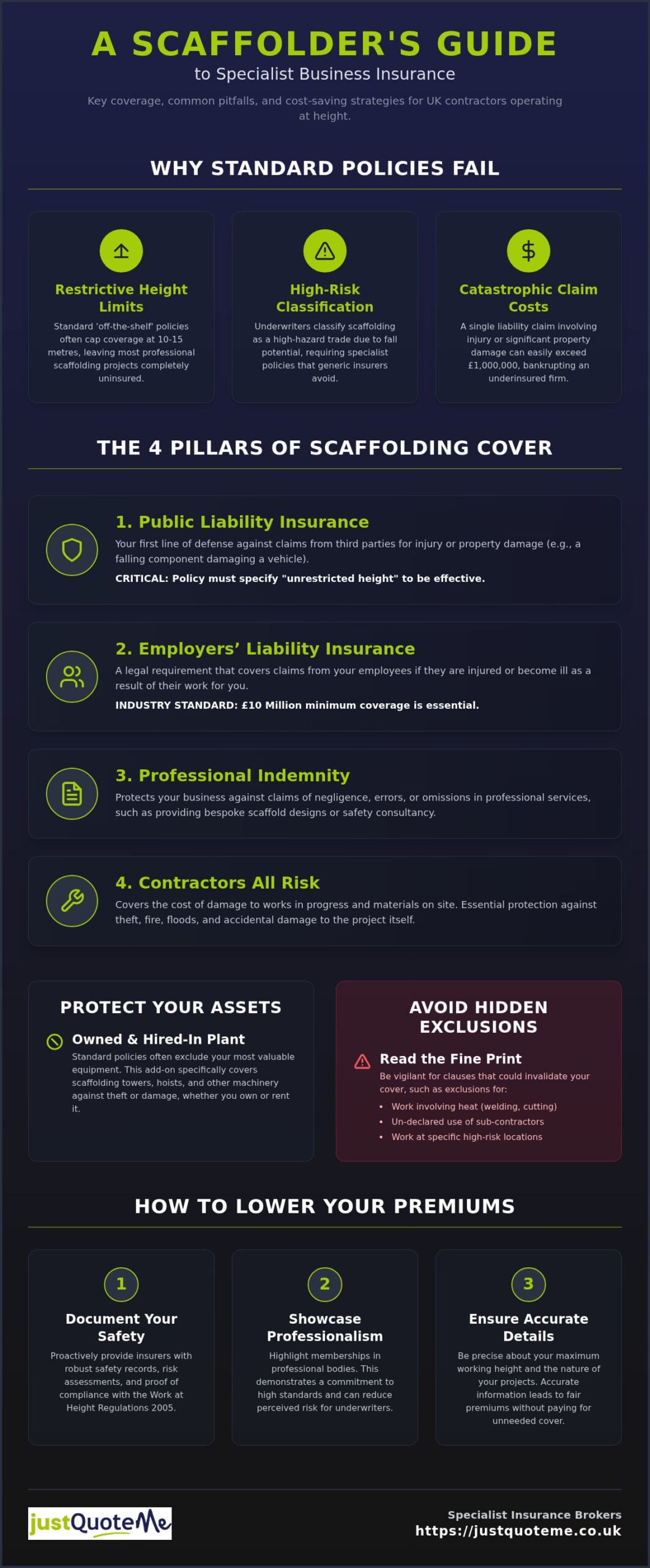
Standard tradesman policies are often dangerous for scaffolders. They frequently include “standard height limits” of 10 or 15 metres. If your project involves a high-rise residential block or a historic church steeple, an off-the-shelf policy might leave you completely exposed. In this sector, a single liability claim can easily exceed £1 million, making comprehensive limits a necessity rather than an option. Just Quote Me acts as your expert intermediary, using our 30 years of experience to connect you with specialist underwriters who actually want to cover high-risk construction.
The Reality of High-Risk Underwriting in 2026
Insurers view scaffolding through a different lens than general building work. In 2026, the UK insurance market is tightening. Inflation has driven up the cost of materials and legal fees, which in turn pushes premiums higher. “Off-the-shelf” digital policies often fail during a serious claim because they lack the bespoke endorsements required for complex structures. You need a policy that reflects your actual risk profile, not a generic template. We help you demonstrate your safety standards to underwriters to ensure your premiums remain fair despite the challenging economic climate.
Regulatory Compliance and the HSE
The Health and Safety Executive (HSE) maintains a strict watch on scaffolding sites. Compliance isn’t just about avoiding fines; it’s the foundation of your insurance validity. Your policy is intrinsically linked to the Work at Height Regulations 2005. If a claim arises and it’s found that you weren’t following these statutory duties, your insurer may have grounds to refuse the payout. It’s vital to stay updated on our Working at Height Guide to ensure your operational procedures match your policy requirements. We also keep a close eye on legislative shifts, such as the 2026 clarification that temporary scaffolding remains outside the scope of the Building Safety Act, ensuring your coverage stays relevant to current laws.
Request a Call back for free Expert advice
Core Insurance Covers Every Scaffolding Business Needs
Building a robust insurance package is about more than just ticking a box; it’s about ensuring your business survival in a high-stakes industry. For any comprehensive insurance for scaffolding company, four core pillars form the foundation of a secure operation. These covers protect you from the financial fallout of accidents, design errors, and site-specific disasters that could otherwise bankrupt a firm.
Public Liability is your first line of defence against third-party claims. If a component falls and damages a vehicle or injures a pedestrian, this cover handles the legal fees and compensation. Given that UK health and safety guidelines, such as those from the Health and Safety Executive (HSE), frequently highlight falling objects as a primary hazard, having specialist protection is non-negotiable. You can find more detail on our Public Liability Insurance for Scaffolding page. Additionally, Professional Indemnity is essential if your firm provides bespoke designs or safety consultancy, while Contractors All Risk protects works in progress and materials on-site from fire, theft, or accidental damage.
Public Liability: Height Limits and Exclusions
An unrestricted height policy is the gold standard for scaffolders because it removes the risk of a claim being rejected simply because the structure exceeded a standard 15-metre limit. Many “off-the-shelf” policies hide exclusions that can leave you vulnerable. Common traps to watch for include exclusions for heat work, the use of cradles, or work at high-risk locations like airports and railways. If you’re bidding for local authority or large commercial contracts, you’ll often find a £5 million or £10 million limit is a mandatory requirement to even get on the tender list. If you’re unsure which limits apply to your next contract, it’s worth speaking with an independent broker who understands the trade.
Employers’ Liability: Managing Sub-Contractors
In the UK, Employers’ Liability is a statutory requirement under the Employers’ Liability (Compulsory Insurance) Act 1969. While the legal minimum is £5 million, the industry standard for scaffolding is £10 million per occurrence, as major contractors and local authorities rarely accept less. It’s crucial to understand how this applies to your team. You must cover “Labour-Only” sub-contractors under your policy as if they were direct employees. Conversely, “Bona-Fide” sub-contractors should carry their own insurance, but you’re responsible for checking their documents are valid and provide the same level of cover you hold. You can learn more about these legal obligations on our Employers Liability Insurance section.
Request a Call back for free Expert advice
Specialist Add-Ons: Protecting Your Assets and Fleet
Scaffolding is a capital-intensive trade. Beyond the liability risks discussed earlier, your physical assets represent a massive investment that requires dedicated protection. Whether it’s your owned inventory of poles and boards or specialized hoist systems you’ve leased for a specific project, a robust insurance for scaffolding company must extend beyond basic liability to cover your hardware. A single incident of theft or site damage can disrupt your entire project schedule and leave you with a significant financial hole to fill.
Your assets are often most vulnerable when they’re on the move. Goods in Transit insurance is a critical addition that covers your poles, boards, and fittings while they’re being transported between your yard and the site. Given that the average claim for a scaffolding business between June 2025 and May 2026 was £12,951, protecting your materials against transit accidents or theft is a sensible precaution that safeguards your bottom line.
Plant, Tools, and Equipment Cover
Scaffolding firms often use a mix of their own equipment and specialized items like complex towers. Our Plant and Machinery Insurance addresses both owned and hired-in equipment. It’s a common misconception that the hire company’s insurance covers you. In reality, you’re usually contractually responsible for the equipment from the moment it leaves their yard. This includes coverage for theft from unattended vehicles, which remains a significant concern for UK contractors. Ensuring your tools are protected overnight is a vital part of your risk management strategy that standard policies might overlook.
Scaffolding Fleet and Van Insurance
If your company operates three or more vehicles, managing individual policies is an administrative headache you don’t need. Switching to Motor Fleet Insurance simplifies your life with a single renewal date and often provides more competitive rates than separate van policies. We find that scaffolding firms benefit significantly from telematics. By monitoring driving behavior, you can demonstrate a lower risk profile to underwriters, which helps drive down premiums over time. It’s a pragmatic way to manage one of your largest overheads while ensuring every driver and van is legally protected across the UK.
Request a Call back for free Expert advice
Practical Steps to Lower Your Scaffolding Insurance Premiums
Securing affordable insurance for scaffolding company operations requires a shift in perspective. You aren’t just buying a policy; you’re selling your risk to an underwriter. The more professional your business appears on paper, the more likely you are to secure competitive premiums. Maintaining a clean claims history is your most powerful lever. Insurers see a history of successful, incident-free projects as a sign of a well-managed firm, which directly leads to lower rates over time. In a market where the average claim can exceed £12,000, being a “low-risk” client is a significant financial asset.
Risk Management and Documentation
Robust documentation is your best defence during a claim and a key factor in premium negotiations. Site-specific Risk Assessments and Method Statements (RAMS) shouldn’t be generic templates. They must reflect the actual hazards of the job. Additionally, keeping detailed records of regular equipment inspections via GA3 forms proves your commitment to the Work at Height Regulations 2005. When an underwriter audits your business, seeing a structured health and safety policy can be the difference between a standard quote and a significant discount. These records provide the evidence needed to challenge high-risk classifications and keep your costs manageable.
Choosing the Right Broker for Bespoke Cover
Automated quote engines often struggle with the hazards of high-risk trades, frequently defaulting to the highest possible premium or declining cover altogether. This is where the human element becomes essential. Working with an experienced Commercial Insurance Broker Staffordshire allows you to access niche markets and specialist underwriters that don’t appear on comparison sites.
With over 30 years of experience, Just Quote Me understands how to negotiate on your behalf. We don’t just input data; we present your business as a managed risk. We highlight your staff’s accredited training, such as CISRS cards, and any professional memberships like the National Access & Scaffolding Confederation (NASC). These credentials signal to insurers that your team is elite and less likely to trigger a costly claim. To see how our bespoke approach can benefit your bottom line, you can speak with our specialist team today.
Request a Call back for free Expert advice
Conclusion: Securing Your Scaffolding Business with Just Quote Me
Securing the right insurance for scaffolding company operations is a strategic decision that protects your legacy and your workforce. As we’ve explored, the scaffolding sector faces unique hazards that standard construction policies simply aren’t equipped to handle. From the legal requirement of Employers’ Liability to the contractual necessity of high-limit Public Liability, every layer of your coverage must be precisely aligned with your operational reality. Just Quote Me simplifies the process of finding the best insurance for scaffolding company needs by negotiating directly with specialist underwriters on your behalf.
It’s tempting to opt for the cheapest premium found on a comparison site; however, in the scaffolding trade, “cheap” often translates to “restricted.” A policy that excludes work above a certain height or fails to cover bona-fide sub-contractors is effectively a liability in itself. When a claim arises, those hidden exclusions can lead to catastrophic financial losses. We eliminate this risk by acting as your steady hand in a complex market, ensuring your legal protections are robust and your policy is actually fit for purpose. We handle the administrative burden so you can focus on your sites.
Why Just Quote Me is the Trusted Choice
We believe in a human-centric approach to insurance. Unlike automated systems or impersonal call centres, we provide direct access to expert advisors who understand the Staffordshire and West Midlands construction landscape. We take the time to understand your specific projects, whether you’re working on domestic extensions or large-scale commercial developments. This bespoke service ensures your policy grows alongside your business, adapting as your fleet expands or your project complexity increases. You get the authority of an industry expert with the accessibility of a local partner.
Request a Consultation Today
If you’re concerned about height limits or unsure how to document your risk management for underwriters, our team is ready to assist. Our call-back process is straightforward and designed to provide clarity without the jargon. We’ll review your current arrangements and identify any gaps that could leave you exposed during a claim. By providing FCA-regulated advice, we ensure you feel fully informed and secure in your choices. Don’t leave your business survival to chance with a generic policy.
Secure Your Business Future with Specialist Scaffolding Protection
Navigating the high-risk landscape of the UK construction sector requires more than just a standard policy. You need coverage that specifically acknowledges the unique height risks your team faces every day while meeting the £10 million liability standards demanded by major contractors. By prioritising site-specific RAMS and accredited CISRS training, you can demonstrate your commitment to safety and help drive down your long-term premiums. These proactive steps ensure your business remains both compliant and competitive in a tightening market.
Finding the right insurance for scaffolding company operations shouldn’t be a source of stress or an administrative burden. As an independent, FCA-authorised broker with over 30 years of tradesman insurance expertise, Just Quote Me specialises in bespoke high-risk construction policies. We act as your trusted advisor, negotiating with a broad network of underwriters to find the most robust protection for your specific risk profile. We understand that every project is unique, and your insurance should reflect that individuality.
We’re here to simplify the complex and ensure your business is legally protected for whatever height your next project requires. Your business deserves the security of a specialist partner who understands the trade as well as you do.
Request a Call back for free Expert advice
Frequently Asked Questions
Is public liability insurance a legal requirement for scaffolders?
Public liability isn’t a statutory legal requirement in the United Kingdom, but it’s a contractual necessity for almost every project. Most main contractors and local authorities mandate a minimum of £5 million or £10 million in cover before you can step on-site. Without it, your business is personally liable for third-party injuries or property damage, which can lead to catastrophic financial consequences following a single incident.
What is the standard height limit on a scaffolding insurance policy?
Standard tradesman policies often impose height limits of 10 or 15 metres, which are frequently inadequate for professional scaffolding firms. If your structure exceeds the limit stated in your policy document, your insurer is likely to reject any subsequent claim. It is vital to secure a policy with either an unrestricted height endorsement or a limit that specifically matches your most ambitious project elevations.
Do I need insurance for hired-in scaffolding equipment?
You are typically contractually responsible for any equipment you hire from the moment it leaves the rental depot. Plant and machinery insurance is designed to cover these assets, protecting you against the costs of theft or accidental damage. Relying on the hire company’s own insurance is a common mistake; usually, their cover only protects their interests, not your liability for the replacement costs.
How much does insurance for a scaffolding company cost in 2026?
The cost of insurance for scaffolding company operations in 2026 is highly individual, though industry benchmarks suggest a representative cost of £104.65 per month for basic high-risk cover. Your actual premium will depend on your turnover, the number of employees, and your claims history. We find that firms able to demonstrate high safety standards and professional memberships often secure more competitive rates than those with generic setups.
Can I get insurance for a new-start scaffolding business?
New-start businesses can certainly obtain cover, provided they can demonstrate significant industry experience and the correct certifications. Underwriters will look for CISRS qualifications and a clear health and safety policy before offering terms. While premiums for new ventures may be higher initially, maintaining a clean claims record and using a specialist broker will help you access more favourable rates as your business grows.
What happens if my sub-contractor causes an accident?
Your responsibility depends on whether the sub-contractor is “Labour-Only” or “Bona-Fide.” Labour-only sub-contractors must be covered under your Employers’ Liability policy as if they were direct employees. For bona-fide sub-contractors, you must verify they hold their own valid insurance with limits that match your own. If they are under-insured and cause an accident, the legal and financial burden could ultimately fall back on your business.
Do I need professional indemnity insurance for scaffolding design?
Professional indemnity is essential if your company provides bespoke design drawings or technical safety advice. While public liability covers physical damage, professional indemnity protects you against claims for financial loss resulting from design errors or professional negligence. If a structure is designed incorrectly and causes a project delay or requires expensive remedial work, this policy handles the legal defence and any compensation due.
Does scaffolding insurance cover theft of tools from my van?
Standard liability policies don’t usually include tool cover as a default; it is typically an optional add-on. You should check for specific “theft from unattended vehicle” clauses, which often require the vehicle to be fitted with a factory-standard alarm or parked in a secure location overnight. Ensuring your tools and fittings are covered during transit and on-site is a vital step in protecting your daily operational capacity.
Request a Call back for free Expert advice
