

What if your most complex administrative headache could be solved with a single signature and one annual renewal date? For many landlords, the reality of managing a growing portfolio involves drowning in paperwork, juggling staggered deadlines, and paying multiple admin fees across different insurers. It’s an inefficient way to protect your investments, especially when you need specialized landlord insurance for multiple properties that accounts for varying building types and tenant profiles. We understand the frustration of feeling like an administrator rather than an investor, worrying that a single oversight could leave a gap in your legal protection.
This 2026 portfolio guide will show you how to simplify your property management by consolidating your assets under a single, bespoke policy. We’ll explore how a unified approach provides comprehensive protection for diverse property types while ensuring you stay compliant with the latest regulations, such as the Renters’ Rights Act 2025 and the mandatory PRS Database. You’ll learn how expert advice can eliminate legal gaps and streamline your renewals into one manageable event. This allows you to regain control of your time and focus on your portfolio’s growth rather than its paperwork.
Key Takeaways
- Learn how to eliminate “renewal fatigue” by consolidating your entire portfolio into a single schedule with one annual renewal date.
- Understand the operational flexibility of adding or removing properties mid-term to ensure your insurance keeps pace with your portfolio’s evolution.
- Discover how landlord insurance for multiple properties can lower administrative burdens and reduce the total time spent on policy management.
- Identify the essential coverage requirements for mixed portfolios to ensure no legal gaps exist between your residential and commercial units.
- See why a bespoke broker approach provides more robust protection than off-the-shelf policies through access to specialized UK insurance markets.
The Challenges of Managing Insurance for Multiple Rental Properties in 2026
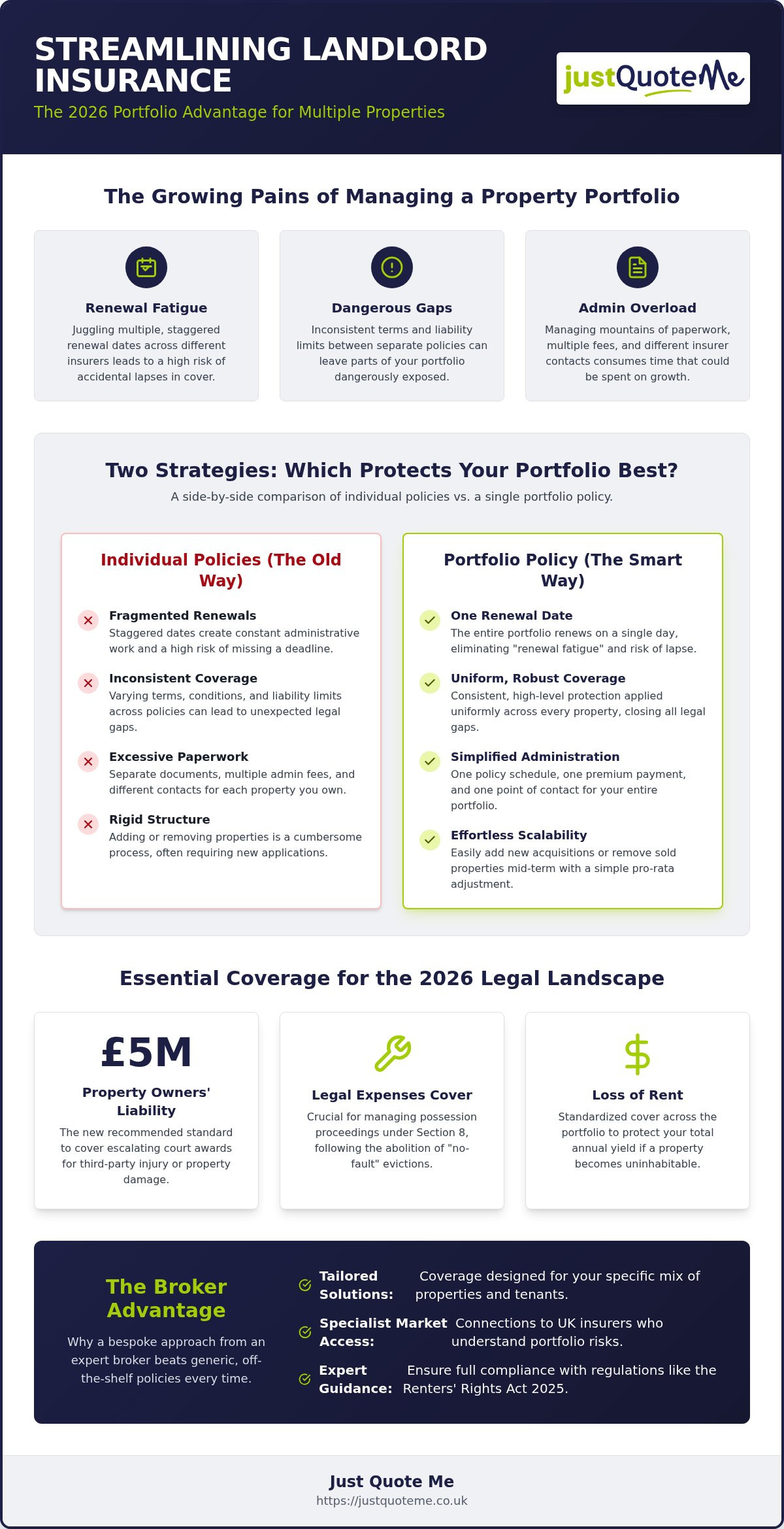
Managing a growing portfolio requires a shift in mindset. Landlord insurance for multiple properties is a specialized product designed to consolidate several buildings under a single policy schedule. It replaces the fragmented approach of holding individual policies for every house or flat you own. By 2026, the administrative burden of tracking separate renewal dates has become a significant risk factor. This “renewal fatigue” often leads to accidental lapses in cover, leaving your assets exposed to total loss or legal claims if you miss a single notification.
Administrative errors are more than just a nuisance. When you manage separate policies, you often deal with different insurers, each with their own set of exclusions and requirements. A gap in liability coverage on one property can jeopardize your entire business. In the current landscape, regulatory pressure is at an all-time high. With the mandatory Private Rented Sector (PRS) Database launching in late 2026, landlords must demonstrate consistent compliance across their entire portfolio. Inconsistent insurance records make this digital reporting much harder than it needs to be.
Why Portfolio Growth Requires a New Insurance Strategy
Many owners start as “accidental landlords” with a single buy-to-let property. As you transition into a professional property manager, standard individual policies often fall short. These basic products are frequently rigid, struggling to accommodate a mix of tenant types like students, professionals, or those receiving housing support. Professional landlord insurance for multiple properties allows you to house different risks under one roof. It provides a unified framework that scales as you acquire new assets, ensuring that your protection grows alongside your investments without the need for dozens of separate contracts.
The Legal Risks of Inconsistent Coverage
The legal environment for landlords has shifted dramatically. The Renters’ Rights Act 2025, which became fully operational on May 1, 2026, abolished Section 21 “no-fault” evictions. This change makes Public Liability Insurance and legal expenses cover more critical than ever. Possession proceedings now require specific grounds under Section 8, increasing the likelihood of protracted legal disputes. Additionally, the recommended standard for Property Owners’ Liability has risen to £5 million to account for escalating court awards. A bespoke portfolio policy ensures this high level of protection is applied uniformly across every location you own, leaving no room for dangerous gaps in your defense.
How Multi-Property Landlord Insurance Works
A portfolio policy operates as a single administrative umbrella. Rather than managing ten different policies with ten different insurers, landlord insurance for multiple properties consolidates every asset into a single schedule. This structure means you have one premium payment and one common renewal date. It’s a highly efficient way to manage risk, especially as your business grows beyond a few units. Instead of managing separate contracts with various end dates, a portfolio or blanket policy brings everything into one place for easier oversight.
Flexibility is a hallmark of this approach. If you acquire a new property in June or sell a flat in November, you don’t need to cancel or start a whole new policy. You simply update the existing schedule. Insurers calculate the pro-rata premium based on the time remaining on the master policy. This streamlined process removes the friction of constant re-application and ensures you never have a gap in cover during an acquisition. It’s a pragmatic solution for landlords who are actively scaling their investments.
Risk assessment also changes at this scale. When insuring a single dwelling, a claim for a burst pipe represents a total loss for that specific policy. With a portfolio, insurers see a diversified risk spread across different postcodes and building types. This diversification often leads to more favorable terms than you’d find by shopping for individual policies. You can also standardize “Loss of Rent” cover across the entire portfolio. This ensures your total annual yield is protected against major incidents that make a property uninhabitable. If you aren’t sure how to structure your schedule, you can speak with a professional advisor to review your current holdings.
The Core Components of a Portfolio Policy
A robust policy centers on three pillars. Buildings insurance covers the full rebuild cost, which is vital as construction prices fluctuate in 2026. For those managing HMOs or serviced apartments, landlord contents cover protects your furniture and appliances. Finally, Residential Letting Insurance includes property owners’ liability. This protects you against claims if a tenant or visitor is injured on your premises, a risk that grows with every new door in your portfolio.
Optional Extras for Growing Landlords
Professional landlords often need more than the basics. Legal expenses cover is now essential for managing Section 8 proceedings under the 2026 Renter’s Rights Act. Home emergency cover provides 24/7 support for boiler breakdowns or electrical failures across all locations, reducing the stress of middle-of-the-night maintenance calls. You should also consider malicious damage by tenants, which offers a higher level of security than standard accidental damage cover, protecting your investment from intentional harm.
Portfolio vs. Individual Policies: Which Strategy Saves More?
Comparing the math between individual policies and a consolidated schedule reveals more than just premium differences. Individual policies often carry hidden costs in the form of separate administration fees and higher base rates. While many direct insurers cap their portfolio offerings at 10 properties, a broker-led approach to landlord insurance for multiple properties allows for unlimited scaling. This is a vital distinction for professional landlords who find themselves outgrowing the rigid structures of automated systems. A bespoke policy doesn’t just match your current needs; it anticipates your next acquisition.
Time is a currency in property management. Managing individual renewals for a 15-property portfolio can consume dozens of hours every year. A single policy consolidates this into one interaction, freeing you to focus on high-level strategy. It also eliminates the risk of “Double Insurance.” This occurs when different policies overlap on shared structures, like roofs or communal hallways in a block of flats. If a claim arises in these areas, having separate insurers can lead to protracted disputes over who pays. A single portfolio insurer removes this friction entirely.
Your No Claims Discount (NCD) also works differently under this model. In a portfolio, a single claim on one unit won’t necessarily reset the progress for your entire business. Insurers look at the overall performance of the portfolio, which often results in more stable pricing over the long term. This pragmatic view of risk helps you avoid the sharp premium spikes that often follow a single isolated incident on a standalone policy.
The Financial Benefits of Consolidation
Insurers view a larger, managed portfolio as a more predictable risk than a scattered collection of individual dwellings. This preference translates into bulk discounts that aren’t available on the retail market. You also benefit from simplified accounting. Instead of tracking dozens of transactions, you receive one tax-deductible invoice and make one annual payment. This reduces your bookkeeper’s workload and ensures your records for HMRC’s Making Tax Digital (MTD) requirements are clean and easy to manage.
The Claim Advantage
When disaster strikes, you don’t want to be stuck in a phone queue for three different call centers. A portfolio policy provides a single point of contact for every property in your care. This is especially useful for mixed-use buildings where a leak in a residential flat might damage a commercial shop below. Having one insurer for both prevents the “blame game” that often stalls repairs. For a deeper look at managing these risks, read our Landlord Insurance Pillar to see how the market has evolved.
Essential Coverages for Diverse and Mixed Portfolios
Managing a diverse portfolio often means owning a variety of building types within the same street or postcode. You might own a standard terraced house, a block of flats, and a commercial unit simultaneously. Standard off-the-shelf policies frequently struggle with this level of diversity. They often exclude specific business types in commercial units, such as takeaways or hair salons, because the perceived fire risk is higher. When you seek landlord insurance for multiple properties through a broker, you gain the ability to include these varied risks under one cohesive agreement. This ensures that a single commercial tenant’s trade doesn’t invalidate the cover for the residential units above or adjacent to it.
Unoccupied properties represent another significant hurdle for professional landlords. Whether a building is between tenants or undergoing a major renovation, standard insurance usually limits cover after 30 or 60 days of vacancy. A bespoke portfolio policy can be structured to provide continuous protection for unoccupied buildings, albeit sometimes with specific security requirements. This prevents you from having to take out expensive, short-term “unoccupied” policies every time a tenancy ends. It’s a pragmatic way to maintain protection during those inevitable transition periods.
Houses in Multiple Occupation (HMOs) require even more specialized attention within a larger portfolio. Due to the higher density of tenants, HMOs face stricter fire safety regulations and higher liability risks. In 2026, insurers are particularly focused on ensuring that HMOs meet all local authority licensing requirements before providing full cover. By including your HMOs in a wider portfolio policy, you can often secure better terms than by insuring them as standalone high-risk units. If you are managing a complex mix of assets, you can get a tailored insurance review to ensure every unit is correctly classified.
Navigating Mixed-Use Property Insurance
Insuring the “flat above the shop” is a classic challenge for growing landlords. Many providers will ask you to buy two separate policies, one for the shop and one for the flat, which doubles your admin fees. A unified Commercial Property Insurance schedule allows you to protect the entire building as a single entity. This is especially vital if you have hospitality or retail tenants, as their specific business activities directly impact the insurance requirements for the residential spaces above them.
Specialist Risks: From Thatch to High-Rise
Standard insurers often shy away from non-standard construction. If your portfolio includes heritage buildings or high-rise blocks, you need wording that specifically addresses these risks. For instance, if you own a rural property, you might need Thatched Pub Insurance or specialized thatch cover to account for the unique fire risks of the material. Similarly, for high-rise assets, your policy must reflect current cladding and fire safety compliance to ensure your liability protection remains valid in the event of a claim.
Why a Bespoke Broker Approach Beats Off-the-Shelf Policies
Direct insurers often present their products as the only option, but they’re limited by their own narrow underwriting criteria. When you’re managing a growing business, you need an advocate, not just a provider. Just Quote Me acts as an independent broker with over 30 years of industry experience. We don’t just offer one product; we provide access to a broad network of the UK’s top insurers. This ensures your landlord insurance for multiple properties is placed with the insurer best suited to your specific risk profile, whether you own a row of terraces or a complex mixed-use block.
Our service is human-centric. Based in Stone, Staffordshire, our advisors understand the regional nuances of the UK property market better than any automated algorithm. We focus on customizing the fine print. In 2026, building material costs and labor rates remain volatile, making accurate rebuild limits essential. We help you adjust these limits to match your asset values precisely, ensuring you aren’t overpaying for cover you don’t need or, worse, leaving yourself under-insured. This pragmatic approach removes the guesswork that often plagues automated online forms.
Moving Beyond the “10 Property Cap”
Scaling a portfolio often leads to a common roadblock: the 10-property cap enforced by many direct insurers. If you’re moving from a small collection to a professional-scale operation, these rigid limits become a significant hindrance to your growth. Just Quote Me is the logical choice for landlords who need professional oversight without arbitrary caps. We manage large-scale portfolios with ease, providing the administrative support needed to keep your business compliant and protected as you acquire new assets.
Request a Call back for free Expert advice.
Your Next Steps: Get Your Portfolio Quote
Transitioning from multiple individual policies to a single schedule doesn’t have to be complicated. We guide you through the process to ensure you don’t lose cover during the switch. To get started, you’ll need basic details for each property, including rebuild costs, tenant types, and current renewal dates. We then consolidate this information to find the most competitive terms from our extensive panel of insurers, creating a bespoke policy that fits your business model perfectly.
Get Your Free Business Insurance Quote now.
Secure Your Growing Property Portfolio Today
Consolidating your assets into a single policy is a strategic move that eliminates the stress of “renewal fatigue” while ensuring your legal protections remain robust. By switching to specialized landlord insurance for multiple properties, you replace fragmented paperwork with a streamlined schedule that covers everything from residential flats to complex commercial units. This approach doesn’t just save you administrative time; it provides the flexibility to scale your investments without the rigid caps often found in automated systems. It’s about moving from an accidental landlord to a professional property manager with total confidence.
As an FCA Authorised Independent Broker with over 30 years of industry experience, Just Quote Me provides a human-centric alternative to faceless algorithms. We use our access to a broad network of top UK insurers to find the bespoke terms your portfolio deserves. You don’t have to manage these complex administrative burdens alone. Partner with a trusted advisor today to simplify your property management and secure your future yields. We’re here to help you protect your investments with clarity and long-term reliability.
Frequently Asked Questions
Can I include residential and commercial properties on the same landlord policy?
Yes, you can include residential and commercial units on a single portfolio policy. This unified approach, often called a mixed-use schedule, protects a high-street shop and the flats above under one agreement. It eliminates the administrative burden of managing separate contracts with different insurers. By consolidating, you ensure consistent liability protection across all property types, preventing the coverage gaps that frequently occur when using multiple individual providers.
Is there a limit to how many properties I can have on one portfolio policy?
There is no fixed limit to the number of properties you can include when using a bespoke broker. While many direct insurers cap automated policies at 10 properties, our independent market access allows us to scale with your business indefinitely. Whether you manage 15 houses or a large-scale commercial estate, we can structure a single policy that accommodates your entire portfolio, providing professional oversight that grows alongside your investments.
What happens if I buy a new property mid-way through my policy term?
You can add new properties to your portfolio policy at any time during the term. When you acquire a new asset, simply notify your advisor to add it to your existing schedule. The insurer calculates a pro-rata premium for the time remaining until your annual renewal date. This flexibility ensures continuous protection during acquisitions and keeps all your properties aligned to a single, manageable renewal event for easier accounting and professional management.
How does a multi-property policy affect my No Claims Discount?
A multi-property policy assesses your No Claims Discount by looking at the overall performance of your entire portfolio. On standard individual policies, a single claim might reset your discount for that specific property. With landlord insurance for multiple properties, insurers take a pragmatic view of risk spread across multiple locations. This often prevents the sharp premium spikes that follow isolated incidents, rewarding professional landlords for their overall risk management strategy.
Do I need separate Employers’ Liability if I employ a gardener or cleaner for my properties?
You legally require Employers’ Liability insurance if you employ staff like gardeners or cleaners, even on a part-time or casual basis. This cover protects you against claims if an employee is injured while working at your properties. While some portfolio policies include this protection, it’s vital to verify that every specific staff role is correctly covered. Failing to hold this insurance can result in significant daily fines from the Health and Safety Executive.
Can I pay for my multi-property landlord insurance in monthly instalments?
Most insurers offer the option to pay your premium in monthly instalments through a premium finance arrangement. This helps you manage cash flow by spreading the cost of your landlord insurance for multiple properties over the year. While paying annually is the most cost-effective method, monthly payments provide a predictable outgoing that aligns with your rental income, making it a pragmatic choice for many professional property managers and investors in 2026.
Is landlord insurance for multiple properties a legal requirement in the UK?
Landlord insurance isn’t a legal requirement in the UK, but it’s a standard condition for most buy-to-let mortgages. Operating without specialized cover is extremely high-risk, as standard home insurance is typically voided once a property is tenanted. Without a dedicated policy, you’d be personally liable for rebuilding costs and third-party injury claims. This makes specialized insurance a practical necessity for anyone looking to protect their financial future and property assets.
