

The cheapest motor trade insurance quotes often prove to be the most expensive mistake a UK business can make. It’s a common frustration for traders who find themselves stuck between basic Road Risk and full Combined cover without a clear explanation of the difference. You know that a single oversight in your Care, Custody, and Control clause could leave you liable for a £40,000 customer vehicle, yet finding a policy that doesn’t penalise new ventures or younger drivers feels like an uphill battle. We believe that securing professional protection shouldn’t be a source of stress for honest business owners.
This guide provides the clarity you need to master the 2026 insurance market and secure a bespoke quote that protects your road risks and business assets. You’ll learn how to satisfy legal requirements while ensuring every vehicle on your pitch is covered against every eventuality. We will break down how to access competitive pricing from a specialist panel of underwriters and identify exactly what is and isn’t included in your policy. By the end of this article, you’ll have a straightforward roadmap to a tailored policy that works as hard as you do.
Key Takeaways
- Learn the fundamental differences between Road Risk and Combined cover to ensure your business assets and premises are correctly insured.
- Understand the legal implications of “Care, Custody, and Control” to protect your business when handling customer vehicles on-site.
- Discover how variables like business location and driver age influence the final cost of your motor trade insurance quotes.
- Use our preparation checklist to gather the necessary trading history and “No Claims Bonus” proof for a faster, more efficient application.
- Explore the benefits of choosing a specialist broker with 30 years of experience over a faceless automated algorithm for a truly tailored policy.
Understanding Motor Trade Insurance Quotes: Road Risks vs. Combined Cover
Motor trade insurance is a specialized form of protection designed for anyone who handles vehicles for profit. Whether you’re selling cars from a forecourt or repairing engines in a garage, standard private car insurance won’t cover your business activities. Securing accurate motor trade insurance quotes ensures you have a safety net that accounts for the unique risks of the industry. This type of motor trade insurance serves as a legal and financial foundation for 99% of the UK’s automotive small businesses, providing the flexibility to drive various vehicles without needing individual policies for each one.
The necessity for professional cover extends beyond full-time dealerships. Mechanics, valeters, and recovery agents all require specific protection. There is a persistent myth that “part-time traders” or “side-hustlers” can operate without professional policies. This is incorrect. Under the Continuous Insurance Enforcement (CIE) regulations introduced in 2011, any vehicle must be insured unless a SORN is declared. If you’re moving vehicles for business purposes, even once a week, a standard policy is likely void, leaving you personally liable for damages. For a comprehensive overview of how the landscape has shifted in recent years, including the impact of rising premiums and the ZEV mandate, the ultimate guide to motor trade insurance in the UK for 2026 provides essential context for every trader.
The Legal Minimum: Road Risk Insurance
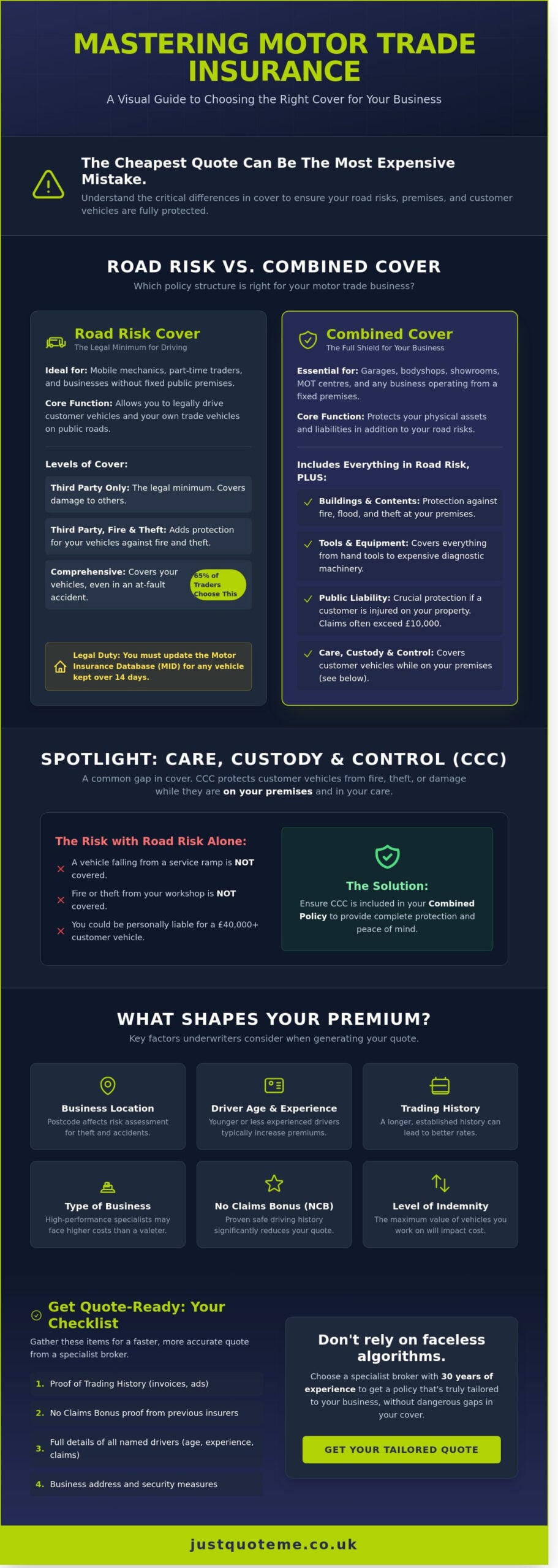
Road Risk insurance is the baseline requirement for anyone operating in the motor trade. It allows you to drive customer vehicles or trade-owned cars on public highways. You can choose from three levels of cover: Third Party, Third Party Fire and Theft, or Comprehensive. Third Party is the legal minimum required by the Road Traffic Act 1988, covering damage to others but not your own vehicles. Comprehensive options are often preferred by 65% of traders to ensure their own stock is protected during transit.
A critical part of this cover involves the Motor Insurance Database (MID). You’re legally required to update the MID with any vehicle registration numbers you own or are keeping for more than 14 days. Failing to maintain these records can lead to fines or vehicle seizure. Road Risk is ideal for mobile practitioners who don’t have a fixed business premises.
The Full Shield: Combined Motor Trade Insurance
If you operate from a fixed site like a bodyshop or a showroom, Road Risk alone isn’t enough. Combined insurance packages protect your physical assets. This includes your buildings, expensive diagnostic machinery, hand tools, and office equipment. For businesses with high-value stock on-site, this cover is essential to prevent a total loss following a fire or theft. Most motor trade insurance quotes for established businesses will default to a combined structure to ensure no gaps in protection.
These packages also integrate vital liability protections. It’s standard practice to include public liability insurance within a combined policy. This protects you if a customer is injured at your premises or if you accidentally damage their property. With the average personal injury claim in the UK often exceeding £10,000, having this “full shield” approach is a pragmatic choice for any serious business owner in Staffordshire.
Care, Custody, and Control: Protecting Vehicles That Are Not Yours
Care, Custody, and Control (CCC) is a fundamental legal concept that dictates your liability for a customer’s vehicle while it is under your professional supervision. In the context of mechanic liability, CCC refers to the legal responsibility a trader assumes for a customer’s vehicle the moment it is handed over for service, storage, or repair. Comparing motor trade insurance quotes involves more than just checking road legalities; it requires ensuring that the physical assets of your clients are protected while they sit in your workshop.
Many traders confuse Road Risk coverage with CCC. Road Risk insurance allows you to drive vehicles on public highways, but it does not necessarily protect a vehicle while it is stationary on your ramp or stored in your compound. While Commercial auto insurance principles often focus on the movement of vehicles, a motor trade policy must address the risks of fire, theft, or accidental damage while the car is being worked on. If a vehicle falls from a lift or is damaged by a fire in your unit, Road Risk alone will likely leave you facing a total loss out of your own pocket.
A common mistake among part-time traders or startups is assuming that a standard personal car insurance policy provides protection. It doesn’t. Personal policies explicitly exclude trade activities. Even if you have a “driving other cars” extension, this is intended for emergency personal use, not for running a business. Additionally, standard policies frequently exclude “Internal Damage.” If you are flushing an engine and a component fails due to your work, or if a tool slips and cracks a cylinder head, only a specific motor trade policy with CCC cover will address these “damage to property being worked upon” risks.
Indemnity Limits and Vehicle Values
Choosing the correct indemnity limit is the most critical decision you’ll make when sourcing motor trade insurance quotes for your Staffordshire business. Your limit must reflect the value of the most expensive vehicle you might realistically have on-site. If you regularly service high-end SUVs worth £60,000 but opt for a £20,000 indemnity limit to save on premiums, you’re taking a massive gamble. In the event of a total loss, the insurer will only pay the £20,000 limit, leaving you legally responsible for the £40,000 shortfall. This gap has led to the closure of several small garages in the West Midlands over the last 24 months. Always calculate your limit based on your peak exposure, not your average vehicle value. Dealers who regularly handle prestige or modified vehicles should also be aware that customers may require performance car insurance for their own vehicles, which can influence the agreed value expectations they bring to your workshop.
Additional Liability Considerations
Protecting the vehicle is just one part of the puzzle. If you employ staff, employers liability insurance is a legal requirement in the UK, protecting you if a technician is injured while handling a customer’s car. For those providing high-level diagnostics or consultancy, professional indemnity insurance is essential to cover claims of financial loss caused by faulty advice. You should also consider Product Liability, which covers you if a part you fitted fails and causes an accident later. These layers of protection ensure your business remains resilient against diverse claims. You can get a tailored quote today to see how these covers fit your specific trade profile.
Evaluating Your Quote: Factors That Influence Your Premium
Your business location is one of the first things an insurer looks at when calculating motor trade insurance quotes. Trading in Staffordshire often works in your favour compared to metropolitan hubs like London or Birmingham. For instance, lower vehicle theft rates in rural Staffordshire postcodes can result in more competitive premiums. Insurers use historical crime data and traffic density statistics to determine the risk level of your premises. A quiet workshop in Leek will likely attract a different rate than a high-volume dealership in the centre of Stoke-on-Trent.
The type of vehicles you handle daily also dictates the cost. Specialising in high-performance sports cars or classic restorations requires a higher indemnity limit than a business focused on standard family hatchbacks. If your stock includes vehicles in high insurance groups, your premium will reflect the increased replacement cost. Traders who work with high-value or modified vehicles should explore how performance car insurance principles — such as agreed value protection and specialist underwriting — can inform the right indemnity limits for their motor trade policy. Most traders find that being specific about their niche helps them avoid paying for coverage they don’t actually need. While specialized policies are vital, the fundamental principles of business insurance remain the same: you’re protecting your assets against the unexpected.
Experience and history are your best tools for lowering costs. Most insurers allow you to transfer up to five years of No Claims Bonus (NCB) from a personal car policy to a new motor trade policy. This can lead to an immediate reduction in your annual bill. If you’ve operated in the trade for over two years without a claim, you’re viewed as a lower risk. It’s a simple way to reward safe driving and professional management.
Driver Restrictions and Named Drivers
Choosing between an “Any Driver” policy and a “Named Driver” policy is a balance of cost versus flexibility. Any Driver policies are convenient for busy showrooms but come with a higher price tag. If you only have two or three regular employees, naming them specifically can save you 15% or more on your premium. Be aware that drivers under 25 or those with recent driving convictions will increase the quote significantly. Some insurers may even refuse to cover drivers with more than six penalty points for certain vehicle categories.
Security Measures and Risk Mitigation
Investing in security isn’t just about safety; it’s about your bottom line. Installing Thatcham-approved Category 1 alarms and GPS trackers on your stock can lead to substantial discounts; companies like Safe & Sound Mobile specialize in these installations to help traders meet insurer requirements. For those with physical premises, insurers look for CCTV systems and gated yards to reduce “Combined” policy premiums. Don’t forget to mention trade plates during the quoting process. These plates require specific mention to ensure you’re legally covered while driving unregistered vehicles on public roads. Proper documentation of your security protocols shows insurers you take risk management seriously.
Preparation Guide: What You Need for a Competitive Motor Trade Quote
Securing the best motor trade insurance quotes requires more than just a quick phone call. Insurers in the UK look for specific data points to assess risk accurately. If you have your documentation ready, you’ll likely secure a more accurate price and avoid the hassle of mid-term adjustments. Start by confirming your legal structure; whether you operate as a Sole Trader or a Limited Company impacts your liability requirements and tax status.
You’ll need to provide several key pieces of information during the application process:
- Business Basics: Your registered trading name, business address, and a clear description of your primary activities (e.g., mechanical repairs, valeting, or car sales).
- Trade History: Most underwriters look for at least three years of trading history. You’ll need to provide proof of your No Claims Bonus (NCB) from a previous motor trade or commercial policy.
- Driver Details: A full list of all employees or drivers who need cover. You must have their full UK driving licence numbers and details of any convictions or accidents within the last five years.
- Financial Estimates: Your projected annual turnover and the maximum total value of vehicles on your premises at any one time. For example, if you typically hold £50,000 in stock but peak at £100,000 in March, you must insure for the higher amount.
- Existing Cover: If you currently manage multiple vehicles, provide details of your existing fleet car insurance to help the broker understand your current risk profile.
The “Proof of Trade” Requirement
Underwriters must verify that you’re running a legitimate business rather than trying to obtain cheaper personal insurance. They usually require at least two or three documents as evidence. Accepted items include recent sales invoices, receipts from parts suppliers, or active trade accounts with wholesalers. It’s vital to be transparent about your “Part-Time” status if you have another job. Data from 2023 suggests that non-disclosure of part-time trading is a leading cause of claim rejection in the UK motor trade sector.
Navigating the Quote Form
Accuracy is your best friend when filling out online forms. A common mistake is underestimating the value of customer vehicles in your care, which can leave you underinsured during a claim. Social, Domestic and Pleasure (SD&P) use must be explicitly requested if you intend to use trade vehicles for personal errands. If your business model is unusual or doesn’t fit standard categories, don’t struggle with automated forms. Speaking directly to a broker allows you to explain the nuances of your operation, ensuring you don’t pay for cover you don’t need while protecting the parts of your business that matter most.
Get your tailored motor trade quote today
Why Use an Independent Broker for Your Motor Trade Insurance in 2026?
The insurance market in 2026 relies heavily on automation, but a “faceless algorithm” cannot understand the specific risks of your Staffordshire business. While comparison sites offer speed, they often produce generic results that leave gaps in your protection. Just Quote Me provides a human-centric alternative, backed by over 30 years of industry experience. We don’t just input data into a search engine; we use our deep-rooted relationships with underwriters to secure motor trade insurance quotes that reflect the reality of your daily operations. Understanding the full scope of available policy types and your MID obligations is easier with a dedicated resource such as the comprehensive 2026 guide to motor trade insurance in the UK, which covers everything from premium trends to the impact of the ZEV mandate on traders.
One of the primary advantages of working with an independent broker is access to “Broker-Only” panels. These are specialized insurance schemes that are not listed on public comparison websites. These insurers prefer working with brokers because they know the risk has been properly assessed and vetted. For you, this means access to more stable premiums and broader coverage terms that the general public simply cannot buy direct. Expert independent firms like Paterson Insurance Brokers demonstrate how professional risk management can benefit traders throughout the UK. Our local expertise across Staffordshire and the West Midlands further allows us to understand regional trends, from local crime rates to the specific needs of the area’s thriving automotive sector.
The Human Advantage in Claims and Renewals
A broker’s value is most evident when you need to make a claim. Instead of waiting in a call centre queue, you have an advocate who understands your policy inside out. We step in to manage the communication with insurers during complex motor trade claims, ensuring your interests are protected and the process moves quickly. We know that if your recovery truck is off the road or your garage is closed, you are losing money.
Our service continues long after you sign the initial policy. Every year, we perform a “Renewal Review.” We proactively shop the market to see if a better deal exists, so you don’t have to spend hours repeating the process yourself. If your business grows, we handle Mid-Term Adjustments (MTAs) with a simple phone call. Whether you’re adding a new driver or increasing your indemnity limits, we provide straightforward advice on how these changes impact your premium. If you operate multiple vehicles across your business, consolidating them under a single fleet car insurance policy is one adjustment we can help you explore to simplify administration and reduce costs.
Bespoke Solutions for Every Trade
The motor trade is not a monolith. A mobile tyre fitter operating in Stone requires a completely different policy structure than a high-end car showroom located in Stafford. We focus on building tailored packages that fit your specific niche. Our team understands the unique requirements for various sectors, including:
- Auto-electricians and diagnostic technicians: Coverage for specialized equipment and professional indemnity.
- Valeters and detailers: Protection for vehicles in your care, custody, and control, including accidental damage.
- MOT stations and mechanical repair garages: Comprehensive public liability and internal risks coverage.
We take the “no-nonsense” approach to insurance. We do the heavy lifting by comparing the market and filtering out policies that don’t meet our standards for quality and reliability. This ensures you receive a policy that is both cost-effective and robust. Get your bespoke motor trade insurance quote today and let our experts find the right fit for your business.
Secure Your Business Future with Expert Coverage
Navigating the complexities of the motor trade industry in 2026 requires more than just a basic policy. You need to understand the critical distinction between simple road risks and comprehensive combined cover to ensure your assets are fully protected. Protecting vehicles under your care, custody, and control remains a legal and financial priority for any garage or dealership. Securing competitive motor trade insurance quotes shouldn’t be a stressful hurdle that takes you away from your daily operations.
At Just Quote Me, we bring over 30 years of independent brokerage experience to the table. We are fully FCA authorised and regulated, giving you the peace of mind that your business is in safe hands. Because we have access to a wide network of top UK insurers, we do the heavy lifting to find the right fit for your specific needs. We pride ourselves on being a human-centric alternative to faceless algorithms. We’re here to provide the personal touch your business deserves.
Get a Tailored Motor Trade Insurance Quote
We’re ready to help you drive your business forward with confidence and the right protection in place.
Frequently Asked Questions
Can I get motor trade insurance if I work from home?
Yes, you can secure coverage if you operate your business from a home address. Many mobile mechanics and part-time traders in Staffordshire run their operations from domestic properties rather than commercial units. You must inform your broker about your setup to ensure the policy reflects where vehicles are stored overnight. This type of tailored motor trade insurance quote ensures you aren’t paying for premises cover you don’t actually need.
Does motor trade insurance cover me for social, domestic, and pleasure use?
Most motor trade policies include social, domestic, and pleasure use as standard for the policyholder. This allows you to use business vehicles for personal errands or family trips outside of working hours. However, you should check if this extension applies to named drivers or employees on your policy. According to the Road Traffic Act 1988, every vehicle on the road must have valid insurance for its specific use type to avoid legal penalties.
What is the difference between a motor trade quote and business car insurance?
A motor trade insurance quote is designed for professionals who handle, repair, or sell vehicles they don’t own. Business car insurance covers a specific vehicle you own while using it for work travel, such as visiting clients. If you’re a valeter or dealer, you need the flexibility of a trade policy to cover various customer vehicles. Business car insurance won’t protect you when driving a customer’s car or stock.
Can I drive any car with a motor trade insurance policy?
You can drive most vehicles for motor trade purposes, but restrictions usually apply based on engine size or vehicle value. High-performance cars or heavy goods vehicles often require specific disclosure to the insurer before you get behind the wheel. Your policy document will list these limitations clearly. You shouldn’t assume every car is covered for personal use, as this usually only applies to vehicles owned by the business or the policyholder.
Is it cheaper to pay for my motor trade insurance annually or monthly?
Paying for your policy annually is typically the most cost-effective option for your business. Monthly instalments usually include interest charges or service fees, which can increase the total cost by 10% to 15% over the year. If cash flow is a priority for your Staffordshire business, monthly payments offer a manageable way to spread the cost. JustQuoteMe helps you compare these options to find the most efficient payment structure for your budget.
Does motor trade insurance cover my own personal vehicles?
Your personal vehicles can be covered under a motor trade policy if they’re registered in your name or your spouse’s name. You must add these vehicles to the Motor Insurance Database to ensure they’re legally recognised as insured. Some specialist policies might exclude certain high-value personal cars, so always verify your vehicle list with your broker. This consolidation often simplifies your paperwork by keeping all your vehicles under one single policy.
What happens if I forget to update the Motor Insurance Database (MID)?
Failing to update the Motor Insurance Database can lead to your vehicle being seized by the police. Under the Continuous Insurance Enforcement regulations, vehicles must appear on the database or be declared SORN. If a vehicle isn’t listed, you risk a £100 fixed penalty notice or even prosecution. It’s your responsibility to ensure every trade vehicle and personal car is logged correctly to maintain legal compliance and avoid unnecessary fines.
Can I get a motor trade quote as a new business with no trading history?
You can certainly get a motor trade insurance quote as a new business without a prior trading history. Insurers will look at your personal driving record and any relevant industry experience to assess your risk level. While you won’t have a trade-specific No Claims Bonus yet, some providers allow you to mirror the bonus from your private car policy. This helps lower the initial premiums while you establish your new business in the local market.
