

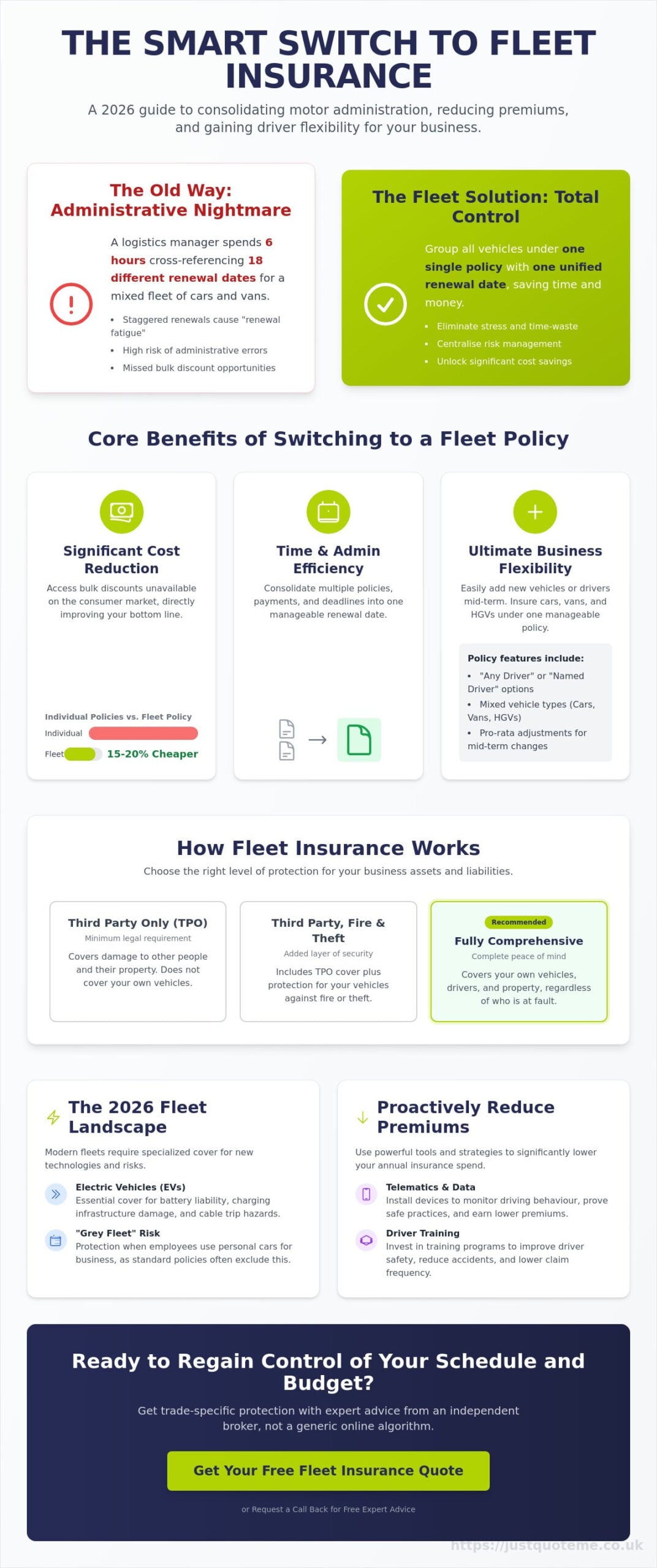
Last Tuesday, a logistics manager in Leeds spent six hours cross-referencing 18 different renewal dates for a mixed fleet of cars and vans. It’s a frustrating reality for many UK firms where administrative tasks eat into valuable growth time. If you’re managing more than two vehicles, juggling separate policies for each isn’t just inefficient; it’s likely costing your business more than necessary in missed bulk discounts. Securing bespoke fleet car insurance is the most effective way to regain control of your schedule and your budget.
We understand that finding the right balance often feels like a moving target, especially when you’re balancing the high costs of younger drivers with the complexity of varied vehicle types. You shouldn’t have to choose between comprehensive protection and your bottom line. This 2026 guide explains how to consolidate your motor administration into one manageable renewal date, reduce premiums through proactive risk management, and secure bespoke coverage that fits your unique operational needs. We’ll show you how to gain the driver flexibility your business requires while lowering your total insurance spend.
Get Your Free Business Insurance Quote now.
Request a Call back for free Expert advice.
Key Takeaways
- Consolidate your vehicle management into a single renewal date to eliminate the stress and time-waste of multiple policy deadlines.
- Learn how to tailor your fleet car insurance with specific coverage levels and driver options that protect your business and your bottom line.
- Discover the flexibility of mixed fleet policies that allow you to insure cars, vans, and HGVs under one bespoke, manageable umbrella.
- Uncover how telematics and proactive driver training can be used as powerful tools to significantly reduce your annual insurance premiums.
- Understand why expert advice from an independent broker provides more secure, trade-specific protection than generic online algorithms.
What is Fleet Car Insurance and How Does it Benefit Your Business?
Managing a growing company is demanding, and tracking individual expiry dates for every car or van shouldn’t be part of your daily routine. Fleet car insurance simplifies your operations by grouping multiple vehicles under one single policy with a unified renewal date. It’s a pragmatic solution for any company that operates more than a couple of vehicles. To understand the foundational structure of these policies, it’s helpful to look at What is Fleet Car Insurance and how it differs from standard private cover in terms of liability and usage.
The transition from individual policies to a fleet setup ends the administrative nightmare of staggered renewals. Instead of juggling ten different documents and payment schedules, you handle one. This consolidation eliminates the risk of missing a payment and accidentally leaving a vehicle uninsured. Insurers also apply bulk discounts that aren’t available on the consumer market. Typically, insuring a fleet of five vehicles can be 15% to 20% cheaper than managing five separate policies, directly improving your bottom line.
Flexibility is another core advantage as your business scales. If you hire a new salesperson or purchase an extra delivery van mid-term, you simply add them to the existing schedule. Most providers offer pro-rata adjustments; you only pay for the cover you use for the remainder of the policy year. This “any driver” or “named driver” flexibility allows your staff to swap vehicles without the need to call a broker every time someone picks up a different set of keys.
Why Businesses Switch from Individual Motor Policies
Many Staffordshire SMEs face “renewal fatigue” as their vehicle count grows. Managing staggered dates often leads to administrative errors where a vehicle might slip through the cracks. For 2026 UK businesses, the “Mini-Fleet” threshold is defined as a policy covering a minimum of two or three vehicles, providing a scalable entry point for small businesses. By switching, you remove the burden of tracking multiple No Claims Bonuses across different providers and centralise your risk management.
The 2026 Landscape: EVs and Modern Fleet Management
The rapid adoption of electric vehicles (EVs) has shifted how we look at fleet risk. In 2026, specialized cover is essential to address unique risks like battery liability and damage to charging infrastructure. Modern policies now include protections for cable trip hazards and cyber-related faults in vehicle software. It’s vital to secure motor fleet insurance that accounts for these technological shifts. This ensures your transition to a greener fleet doesn’t leave you exposed to modern technical failures or specialist repair costs.
Get Your Free Business Insurance Quote now.
Request a Call back for free Expert advice.
How Fleet Insurance Works: Coverage Types and Driver Options
Understanding the mechanics of fleet car insurance is the first step toward reducing business overheads. At its core, a fleet policy consolidates multiple vehicles under one renewal date, but the level of protection you choose dictates your financial resilience. Most UK insurers offer three distinct tiers. Third Party Only (TPO) meets the minimum legal requirement under the Road Traffic Act 1988, covering damage to other people and their property. Third Party, Fire and Theft (TPFT) adds a layer of security against arson or vehicle crime. For most businesses, Fully Comprehensive is the logical choice; it covers your own vehicles regardless of who is at fault in an accident.
To get the most out of your policy, you need to understand How Fleet Insurance Works in a commercial setting. Beyond basic coverage, compliance is a major factor. Every vehicle on your policy must be registered on the Motor Insurance Database (MID). Since the 2011 Continuous Insurance Enforcement (CIE) regulations, the police use the MID to identify uninsured vehicles instantly. Keeping this database updated is a legal obligation for the policyholder, and failing to do so can lead to fixed penalties or vehicle impoundment.
A growing concern for modern businesses is the “Grey Fleet” risk. This refers to employees using their personal cars for business trips. While it seems cost-effective, personal insurance policies often exclude business use. If an employee has an accident while driving for work, your business could be held liable for damages. Integrating these vehicles into a formal fleet structure or ensuring strict proof of business-use extensions is vital for risk management. If you are unsure about your current liabilities, you can speak with a specialist broker to identify gaps in your coverage.
Any Driver vs. Named Driver: Finding the Balance
Choosing how you assign drivers is a direct lever for your premium costs. “Any Driver” policies offer total flexibility, allowing any staff member to hop into any vehicle at a moment’s notice. This is perfect for rapid-response trades, but it comes with a higher price tag. Insurers often set age thresholds, such as “Any Driver over 21” or “Any Driver over 25,” to mitigate risk. If you have high-value vehicles or younger apprentices, using “Named Driver” restrictions for those specific cases can significantly lower your annual spend.
Essential Add-ons for Business Continuity
Standard fleet car insurance handles the accident, but add-ons handle the business fallout. Fleet breakdown cover is essential for service-based companies where a stationary vehicle means lost revenue. For those carrying equipment or stock, Goods in Transit (GIT) cover protects the cargo within the vehicle from theft or damage. If your business relies heavily on trade vehicles, you should also consider van and tools insurance to protect the expensive equipment that stays in the vehicle overnight.
Get Your Free Business Insurance Quote now.
Request a Call back for free Expert advice.
Qualifying for a Fleet Policy: Size, Vehicles, and Drivers
Transitioning from individual policies to fleet car insurance usually starts when a business operates 2 or more vehicles. This entry point allows small enterprises to consolidate their administration and benefit from bulk pricing. Insurers require these vehicles to be owned or leased by the company or its directors to establish a clear insurable interest. It’s a pragmatic way to manage risk; if the business doesn’t hold the title or the lease, the policy won’t cover the asset.
Driver eligibility remains a cornerstone of the qualification process. Most UK brokers look for drivers who are at least 21 years old, though many competitive policies set the bar at 25 to reduce premium costs. A clean driving record is vital. Insurers typically review the last 3 to 5 years of claims history for every named driver. Following standards like those outlined in the IRS Fleet Management Program can help businesses establish rigorous internal safety protocols, which often leads to better terms from underwriters who value proactive risk management.
Mini-Fleet vs. Large Fleet Qualifications
Mini-fleet options cater specifically to small businesses with 2 to 5 vehicles. These policies offer the flexibility of a larger corporate plan without the complex reporting requirements. As a business grows to 50 or even 500 units, the policy transitions into a large fleet category with more bespoke terms. In 2026, a mixed fleet is defined as a single insurance contract that integrates various vehicle weights and purposes, from electric pool cars to 44-tonne HGVs, under one unified renewal date.
Mixed Vehicle Types: From Executive Cars to Delivery Vans
Insurers weigh risks differently across vehicle classes. A director’s executive saloon carries a different risk profile than a high-mileage delivery van operating in urban centres. Managing this transition means moving away from fragmented personal car use toward a dedicated motor fleet insurance structure. For those operating in the automotive sector, such as garages or showrooms, specialized motor trade insurance quotes are often more appropriate than a standard fleet policy, as they cover vehicles not owned by the business. If you operate a garage, dealership, or any automotive business and want a comprehensive overview of your obligations and options, the ultimate guide to motor trade insurance in the UK for 2026 covers everything from MID obligations to bespoke policy structures for modern trade operations. Similarly, if your fleet includes high-value or modified vehicles, understanding the requirements for performance car insurance can help you secure agreed value protection and specialist coverage that standard fleet algorithms routinely overlook.
- Vehicle Ownership: Must be registered to the business or a director.
- Minimum Size: Usually 2 vehicles, though some specialists start at 3.
- Driver Age: Preferred minimum of 25 for “any driver” policies.
- Usage: Must be for business purposes or social, domestic, and pleasure for employees.
Get Your Free Business Insurance Quote now.
Request a Call back for free Expert advice.
Reducing Premiums: Proactive Risk Management and Telematics
Controlling the cost of fleet car insurance isn’t just about shopping around at renewal time. It’s about demonstrating to underwriters that your business is a lower risk than the industry average. Proactive risk management yields tangible financial rewards that go straight to your bottom line. By taking a “no-nonsense” approach to safety, you show insurers that you’re a partner worth investing in.
One of the most effective ways to lower your annual bill is by adjusting your voluntary excess. Established businesses with healthy cash flow often choose to increase their excess from a standard £250 to £1,000 or higher. This shift can lower annual premiums by 15% or more; the insurer takes on less risk for minor incidents, and you benefit from the immediate discount. It’s a pragmatic choice for companies that have confidence in their drivers.
Managing your No Claims Discount (NCD) works differently on a fleet policy. Most insurers provide a “Fleet Rated” premium based on the claims experience of the entire group rather than individual NCDs for each driver. Keeping a clean collective record is vital. Implementing safety incentives, such as small monthly bonuses for drivers who maintain high safety scores, often costs less than the premium hike following a single at-fault accident.
Implementing Telematics and Modern Tracking
Telematics and dashcams have moved from optional extras to essential tools for premium reduction. By 2026, Usage-Based Insurance (UBI) has become the standard for smaller fleets. This model calculates premiums based on actual mileage and driving style. Real-time monitoring helps reduce accident frequency by up to 30% by identifying harsh braking or speeding before they lead to collisions. It’s about using data to coach better habits.
GPS data is equally valuable during the claims process. In complex “he said, she said” scenarios, telematics provides indisputable proof of speed and location. This data allows your broker to prove non-fault quickly, protecting your claims history and preventing costly legal disputes that can drag on for months.
Managing the Motor Insurance Database (MID)
Keeping the Motor Insurance Database (MID) updated is a legal requirement in the UK. Failure to register a new vehicle or remove an old one can result in a £300 fixed penalty fine or even vehicle seizure. It’s an administrative burden that many business owners struggle to manage alone. Accuracy is paramount to avoid unnecessary police interest and potential fines.
A specialist broker handles this heavy lifting for you, ensuring your records are accurate and compliant. This level of oversight is a key part of a broader risk strategy, much like ensuring you have the correct employers liability insurance to protect your staff. Integrated management ensures there are no gaps in your business protection, leaving you free to focus on operations.
If you want to see how much you could save through better risk management, get a specialist fleet car insurance review here.
Get Your Free Business Insurance Quote now.
Request a Call back for free Expert advice.
Choosing the Right Fleet Policy with Just Quote Me
Selecting the right insurance partner determines how quickly your business recovers after a road incident. Online comparison sites rely on rigid algorithms that often miss the specific nuances of your trade. These “one size fits all” models lead to many UK firms being underinsured, leaving them vulnerable to unexpected costs. Just Quote Me operates differently. We leverage 30 years of industry knowledge to ensure your fleet car insurance is built around your actual operations, not a generic template.
Independent Brokerage vs. Faceless Algorithms
Algorithms cannot understand why a courier firm in Stone needs different terms than a plumbing contractor in Newcastle-under-Lyme. We provide a personal touch that automated systems lack. Our team takes the time to understand your vehicle usage patterns and driver profiles. This bespoke approach often uncovers savings that automated platforms overlook. When things go wrong, you won’t be trapped in an endless loop of automated phone menus. You’ll have a human expert at the end of the phone, providing direct support from our Staffordshire base. This local expertise is vital for West Midlands firms that value reliability and clear, honest communication.
Your Next Steps to Fleet Efficiency
Securing a better deal requires a small amount of preparation. To get the most accurate quote for your motor fleet insurance, you should gather specific data regarding your current setup. Our experts look for hidden risks, such as restrictive driver age limits or inadequate goods-in-transit limits, to ensure you aren’t paying for cover you don’t need or missing cover you do. Please have the following ready:
- Full vehicle registration details and current annual mileage.
- Confirmed Claims Experience (CCE) for at least the last three years.
- Details of any drivers with convictions or specific medical conditions.
- An overview of your typical radius of operation and goods carried.
Our consultation process focuses on streamlining your administration and reducing your total cost of risk. Whether you are based in Stafford or the wider West Midlands, we make the transition simple and transparent. We do the heavy lifting so you can focus on running your business. It’s about more than just a policy; it’s about a partnership that protects your bottom line.
Get Your Free Business Insurance Quote now.
Request a Call back for free Expert advice.
Secure Your Business Fleet for 2026 and Beyond
Managing a commercial fleet requires more than just basic coverage; it demands a strategic approach to risk. By implementing telematics and choosing a policy that scales with your growth, you can effectively lower premiums and reduce administrative burdens. Selecting the right fleet car insurance ensures your business stays mobile while protecting your bottom line from unexpected liabilities. At Just Quote Me, we bring over 30 years of independent brokerage experience to the table. As an FCA authorised and regulated partner, we leverage our broad network of top UK insurers to find the specific protection your vehicles need.
We believe in a straightforward, no-nonsense approach to business protection. Our experts handle the complex market comparisons so you don’t have to spend hours on paperwork. Whether you’re running a small local delivery service or a national logistics operation, we provide the steady hand and local expertise required to keep your drivers safe and your costs predictable. Take the first step toward a more efficient insurance strategy today.
Get Your Free Business Insurance Quote now.
Request a Call back for free Expert advice.
We look forward to helping you protect your business assets with confidence and ease at Just Quote Me.
Frequently Asked Questions
How many vehicles do I need to qualify for fleet car insurance?
You typically need a minimum of two vehicles to qualify for fleet car insurance. While some specialist providers require a fleet of five or more, many UK insurers now offer mini-fleet policies for small businesses starting with just two cars or vans. This allows you to consolidate your renewals into a single date, reducing administrative time by approximately 50% for busy business owners.
Is fleet insurance cheaper than individual car insurance policies?
Fleet insurance is often cheaper than managing multiple individual policies because insurers provide bulk discounts for grouped risks. By placing all your vehicles under one policy, you can often save between 10% and 25% on your total annual premiums compared to insuring every vehicle on a standalone basis. It’s an efficient way to lower your overheads while ensuring every vehicle has the same high level of protection.
Can I include different types of vehicles, like vans and cars, on one fleet policy?
You can absolutely include a mix of vehicle types, including cars, vans, and even HGVs, on a single fleet car insurance policy. This mixed fleet approach is a core benefit for businesses with diverse transport needs, as it keeps all your documentation in one place. It simplifies your paperwork and ensures that every business asset, from the director’s saloon to the site delivery van, has consistent coverage levels.
What is an “Any Driver” fleet policy and how does it work?
An Any Driver policy allows any employee to drive any vehicle in your fleet as long as they have your permission and a valid licence. This provides maximum flexibility for businesses where staff frequently swap vehicles or work on rotating shifts. While this option often carries a higher premium than named driver policies, it removes the need to notify your broker every time a different staff member gets behind the wheel.
Will my personal No Claims Discount (NCD) count towards a fleet policy?
Most insurers won’t directly transfer a personal No Claims Discount to a fleet policy because fleets operate on a collective Fleet Rated basis. However, some specialist providers will take your personal driving history into account to offer a more competitive introductory rate. Once the policy is active, you’ll build a collective fleet claims experience rather than individual NCDs for each specific driver.
What happens if a driver has an accident on a fleet insurance policy?
If a driver has an accident, your fleet policy covers the claim, but the incident will affect your overall fleet claims experience at renewal. Unlike individual policies where only one person’s discount is affected, a claim on a fleet policy can potentially increase the premium for the entire group of vehicles. We suggest implementing a robust driver safety programme to keep your claims frequency low and your premiums stable.
Are there age restrictions for drivers on a business fleet policy?
Most business fleet policies have age restrictions, typically requiring drivers to be over 21 or 25 years old. While it’s possible to insure drivers aged 18 to 20, this usually results in a much higher excess and increased premium costs. Insurers view younger drivers as a higher risk, so many businesses restrict their fleet access to staff with at least three years of driving experience.
Does fleet car insurance cover personal use for employees?
Fleet insurance can cover personal use for employees if you specify Social, Domestic and Pleasure use when we set up your policy. This is a common requirement for company car schemes where vehicles are part of a staff benefits package. You must ensure your policy documents clearly state that private use is permitted to avoid any issues with HMRC or potential claim denials during non-work hours.
Get Your Free Business Insurance Quote now.
Request a Call back for free Expert advice.
