

If a tenant trips on a loose carpet tile this afternoon, would your current buildings policy stop a £50,000 legal claim from reaching your personal savings? Many UK property owners mistakenly believe their standard cover is enough, yet 2026 regulations have made health and safety obligations stricter than ever. It’s a genuine worry to feel that one minor maintenance oversight could lead to a lengthy court case, which is why understanding landlord liability insurance for tenant injury is now a critical part of your risk management strategy.
We understand that you want to manage your properties with confidence rather than the constant fear of litigation. You deserve a policy that acts as a robust safeguard for your livelihood. We’ll show you exactly how to protect your assets and your reputation by securing cover that includes both expert legal defence and compensation awards. This guide breaks down your specific legal obligations for 2026 and provides practical, no-nonsense steps to reduce the likelihood of a claim before it ever reaches a solicitor’s desk.
Key Takeaways
- Learn how to safeguard your assets and reputation by understanding exactly what landlord liability insurance for tenant injury covers, from legal fees to compensation.
- Navigate your specific legal obligations under the Occupiers Liability Act and understand how UK courts define negligence in 2026.
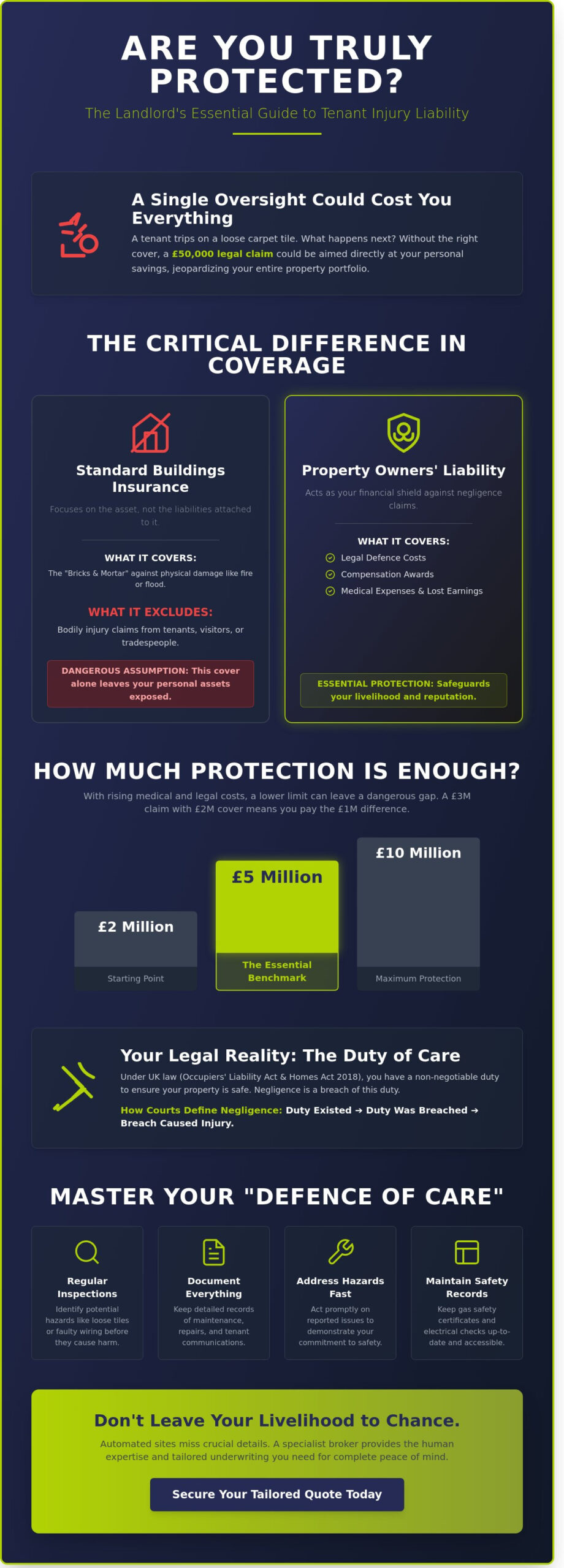
- Evaluate your current coverage to see why a £5 million indemnity limit is becoming the essential benchmark for UK residential property owners.
- Master proactive “Defence of Care” strategies and inspection routines to identify hazards before they lead to costly litigation.
- Discover the benefits of using a specialist broker to access tailored underwriting and human expertise that automated comparison sites often miss.
What is Landlord Liability Insurance for Tenant Injury?
Landlord liability insurance for tenant injury is a specialized form of protection designed specifically for property owners. It doesn’t just cover the building; it protects the person or business behind the property. This coverage is essential because UK law, specifically the Occupiers’ Liability Act 1957 and 1984, places a strict duty of care on landlords to ensure their premises are safe for anyone entering them. To understand the broader context of these policies, you can read more about What is Landlord Liability Insurance? on Wikipedia.
The core purpose of this insurance is to cover legal costs and compensation if a tenant or visitor is injured due to your negligence. Negligence might include failing to fix a broken floorboard, ignoring a damp issue that leads to respiratory illness, or leaving a faulty electrical circuit unrepaired. In the UK market, indemnity limits usually start at £2 million, but many professional landlords opt for £5 million or £10 million to account for the rising costs of medical care and legal fees. If a court awards a claimant £3 million and your limit is only £2 million, you’re responsible for the remaining £1 million yourself.
Property Owners Liability vs. Public Liability
You’ll often hear these terms used interchangeably in the rental sector. While they’re similar, the distinction lies in the “trigger” for a claim. Standard public liability insurance often focuses on active business operations. Property Owners Liability triggers based on “ownership-based negligence.” It focuses on the physical state of the property rather than your daily activities. This policy protects you against claims from a wide range of people, including the tenants named on the lease, their guests, visiting tradesmen, and even trespassers who might be injured by a structural hazard.
Why Buildings Insurance Alone is a Dangerous Risk
Many landlords fall into the “Total Loss” fallacy. They think that because they’ve secured residential letting insurance to cover the bricks and mortar against fire or flood, they’re fully protected. This is a dangerous assumption. Standard buildings insurance focuses on the asset, not the legal liabilities attached to it. Most basic policies specifically exclude third-party bodily injury claims unless a liability add-on is present.
If a tenant trips on a frayed carpet and suffers a life-changing spinal injury, your buildings insurance won’t pay the legal fees to defend you or the settlement to support the victim. Property Owners Liability is the financial shield for your personal or business assets. Without it, a single lawsuit could force the sale of your entire portfolio to cover the debt.
- Covers legal defense costs regardless of the claim’s outcome.
- Pays out for medical expenses and loss of earnings for the injured party.
- Fulfills requirements often set by mortgage lenders and local authorities.
Securing the right landlord liability insurance for tenant injury ensures that a physical defect in your property doesn’t lead to a total financial collapse. It’s a straightforward way to manage the inherent risks of being a property owner in a litigious environment.
While this insurance covers your professional risks, personal financial planning is just as critical for long-term stability. For those interested in securing their family’s future against end-of-life expenses, The Paul Group offers specialized final expense life insurance for seniors.
The Legal Reality: Duty of Care and Negligence in 2026
The legal landscape for UK property owners has shifted significantly. Under the Occupiers Liability Act 1957, you have a statutory “common duty of care” to ensure your tenants are reasonably safe while using your property. Negligence occurs when you breach this duty. In court, a judge looks for three things: a duty of care existed, that duty was breached, and the breach directly caused the injury. If a tenant slips on a leaking pipe you failed to fix, the liability sits squarely on your shoulders.
The rise of “No Win, No Fee” legal services has made it easier for tenants to pursue claims for even minor slips or trips. While UK law is your primary concern, the principles of liability are becoming more stringent worldwide. This aligns with UK legal principles, where any contractual clauses seeking to absolve landlords of their statutory duty of care or liability for negligence are typically deemed void, underscoring your non-negotiable responsibilities. In Britain, the Homes (Fitness for Human Habitation) Act 2018 empowers tenants to take direct legal action if a property is unsafe, making landlord liability insurance for tenant injury a vital safeguard.
Understanding Your Statutory Obligations
Safety compliance isn’t just about avoiding local council fines. It’s your primary shield against injury claims. If a tenant is injured by a faulty boiler and you don’t have a valid Gas Safety Record, proving you weren’t negligent is almost impossible. You’re also responsible for common areas like hallways and stairwells in HMOs or multi-unit blocks. A digital paper trail of every repair and inspection is your first line of defence. For those managing multiple properties, securing residential letting insurance provides a safety net when paperwork alone isn’t enough.
The Burden of Proof in Tenant Injury Claims
Tenants must prove you were aware of a hazard, or should’ve been aware of it through regular inspections. You aren’t expected to be perfect, but you must be proactive. The courts use the “reasonable care” standard. If a tenant reports a loose floorboard and you ignore it for 14 days, you’ve likely failed that test.
Consider a 2022 case where a tenant tripped on a loose stair carpet. The landlord had been notified via email two weeks prior but hadn’t sent a contractor. The resulting fall led to a fractured ankle and a £50,000 compensation payout. This demonstrates why landlord liability insurance for tenant injury is a non-negotiable part of modern property management. It covers the legal fees and the settlement costs that could otherwise bankrupt an individual landlord. If you’re concerned about your current level of protection, you can Just Quote Me to find a policy that fits your specific needs.
Evaluating Your Coverage: How Much Protection is Enough?
Deciding on an indemnity limit isn’t a guessing game; it’s a calculation based on your specific risk profile. Several factors influence how much protection you need. The size of your property portfolio, the location of your units, and the demographic of your tenants all play a role. For example, a large multi-unit block in a high-traffic urban area carries a higher statistical risk of accidents than a single-family home in a rural setting. By 2026, a £5 million indemnity limit is expected to become the industry standard for UK residential landlords. This shift is driven by the rising costs of long-term care settlements and private medical treatments that courts now frequently award.
One of the most overlooked aspects of a claim is the cost of legal fees. Even if a claim for a minor trip is settled for £15,000, the associated legal defence costs, expert witness fees, and court charges can easily exceed £50,000. If you’re relying on a generic, off-the-shelf policy, you might find these costs are capped or restricted. Choosing a bespoke policy through a specialist broker ensures that your landlord liability insurance for tenant injury is robust enough to cover both the compensation and the professional fees required to defend your reputation.
Residential vs. Commercial Liability Needs
Commercial properties involve a higher level of complexity due to increased footfall. If you own a building with a ground-floor retail unit, your risk profile changes the moment a member of the public enters the premises. For mixed-use properties, it’s often necessary to integrate shop insurance to ensure every square inch of the building is protected. The nature of the business tenant is vital. A quiet accounting office presents a much lower risk than a fast-paced restaurant with wet floors and hot surfaces.
What is Typically Excluded?
Understanding what your policy won’t cover is just as important as knowing what it will. Most landlord liability insurance for tenant injury policies exclude intentional acts or “deliberate neglect.” If you’re aware of a broken floorboard and choose not to fix it for six months, an insurer may refuse to pay out. Additionally, liability for your staff is a separate matter. If you employ a property manager or a cleaner, you’re legally required to hold Employers Liability Insurance. Finally, if you provide professional consultancy or advice as part of your service, you’ll need Professional Indemnity Insurance to cover errors in judgment or advice.
Getting your coverage levels right from the start saves you from financial ruin later. It’s about finding that balance between a premium that fits your budget and a limit that actually protects your assets when things go wrong.
Proactive Risk Management: Preventing Injuries and Claims
Preventing a claim is always better than filing one. While landlord liability insurance for tenant injury provides a vital financial safety net, your primary goal is to maintain a safe environment. You build a “Defence of Care” by proving you took every reasonable step to prevent harm. This doesn’t just mean fixing things when they break; it requires active, documented oversight.
Mid-term inspections are your best tool here. Property managers who conduct quarterly walkthroughs identify 40% more potential hazards than those who only visit at renewal, according to 2023 industry data. These visits let you spot a loose floorboard or a flickering stairwell light before they cause a fall. If a claim does arise, having a record of these regular checks demonstrates that you’re a responsible, proactive landlord.
Clear communication protocols are just as vital. Insist that tenants report all repair needs in writing via email or a dedicated portal. This creates a timestamped audit trail. If a tenant claims they told you about a broken handrail months ago, but your records show no such message, your legal position is significantly stronger. Always respond to these reports within 24 to 48 hours to show you take tenant safety seriously.
The 5-Step Inspection Checklist
- Step 1: Inspect external pathways for uneven paving and ensure all outdoor lighting works. These are prime areas for “slip and trip” claims.
- Step 2: Check internal safety features. Test handrails for stability and inspect flooring for fraying or lifting. Look for early signs of damp or mould.
- Step 3: Audit your compliance. Ensure Gas Safety Certificates (CP12) and EICRs are valid and up to date.
- Step 4: Keep a photographic log. Take clear photos of every room and safety feature during the inspection to prove the condition of the property.
- Step 5: Get the tenant to sign the inspection report. This confirms they agree with the findings and the stated condition of the home.
When Repairs Go Wrong: Vicarious Liability
You might think hiring a professional absolves you of blame, but that isn’t always the case. Under the “duty of selection,” you’re responsible for ensuring the people you hire are competent. If a plumber leaves a leak that causes a tenant to slip, you could still face a claim under your landlord liability insurance for tenant injury if you failed to vet the contractor properly.
Always verify that your tradespeople have their own builders insurance before they set foot on the premises. This ensures their mistakes are covered by their policy, not yours. For larger projects like extensions or roof replacements, you should consider Contractors All Risk Insurance to cover the site and materials during the works. Using qualified professionals creates a vital layer of protection between a mishap and your own liability policy.
Why Use a Broker for Landlord Liability Insurance?
Finding the right landlord liability insurance for tenant injury shouldn’t feel like a gamble with an automated algorithm. While comparison sites offer speed, they often lack the depth required to protect a property portfolio properly. At Just Quote Me, we move beyond the “one size fits all” approach by providing direct access to specialist underwriters. These insurers often don’t appear on standard search engines, yet they offer the most robust protection for complex risks that standard policies might miss.
A broker provides vital support during the most stressful part of property management: the claim. If a tenant’s solicitor sends a formal letter of claim regarding an injury, you need more than just a policy number. We act as your claims advocate, standing in your corner to ensure the process is handled professionally and fairly. Whether you manage a single flat in a converted house or a sprawling commercial block, we tailor every policy to fit your specific needs. This prevents you from paying for unnecessary extras while ensuring no dangerous gaps remain in your coverage.
The Personal Touch in a Faceless Market
Insurance has become increasingly impersonal, but we’ve spent 30 years proving that human expertise matters. Our Stafford-based team combines local knowledge with a national reach across the UK to help you identify risks that standard policies might overlook. We don’t hide behind jargon or complex terms. Instead, we do the heavy lifting by translating technical requirements into plain English. This allows you to focus on managing your tenants while we ensure your financial interests are secure.
Get Your Bespoke Quote Today
Our quoting process is designed for efficiency without sacrificing detail. We understand that your time is valuable, so we’ve streamlined our system to be quick and easy. Remember that landlord liability insurance for tenant injury is often the only barrier between a minor accident and total financial ruin. A single successful claim for a long-term injury can reach six figures; having the right level of protection is essential for your peace of mind. Don’t leave your assets to chance. Just Quote Me for your tailored Landlord Insurance today and get the professional cover your business deserves.
Secure Your Property Portfolio for 2026
Managing a rental property in the UK involves balancing tenant safety with robust financial protection. You now understand that fulfilling your legal duty of care is the first line of defence against negligence claims. Implementing regular safety inspections and maintaining clear records are essential steps to reduce risks. However, even the most diligent landlords need landlord liability insurance for tenant injury to cover legal fees and compensation costs that can quickly escalate.
Professional support makes a world of difference when navigating the 2026 insurance market. Just Quote Me offers over 30 years of specialist insurance brokerage experience to help you find the right fit. Our FCA-authorised team provides expert advice tailored to UK property law, ensuring your coverage meets every legal requirement. We use our access to a broad network of top-tier UK insurers to secure competitive pricing that doesn’t compromise on quality. We’ll do the heavy lifting so you can focus on managing your properties with total peace of mind.
Get a Tailored Landlord Liability Quote from Just Quote Me
Frequently Asked Questions
Is landlord liability insurance a legal requirement in the UK?
Landlord liability insurance isn’t a legal requirement under UK law, but it’s often a mandatory condition set by buy-to-let mortgage lenders. If you own the property outright, you aren’t legally forced to have it. However, without it, you’re personally responsible for legal fees and compensation costs. Most professional landlords consider it essential because a single claim can reach five or six figures, making it a vital safety net for your business.
Does landlord liability cover injuries to visitors as well as tenants?
Yes, this insurance typically covers any third party who suffers an injury on your property, including visitors, guests, and postal workers. If a delivery person trips on a loose floorboard you failed to fix, they could sue for damages. Your policy is designed to protect you against these claims, ensuring that anyone legally on the premises is accounted for in your risk management. It’s about protecting you from the unexpected, whoever walks through the door.
What is the difference between public liability and property owners liability?
Property owners liability is a specific type of public liability insurance designed for those who own land or buildings. While public liability is a general term used by many businesses, property owners liability focuses on risks stemming from the building’s structure. In the context of a rental property, the terms are often used interchangeably by brokers to describe the protection you need against third party injury claims. We focus on getting you the right specific cover.
Can I be held liable if a tenant is injured due to their own clutter?
You’re typically not held liable if a tenant’s own possessions or lack of tidiness causes their injury. Liability usually depends on a breach of your statutory duties under the Landlord and Tenant Act 1985. If the injury results from a structural fault or a maintenance issue you were informed about but didn’t fix, the responsibility lies with you. It’s vital to keep clear records of all inspections and repairs to prove you’ve met your obligations.
How much does landlord liability insurance typically cost in 2026?
While we can’t predict exact 2026 premiums, industry data from 2024 shows that basic landlord liability cover often begins at approximately £170 per year for a standard residential property. Costs vary based on the property’s location, the number of tenants, and the level of indemnity chosen. Most UK landlords opt for £2 million or £5 million in cover to meet the requirements of local authorities and housing associations. We recommend getting a tailored quote for accuracy.
What should I do immediately if a tenant informs me of an injury?
You must document the incident immediately by taking photos of the area and writing down exactly what happened. Don’t admit liability or offer any compensation to the tenant at this stage, as this can invalidate your policy. Notify your insurance provider as soon as possible to ensure they can handle the legal proceedings. Early reporting is a standard requirement in the Pre-Action Protocol for Personal Injury Claims, which governs how these disputes are handled in court.
Does landlord liability cover me for “no-win, no-fee” legal expenses?
Yes, landlord liability insurance for tenant injury is specifically designed to cover legal defense costs, including those associated with “no-win, no-fee” claims. If a tenant’s solicitor brings a case against you, your insurer provides professional legal representation. The policy pays out for the legal fees and any court-awarded compensation, which protects your personal finances from the high costs of the UK legal system. It’s a straightforward way to keep your investment safe from litigation.
Will my insurance cover me if my gas safety certificate has expired?
Your insurance will likely be void if you fail to maintain a valid gas safety certificate as required by the Gas Safety (Installation and Use) Regulations 1998. Insurers expect you to comply with all UK safety legislation to keep the policy active. If an injury or accident occurs and your CP12 certificate is out of date, the provider will almost certainly refuse to pay the claim. This leaves you with the full bill for legal fees and compensation.
