

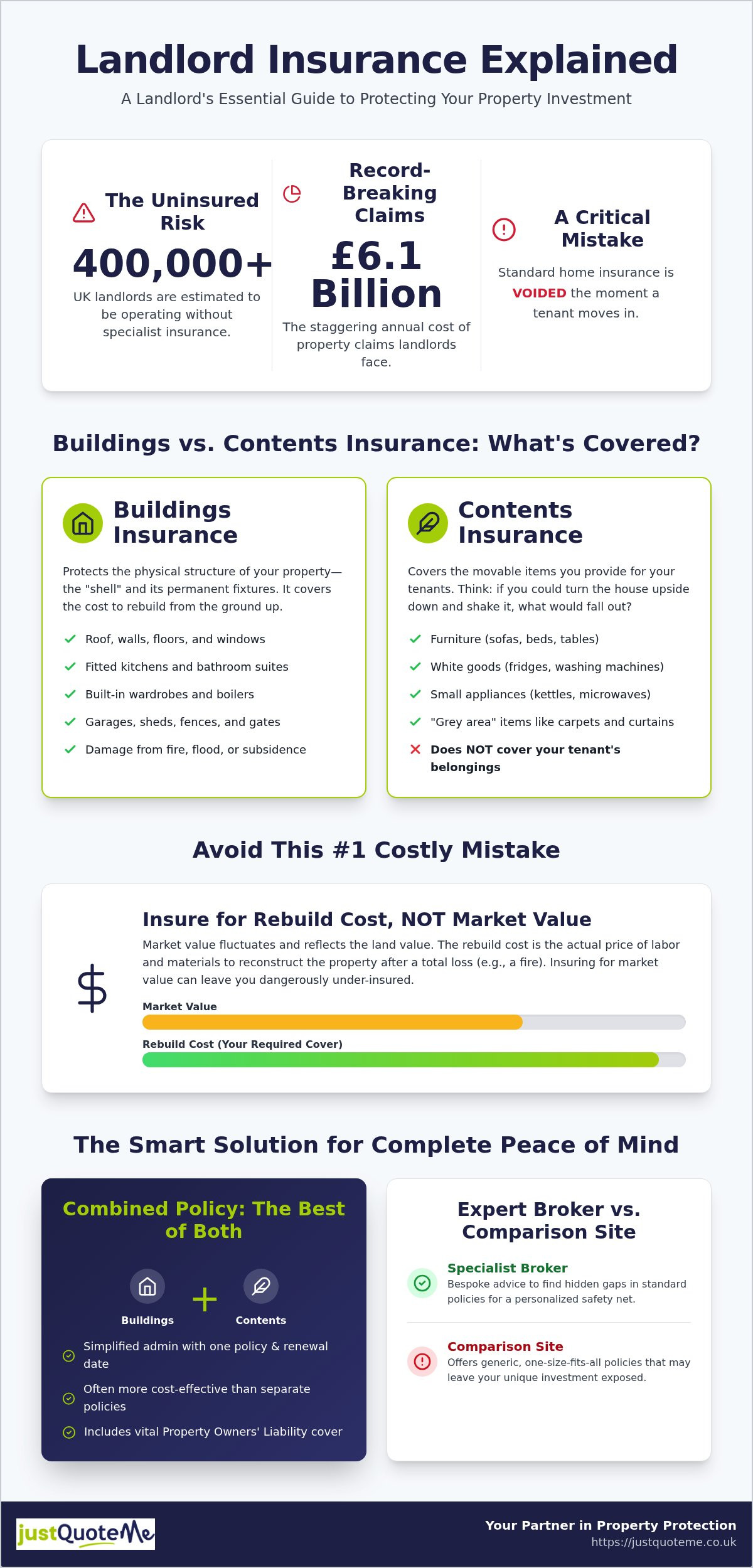
Did you know that an estimated 400,000 UK landlords are currently operating without any specialist insurance, leaving their largest assets exposed to a record-breaking £6.1 billion in annual property claims? When you are weighing up landlord contents insurance vs buildings insurance, it’s easy to feel overwhelmed by technical jargon and the fear of being under-insured. Many property owners mistakenly assume that buildings cover includes everything within the four walls, while others accidentally pay to insure their tenants’ laptops and furniture.
You want your investment to be a source of steady income, not a financial sinkhole after a burst pipe or storm damage. We understand that distinguishing between a permanent fixture and a movable content can be confusing, especially with the new regulatory landscape following the Renters’ Rights Act 2025. This guide provides a clear roadmap to ensure your rental property is fully protected. We will explain the critical differences between structural and internal cover, help you avoid common overpayment traps, and show you how to build a bespoke policy that provides genuine peace of mind in 2026.
Key Takeaways
- Understand the fundamental distinction between landlord contents insurance vs buildings insurance to ensure you aren’t paying for tenant belongings while leaving your own assets exposed.
- Learn why insuring for the actual rebuild cost, rather than the market value, is the only way to safeguard your property against major perils like fire or subsidence.
- Identify the “grey area” items like carpets and curtains that often fall between policies, ensuring your furnished or unfurnished rental has seamless protection.
- Discover why a combined policy is often the most efficient way to manage administrative burdens while securing essential Property Owners Liability cover.
- Find out how a bespoke broker approach in 2026 identifies hidden gaps in standard comparison site policies to provide a personalized safety net for your investment.
Understanding the Basics: Landlord Buildings vs. Contents Insurance
Landlord insurance isn’t just a single product; it’s a strategic combination of protections designed to safeguard your investment. When you compare landlord contents insurance vs buildings insurance, the differences might seem subtle, but they are financially significant. In 2026, relying on a standard homeowner’s policy is a critical mistake that could leave you without any cover at all. Standard policies are typically voided the moment a tenant moves into the property because they don’t account for the specific risks associated with renting, such as property owner’s liability or loss of rent. Gaining a foundational understanding property insurance principles is essential for any serious investor looking to protect their portfolio.
If you have a buy-to-let mortgage, your lender will almost certainly mandate buildings cover as a condition of the loan. For investors who want to explore Home Loans and specialized financing for residential property, aligning your mortgage terms with the right insurance coverage is a key step in risk management. However, contents insurance remains an optional but vital extra depending on how you let the property. It’s also important to clarify that your policy only covers items you provide. Your tenants are entirely responsible for insuring their own personal belongings, such as laptops, clothes, and gadgets. Making this clear in the tenancy agreement helps avoid confusion when a claim arises.
What is Landlord Buildings Insurance?
This cover focuses on the “shell” of your property. It protects the physical structure, including the roof, walls, windows, and floors. Beyond the bricks and mortar, it also includes permanent fixtures. These are items that cannot be easily removed without damaging the property, such as fitted kitchens, bathroom suites, and built-in wardrobes. Because reconstruction costs have risen due to material price hikes throughout 2025 and 2026, having accurate buildings cover ensures you aren’t left with a massive financial shortfall after a major event like a fire, flood, or subsidence. It provides the security needed to rebuild your investment from the ground up if the worst happens.
What is Landlord Contents Insurance?
If you could pick up the house and shake it, everything that falls out would generally fall under contents. This insurance covers movable items you provide for the tenant’s use. Common examples include white goods like fridges and washing machines, free-standing furniture, and even smaller items like kettles or microwaves in a fully furnished let. Choosing the right level of cover depends on your specific rental strategy. For a furnished flat in the West Midlands, contents cover is indispensable. For an unfurnished house, you might only need minimal cover for items like carpets and blinds. To get the right balance for your specific portfolio, Just Quote Me for a policy that reflects your actual risk rather than a generic estimate. We focus on bespoke solutions that handle the administrative burden so you don’t have to.
Landlord Buildings Insurance: Protecting the Fabric of Your Investment
Landlord buildings insurance is the bedrock of your protection strategy. One of the most dangerous mistakes a property owner can make is confusing market value with the actual rebuild cost. In 2026, the cost of labor and materials remains a primary driver of insurance premiums. If a fire destroys your rental, your policy needs to cover the full expense of clearing the site and rebuilding the structure from scratch. Market fluctuations don’t affect this cost, so an accurate professional valuation is essential to avoid the trap of under-insurance, which can lead to reduced payouts during a claim.
Standard policies cover a range of “perils” including fire, flood, subsidence, and vehicle impact. It’s also vital to ensure your cover extends to the boundary of your property. This means including external structures like garages, fences, and gates, which are often the first items damaged during high-winds or vehicle collisions. When evaluating landlord contents insurance vs buildings insurance, remember that the buildings portion is there to restore the physical asset and its permanent attachments to their original state.
What Counts as a Permanent Fixture?
Fixtures are the elements of the home that are physically attached to the structure. This category includes fitted wardrobes, central heating systems, boiler units, and bathroom tiling. These are not considered “contents” because removing them would cause structural or cosmetic damage to the building. A fixture is any item that cannot be removed without damaging the property. This distinction is critical because it ensures these high-value installations are protected under the structural sum insured rather than a smaller contents limit, which might not cover the full replacement cost of a modern heating system.
Specialist Cover: Subsidence and Accidental Damage
Subsidence cover is a non-negotiable for many landlords in Staffordshire and the West Midlands, where local geology and historic mining can pose specific risks to older foundations. While standard buildings cover handles sudden events like fire, it doesn’t always include damage caused by tenants. Adding Accidental Damage cover is a pragmatic choice for landlords who want protection against mishaps like a tenant accidentally drilling through a pipe or damaging a permanent floor. To ensure your specific property risks are addressed, you can get a tailored commercial property quote that accounts for these regional variables and provides the steady hand you need in a complex market.
Landlord Contents Insurance: Navigating the Grey Areas
Many landlords struggle with the furnished vs unfurnished distinction. Even if you let a property “unfurnished,” you likely still own the carpets, curtains, and blinds. These are classic grey area items. When comparing landlord contents insurance vs buildings insurance, these items usually sit on the contents side because they aren’t part of the physical structure. Malicious damage cover is also a vital consideration here. It protects your internal assets if a tenant intentionally damages your property, providing a safety net that standard accidental damage cover might miss.
The median insurance cost for landlords in 2026 is approximately £285 per year, but this can rise quickly if you miscalculate the value of your internal assets. It’s essential to understand that you are not insuring the tenant’s lifestyle. You are insuring the tools that make your rental functional. Focusing on your specific liabilities ensures you don’t overpay for cover you can’t actually claim on.
The Landlord vs. Tenant Possessions Trap
You are only responsible for the items you provide. It’s a common mistake to think your policy covers a tenant’s expensive electronics or furniture. It doesn’t. If you try to claim for a tenant’s stolen laptop, the insurer will likely reject the entire claim. Clearly stating responsibilities in the tenancy agreement protects both parties. To ensure your specific arrangement is correctly covered, exploring Residential Letting Insurance is a pragmatic step. This specialized cover helps you avoid the administrative burden of sorting through these traps alone.
White Goods and Integrated Appliances
The distinction between buildings and contents often comes down to how an appliance is installed. An integrated dishwasher behind a cupboard door is usually classified under buildings because it’s a permanent fixture. A free-standing unit is almost always a content. White goods are the most frequent source of contents claims due to electrical faults or leaks. Landlords should keep a detailed inventory of all insured contents, including serial numbers and purchase dates, to streamline the claims process. This simple administrative task can save days of back-and-forth with insurers if a kitchen flood occurs in 2026. Because “escape of water” accounts for 29.3% of all claims, knowing exactly which appliance caused the issue is vital for a successful payout.
Strategic Coverage: Why a Combined Policy is Often Best
Managing a property portfolio involves enough paperwork without doubling your insurance renewals. Opting for a combined policy brings administrative efficiency that automated systems often lack. When you look at landlord contents insurance vs buildings insurance, treating them as a single strategic unit ensures that no “grey area” item falls through the cracks. Most brokers also offer multi-cover discounts when you bundle these risks, providing a financial incentive alongside the reduced workload of managing a single renewal date.
Beyond the physical assets, there is a hidden third essential: Property Owners Liability. In 2026, the recommended standard for this cover has risen to £5 million to account for increasing legal costs. If a tenant or visitor is injured due to a fault in the property, you could face a life-altering claim. A combined policy typically integrates this protection seamlessly, ensuring you aren’t just protecting bricks and mortar, but also your personal financial future. This holistic approach prevents the finger-pointing that can occur between different insurers when a claim involves both the structure and its contents.
Liability: Protecting Your Legal Position
Every landlord needs Public Liability Insurance to protect against injury claims. Whether it’s a loose floorboard or a faulty handrail, the legal burden falls on you. Just Quote Me specializes in bespoke liability solutions that go beyond the generic limits found on comparison sites. We assess the specific profile of your tenants and the age of your property to ensure your legal position is robust. Consult with our experts to verify your current liability limits and ensure they meet 2026 standards.
Loss of Rent and Alternative Accommodation
What happens if a major buildings claim, like a significant flood, makes your property uninhabitable? While buildings insurance covers the repairs, your rental income stops immediately. Loss of Rent cover is a critical add-on that bridges this financial gap. For landlords who rely on monthly rent to pay a buy-to-let mortgage, this protection is a lifeline. It can also cover the cost of alternative accommodation for your tenants, helping you fulfill your legal obligations under the Renters’ Rights Act 2025 without draining your savings. When balancing landlord contents insurance vs buildings insurance, this strategic layer provides the total security you need to manage your investment with confidence.
Expert Guidance: Why a Broker Beats a Comparison Site in 2026
Automated comparison sites promise speed, but they often lack the depth required for complex rental investments. In 2026, the real danger isn’t just the price of the premium; it’s the fine print that leaves you exposed. When you are deciding between landlord contents insurance vs buildings insurance, a generic algorithm won’t tell you if your specific property in the West Midlands needs extra subsidence cover or if your “furnished” status is correctly defined. These platforms rely on a one-size-fits-all approach that frequently misses the nuances of modern property management.
We’ve spent 30 years acting as a human-centric alternative to these faceless systems. Our experience allows us to spot the gaps that automated engines ignore. Whether it’s ensuring your rebuild cost is accurately calculated or verifying that your malicious damage cover is robust, we handle the administrative burden so you don’t have to. Using a broker means you get a partner who understands the local landscape in Staffordshire, providing a steady hand in an increasingly complex insurance market.
The Just Quote Me Difference
Our personalized service is rooted in our offices in Stone. We don’t just provide a list of quotes; we provide expert advice tailored to your specific portfolio. Being an independent, FCA-authorised firm gives us access to a broad network of top UK insurers, many of whom don’t appear on standard comparison sites. This allows us to build a bespoke policy that offers genuine value and security. For a deep dive into the evolving regulations of the year, see our Landlord Insurance Pillar. We focus on specialized knowledge to ensure your investment is protected from every angle.
Secure Your Investment for 2026
Complex properties require more than a digital tick-box. If you manage an HMO, a listed building, or a property with a thatched roof, the standard rules of landlord contents insurance vs buildings insurance change. These assets carry unique risks that demand a tailored approach to prevent claim rejection. We pride ourselves on being approachable advisors who simplify these processes for you. Don’t leave your largest assets to chance with a generic policy. Start your journey toward a more secure rental portfolio today by engaging with experts who prioritize your protection over simple automation. For further insights into maximizing the value of your property assets, check out Dr. Zakk Varughese, Real Estate Broker – HomesRX.
Get Your Free Business Insurance Quote now
Request a Call back for free Expert advice
Secure Your Rental Legacy in 2026
Protecting your rental investment requires more than just ticking boxes on a screen. By mastering the nuances of landlord contents insurance vs buildings insurance, you ensure that every brick, boiler, and blind is accounted for under the correct policy limit. Remember that structural integrity is only half the battle; the strategic layers of Liability and Loss of Rent are what truly safeguard your income if the property becomes uninhabitable.
As an independent, FCA-authorised broker with over 30 years of industry experience, Just Quote Me provides the specialized oversight that automated sites simply can’t match. We have access to top UK insurers to build a bespoke policy that fits your specific portfolio perfectly. Don’t leave your financial future to chance in a complex market. You can protect your investment today by speaking with a partner who understands the local landscape. We are here to handle the administrative burden so you can focus on growing your business with confidence.
Frequently Asked Questions
Is landlord buildings insurance a legal requirement in the UK?
No, landlord insurance is not a legal requirement in the UK, but it is a standard condition for most buy-to-let mortgage lenders. If you have a mortgage, your lender will mandate buildings cover to protect their interest in the asset. Even if you own the property outright, operating without it leaves you personally liable for the full rebuild cost after a disaster. Most professionals consider it a non-negotiable part of responsible property management.
Do I need contents insurance if I let my property unfurnished?
You should still consider it because even an “unfurnished” property usually contains expensive items like carpets, curtains, and white goods. When you are looking at landlord contents insurance vs buildings insurance, remember that structural cover won’t replace a ruined floor or a broken washing machine. Minimal contents cover is often very affordable and ensures these essential internal assets are protected against common perils like fire, theft, or escape of water damage.
Does buildings insurance cover a leaking boiler or burst pipes?
It covers the damage caused by a leak, such as ruined plasterwork or flooring, but it doesn’t typically cover the repair of the boiler itself. Boiler breakdowns are usually considered maintenance issues rather than insurance claims. However, escape of water from burst pipes is a standard covered peril. You should check your policy for specific excesses, as many insurers in 2026 apply a higher compulsory excess for water damage claims compared to standard perils.
Can I use standard home insurance for a buy-to-let property?
No, you cannot use standard home insurance as it is almost always invalid once a tenant moves into the property. Homeowner policies don’t account for the specific risks of renting, such as property owner’s liability or loss of rent. If you try to claim on a standard policy for a buy-to-let investment, the insurer will likely reject the claim entirely. You need a specialist policy to ensure your legal and financial protections remain robust.
Who is responsible for insuring the tenant’s furniture and electronics?
The tenant is entirely responsible for insuring their own personal possessions, including furniture, gadgets, and clothes. Your landlord policy only covers items that you own and provide for their use. It’s a wise move to include a clause in your tenancy agreement advising tenants to take out their own cover. This prevents any confusion or financial disputes if their high-value electronics are damaged or stolen during an event like a fire or break-in.
What is the difference between fixtures and contents for insurance purposes?
Fixtures are permanent parts of the building that cannot be removed without causing damage, such as fitted kitchens, bathroom suites, and tiled floors. Contents are movable items like free-standing sofas, fridges, or washing machines. Correcting this distinction is vital when comparing landlord contents insurance vs buildings insurance. It ensures your structural sum insured is high enough to rebuild the shell and fixtures, while your contents limit covers the movable items you’ve provided for tenants.
Does landlord insurance cover malicious damage by a tenant?
It is typically available as an optional extra rather than a standard feature in basic policies. While standard cover handles accidental damage, malicious damage is a deliberate act by a tenant or their guests. Given that UK property insurers paid out a record £6.1 billion in claims during 2025, adding this protection is a pragmatic choice for many landlords. It provides a strategic shield for your internal assets against intentional harm or vandalism.
How much does landlord buildings and contents insurance cost in 2026?
The cost of your policy depends on several variables, including the property type, location, and the level of cover you choose. Factors like the postcode, the tenant’s profile, and your previous claims history will all influence the final premium. Because every rental investment is unique, we recommend getting a tailored quote rather than relying on general averages. This ensures you are protected without overpaying for unnecessary extras while still meeting your lender’s specific requirements.
