
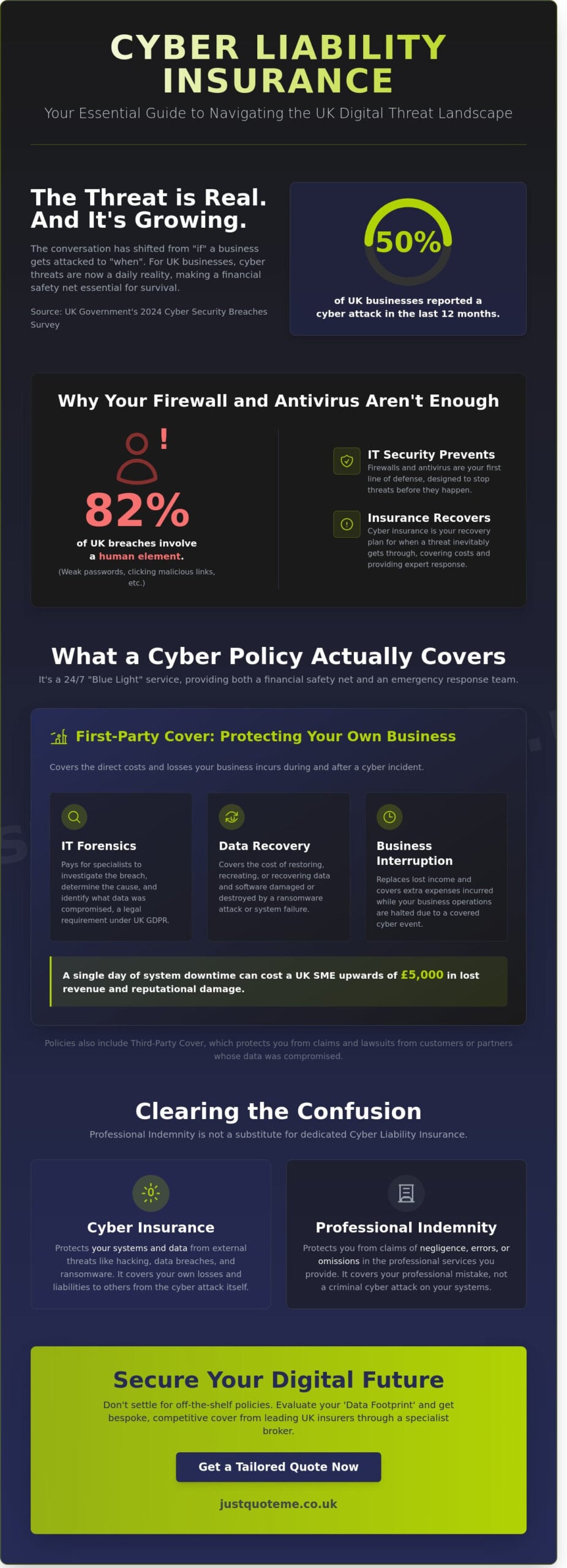
Did you know that 50% of UK businesses reported a cyber attack in the last 12 months? According to the UK Government’s 2024 Cyber Security Breaches Survey, the threat isn’t just growing; it’s becoming a daily reality for companies of all sizes. You likely already feel the weight of protecting your customer data, especially with the constant worry about GDPR fines or a business-ending ransomware demand. It’s a lot to manage, and the complex jargon surrounding cyber liability insurance often makes a stressful situation feel even more overwhelming.
We believe securing your digital future shouldn’t be a struggle. This guide will show you exactly how to protect your assets with confidence. You’ll learn the vital difference between first-party and third-party risks, ensuring you choose a policy that provides a genuine safety net during a crisis. We’ll cut through the noise to help you find straightforward, reliable coverage that lets you get back to running your business with total peace of mind. From understanding terminology to picking a policy that actually pays out, we have you covered.
Key Takeaways
- Understand the 2026 threat landscape and why a financial safety net is essential to protect your business from AI-powered phishing.
- Learn the difference between first-party and third-party coverages to ensure you have a 24/7 “Blue Light” response team on standby.
- Discover why professional indemnity is no substitute for dedicated cyber liability insurance when protecting your systems and sensitive data.
- Evaluate your “Data Footprint” to determine the precise level of cover required for your specific cloud and software dependencies.
- Find out how to access bespoke, competitive rates from leading UK insurers through a specialist broker instead of settling for off-the-shelf policies.
What is Cyber Liability Insurance and Why is it Essential in 2026?
Think of cyber liability insurance as a financial and operational safety net for your business. It protects your company from the fallout of data breaches, hacking attempts, and system failures. As we move through 2026, the digital world is more volatile than ever. Cyber insurance has transitioned from a luxury for tech giants to a fundamental requirement for every local business. The Financial Conduct Authority (FCA) sets high standards for these policies in the UK, ensuring that coverage is transparent and reliable when you need it most.
The conversation has shifted. We’ve moved past the era of “if” a business gets hacked. Now, it’s a matter of “when” it happens. AI-powered phishing and sophisticated ransomware have made attacks faster and harder to detect. Without a policy in place, the cost of recovery can easily bankrupt a small enterprise before they’ve even identified the source of the breach. You need a partner who understands the risks and provides a straightforward way to protect your livelihood.
The Evolving Threat Landscape for UK SMEs
Small businesses across Staffordshire and the West Midlands are prime targets for modern hackers. Criminals often use social engineering and Business Email Compromise (BEC) to trick employees into transferring funds or revealing passwords. These aren’t just random attacks; they’re often targeted at local firms that hackers assume have weaker security than London corporations. While a monthly premium is a predictable expense, the cost of downtime is anything but. A single day of system inactivity can cost a UK SME upwards of £5,000 in lost revenue and reputational damage, making the insurance premium a sensible investment in your business’s future.
Why Antivirus and Firewalls Are Not Enough
IT security prevents, but insurance recovers. While firewalls and antivirus software are essential, they can’t stop every threat. Data from the 2024 Cyber Security Breaches Survey shows that 82% of UK breaches involve a human element. This includes everything from weak passwords to employees clicking on malicious links. Resilience isn’t just about building a digital wall; it’s about having a plan for when that wall is breached. Cyber liability insurance fills the gap between your technical defences and the reality of human error. It provides the necessary funds for:
- Forensic investigations to find the breach source
- Legal fees and regulatory fines
- Customer notification costs
- Restoration of damaged digital assets
By combining robust tech with a tailored insurance policy, you create a resilient business that can survive a digital crisis and keep trading.
The Core Components: What Does a Cyber Policy Actually Cover?
A common mistake is assuming that standard business insurance covers digital threats. It usually doesn’t. A dedicated cyber liability insurance policy is designed to handle the unique, fast-moving nature of digital crime. It functions as both a financial safety net and an emergency response team. When a breach occurs, you aren’t just getting a payout; you’re gaining access to a 24/7 “Blue Light” service. This provides immediate access to specialists who stop the bleed, secure your systems, and manage the fallout.
These policies are split into two distinct areas: protecting your own business and protecting you from claims made by others. Understanding this distinction is vital for any UK business owner looking to secure their digital assets. If you’re ready to see how these protections fit your specific trade, you can get a tailored quote in minutes.
First-Party Cover: Protecting Your Own Business
First-party coverage handles the direct costs your business faces during a crisis. According to the UK Government’s Cyber Security Breaches Survey 2023, the average cost of an attack for a medium or large business was £1,100, though this figure often excludes the long-term impact of lost productivity.
- IT Forensics: Specialist investigators work to find out how hackers bypassed your security. They identify exactly what data was accessed, which is a legal requirement under UK GDPR if personal details are involved.
- Data Recovery: If a ransomware attack encrypts your files, this cover pays for experts to restore your data from backups or, in extreme cases, recreate lost information.
- Business Interruption: If your systems are offline, you can’t trade. This cover replaces the revenue you lose during the period your business is unable to function.
Third-Party Cover: Protecting You from Others
Third-party coverage defends you if a client or member of the public suffers a loss because of your security failure. This is where cyber liability insurance prevents a single mistake from causing total financial ruin.
- Privacy Liability: If customer data is leaked, you could face massive legal claims. This covers the defence costs and any settlements you’re ordered to pay.
- Network Security Liability: If a virus spreads from your system to a client’s network, they may sue you for the damage caused to their business.
- Media Liability: This protects you against claims of digital libel, slander, or unintentional copyright infringement on your website or social media.
Beyond these basics, policies often include coverage for regulatory fines from the Information Commissioner’s Office (ICO), provided the fine is legally insurable in the UK. Many insurers also offer Cyber Essentials insurance as part of a package, which aligns your business with government-backed security standards. This combination of proactive defence and reactive financial support ensures that a cyber attack is a manageable setback rather than a business-ending event.
Cyber Insurance vs. Professional Indemnity: Clearing the Confusion
Many UK business owners assume their Professional Indemnity (PI) insurance acts as a safety net for digital disasters. This misunderstanding often leads to expensive gaps in coverage. While PI protects you against claims of negligence or poor advice, it rarely extends to the technical fallout of a data breach. PI insurance focuses on the “intellectual” output of your business. If a solicitor gives incorrect legal advice, PI steps in. However, if that same solicitor’s database is encrypted by ransomware, the PI policy will likely remain silent.
Cyber liability insurance is designed to cover the “digital” assets, including your servers, websites, and the sensitive data stored within them. A 2023 report by the UK Government found that 32% of businesses experienced a cyber breach in the last year, yet many still rely on outdated policies. Following a mandate from Lloyd’s of London in January 2023, most traditional insurers now explicitly exclude “Silent Cyber” risks. This means if your policy doesn’t specifically mention cyber coverage, you probably aren’t protected against digital attacks.
As highlighted by Forbes on cyber liability insurance, these policies fill the gaps left by general liability and PI by covering the immediate costs of a breach, such as forensic investigations and legal fees. Consider a scenario where an IT consultant accidentally uploads a corrupted file to a client’s network. The client sues for the loss of their own data. The consultant’s PI policy might cover the legal defence for “bad advice,” but it won’t pay for the consultant’s own lost income or the expensive work of cleaning their own infected systems. Only a dedicated cyber policy handles those internal recovery costs. Company directors and senior leaders face additional personal exposure beyond these digital risks, which is why many board members also consider directors and officers insurance to protect their personal assets from claims arising under the Companies Act 2006.
The Professional Indemnity Gap
Most modern PI policies now contain a “cyber exclusion” clause. This is a deliberate move by insurers to separate professional errors from digital security failures. Relying on general liability for a hack is a high-stakes gamble. Standalone cyber liability insurance provides a bespoke layer of protection that handles incident response, GDPR fines where insurable, and extortion demands. It ensures you have the funds to hire specialists immediately rather than waiting for a liability claim to be proven.
Understanding Business Interruption in a Digital Context
Traditional business interruption covers physical damage, like a fire at your office. Cyber business interruption is different. It triggers when a system failure or hack stops you from trading. Most policies include a “waiting period,” often between 8 and 12 hours, before the coverage kicks in. Cyber Business Interruption is the protection of cash flow during system downtime. This ensures that even if your servers are offline, your business remains financially viable during the recovery phase.
How to Choose the Right Level of Cyber Cover for Your Business
Choosing the right level of cyber liability insurance isn’t about picking a random figure. It requires a pragmatic look at your digital exposure. Start by auditing your data footprint. This means quantifying exactly how many sensitive records you hold. A business storing 10,000 customer credit card profiles faces a vastly different risk profile than a firm holding 500 email addresses for a newsletter. Every record represents a potential cost in the event of a breach.
You must also evaluate your reliance on third-party services. If your cloud-based CRM or project management tool goes offline, does your revenue stop immediately? Many UK businesses forget to account for “contingent business interruption,” which covers losses when a supplier you rely on is hacked. Industry-specific risks play a major role too. A hospitality business in the West Midlands might be a prime target for point-of-sale malware, whereas a construction company is more likely to face “spear-phishing” attacks aimed at diverting large invoice payments. Retail businesses face their own distinct vulnerabilities, and understanding the full scope of your commercial exposure — including shop insurance requirements for UK retailers in 2026 — is essential to building a complete protection strategy. Similarly, businesses operating from a fixed premises should ensure their office insurance for 2026 keeps pace with new equipment, hybrid working patterns, and the evolving digital risks that now sit alongside traditional physical threats.
Securing a Cyber Essentials certification is one of the most effective ways to lower your costs. This government-backed scheme demonstrates to insurers that you have the five technical controls in place to prevent 80% of common cyber attacks. Many underwriters now view this certification as a prerequisite for competitive rates, often resulting in lower premiums and reduced excesses.
Calculating Your Potential Loss
To find your ideal indemnity limit, calculate the financial impact of 48 hours of total downtime. Sum your lost daily revenue and ongoing staff costs. You must then factor in GDPR compliance. Under UK law, you have 72 hours to notify the ICO and affected individuals if a breach puts them at risk. Notification costs, including legal counsel and dedicated call centres, can exceed £20,000 for even modest data sets. Don’t forget reputation management; the cost of a specialist PR firm to win back customer trust is often the difference between recovery and closure.
The Importance of a UK-Based Specialist Broker
Using a commercial insurance broker staffordshire provides a level of local insight that automated platforms cannot match. We understand the specific threats facing businesses in our region and provide a human advocate to handle the heavy lifting during a claim. When your systems are locked by ransomware, you need a steady hand and a direct phone line, not a generic support ticket. We help you navigate the fine print to ensure your cyber liability insurance actually performs when you need it most.
Securing Your Digital Future with Just Quote Me
Choosing the right cyber liability insurance isn’t just about ticking a box; it’s about building a safety net that actually works when things go wrong. At Just Quote Me, we don’t believe in off-the-shelf policies that leave gaps in your protection. We’ve spent 30 years refining our approach, evolving from traditional risks to the complex digital threats businesses face in 2024. Our team leverages a wide panel of leading UK insurers to find competitive rates that don’t compromise on the quality of cover. We translate three decades of brokerage experience into modern digital protection, ensuring your business stays resilient against ever-evolving threats.
A Personal Touch in a Faceless Market
Many modern brokers rely on automated algorithms that fail to understand the nuances of your specific industry. We take a different path. For businesses across Staffordshire, from Stone to Stafford, we provide a dedicated contact who knows your name and your trade. We understand that application forms for cyber liability insurance can be daunting. Our experts help you navigate these complex documents, ensuring every detail is accurate so your claims are never compromised by a simple clerical error. You get the benefit of national-scale insurer access with the reliability of a local partner who is always a phone call away.
Get Your Bespoke Quote Today
Our process is designed to be as efficient as possible. We handle everything from small SME policies to high-limit corporate risks, ensuring the solution fits your budget and your exposure. We start by listening to your specific needs, then we shop the market to find the best fit. This bespoke approach means you aren’t paying for features you don’t need while maintaining robust protection against ransomware and data theft.
- Step 1: Tell us about your trade and how you handle data.
- Step 2: We conduct a no-obligation cyber risk assessment.
- Step 3: We compare our panel of top UK insurers.
- Step 4: You receive a tailored policy that fits your business perfectly.
Don’t leave your digital assets to chance. Our expert team is ready to do the heavy lifting so you can focus on running your business. Get your business insurance quote today and secure the future of your company with a partner you can trust.
Future-Proof Your UK Business Against Cyber Risks
The digital landscape in 2026 demands more than just basic firewalls. Protecting your company requires a clear understanding of how cyber liability insurance shields you from data breach costs and recovery expenses. You’ve now identified the core components of a robust policy and learned how to select the correct level of cover for your specific needs. This knowledge ensures that your business doesn’t fall through the gaps when a breach occurs.
Securing the right protection is simple with a specialist on your side. Just Quote Me acts as an FCA Authorised Independent Broker with over 30 years of industry expertise. We leverage our access to leading UK insurance panels to find bespoke coverage that fits your trade. We don’t believe in automated algorithms; we provide a personal touch that prioritises your peace of mind. It’s about getting the right cover without the usual jargon or delays. To ensure you have every aspect of your protection covered, reviewing a comprehensive small business insurance UK checklist for 2026 is an invaluable step before finalising your policy decisions.
Just Quote Me: Get Your Tailored Cyber Insurance Quote Now
Taking action today prevents a manageable incident from becoming a financial crisis. We’re here to help you navigate the complexities of the market with confidence.
Frequently Asked Questions
Is cyber liability insurance a legal requirement for UK businesses?
No, cyber liability insurance isn’t currently a legal requirement for UK businesses under any specific act of parliament. While Employers’ Liability is mandatory for those with staff, cyber cover remains an optional choice for risk management. However, the Information Commissioner’s Office (ICO) can issue fines up to £17.5 million for data breaches under UK GDPR. Most firms choose coverage to manage these specific financial risks and legal obligations effectively.
How much does cyber insurance cost for a small business in 2026?
Costs for cyber liability insurance depend on your turnover and data volume, but small UK businesses often see annual premiums starting from £500. According to 2024 industry benchmarks, a firm with under 10 employees might pay between £40 and £80 per month. Prices for 2026 will likely reflect the 15% increase in claim frequency reported by insurers last year. We provide tailored quotes to ensure you don’t overpay for unnecessary extras.
What is the difference between cyber liability and data breach insurance?
Cyber liability insurance is a comprehensive policy that covers third-party claims and first-party losses, while data breach insurance specifically focuses on the costs of a data leak. A full policy handles legal fees, PR costs, and system restoration. Data breach elements specifically manage the fallout of stolen customer records. Most UK providers bundle these together to provide a robust shield against modern digital threats and regulatory penalties.
Does cyber insurance cover ransomware payments?
Many policies include coverage for ransomware extortion, but insurers often prioritize recovery and negotiation over direct payments. Following 2023 guidance from the National Cyber Security Centre (NCSC), insurers focus on restoring backups and forensic investigations. Some providers may cover the ransom if it’s the only way to save the business. You should check your specific policy wording to see if extortion costs are included in your chosen plan.
Can I get cyber insurance if I don’t have Cyber Essentials certification?
You can still obtain coverage without a Cyber Essentials certification, though your premiums might be higher. Insurers use the 5 technical controls of Cyber Essentials as a benchmark for risk. Without it, you’ll need to demonstrate equivalent security measures, such as multi-factor authentication and regular patching. Having the certification can often secure a 10% to 15% discount on your annual premium with certain UK underwriters who value proactive security.
Will cyber insurance cover me if my employees make a mistake?
Yes, most policies cover claims resulting from employee errors, such as clicking a phishing link or sending data to the wrong recipient. Human error accounted for 68% of data breaches in 2023 according to Verizon’s Data Breach Investigations Report. Your insurance will typically cover the resulting legal costs and data recovery efforts. It’s a vital safety net for when training isn’t enough to prevent a simple but costly slip-up.
How long does it take to get a cyber insurance quote?
You can get a tailored quote in under five minutes when you use our online system. We’ve streamlined the process to ask only the essential questions about your business operations and digital footprint. If your business has complex needs or high turnover, one of our UK-based specialists will review your details manually. We aim to provide a firm price as quickly as possible so you can get back to work protected.
What happens if my business is hacked and I don’t have insurance?
Without insurance, your business is responsible for all costs, which averaged £1,100 for UK small businesses in 2023 according to government data. You’ll have to fund forensic investigators, legal counsel, and mandatory ICO notifications from your own cash flow. These immediate expenses often lead to significant downtime. For 1 in 5 small firms, a major unshielded attack results in permanent closure within six months of the incident occurring.
