
A commercial property’s rebuild cost can differ greatly from its market value. Calculating the rebuild cost of a commercial property means estimating what it would cost to reconstruct the building from the ground up, not using its sale price or investment value.
It’s easy to focus on the structure, but the total may also include demolition, site clearance, labour, materials and professional fees. The estimate should account for current building regulations and energy requirements, as well as the property’s design and site conditions.
This guide explains what rebuild cost means and what a commercial reinstatement estimate should include. It covers demolition and clearance, professional fees, regulatory standards and energy efficiency, and explains why an accurate figure matters when arranging commercial property insurance.
Key Takeaways
- Separate rebuild cost from market value: it estimates the cost of reinstating the building, not its sale or investment value.
- Use a calculator as an initial estimate, then consider a professional reinstatement valuation for the property’s specific features and constraints.
- Allow for current building requirements and energy-efficiency standards, which can affect the materials, design and work involved.
- Include demolition, debris removal and site clearance alongside construction, labour and professional fees when assessing the full rebuild scope.
What is commercial property rebuild cost?
A commercial rebuild cost estimates the expense of reconstructing a building from the ground up. The Association of British Insurers defines it by the cost of rebuilding, not by the property’s market value.
Rebuild assessments and estimation methods
Calculating the rebuild cost of a commercial property means estimating reinstatement costs, not its sale price. A calculator can apply construction rates to gross internal area, then adjust for complexity, specification and scale. Its result is indicative. A professional assessment can account for the building’s characteristics, condition and site constraints to produce a figure tailored to the property for an insurance declaration.
Fees and additional rebuild requirements
A complete estimate includes costs beyond construction, including architects’ and other professional fees, demolition, site clearance and external works. It should also account for planning requirements and compliance with current building regulations. Commercial reconstructions typically attract the UK standard VAT rate of 20%. These items matter because leaving them out can make the insured rebuild figure lower than the total reinstatement cost.
Reviewing insurance rebuild estimates
Review a commercial property’s rebuild estimate regularly, as building and labour costs can change. A formal RICS Insurance Reinstatement Valuation considers the building’s characteristics, condition and constraints. Waiting more than three years for a professional survey significantly increases the risk of a valuation gap. Regular reviews help keep the insured figure aligned with the work needed to reinstate the property.
Underinsurance and overinsurance risks
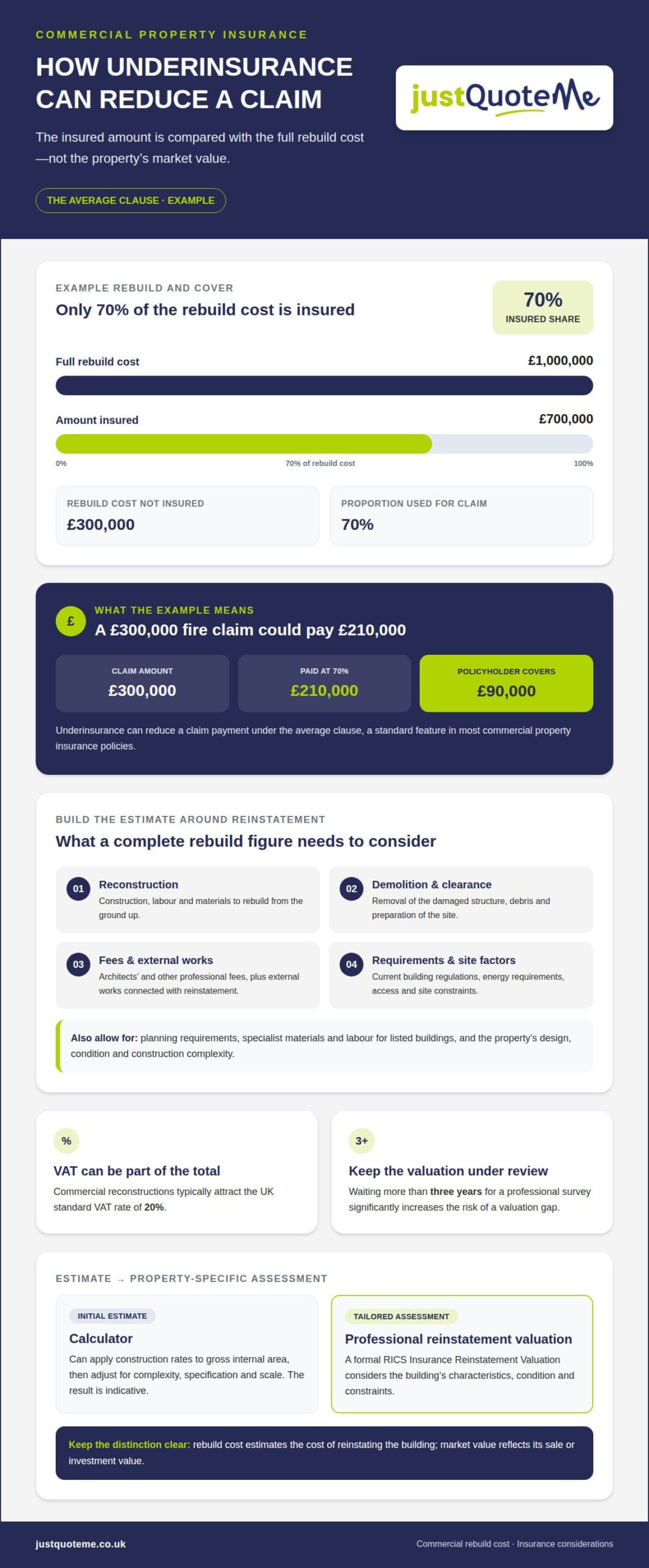
Underinsurance can reduce a claim payment under the average clause, a standard feature in most commercial property insurance policies. For example, a building with a £1,000,000 rebuild cost insured for £700,000 is covered for 70% of its rebuild cost. A £300,000 fire claim could then be paid at 70%, leaving the policyholder to cover £90,000. Overinsurance means insuring above the estimated rebuild cost, which can mean paying for more cover than the reinstatement figure requires.
Building regulations and energy-efficiency requirements
Building standards, energy performance and heritage constraints can change the work involved in reinstatement. These factors also affect how a valuer assesses construction complexity across commercial buildings.
Energy-efficiency expectations can influence the specifications considered for new commercial builds. Rebuilding an older property may therefore involve energy-efficiency requirements that differ from simply replacing its damaged structure. The materials and specification needed to meet current expectations can affect the estimate. The assessment should reflect the work required for the particular building, rather than assume an identical replacement.
Owners of Grade I and Grade II listed buildings need to allow for like-for-like replacement using specialist heritage materials and labour. For example, reinstating a listed façade may require matching its original materials and detailing. These constraints can make the work more complex than rebuilding a modern commercial unit. A valuation should reflect the property’s heritage status and the specialist construction methods required for reinstatement.
Rebuild rates per square metre vary by property type because buildings differ in size, layout, construction and specification. A straightforward industrial unit and a complex commercial building won’t necessarily have the same rate. Assessments apply building cost rates to gross internal area, then adjust for complexity, specification and scale. A larger floor area does not automatically mean a proportionally higher total, as size adjustments may account for economies of scale.
Valuers consider features that affect the work, including the building’s construction type, configuration and condition. Access restrictions and specialist plant machinery can also affect the base construction rate, particularly if they make reinstatement more difficult. For a listed building, heritage materials and specialist labour are relevant; for a modern commercial building, its design and energy-performance requirements shape the assessment.
These factors help define the reinstatement figure used for insurance, rather than the building’s market value. A considered commercial property insurance arrangement should reflect the specific building and its rebuild requirements.
Demolition and site-clearance costs
Demolition and site clearance are part of reinstating a commercial building after a total loss. The estimate needs to include removing the damaged structure and clearing debris before reconstruction begins. Treating these as separate from construction can leave the insured rebuild figure short of the full cost of the work. The property’s market value doesn’t show what demolition, clearance and rebuilding the site would involve.
Site conditions affect the work. Restricted access can limit how demolition equipment and materials reach the building, while specialist plant machinery may be needed for particular structures. Restricted access or specialist plant machinery can increase a commercial property’s base construction rate by 10% or more. Location matters through these practical constraints: a site that is difficult to reach or work on can require a different allowance from one with straightforward access.
Clearance also includes the work needed to prepare the site for rebuilding. An assessment should consider debris removal and any external works connected with reinstatement, not just the building’s internal structure. For example, if the insured property includes external areas affected by the loss, the estimate should reflect their reinstatement too. The scope depends on the site and the damage being assessed.
Labour is involved in both demolition and clearance and the subsequent construction. The estimate should reflect the work involved in taking down the damaged building, removing materials and preparing the site. These tasks contribute to the total even though they don’t add floor area to the finished property. Listing them separately in the assessment helps show how the rebuild figure covers the complete reinstatement process.
In the UK, access restrictions and site conditions influence commercial rebuild estimates because they can change the construction rate and the work required. A professional assessment considers these constraints alongside demolition, debris removal and external works. This ties the insured figure more closely to the actual site, rather than treating every commercial property as an uncomplicated, accessible plot.
What a commercial property rebuild cost includes
A useful rebuild figure captures all the work needed to reinstate the property, not just the new building’s walls and roof. It combines construction, labour, materials and associated work in one insurance assessment. Treat every component as part of the total: omitting a stage can leave the figure below the cost of completing the rebuild.
Start with the building itself. The assessment reflects the materials and labour required to reconstruct its structure and internal areas. A commercial kitchen, for example, has a different specification from an open-plan office. Size, layout and construction type help determine the work involved. Residential rebuild figures aren’t a reliable substitute, as commercial buildings may have different layouts and uses.
Then include the work needed to make construction possible. Demolition and debris removal clear the damaged structure; architects’ and planning costs support the design and approvals process. The estimate should also account for current building regulations, VAT and any external works. These items form part of the reinstatement total, even though they don’t appear in the finished building’s floor area.
Site conditions can change the scope. Restricted access, specialist plant machinery and external works may affect the work required and the construction rate. A property with difficult access, for instance, may need a different allowance from a similar building on an open site. Professional fees should also be included in the figure, rather than treated as an optional extra after the main construction estimate.
A calculator may present one headline figure, but its usefulness depends on the components behind that average estimate. The practical takeaway is to assess the building, clearance, fees, compliance and associated works together. This gives a clearer basis for the insured amount than relying on market value or a residential comparison. To explore cover for your premises, get help with commercial property insurance.
Just Quote Me: Commercial Property Insurance
Once you’ve worked out your property’s rebuild figure, Just Quote Me can help you consider Commercial Property Insurance. This is a useful next step when arranging cover or reviewing an existing insurance declaration, particularly if the building’s specification, condition or site constraints have changed.
The assessment gives you a clearer basis for discussing the property’s insurance needs. Just Quote Me also offers Public Liability Insurance, Employers Liability Insurance and Professional Indemnity Insurance for businesses considering these alongside property cover. Each addresses a different exposure, so the right combination depends on your business and its activities.
Request a Call back for free Expert advice.
Make your next insurance decision with confidence
Use the rebuild figure as a practical reference for property decisions, not a number to file away. When ownership, occupancy or planned works change, revisit the assumptions behind the insurance declaration. Keeping a clear record of how the figure was reached can make future discussions more focused and help everyone involved understand what the cover is intended to protect.
A considered approach to calculating the rebuild cost of a commercial property gives you a clearer starting point for discussing cover. Just Quote Me can help you consider insurance options for your business and premises, so you can move forward with greater clarity.
Get Your Free Business Insurance Quote now, and take the next step at your pace.
Frequently Asked Questions
What’s often missed?
Fixed features connected with how a business operates can be overlooked. A commercial kitchen, rooftop plant, mezzanine or specialist internal fit-out may not be apparent in a basic floor-area estimate. For example, a warehouse valuation based only on its shell could miss substantial internal installations. Record these features separately in the building information so the assessment reflects the actual premises and reinstatement scope.
How is the rebuild cost of a commercial property calculated in the UK?
A UK estimate generally starts with the building’s measured gross internal area and applies a construction rate suited to its type and specification. The figure is then adjusted for complexity, scale and site constraints. A calculator can provide an initial indication, while a formal insurance valuation can consider property-specific details. Use consistent area measurements and a clear building description so the inputs accurately represent the premises being insured.
What information is needed to estimate a commercial property’s rebuild cost?
Useful information includes measured floor area, building plans, use, construction type, condition and specification. Include details about restricted access, listed status, external areas, outbuildings and substantial tenant alterations. For example, plans showing a mezzanine or specialised fit-out can distinguish the premises from a basic unit of similar size. Clear records make it easier to identify the building features that affect its reinstatement scope.
Where can I find current UK commercial construction cost data and price indices?
Published UK construction cost ranges and indices provide useful context for changing costs. The Turner Building Cost Index reached 1530 in the first quarter of 2026, up 4.87% from the previous year. The Producer Price Index for construction materials reached 354.99 in March 2026. These measures track broader movements; they don’t replace a property-specific assessment of construction type, condition and site constraints.
How should demolition, site clearance and professional fees be included in rebuild cost?
List demolition, debris removal, site preparation and professional fees as identifiable parts of the reinstatement estimate. This makes the scope easier to understand and helps reveal whether a cost has been omitted or counted twice. For example, clearance and waste removal can be listed as separate tasks, while architects’ and planning costs relate to preparing and progressing the rebuild. Link each item to the work required at that property.
Should a commercial property rebuild valuation include external works, outbuildings and tenant improvements?
Yes, assess them if they form part of the property’s reinstatement scope. An external store, access area or fixed tenant improvement may need a separate description so it isn’t missed within the main building figure. Identify who owns or maintains each improvement and how it relates to the premises. This can help prevent the assessment from overlooking relevant features or duplicating items recorded elsewhere.
