

Could your insurance reflect the work your business actually does, not just the vehicles it owns? A haulage and logistics insurance policy may involve separate cover for vehicles, goods in transit and liability. If your routes, cargo or day-to-day activities don’t match what’s declared, the policy wording may not respond as you expect.
It’s understandable to find policies difficult to compare. Limits, exclusions, excesses and conditions can vary, and similar-sounding covers may protect against different risks. The key is to consider how each part of the insurance fits your operations.
This guide explains the main cover categories relevant to haulage and logistics businesses, including vehicle, cargo and liability insurance. You’ll learn what to check in policy wording against your vehicles, routes, loads and business activities, and what information to prepare before requesting a tailored quote. That gives you a clearer starting point for discussing your needs with an independent insurance broker.
Key Takeaways
- A haulage and logistics insurance policy should reflect the work you do, not just the vehicles you own.
- Vehicle, goods-in-transit and liability covers address different exposures; policy limits, exclusions and conditions depend on the wording.
- Compare policies against your activities, vehicles, cargo and routes, as similar policy names don’t guarantee identical protection.
- Prepare accurate details about drivers, staff, occasional work and subcontracting before requesting a tailored quote.
- An independent broker can help organise your business information and approach insurers with relevant details.
What does a haulage and logistics insurance policy mean for your business?
A haulage and logistics insurance policy is a tailored arrangement of relevant business covers, not one universal policy that automatically protects every part of a transport operation. Vehicle cover concerns the insured vehicle; goods-in-transit cover relates to cargo being carried; and liability covers may address claims involving other people, their property or employees. These are distinct areas, and one doesn’t automatically include the others.
Owning a van or lorry tells only part of the story. The goods you carry, where and how you operate, who employs or engages the drivers, and the responsibilities you accept under customer contracts can all affect the cover to consider. The exact protection depends on the policy wording, declared activities, limits, exclusions and conditions.
Which haulage and logistics businesses should review their cover?
Owner-operators, courier firms, fleet operators and businesses transporting goods for others can all have different insurance needs. A company delivering its own products may face different cargo and contractual exposures from a haulier carrying customers’ goods for payment. The vehicles may be similar, but the work is not.
Be clear about the full operation, including occasional jobs, new routes, changes in cargo and subcontracting arrangements. If another business carries loads on your behalf, or you take on subcontracted work, describe that arrangement accurately when discussing cover.
Why one policy label does not explain the protection
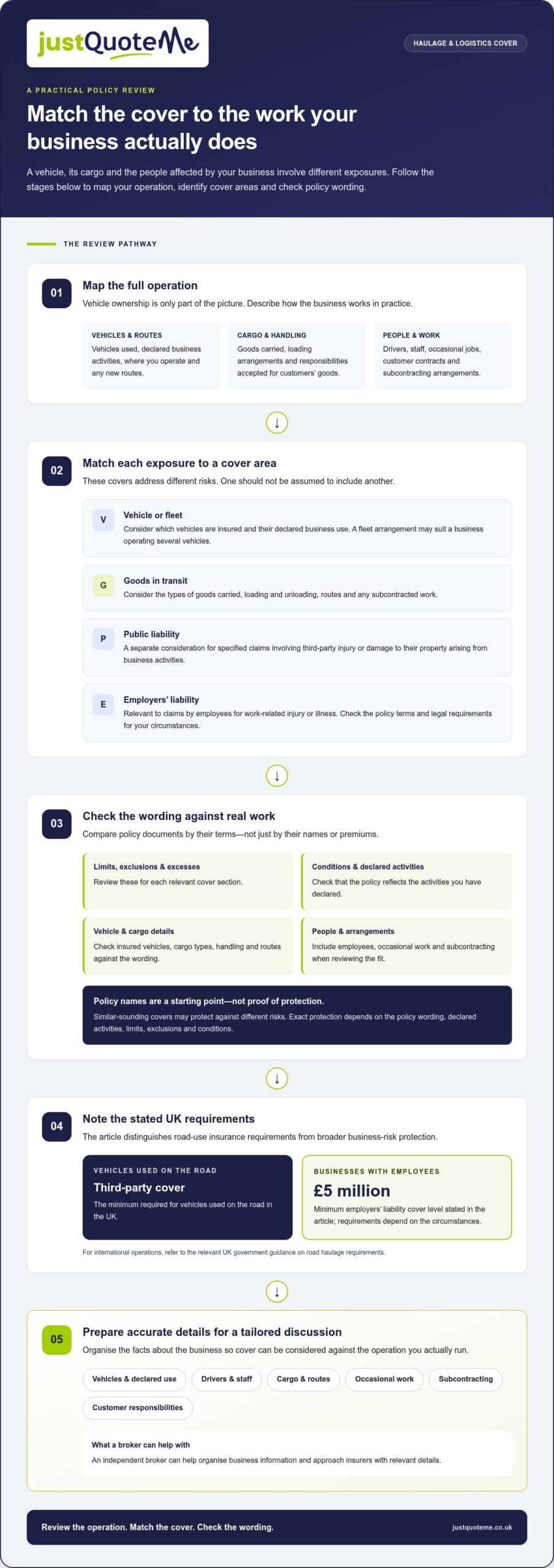
A policy name is a starting point, not proof that every operational risk is covered. A motor section concerns the vehicle and its insured use. Goods-in-transit cover relates to the load, while liability cover addresses specified claims connected with business activities. These protections may sit in separate sections or arrangements, each with its own terms.
For a quick sense of the vehicle-cover basics, read this overview of vehicle insurance. Then consider your operation through three practical lenses:
- Vehicle: Which vehicles are used, and for what declared business activities?
- Cargo: What goods do you carry, and what responsibilities do you accept for them?
- People: Who works for or with the business, and what third-party or employee exposures may arise?
These categories help you identify what to compare in the wording rather than relying on a broad label. If your operation uses several vehicles, motor fleet insurance is one relevant area to explore as you assess how vehicle cover fits your business.
What cover areas can a haulage and logistics insurance policy involve?
A haulage and logistics insurance policy can bring together several distinct areas of cover. Vehicle insurance concerns the insured vehicles and their declared business use; goods-in-transit cover relates to cargo being carried; and liability covers address specified claims involving other people, property or employees. These protections aren’t interchangeable, and one shouldn’t be assumed to include another.
Road-use insurance requirements are separate from broader business-risk protection. In the UK, third-party cover is the minimum required for vehicles used on the road. Businesses with employees generally need employers’ liability insurance, with a minimum cover level of £5 million. For international operations, refer to the relevant UK government guidance on road haulage requirements.
How do vehicle, fleet, and goods-in-transit cover differ?
Vehicle cover should reflect which vehicles are insured and how they’re used for work. A fleet arrangement may suit a business operating several vehicles, while goods-in-transit cover is a separate consideration for the load itself. Review wording for the cargo types, loading arrangements, routes and any subcontracted work involved in your operations.
| Cover area | What to consider |
|---|---|
| Vehicle or fleet | Vehicles insured, declared business use, limits, excesses and applicable conditions. |
| Goods in transit | Types of goods carried, loading and unloading, routes, and subcontracting arrangements. |
| Public liability | Specified claims for injury to third parties or damage to their property arising from business activities. |
| Employers’ liability | Cover relevant to claims by employees for work-related injury or illness; check the policy terms and legal requirements for your circumstances. |
When should liability covers enter the discussion?
Liability cover deserves attention alongside vehicle and cargo protection. Public liability is a separate consideration if business activities could lead to a third-party injury or property damage claim. Employers’ liability is relevant if you employ staff, including drivers or warehouse personnel. The covers have different purposes, so assess each against your workforce and daily operations rather than treating liability as one broad category.
Availability, limits, exclusions and conditions depend on the specific policy wording. Compare the terms against the work you actually do, not just the cover labels. If your operation uses multiple vehicles, explore commercial fleet insurance as part of reviewing how vehicle cover may fit your business.
How can you compare haulage and logistics insurance policies fairly?
A fair comparison looks beyond the premium and policy name. Two documents may use similar labels but set different limits, exclusions, conditions and requirements. Declared operations and policy wording determine how cover responds. A lower price alone can’t show whether the cover fits your vehicles, cargo, contracts and day-to-day work.
Compare the details side by side, using your current proposal information and business contracts as a reference. The Road Haulage Association (RHA) insurance-services site is one example of the specialist categories hauliers may encounter, including goods in transit and liability. The policy documents themselves remain the basis for understanding the terms being offered.
Which policy details should you compare side by side?
Use a checklist or table to make differences visible. Check limits and any sub-limits against the responsibilities and potential exposures set out in your customer contracts. Then read the conditions that could affect a claim, not just the headline benefits.
| Detail | What to check |
|---|---|
| Insured activities | Do the declared services reflect your actual haulage, courier or delivery work? |
| Vehicles and drivers | Are the vehicles, their business use and driver details accurately represented? |
| Cargo and routes | Do the goods carried and intended journeys match the proposal and wording? |
| Limits and sub-limits | Are the amounts relevant to the loads and contractual responsibilities involved? |
| Excesses and exclusions | What costs may remain with your business, and which situations or goods are excluded? |
| Conditions and claims | Review warranties, security requirements and claim-notification procedures. |
Small details matter. For example, a proposal describing routine local deliveries may not reflect a new cross-border route or a change in the types of goods carried. Keep the information consistent with your current operations, and update it when those operations change.
How can you spot gaps before a claim?
Walk through a typical job from collection to delivery. Consider loading and unloading, overnight parking, subcontractors, and changes in cargo or routes. Check the wording for how it treats these activities, rather than assuming they’re included. If work crosses borders, compare the policy’s territorial limits with the journeys you intend to make.
For a focused explanation of third-party injury and property damage considerations, read the guide to Public Liability Insurance. Reviewing each exposure this way helps you identify questions and differences before choosing between quotations.
What information should you prepare before requesting haulage insurance?
A clear, accurate picture of your operation helps a broker assess relevant options from its insurer network. For a haulage and logistics insurance policy, the details should describe the work you do now, not just the business as it looked when you last arranged cover. Include occasional jobs, subcontracting and recent operational changes so the information is consistent from the outset.
What operational details help describe your haulage business?
Gather the information in a simple sequence. If you don’t have every detail to hand, note what needs checking rather than guessing.
- Business activities: Describe your services, including deliveries of your own goods and carrying goods for customers.
- Vehicles: List vehicle types, how many you operate, whether they’re owned or leased, and their business use.
- Drivers: Record relevant driver details and explain who drives each vehicle or vehicle type.
- Cargo and delivery patterns: Note the types of goods carried, typical loading arrangements and how often or where deliveries take place.
- Routes and territories: Describe regular journeys and any cross-border work, including routes you undertake only occasionally.
- People and contracts: Include employee numbers, subcontractor arrangements and relevant customer or contractual insurance requirements.
Accuracy matters. For example, disclose a change from delivering your own stock to carrying customers’ goods, or a new subcontracting arrangement. These details help frame the enquiry around your real activities rather than assumptions based on the business name or vehicle type.
How should you review a quote and policy documents?
Once you receive proposed terms, compare the cover schedule with the information you provided. Check that the listed activities, vehicles, drivers, goods and routes reflect the operation you described. If anything is missing or inaccurate, raise it before accepting cover so the documents can be considered against the correct details.
Read the limits, exclusions, excesses and conditions carefully. Pay particular attention to requirements that affect how you operate, along with the instructions and timeframes for reporting a claim. Employee-related cover deserves a separate review. For more detail, see the guide to Employers’ Liability Insurance.
With more than 30 years of industry experience, Just Quote Me can help organise the information for a tailored business insurance enquiry and approach insurers with relevant details. Get Your Free Business Insurance Quote now.
How can a broker help arrange tailored haulage and logistics insurance?
Haulage businesses can have very different insurance needs, even when they operate similar vehicles. An independent broker helps turn your business activities and risk details into a clear enquiry for insurers, then helps you understand the options and their terms. Just Quote Me is an independent, FCA-authorised UK insurance broker with access to a broad network of UK insurers and more than 30 years of industry experience.
The broker’s role is to make the process easier to follow, not to promise a particular premium, acceptance or level of cover. Accurate information gives insurers a clearer picture of your operation and helps the discussion focus on relevant options for your business.
What happens during a tailored insurance enquiry?
The enquiry starts with how your business works: the activities you undertake, vehicles and drivers, cargo, routes, employees and subcontracting arrangements. Those details help inform which insurer options may be relevant. A broker can then help you review the proposed wording, limits, exclusions and conditions, and explain how they relate to the risks you’ve described. The final terms depend on the insurer and policy documents.
Be open about occasional jobs and recent changes, too. If you’ve added a new delivery route or begun carrying a different type of cargo, include that information rather than relying on an old description of the business.
What is the next step for your haulage business?
Before starting an enquiry, gather a concise summary of your business activities, vehicles, drivers, goods, routes and workforce. Include cross-border journeys, subcontracting arrangements and any relevant contractual requirements. This gives the broker a practical basis for discussing your needs and approaching insurers with consistent information.
As an insurance broker, Just Quote Me can help you consider a tailored haulage and logistics insurance policy by matching the details of your operation with relevant insurer options. Review any proposed documents carefully, including the cover schedule and the terms that apply, before deciding whether they meet your needs.
Get Your Free Business Insurance Quote now
If you’d prefer to discuss your requirements with the team, request a callback for guidance.
Request a Call back for free Expert advice
Build cover around the work you do
A suitable haulage and logistics insurance policy should reflect your real operations, from vehicles and cargo to routes, staff and contractual responsibilities. Compare the wording, limits, exclusions and conditions, and keep the information you provide accurate as your business changes.
Preparing those details gives a broker a clearer basis for discussing relevant options. Just Quote Me is an independent, FCA-authorised UK insurance broker with more than 30 years of industry experience and access to a broad network of UK insurers.
Take the next step with a clear picture of your business. Get Your Free Business Insurance Quote now, or explore tailored business insurance with Just Quote Me. With accurate information and careful policy review, you can move forward with greater confidence.
Frequently Asked Questions
Is haulage insurance a single policy?
No, haulage insurance isn’t necessarily one standard policy. It can involve separate cover areas for vehicles, goods in transit and liabilities, arranged to reflect the business’s operations. A policy label alone doesn’t establish what’s protected. Check the schedule and wording for insured activities, limits, exclusions and conditions, and make sure the details match the work you actually do, including cargo, routes and subcontracting.
Is haulage insurance legally required in the UK?
Insurance for road use and wider business cover are separate considerations. Vehicles used on UK roads must have at least third-party motor insurance. Employers’ liability insurance is generally legally required for businesses with employees, with a minimum cover of £5 million. Requirements can depend on the circumstances, so check current official guidance for your situation. Goods-in-transit and public liability cover address different risks and shouldn’t be assumed to be included in motor insurance.
Does haulage insurance include goods in transit?
Not automatically. Goods-in-transit cover is a distinct consideration from insurance for the vehicle carrying the load. Review the wording for the types of goods, loading arrangements, routes and any subcontracting involved. Also compare limits, exclusions and conditions with your contracts and responsibilities for customer cargo. A haulage and logistics insurance policy should be assessed by its documents, not just its name.
What is the difference between haulage insurance and fleet insurance?
Haulage insurance describes cover considerations related to transport work, which may include vehicles, cargo and liabilities. Fleet insurance is an arrangement for insuring multiple vehicles under a fleet policy. It focuses on the vehicles and doesn’t automatically provide goods-in-transit or liability protection. Review each section of the wording to see which vehicles and uses are insured and what separate business covers may be relevant.
Can a courier or small operator get haulage insurance?
Couriers and small operators can discuss their business activities and insurance needs with a broker. The relevant options depend on factors such as vehicle use, whether you carry your own goods or customers’ goods, delivery routes, cargo and any subcontracting. Describe occasional work as well as regular jobs. An independent broker can use those details to approach insurers, but cover terms and acceptance depend on the insurer.
What details do I need to get a haulage insurance quote?
Prepare a clear outline of your business activities, vehicles and their use, driver details, types of goods carried, delivery patterns and routes. Include cross-border journeys, staff, subcontracting arrangements and any relevant customer contract requirements. Be accurate about occasional work and recent changes, too. Consistent information helps a broker present your operation to insurers and assess options against the work you actually do.
How much does haulage and logistics insurance cost?
There isn’t one standard price for haulage and logistics insurance. The premium depends on the business and the cover being considered, including its activities, vehicles, cargo, routes, selected limits and claims history. To make a useful comparison, look beyond the premium and review excesses, exclusions and conditions alongside the cover schedule. Provide accurate operational details when requesting a tailored quote, as incomplete information may affect the assessment.
