

Treating your policy excess as nothing more than an unavoidable out-of-pocket penalty is one of the costliest assumptions a business owner can make. If you are wondering what is an insurance excess on a commercial policy, you are likely trying to shield your business from sudden cash flow shocks when disaster strikes. It’s completely understandable to feel cautious; commercial terms operate quite differently from domestic home policies, and setting the wrong threshold can leave your day-to-day liquidity vulnerable after an incident.
You don’t have to leave those figures to chance. In this guide, you’ll discover how a commercial excess functions as an active risk-management lever rather than an arbitrary deduction. We’ll clarify the essential differences between compulsory and voluntary excess, explain exactly how and when settlement amounts are adjusted during a claim, and show you how adjusting these figures directly influences your annual premiums. Here is your roadmap to selecting excess levels that match your risk appetite while keeping your bottom line secure.
Key Takeaways
- Clarify exactly what is an insurance excess on a commercial policy and how underwriters use it to balance shared operational risk.
- Distinguish between non-negotiable compulsory baselines and voluntary excess to lower annual premiums without creating cash flow vulnerabilities.
- Unpack how excess structures differ across commercial property, liability, and fleet covers, including where statutory rules waive excess entirely.
- Understand the precise mechanics of how insurers deduct policy excess during the claims process rather than issuing surprise invoices.
- Discover practical risk mitigation options and standalone protection products designed to shield your business from substantial out-of-pocket costs.
Understanding Commercial Policy Excess: What It Is and Why Insurers Use It
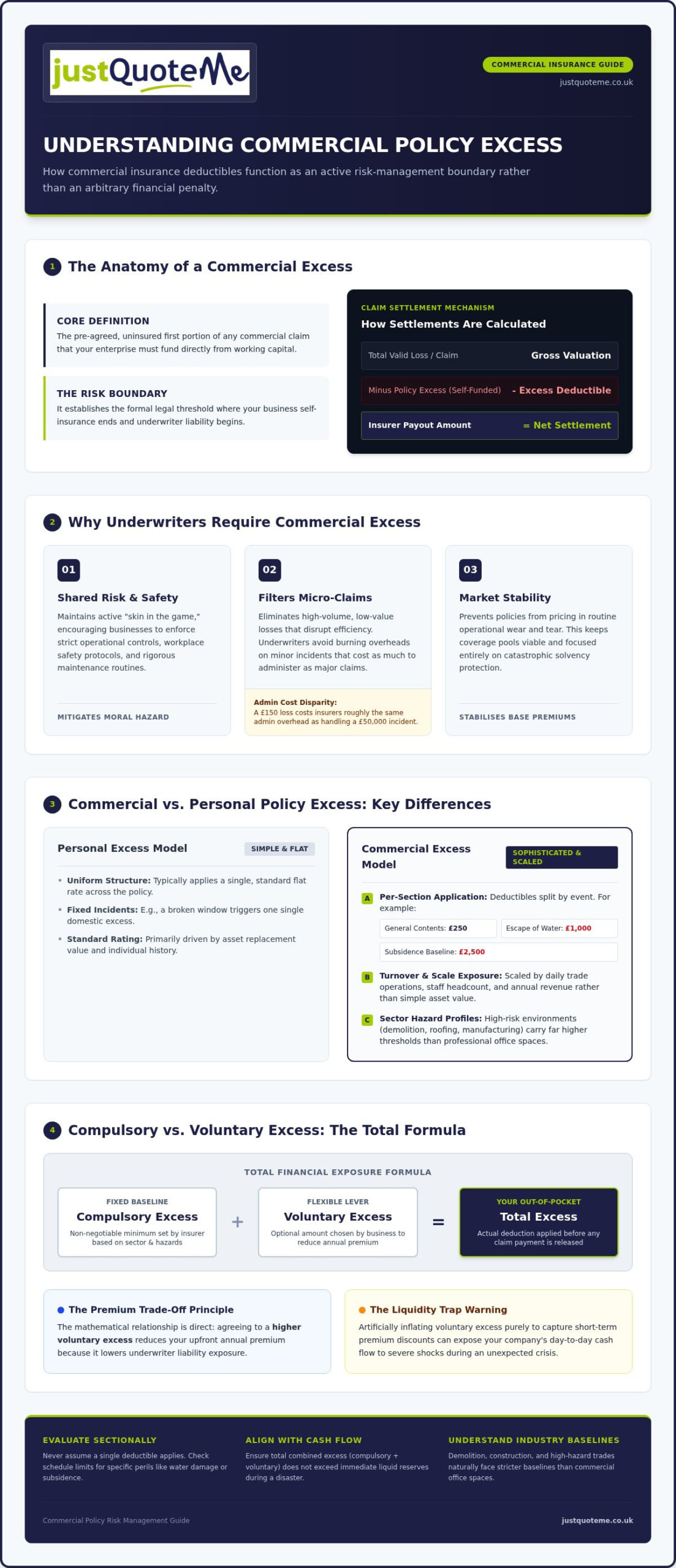
Every commercial insurance policy is an exercise in managed risk. At its core, commercial policy excess is the pre-agreed, uninsured first portion of any claim that your business must cover from its own funds. Underwriters do not view this figure as a punitive hurdle. Instead, it forms an essential financial boundary that defines where your self-insurance ends and the insurer’s liability begins.
To understand what is an insurance excess on a commercial policy, you must look at how risk is shared. Underwriters use excesses to ensure businesses maintain active skin in the game. When a business shoulders a financial stake in minor incidents, it naturally adheres to stronger workplace safety, rigorous maintenance, and tight operational controls. Excesses also filter out high volumes of low-value administrative micro-claims. Processing a £150 loss costs an insurer roughly the same administrative overhead as handling a £50,000 incident. By removing minor losses from the claims pipeline, underwriters keep administrative overheads sustainable, which directly stabilizes commercial premiums across the entire market.
The Core Purpose of an Excess in Business Insurance
An excess serves as a mutual financial agreement between you and your insurer. Without this threshold, underwriters would need to price policies to absorb routine business wear and tear, causing annual premiums to skyrocket. Setting a sensible baseline keeps annual coverage viable. It prevents small operational mishaps from disrupting the underwriting pool, ensuring funds remain focused on shielding your enterprise against catastrophic losses that could otherwise threaten your solvency.
Commercial vs. Personal Policy Excess: Key Differences
Personal insurance policies usually feature simple, uniform excess structures. If you break a window at home, you pay a single, fixed domestic excess. Commercial coverage works under far more sophisticated rules. A comprehensive policy, such as commercial property insurance, often splits deductibles across specific operational sections rather than applying one flat rate:
- Per-section application: Your schedule might apply a £250 excess for general contents damage, but require a £1,000 or £2,500 baseline for escape of water or subsidence.
- Turnover and scale exposure: Underwriters scale commercial thresholds based on annual turnover, staff numbers, and daily trade activities rather than simple asset replacement values.
- Sector volatility: Higher-risk environments, such as construction sites or industrial manufacturing plants, carry substantially higher baseline excesses than professional office environments.
Knowing what is an insurance excess on a commercial policy allows you to evaluate your policy schedule with precision. Rather than accepting generic figures, you can assess how each specific threshold impacts your operational cash flow.
Compulsory vs. Voluntary Excess: How They Affect Your Premium
Balancing insurance costs requires understanding how two distinct figures combine on your policy schedule. When asking what is an insurance excess on a commercial policy, you will encounter both compulsory and voluntary figures. Together, they represent your total financial exposure whenever an insured loss occurs.
The relationship between excess and premium is straightforward: the higher the total excess you agree to shoulder, the lower your upfront annual premium. Underwriters reward businesses willing to take on greater self-insurance because it reduces potential claim payouts. However, adjusting voluntary excess simply to chase short-term savings can expose your working capital to sudden liquidity traps if an incident happens unexpectedly.
Compulsory Excess: Why Insurers Set Non-Negotiable Baselines
Compulsory excess is the mandatory minimum set by underwriters during policy drafting. It cannot be negotiated away. Insurers determine this baseline by evaluating sector-specific risks, trade hazards, premises location, and claims track records. High-hazard activities, such as demolition or roofing, face elevated compulsory thresholds compared to standard retail trades. Similarly, commercial premises located in known flood zones or areas prone to subsidence carry high compulsory baselines to offset environmental exposures.
Voluntary Excess: Calculating the True Cost-Benefit for Your Cash Flow
Voluntary excess is an optional sum you choose to pay on top of the compulsory figure. According to UK broker market benchmarks, increasing your voluntary excess from £500 to £1,000 typically reduces the base premium by approximately 10% to 15%. Even so, you must weigh those annual savings against liquid cash flow:
- Liquid reserve requirement: Never commit to a voluntary excess that your trading accounts cannot liquidate within 24 hours.
- Break-even horizon: If increasing your excess by £1,000 saves you only £80 annually, your business needs over twelve claim-free years to break even on that choice.
Each and Every Claim vs. Aggregate Excess Terms
Most commercial wordings apply deductibles on an “each and every claim” basis. This means if your business suffers three distinct property incidents in a single policy year, you must pay your combined excess three separate times. For growing enterprises, this creates substantial cumulative exposure.
To prevent this compounding burden, policies can sometimes incorporate aggregate excess clauses or stop-loss limits. An aggregate excess caps your cumulative out-of-pocket payments at an agreed annual threshold. Once your combined claim payments reach that ceiling during a 12-month policy term, the insurer covers subsequent qualifying losses in full. If you need help reviewing these complex loss terms, working with an experienced broker like Just Quote Me ensures your thresholds remain aligned with your operational finances.
Understanding what is an insurance excess on a commercial policy across both single-event and aggregate structures ensures you avoid dangerous blind spots during high-frequency claim years.
How Excess Operates Across Different Commercial Policy Types
Excess structures are not uniform across your commercial coverage portfolio. Under UK law, employers’ liability insurance legally carries a £0 excess for employee bodily injury claims under the Employers’ Liability (Compulsory Insurance) Regulations 1998. The law prevents underwriters from applying deductibles to statutory worker compensation. Beyond statutory covers, however, deductibles fluctuate significantly based on the risks insured. Understanding what is an insurance excess on a commercial policy requires looking at how liability, property, and vehicle policies handle claims differently.
Public Liability and Property Damage Excesses
Standard public liability policies treat bodily injury and property damage separately. If a visitor suffers personal injury on your premises, no deductible applies (£0 excess). In contrast, Third-Party Property Damage (TPPD) claims standardly carry an excess between £100 and £500. Higher-risk activities, such as hot works using blowtorches or working at heights, often trigger specialist endorsements with elevated compulsory amounts. Securing robust public liability insurance ensures these operational exclusions and property excess terms are clearly defined upfront.
Commercial Property and Contractors All Risks
Commercial property schedules allocate specific excesses to distinct perils. A standard burst pipe or small theft might carry a baseline excess of £250, while severe flood or subsidence claims can trigger compulsory baselines of £1,000 to £2,500 or more. On active developments, construction equipment and partially built structures face distinct hazards. Arranging tailored builders insurance alongside contractors all risk insurance protects plant, machinery, and contract works against high out-of-pocket losses on active jobsites.
Commercial Fleet and Motor Trade Excess Dynamics
Fleet and commercial motor policies feature sliding excess scales based on vehicle specifications and driver risk profiles. Drivers under 25 or those with recent driving convictions often face substantial compulsory additions. If a third party hits your company vehicle and admits full liability, your insurer can typically recover your paid excess directly from the at-fault driver’s insurer. Consolidating company vehicles under structured motor fleet insurance gives you uniform terms across your business transport rather than managing disparate vehicle policies.
When and How Do You Pay the Commercial Excess During a Claim?
A common source of confusion during a loss is the physical transaction of the excess itself. Rather than receiving a separate bill the moment you file first notice of loss, the process depends entirely on whether your claim involves first-party property, direct repairs, or third-party liabilities. Clarifying what is an insurance excess on a commercial policy in practical terms means looking at how cash actually moves between your enterprise, your insurer, and third-party suppliers.
Deduction from Settlement vs. Direct Payment to Contractors
For first-party property losses, insurers rarely demand payment upfront. Instead, they apply a deduction mechanism:
- Net cash settlements: If storm damage destroys £12,000 of inventory and your policy carries a £1,000 excess, your insurer issues a cash settlement of £11,000. You absorb the remaining £1,000 internally.
- Direct repairer payments: When an insurer dispatches an approved contractor or bodyshop to carry out physical repairs, you pay your excess directly to that contractor upon completion of the work. The insurer settles the remaining balance with the contractor.
- VAT obligations for VAT-registered firms: Under HMRC rules, insurance settlements are VAT-exempt. If your firm is VAT-registered, the insurer pays the repair costs net of VAT and net of your excess; you pay the excess and VAT directly to the contractor, reclaiming the input VAT on your next quarterly return.
- Third-party claims recovery: If a third party claims against your liability cover, your insurer handles the legal defence and compensation payouts directly, then invoices your business to reimburse the policy excess afterwards.
Non-Fault Incidents and Excess Recovery Mechanics
When an incident is entirely the fault of an identifiable third party, you must still pay or absorb your policy excess initially to get repairs underway. Once liability is legally established, your insurer exercises its right of subrogation, demanding full reimbursement of all claim costs, including your excess, from the negligent party’s insurer. While recovery timelines can take anywhere from a few months to over a year depending on liability disputes, commercial legal expenses cover can assist in recovering uninsured losses when negotiations stall.
What Happens When a Commercial Claim Is Below the Excess?
If a burst pipe causes £400 of damage and your property excess sits at £500, your insurer pays nothing. Even though the financial cost falls entirely on your business, your policy terms still require prompt notification. Informing your broker preserves your cover integrity and protects you should hidden damage surface later. For immediate assistance structuring practical deductibles that keep claim settlements seamless, get in touch with Just Quote Me to protect your business.
Mastering these procedures ensures you know exactly when cash leaves your bank accounts, preventing friction when resolving what is an insurance excess on a commercial policy during critical operational emergencies.
How to Manage, Reduce, and Protect Against High Commercial Excesses
Managing operational risk involves more than simply accepting whatever terms an underwriter provides. Knowing what is an insurance excess on a commercial policy gives you the insight needed to actively control your out-of-pocket exposure. By combining targeted protection products, workplace risk management, and independent broking advice, you can protect your working capital from sudden claim deductions.
Evaluating Commercial Excess Protection Insurance
Commercial excess protection is an optional, standalone policy that reimburses the excess you pay following a settled claim on your primary cover. These policies standardly provide annual aggregate reimbursement tiers ranging from £250 up to £2,500, subject to standard 12% Insurance Premium Tax (IPT). While this provides valuable peace of mind, examine the fine print closely. These policies standardly exclude incidents caused by unapproved vehicle drivers, undeclared business activities, or claims where the primary underwriter denies liability.
Proactive Risk Management to Negotiate Better Terms
Insurers price compulsory deductibles based on perceived operational risk. Demonstrating proactive loss prevention gives you strong leverage to negotiate these baselines downward:
- Physical security and monitoring: Installing accredited intruder alarms, fire suppression systems, and CCTV protects commercial premises against forced entry and water leaks.
- Fleet telematics: Equipping commercial vehicles with dashcams and telematics tracking encourages safer driving, reduces fault disputes, and lowers fleet excess penalties.
- Documented health and safety: Maintaining verified risk assessments, staff training logs, and equipment service histories reassures underwriters and keeps compulsory liability terms manageable.
Partnering with an Independent UK Broker
Automated online comparison engines rarely explain the granular terms hidden within policy schedules. An independent, FCA-authorised broker like Just Quote Me reviews policy wordings across top UK insurance panels, bringing over 30 years of brokerage experience to evaluate your specific trading hazards. Independent brokers ensure your excess levels remain practical, preventing surprise liabilities when you make a claim.
Taking control of your commercial risk profile ensures your business remains resilient against unforeseen trading disruptions. Explore your options with our team today:
Get Your Free Business Insurance Quote now
Request a Call back for free Expert advice
Take Control of Your Commercial Risk and Policy Excess
Understanding what is an insurance excess on a commercial policy transforms a potential operational headache into a proactive financial strategy. Setting realistic voluntary thresholds keeps your annual premiums balanced without creating unmanageable cash reserve strain during high-frequency claim periods. Recognizing how specific peril schedules operate and how deductions are processed gives you complete control over your balance sheet when an unexpected incident occurs.
You don’t need to decipher intricate underwriter terms alone. With over 30 years of independent brokerage experience across the UK, Just Quote Me connects your enterprise directly to leading UK underwriting panels. As an FCA-authorised broker, our team provides transparent, jargon-free guidance to ensure your excess levels remain practical and aligned with your operational cash flow. Partner with Just Quote Me today to secure robust coverage that shields your business and keeps your bottom line resilient.
Frequently Asked Questions
What is an insurance excess on a commercial policy?
An insurance excess on a commercial policy is the agreed sum or percentage your business pays towards an insured loss before the underwriter covers the remainder. When assessing what is an insurance excess on a commercial policy, view it as a shared risk boundary. By absorbing minor losses internally, your enterprise secures lower annual premiums while ensuring underwriters remain available to protect you against catastrophic trading interruptions.
Do I have to pay an excess on an employers’ liability insurance claim?
No, UK commercial employers’ liability insurance carries a statutory £0 excess for employee bodily injury or occupational illness claims. Under the Employers’ Liability (Compulsory Insurance) Regulations 1998, underwriters cannot apply deductibles that reduce legal compensation awarded to an injured worker. If an employee successfully claims against your business for a workplace injury, your insurer covers the full settlement and legal defence costs without deducting an excess.
How does voluntary excess affect my commercial insurance premium?
Agreeing to a higher voluntary excess directly reduces your annual insurance premium. By taking on greater financial responsibility during a loss, you lower the underwriter’s potential claim payouts. Across UK commercial sectors, doubling your voluntary excess typically yields a 10% to 15% reduction on your base premium. You must ensure your enterprise maintains sufficient liquid cash reserves to cover that committed sum immediately if an incident occurs.
What is the difference between an each-and-every-claim excess and an aggregate excess?
An each-and-every-claim excess applies to every single incident you report, meaning three separate property losses require three separate excess payments. An aggregate excess establishes a cumulative financial ceiling across your twelve-month policy term. Once your combined excess payments reach that agreed cap during the policy year, your insurer pays 100% of any subsequent covered losses, shielding your working capital against high-frequency claim cycles.
Can my business recover its commercial excess if an incident was not our fault?
Yes, your business can usually recover its excess if an identifiable third party caused the damage and accepts liability. While you initially absorb or pay the excess to begin repairs, your insurer exercises subrogation rights to recoup all claim expenses from the at-fault party’s insurer. If negotiations stall, commercial legal expenses cover helps your enterprise pursue unrecovered uninsured losses without draining administrative resources.
What happens if the repair cost is lower than my commercial policy excess?
If repair costs fall below your agreed excess, your insurer will not issue any payout, and your business must fund the work entirely. You must still formally report the incident to your insurance broker. Most commercial policies include a notification condition requiring businesses to declare all material incidents, protecting your policy validity in case hidden structural issues or secondary liabilities emerge later.
Is commercial excess protection insurance worth buying for a small business?
Commercial excess protection can be highly valuable if your business operates high-risk property, plant, or fleet vehicles carrying substantial compulsory excesses. It functions as a secondary policy that reimburses the excess you pay on settled claims, subject to 12% Insurance Premium Tax. For enterprises with tight cash flow margins, paying a modest supplementary premium to cap unexpected out-of-pocket liabilities protects essential trading liquidity.
Can I negotiate the compulsory excess on my business insurance policy?
Compulsory excesses are set directly by underwriters based on trade risk, claims history, and premises location, making them difficult to modify on standard terms. However, an independent broker can negotiate on your behalf. Demonstrating proactive risk mitigation, such as verified CCTV systems, telematics, or staff safety certifications, often persuades panel underwriters to adjust baseline terms or provide more competitive policy wordings.
