

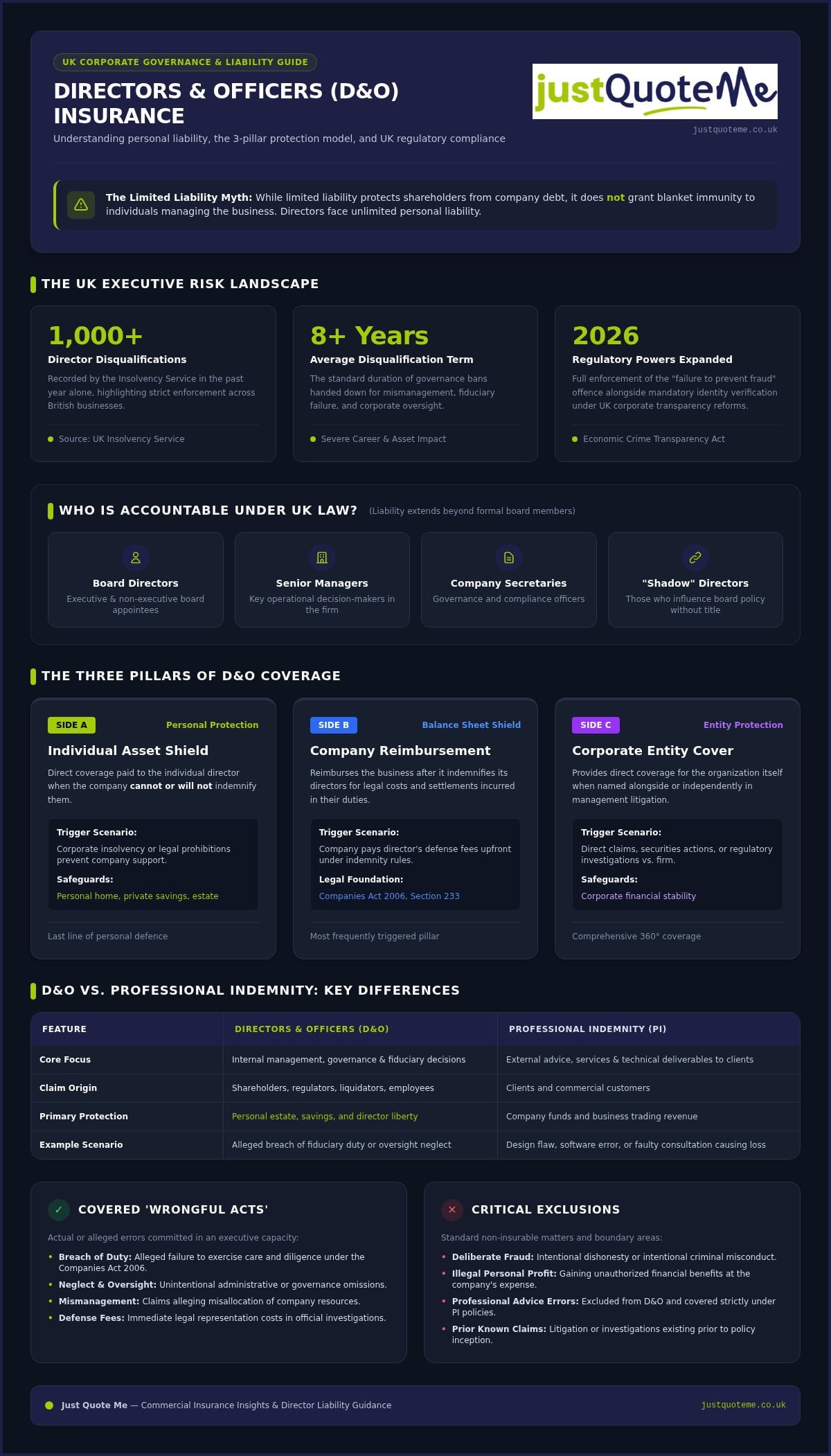
If your business faced a sudden legal claim tomorrow, would your personal savings, your home, and your family’s future stay protected from the fallout? Many board members and senior managers ask, what does directors and officers insurance cover uk when they realize that a company’s limited liability status doesn’t necessarily shield the individuals making the decisions. It’s a stressful realization, especially with over 1,000 director disqualifications recorded by the Insolvency Service in the last year and the average ban lasting more than eight years.
You’re right to feel that the stakes have never been higher. With the full implementation of mandatory identity verification and the “failure to prevent fraud” offence in 2026, UK authorities now have more power than ever to hold you personally accountable for corporate oversights. This guide provides a clear roadmap to understanding how D&O insurance protects your personal assets and business reputation. We will clarify the vital differences between this and professional indemnity cover, explain the “Three Pillars” of protection, and show you how to maintain compliance in an increasingly scrutinized market.
Key Takeaways
- Learn how D&O insurance acts as a vital safety net for your personal estate when the company is legally or financially unable to indemnify you.
- Gain clarity on what does directors and officers insurance cover uk, from legal defense fees to settlements arising from alleged wrongful acts.
- Master the structure of Side A, B, and C coverage to ensure your policy protects both you as an individual and the corporate entity.
- Identify critical exclusions such as deliberate fraud and professional negligence to avoid dangerous gaps in your professional risk management.
- Stay ahead of 2026 UK regulatory shifts, including the latest identity verification rules and the corporate criminal offence of failure to prevent fraud.
What is Directors and Officers (D&O) Insurance in the UK?
Understanding exactly what does directors and officers insurance cover uk is a priority for anyone holding a senior position in a British business. At its core, D&O insurance is a specialized liability policy designed to protect the personal assets of company directors, officers, and senior managers. It provides financial support for legal defense costs and potential settlements if you are personally sued for decisions made while running the organization. Without this cover, your home, savings, and personal estate are directly on the line.
A common misconception is that the “corporate veil” of a limited company provides total protection. While limited liability shields shareholders from the company’s debts, it doesn’t offer a blanket immunity for the individuals managing the firm. In the UK, Directors and officers liability insurance is essential because directors can be held personally and unlimitedly liable for their actions. This applies not just to board-level directors, but also to “Officers”-a term that typically includes senior managers, company secretaries, and even “shadow directors” who influence board decisions without a formal title.
D&O vs. Professional Indemnity: Clearing the Confusion
It’s easy to confuse these two products, but they serve very different purposes. Professional Indemnity Insurance covers the company against claims arising from errors in the professional advice or services you provide to clients. D&O insurance, however, covers the management and governance of the business itself. If a client sues because a project failed, that’s a PI claim. If a shareholder or regulator sues because they believe you mismanaged the company’s funds or failed in your fiduciary duties, that’s a D&O claim. In the current regulatory climate of 2026, most senior leaders find they need both to be fully protected.
The Legal Landscape for UK Directors in 2026
The Companies Act 2006 remains the foundation of director duties, requiring you to act in good faith and exercise reasonable care and diligence. However, new legislation like the Economic Crime and Corporate Transparency Act has increased the pressure. Since the “failure to prevent fraud” offence became active in late 2025, and with mandatory ID verification now standard, regulators have clearer paths to prosecute individuals for corporate oversights. Even an innocent error in judgment can trigger a claim. For insurance purposes, a “Wrongful Act” is defined as any actual or alleged breach of duty, neglect, error, or omission committed by a director or officer in their professional capacity. Knowing what does directors and officers insurance cover uk ensures you aren’t left funding a complex legal defense out of your own pocket when these allegations arise.
The Three Pillars of D&O Coverage: Side A, B, and C
To fully grasp what does directors and officers insurance cover uk, you need to look at the modular way these policies are built. Most standard wordings use a three-pillar structure known as Sides A, B, and C. These sections work together to create a 360-degree safety net, ensuring that legal defense funding is available regardless of whether the company is solvent or legally permitted to help you. Understanding these distinctions is the only way to ensure you aren’t left with a gap in your personal protection.
Side A: Protecting Your Personal Assets
Side A is the most vital component for any director concerned about personal bankruptcy. It provides direct coverage to the individual when the company cannot or will not indemnify them. This often happens during corporate insolvency, where the business has no funds left to pay for your legal representation. Side A is the ‘last line of defence’ for individuals, protecting your home and private savings from being drained by litigation. For those also looking to secure their personal legacy through estate planning, you can visit Aiker Wills and Trusts to explore protective property trusts. It’s the primary reason many senior leaders refuse to sit on a board without a robust policy in place.
Side B is the “Company Reimbursement” pillar and is the most frequently triggered part of a policy. In this scenario, the business pays for the director’s legal costs first and then claims that money back from the insurer. This keeps the company’s balance sheet stable during a crisis. Under Section 233 of the Companies Act 2006, UK firms are explicitly permitted to purchase this cover to ensure their leadership isn’t left exposed. If you’re unsure if your current policy includes these vital protections, you can speak with a specialist broker for a full review of your current wording.
Side C: Entity Securities Cover
Side C, or “Entity Securities Cover,” shifts the focus from the individuals to the company itself. It protects the organization against claims arising from the offer or sale of its securities. For many private UK SMEs, this is often extended into “Management Liability,” which covers the corporate entity against certain legal actions like shareholder disputes. While Side A protects your house, Side C protects the business’s reputation and financial health, ensuring the entity can survive the cost of a high-stakes legal challenge. Knowing what does directors and officers insurance cover uk across all three sides ensures your management team can lead with confidence.
What Counts as a ‘Wrongful Act’? Common Claim Scenarios
In the context of a legal claim, a ‘wrongful act’ doesn’t necessarily imply criminal intent or deliberate malice. Most D&O claims in the UK arise from management errors, oversights, or failures to act within the best interests of the company. When assessing what does directors and officers insurance cover uk, it’s vital to recognize that the policy triggers based on allegations of breach of duty, neglect, or misleading statements. These claims can come from various parties, including shareholders who feel their investment was mismanaged or creditors who believe they were misled about the company’s financial health.
Negligence in leadership is a frequent trigger for litigation. This might involve a failure to supervise subordinates effectively or making poor strategic decisions that lead to significant corporate loss. Additionally, insolvent trading remains a high-risk area in 2026. If you continue to run a business when there is no reasonable prospect of avoiding insolvent liquidation, you may be held personally liable for wrongful trading. In such cases, liquidators can seek to recover funds directly from your personal estate to satisfy the company’s debts. Adhering to the statutory responsibilities of company directors is your primary duty, but D&O insurance provides the financial backing to defend yourself if those actions are called into question.
Regulatory and Legal Investigations
UK regulators like HMRC and the Health and Safety Executive (HSE) have become increasingly proactive. If your business is targeted by a formal investigation or a sudden dawn raid, the legal costs associated with responding to these information requests can be staggering. While your Public Liability Insurance protects the business against physical injury claims, it won’t fund your personal legal defense during a regulatory probe into management failures. D&O cover ensures you have immediate access to expert legal counsel to navigate these complex administrative processes.
Employment Practice Violations
Senior managers often find themselves personally named in employment tribunals. Claims regarding wrongful dismissal, harassment, or discrimination are common, and claimants frequently target individuals alongside the company to increase their leverage. It’s a common mistake to assume that Employers Liability Insurance covers these personal legal costs. It doesn’t. Employers liability covers the company’s responsibility for workplace injuries, while D&O specifically protects the individual’s personal assets against management-related employment claims. Understanding what does directors and officers insurance cover uk allows you to build a comprehensive defense strategy that guards against these personal financial risks.
What Directors and Officers Insurance Does Not Cover
While it is vital to understand what does directors and officers insurance cover uk, knowing where the protection ends is just as important for your risk management strategy. No insurance policy is a “blank cheque” for all corporate troubles. Exclusions exist to prevent moral hazard and to ensure that the policy focuses on genuine management errors rather than criminal activity or risks that belong under different types of cover. For instance, D&O insurance will not pay for bodily injury or property damage. These physical risks are the domain of Public Liability Insurance or Employers Liability, rather than management liability.
You also cannot insure a “burning house.” This means that any litigation or known circumstances that existed before the policy started will be excluded. Because UK D&O policies are written on a “claims-made” basis, you must have a policy in force at the time the claim is actually made against you. Additionally, certain fines and penalties are legally uninsurable in the UK. If a court imposes a criminal fine or a penalty intended to punish the individual rather than compensate a victim, the insurer is often legally prohibited from paying it on your behalf.
The Fraud and Dishonest Acts Clause
D&O insurance is designed to protect honest directors from the consequences of their mistakes, not to facilitate criminal behaviour. Consequently, policies contain a strict exclusion for proven fraud, dishonesty, or malicious acts. However, most modern wordings include a “severability” provision. This ensures that “innocent” directors remain protected even if one of their colleagues is found to be fraudulent. It’s a vital safety net that prevents the entire board from losing cover due to the actions of one individual. Crucially, legal defence is usually funded until fraud is proven or a final adjudication is reached in court.
Pollution and Environmental Claims
Environmental damage is another common exclusion that surprises many senior leaders. While a D&O policy might cover the legal costs if shareholders sue you for a management failure that led to an environmental disaster, it typically won’t cover the actual cleanup costs or physical pollution damage. These risks require specialist environmental impairment liability insurance. The distinction lies between the physical act of pollution and the management decision that allowed it to happen. To ensure your leadership team has no dangerous gaps in protection, you should speak with an independent broker to review your specific exposures. Understanding exactly what does directors and officers insurance cover uk across these complex scenarios ensures you can lead with absolute clarity.
Securing the Right D&O Protection with Just Quote Me
Selecting a policy based solely on price is a common pitfall. When you ask what does directors and officers insurance cover uk, the answer depends heavily on the quality of the wording and the specific limits you choose. As an independent broker with 30 years of industry experience, Just Quote Me provides access to a broad network of top UK insurers. This independence is crucial. We don’t push a single product; instead, we find the bespoke fit that aligns with your specific risk profile and ensures your board is truly protected.
Determining the right ‘Limit of Indemnity’ is a strategic decision that shouldn’t be left to chance. For many UK SMEs, standard indemnity limits typically range from £1 million to £5 million aggregate. The right choice for your firm depends on your sector’s regulatory scrutiny, your turnover, and the complexity of your shareholder structure. An ‘off the shelf’ policy often lacks the nuance required for high-growth firms, potentially leaving you exposed to gaps in Side A protection or restrictive exclusions. We help you navigate these nuances so your personal assets remain secure regardless of corporate insolvency.
Why Regional Expertise Matters
We believe in a human-centric approach. While big corporate platforms rely on automated algorithms, we rely on professional relationships. Based in Stone, Staffordshire, we’ve spent three decades serving businesses across the West Midlands and the wider UK. This local knowledge allows us to understand the specific pressures facing regional firms in the 2026 market. If you want a partner who manages the complex administrative burden so you don’t have to, our Business Insurance Staffordshire guide offers deeper insight into our regional expertise and pragmatic approach.
Next Steps: Protecting Your Future
Getting started is straightforward. To provide a tailored quote, we typically need your latest company accounts, details of your board members, and a brief overview of your operations. Our role is to simplify this process, acting as a steady hand in a complex market. We strip away the jargon and focus on the practical value of your cover. Once we have your information, we work quickly to secure a solution that meets current UK regulatory expectations and protects your private estate.
Take the first step toward securing your personal and professional reputation today. Get Your Free Business Insurance Quote now to see how a bespoke policy can protect your assets. Knowing exactly what does directors and officers insurance cover uk gives you the confidence to lead your business without the constant fear of personal liability.
Protect Your Personal Legacy and Business Future
The shift toward individual accountability in 2026 means the “corporate veil” is thinner than ever for UK leaders. Evaluating what does directors and officers insurance cover uk is now a critical part of any senior manager’s risk strategy. It’s no longer just about protecting the business; it’s about securing your home, your savings, and your professional reputation against an increasingly complex regulatory landscape.
Managing these high-stakes risks shouldn’t be a solo effort. Just Quote Me brings 30 years of industry expertise and FCA-authorised status to the table, offering a steady hand in a volatile market. We provide access to a broad network of top UK insurers, ensuring your policy is a bespoke fit. You can learn more about our approach or speak to our team directly to see how we manage the complex administrative burdens for you. You’ve worked hard to build your career. Let us help you keep it safe.
Get Your Free Business Insurance Quote now
Request a Call back for free Expert advice
Directors and Officers Insurance FAQs
Is Directors and Officers insurance a legal requirement in the UK?
Directors and Officers insurance isn’t a legal requirement in the UK, unlike Employers Liability insurance. However, Section 233 of the Companies Act 2006 explicitly allows companies to purchase this cover for their leadership. Without it, you’re personally responsible for funding your own legal defence. Given that regulators can pursue individuals for corporate failures, most UK directors consider this cover an essential part of their risk management strategy.
Does D&O insurance cover me if the company goes insolvent?
Yes, D&O insurance provides critical protection during corporate insolvency. When a business fails, the “Side A” portion of the policy directly covers the individual directors. This is necessary because the insolvent company no longer has the funds to indemnify you for legal costs or settlements. It ensures that your personal assets, such as your home and private savings, aren’t used to pay for litigation brought by liquidators or creditors.
What is the difference between D&O and Professional Indemnity?
The main difference lies in the target of the claim. Professional Indemnity (PI) covers the professional services or advice your business provides to clients. In contrast, D&O insurance covers the management and governance decisions made by senior leaders. If a client sues for a failed project, that’s PI. If a shareholder sues for mismanagement of company funds, you need to know what does directors and officers insurance cover uk to stay protected.
Can a small private company benefit from D&O insurance?
Small private companies absolutely benefit from D&O insurance. Personal liability doesn’t depend on the size of your turnover or the number of employees you have. Directors of small firms often have their personal wealth more closely tied to the business, making them more vulnerable to claims from HMRC, creditors, or employees. Having a tailored policy ensures that a single management error doesn’t lead to personal financial ruin for the owner-manager.
Are retired directors still covered by a D&O policy?
Retired directors can remain covered if the policy includes an appropriate “run-off” provision. Claims often arise years after a director has left the board or the company has been sold. Run-off cover ensures that you’re protected for wrongful acts alleged to have occurred while you were still in office. This is a vital consideration for anyone planning their exit strategy or retirement from a senior management position in the UK.
Does D&O insurance cover the company or just the individuals?
A standard policy covers both the individuals and the corporate entity through different “Sides.” Side A protects individual directors when the company can’t. Side B reimburses the company after it has paid to defend its directors. Side C covers the company itself for specific securities-related claims. Understanding what does directors and officers insurance cover uk across these three pillars ensures that both your personal estate and the company balance sheet are insulated.
What is ‘Run-off’ cover in D&O insurance?
Run-off cover is a specific extension of a D&O policy that provides protection for a set period after the company ceases trading or is acquired. Because D&O is a “claims-made” policy, you must have active cover at the time the claim is filed. Run-off cover bridges the gap, protecting past directors from legacy claims that might emerge months or even years after the business has officially closed its doors.
How much D&O insurance cover do I actually need?
The amount of cover you need depends on your business size, sector, and risk profile. For many UK SMEs, a limit of indemnity between £1 million and £5 million aggregate is standard. However, businesses in highly regulated sectors or those with complex shareholder structures may require much higher limits. You should consult an independent broker like Just Quote Me to assess your specific exposures and determine a limit that offers genuine peace of mind.
