

What if a sudden storm destroys your half-finished residential site, but your Public Liability policy doesn’t pay a penny because the damage wasn’t caused by your negligence? It’s a frustrating reality for many in the trade who realize too late that their standard cover stops where the project begins. We understand that deciphering the jargon in the new JCT 2024 contracts is a headache you’d rather avoid, especially with the added pressure of the Building Safety Act’s latest staircase and levy regulations. You need a steady hand to ensure your financial security isn’t left to chance.
This comprehensive guide will help you master the essentials of contractors all risks insurance to protect your construction projects, plant, and materials from unforeseen loss. We’ll clarify exactly how this cover differs from Public Liability and how it fits into your specific legal obligations. By the end, you’ll have the knowledge to explain your policy clearly to any bank or client. We’ll also explore why the current softening market in 2026 offers a prime opportunity to secure bespoke protection without the high premiums of generic insurers, giving you the confidence to focus on the build instead of the paperwork.
Key Takeaways
- Learn how to safeguard the physical structure of your build, known as “the Works,” from the moment you break ground until the final handover.
- Understand the comprehensive scope of contractors all risks insurance and why it serves as a vital safety net for materials and plant on site.
- Discover the critical difference between project-specific protection and Public Liability to ensure your business isn’t exposed to massive uninsured losses.
- Master the requirements of JCT contract clauses, including how “Joint Names” status protects both the contractor and the employer from legal disputes.
- Find out how to leverage 30 years of industry expertise to secure a bespoke policy that satisfies both your bank’s requirements and your project’s unique risks.
What is Contractors All Risks Insurance and Why Need It?
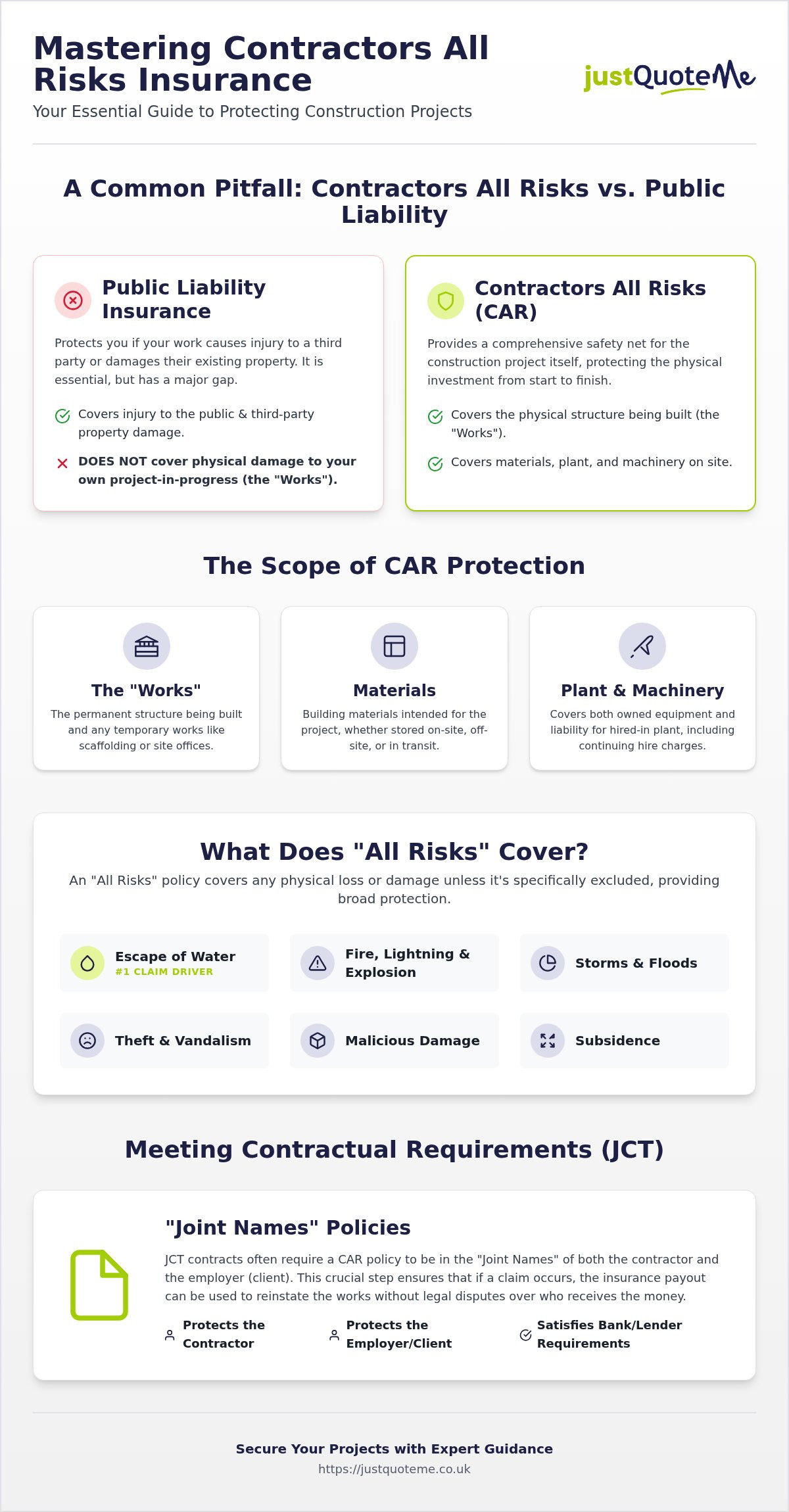
Contractors all risks insurance is a specialized policy designed to provide a physical safety net for construction projects from the moment ground is broken until the final handover. While many tradespeople start with liability cover, those managing larger developments quickly find that standard policies have a significant gap: they don’t cover the cost of rebuilding your own work if it’s destroyed by fire, flood, or theft. This is where CAR steps in. It is often referred to as Builder’s risk insurance in international contexts, and its primary role is to protect the financial investment embedded in the physical structure, known in the industry as “the Works.”
Relying solely on public liability insurance is a common mistake. PL is designed to protect you if your work causes injury to a third party or damages their property. However, if a fire levels a house you are building, PL won’t pay for the bricks, mortar, and labor required to start again. For high-value projects, especially those involving bank lending or external stakeholders, having a robust contractors all risks insurance policy is usually a non-negotiable requirement. It ensures that the project can continue even after a catastrophic event, protecting the interests of everyone from the lead contractor to the project’s financiers.
The Scope of Protection: Works, Plant, and Materials
A CAR policy covers the permanent structure being built and any temporary works, such as scaffolding or site offices. It extends to materials destined for the project, whether they are stored on-site, held in a secure off-site location, or currently in transit. Crucially, it also includes plant and machinery insurance. This covers your owned equipment and, perhaps more importantly, your legal liability for hired-in plant. This includes the ongoing hire charges you might owe while a machine is being repaired or replaced, a cost that can quickly spiral without the right protection.
Who Needs a CAR Policy in 2026?
Main contractors typically take out this policy to cover the entire site under a single contract, ensuring there are no gaps between different trades. Property developers also frequently purchase CAR to protect their capital investment from the ground up, providing peace of mind that their assets are secure. With the 2024 JCT contract updates now standard, sub-contractors may also find themselves contractually obligated to insure their specific portion of the works or their own equipment. Whether you’re a local builder or a large-scale developer, this cover is the backbone of site risk management.
The ‘All Risks’ Explained: What Your Policy Actually Covers
In the insurance world, “All Risks” is a technical term that provides a broad umbrella of protection. Rather than listing every single event that is covered, a Contractors’ all-risk insurance policy covers any physical loss or damage unless the cause is specifically excluded in the policy wording. This approach is much more comprehensive than “named perils” insurance. For a site manager, this means the burden of proof often shifts; the insurer must show why a claim shouldn’t be paid, rather than you having to prove that a specific event was included.
The primary coverage includes traditional heavy hitters like fire, lightning, and explosions. However, the risks on a modern site are evolving. In 2026, industry data shows that “escape of water” has officially surpassed fire as the primary driver of claims under CAR policies. Whether it’s a burst pipe in a high-rise or a faulty valve in a residential development, water damage can be just as devastating as a blaze. Your policy also acts as a shield against natural disasters such as storms, floods, and subsidence, alongside human-led risks like theft, malicious damage, and vandalism.
Protecting Your Tools and Plant
Equipment is the lifeblood of any project. A robust contractors all risks insurance policy integrates plant and machinery insurance to cover both your owned assets and equipment you’ve brought on-site temporarily. Hired-in plant cover is particularly critical because it handles your legal liability for the machine itself and covers “continuing hire charges.” This ensures you aren’t paying daily rental fees out of your own pocket while a damaged excavator sits idle in a repair yard. If you’re unsure about your current equipment limits, it’s always wise to speak with a specialist broker who understands the nuances of site machinery.
Materials and Transit Coverage
Protection doesn’t start when a brick is laid; it starts much earlier. CAR policies cover materials from the moment they leave the supplier, protecting them during transit and while they are stored in off-site facilities. This is essential for high-value components, such as bespoke glazing or HVAC units, that might be delivered weeks before installation. The policy also covers accidental damage during the construction process, providing a safety net for those inevitable site mishaps that can otherwise derail a project’s budget.
Contractors All Risks vs. Public Liability: Clearing the Confusion
Understanding the difference between liability and property protection is the first step in robust site management. While many builders assume their liability cover is a catch-all safety net, the reality is quite different. The fundamental distinction is simple: Public Liability (PL) protects people and third-party property, while contractors all risks insurance protects the project itself. One covers your legal mistakes; the other covers your physical assets.
To see how this works in practice, imagine a fire breaks out on a residential site at midnight. If the fire destroys the timber frame you just erected, your CAR policy covers the cost of the materials and the labor required to rebuild it from scratch. However, if that same fire spreads and damages the neighboring property, your PL policy handles the neighbor’s claim for damages. Without both, you could be left paying for either the rebuild or the neighbor’s repairs out of your own pocket.
These policies interact during major incidents to provide a 360-degree shield. In the event of a site collapse, securing a bespoke contractors all risks insurance policy ensures the works are protected, while PL addresses any injuries to passers-by or damage to the pavement. Most UK lenders and commercial clients won’t allow a project to start without proof of both, as a gap in either could lead to total project insolvency. Each policy serves a distinct purpose, and relying on one to do the job of the other is a risk no contractor should take.
Understanding Public Liability for Builders
A standard public liability insurance for builders policy is often the first requirement mentioned in UK construction contracts. It’s essential for protecting against injury claims from the public or damage to property you don’t own. However, PL has a significant limitation: it typically excludes “damage to the property worked upon.” This means if you drop a tool and crack a bespoke floor you’re installing, your PL policy likely won’t pay for the replacement. This is why CAR is vital for the physical build.
Contract Works Insurance: Is it the Same Thing?
Contract Works is the primary component of a CAR policy, specifically covering the materials and the structure being built. While some firms might opt for a standalone Contract Works policy, a full CAR package is usually more efficient because it includes plant and tools. For smaller firms or individual contractors, a tradesman insurance bundle often provides a cost-effective way to combine these essential protections into one manageable renewal, ensuring you don’t have to navigate complex administrative burdens alone.
Contractual Requirements: Joint Names and JCT Clauses
JCT 2024 is now the industry standard for UK construction. If you’re working under these contracts, you’ll likely encounter the “Joint Names” requirement. This isn’t just an administrative box to tick. By naming both the employer and the contractor on your contractors all risks insurance policy, you create a mutual shield. The most significant benefit is the waiver of subrogation. This legal principle prevents an insurer from paying a claim to one party and then attempting to sue the other to recover the costs. It keeps the project moving without the threat of internal litigation between partners.
Banks and lenders are equally firm about these requirements. If a development is financed, the building itself is the lender’s security. They won’t risk that security being uninsured during the high-risk construction phase. They need to know that if the site is leveled by a storm, the funds to rebuild are guaranteed. This is why a bespoke policy is often a prerequisite for releasing project funds. It provides the financial certainty required to protect high-value investments from the ground up.
Common Exclusions to Watch For
Understanding what isn’t covered is just as important as knowing what is. Most policies use “DE” or Design Exclusion clauses to define the boundaries of coverage for defects. DE3 is the market standard; it excludes the cost of replacing the defective part itself but covers any resulting damage to the rest of the works. If you want the broadest protection, DE5 covers both the defect and the resulting damage, though it usually carries a higher premium. Standard exclusions also apply to gradual damage, wear and tear, and atmospheric conditions. While faulty workmanship itself is typically excluded, a fire or flood caused by that workmanship is usually covered.
Specialist Risks: Working at Height and Depth
Construction projects often involve high-risk activities that require specific disclosure. If your team is working at height, your broker needs to know the exact heights involved to ensure your CAR policy remains valid. Similarly, depth restrictions for excavations and strict heat work permits for welding or torch-on roofing are standard features of modern policies. Failing to disclose these details can lead to a rejected claim at the worst possible time. You can get professional help with your policy to ensure every specialist risk is fully accounted for before you start work.
Choosing the Right CAR Policy with Just Quote Me
Selecting the right contractors all risks insurance shouldn’t feel like a gamble. While online aggregators offer speed, they often lack the deep industry insight required to navigate complex construction risks. As an independent, FCA-authorised broker with over 30 years of experience, we act as a steady hand in a complex market. We don’t just provide a policy; we provide a partnership. Our team leverages a broad network of top UK underwriters to find bespoke coverage that fits your project’s specific needs, ensuring you aren’t paying for features you don’t need or leaving dangerous gaps in your protection.
Regional expertise is our hallmark. We understand the specific challenges facing contractors in Stafford, Stone, and across the West Midlands. This local perspective allows us to offer a level of service that impersonal national firms simply can’t match. We’re here to manage the administrative burdens so you can focus on the build. Whether you are a local tradesman or a large-scale developer, our goal is to make the insurance process as frictionless as possible.
Bespoke Advice for Staffordshire Businesses
Local knowledge is invaluable when securing business insurance in Staffordshire. We know the area, the risks, and the underwriters who have the strongest appetite for West Midlands construction projects. Unlike the “one-size-fits-all” approach of digital comparison sites, we provide personalised service that evolves with your business. If your project scope changes or timelines shift, we handle mid-term adjustments quickly and efficiently. You won’t be stuck in an automated phone queue; you’ll speak to an expert who understands your specific contract requirements.
Securing Your Quote Today
To get an accurate contractors all risks insurance quote, you’ll need to provide a few key details. Have your estimated project value, duration, and the specific type of contract, such as JCT 2024 or NEC4, ready for our team. We’ll also need details about the construction methods and any specialist risks like deep excavations or high-altitude work. Our team ensures your policy meets the exact requirements of your lenders and stakeholders, providing the financial security needed to break ground with confidence. Protecting your livelihood is our priority, and we’re ready to help you secure the best possible terms in the 2026 market.
Get Your Free Business Insurance Quote now
Request a Call back for free Expert advice
Build With Confidence and Financial Security
Securing your construction project requires more than just standard liability. You’ve now seen how contractors all risks insurance provides the essential safety net for your materials, plant, and the physical structure itself. By aligning your coverage with the latest JCT 2024 standards and ensuring “Joint Names” are correctly listed, you protect your investment and satisfy lenders. This clarity allows you to move from a state of uncertainty to complete site security.
Just Quote Me has provided expert advice since 1989. As an FCA-authorised independent broker, we offer access to a broad network of top UK insurers to create a policy that fits your specific project. We manage the complex administrative burdens so you can stay focused on the build. Take the next step toward a secure site and secure your bespoke coverage today. Your project deserves a steady hand and the peace of mind that comes with professional protection.
Get Your Free Business Insurance Quote now
Request a Call back for free Expert advice
Frequently Asked Questions
What does Contractors All Risks insurance actually cover?
CAR covers physical damage to “the Works,” which refers to the structure being built, site materials, and construction plant. It includes protection against fire, flood, theft, and accidental damage. Unlike named-peril policies, it covers any physical loss unless specifically excluded. This ensures that if a storm destroys a project mid-build, you have the funds to restart without depleting your capital or relying on third-party liability claims, providing total site-wide security.
Is Contractors All Risks insurance a legal requirement in the UK?
While not a statutory legal requirement like Employers Liability, it is almost always a contractual obligation. Most JCT or NEC contracts require contractors all risks insurance to protect the project. Banks and lenders also mandate this cover as a condition of financing to protect their security. Without it, you’ll likely be unable to secure high-value contracts or the necessary funding to break ground on a new development.
What is the difference between Contract Works and Contractors All Risks?
Contract Works is a specific component of a CAR policy that covers the permanent and temporary works and materials. Contractors All Risks is a broader package that typically bundles Contract Works with additional protections like plant and machinery insurance for owned or hired-in equipment. While the terms are sometimes used interchangeably, a full CAR policy provides more comprehensive site-wide protection for all your physical assets, including your tools and machinery.
What does “Joint Names” mean in a construction insurance policy?
Joint Names means that both the contractor and the employer are named as the insured parties on the policy. This arrangement creates a mutual benefit by preventing the insurer from using “subrogation” to sue one party for damage caused to the other. It’s a standard requirement in JCT contracts to ensure that if a claim occurs, the project can continue smoothly without internal legal disputes between the project partners.
How much does Contractors All Risks insurance cost for a standard build?
The cost of a policy depends on several variables, including the total project value, the build duration, and the specific construction methods used. Factors like the location of the site and the experience of the contractor also influence the final premium. Because every project has unique risks, we recommend speaking with an independent broker to get a bespoke quote that accurately reflects your specific contractual requirements and project scope.
Does CAR insurance cover my tools and hired-in plant?
Yes, a comprehensive contractors all risks insurance policy can be tailored to include both your owned tools and any hired-in plant. Hired-in plant cover is particularly important as it handles your legal liability for the equipment and covers continuing hire charges while the machinery is being repaired. This prevents you from facing significant out-of-pocket expenses if a rented excavator or crane is damaged on your site during the build.
Can I get a Contractors All Risks policy for a single project?
You can choose between a single-project policy or an annual “blanket” policy depending on your business needs. A single-project policy is ideal for developers or contractors focusing on one specific build with a set completion date. Conversely, an annual policy covers all projects undertaken within the year up to a specified maximum value. This flexibility allows you to align your insurance costs directly with your project pipeline and business growth.
What are the most common exclusions in a CAR policy?
Common exclusions include wear and tear, atmospheric conditions, and gradual deterioration of materials. Faulty workmanship is typically excluded, though the resulting damage to other parts of the project might be covered depending on your specific “DE” clause. Other standard exclusions include war, nuclear risks, and professional negligence, which would instead be covered under a professional indemnity insurance policy. Always check your policy wording for specific site-based restrictions.
