
Did you know that failing to secure the right Employers’ Liability cover could cost your retail business £2,500 for every single day you remain uninsured? It’s a staggering figure that highlights why getting your shop insurance right isn’t just about ticking a box; it’s about the survival of your livelihood. We understand that rising premiums and the dense jargon found in policy fine print make the process feel like a hurdle rather than a help. You want to focus on your customers and your stock, not worry about whether a hidden clause will invalidate a future claim.
This guide cuts through the noise to help you secure your retail premises with tailored shop insurance that covers liability, stock, and business interruption. We’ll break down the legal essentials for 2026, explain which optional extras actually add value, and show you how expert broker support ensures your claims are never rejected on a technicality. Whether you’re managing stock valuations or staff safety, you can Just Quote Me to simplify the administrative burden. We will explore how to balance comprehensive protection with cost efficiency so you can trade with total confidence.
Key Takeaways
- Understand the mandatory legal requirements for UK retailers, including why Employers’ Liability is non-negotiable for protecting your staff and business.
- Learn how to customize your shop insurance policy to cover niche-specific risks such as seasonal stock fluctuations or food-related product liability.
- Identify practical ways to lower your annual premiums by implementing robust security measures and selecting strategic voluntary excesses.
- Discover why a human-led brokerage approach provides more reliable protection than automated comparison sites when navigating complex retail claims.
What is Shop Insurance and Why is it Essential in 2026?
Shop insurance is a specialized bundle of protections designed to shield retail owners from financial ruin. It isn’t a single policy, but rather a coordinated defense against the specific risks that come with running a physical store. While many providers offer a generic Business Owner’s Policy (BOP), a truly effective plan accounts for your unique location, stock turnover, and footfall. In 2026, the retail environment has shifted significantly. Physical storefronts now act as hybrid hubs for digital integration and experiential shopping, creating a complex risk profile that a standard commercial policy simply can’t cover.
Choosing a bespoke shop insurance plan over a generic one ensures you aren’t paying for irrelevant cover while leaving your most vulnerable assets exposed. As an independent broker with over 30 years of experience, we’ve seen how automated comparison sites often miss these nuances. We act as a steady hand, navigating the 2026 market to find a policy that balances cost with comprehensive security.
The Core Components of a Retail Policy
A robust retail policy combines several layers into one manageable premium. This typically includes Public Liability to protect against customer accidents, Buildings and Contents cover, and Stock insurance. For Staffordshire small businesses in areas like Stone and Newcastle-under-Lyme, a ‘one size fits all’ approach is particularly dangerous. Local risks vary, and underinsurance remains a major threat in 2026 due to the rising costs of materials and stock reinstatement. An independent broker’s perspective is vital here; we analyze your specific operations to ensure your limits reflect current market values rather than outdated estimates.
Legal vs. Discretionary Insurance for Retailers
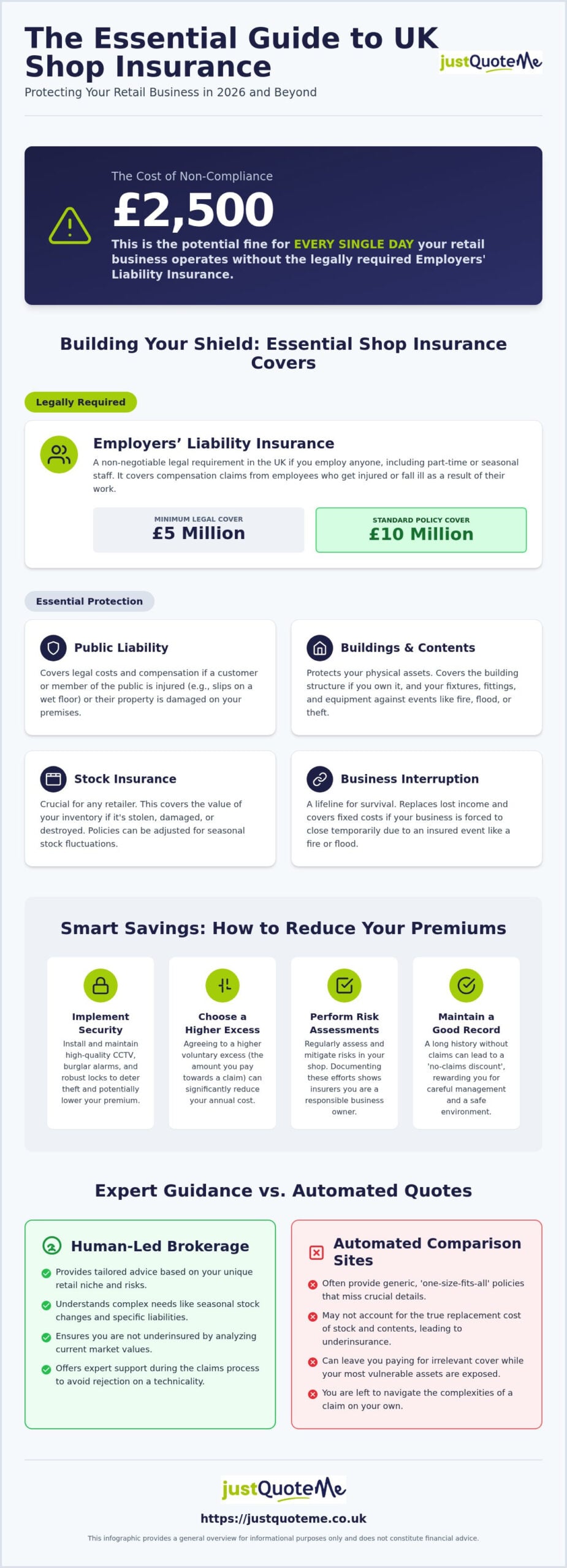
Understanding the difference between what you must have and what you should have is critical for your budget. Under UK law, Employers’ Liability insurance is a legal requirement if you employ even one person, including seasonal or part-time staff. Failure to maintain at least £5 million in cover can result in a fine of £2,500 for every day you’re uninsured. Most of our policies provide £10 million as standard to ensure total compliance.
Beyond legal mandates, discretionary covers like Business Interruption are often the difference between a shop reopening or closing permanently after a fire or flood. This cover replaces lost income while your doors are shut, protecting your cash flow when you need it most. ‘In 2026, shop insurance is no longer just a legal hurdle but a strategic asset for retail resilience.’
Understanding the Key Covers: From Liability to Stock
Your shop is more than just a place of trade; it’s a collection of assets, people, and public interactions. To protect these effectively, you need a coordinated approach. While the previous section highlighted why this protection is essential in 2026, we now look at the specific components that make up a standard shop insurance policy.
Public and Employers’ Liability Essentials
Public liability is the bedrock of retail protection. It covers legal costs and compensation if a customer is injured or their property is damaged while on your premises. Common retail scenarios include a shopper slipping on a wet floor or a display unit falling and causing injury. Without Public Liability Insurance, a single claim could devastate your cash flow and reputation.
If you hire staff, including seasonal help or part-time assistants, Employers’ Liability (EL) insurance is a legal requirement in the UK. You must have at least £5 million in cover, though most insurers provide £10 million as standard to ensure total compliance. Failing to have this in place can lead to a fine of £2,500 for every day you’re without it. You can review Employers’ Liability Insurance details to see how it integrates with your wider retail policy.
Protecting Your Assets: Buildings and Stock
Whether you own the building or lease it, your insurance responsibilities differ. Commercial Property Insurance for owners covers the structure itself, while tenants usually only need to cover their own fit-out, signage, and glass. Underinsurance is a major risk in 2026. If you under-report stock values to save on premiums, insurers may apply the ‘average’ rule, significantly reducing your payout during a claim.
Stock and Contents insurance covers your inventory against theft, fire, or flood damage. It’s vital to value your stock at the cost price to replace it, not the retail price. Special considerations are needed for high-value items or perishable goods, which may require specific extensions. Business Interruption cover is equally crucial; it ensures your income continues if an insured event forces you to close temporarily. It covers fixed costs like rent and wages, providing a lifeline when your doors are shut. If you’re unsure about your current valuation, it’s worth speaking with an independent broker to ensure your shop insurance remains accurate and reliable.
Tailoring Cover for Your Specific Retail Niche
Generic shop insurance often misses the mark for specialized retailers. A fashion boutique in Stone has vastly different requirements than a takeaway in Birmingham. High-street fashion retailers, for example, must manage seasonal stock fluctuations where inventory values might double during the golden quarter. Fitting rooms also introduce specific public liability risks that require precise policy wording to ensure you aren’t left exposed during a claim.
For those in food retail, integrating elements of Restaurant Insurance is vital. This ensures your policy includes robust product liability and cover for food spoilage if your refrigeration fails. If your business operates from a unique property, such as those needing Thatched Pubs coverage, or if your shop includes residential quarters, your policy must reflect these structural complexities and the increased fire risks associated with them.
Bespoke Solutions for Unique Retailers
Retailers offering services, such as hair salons or repair centers, face professional risks alongside traditional retail ones. If you provide expert advice or specialized consultations, Professional Indemnity Insurance protects you against claims of negligence or poor advice. Even temporary “pop-up” spaces require short-term cover that mirrors the legal requirement for employers’ liability insurance found in permanent stores. We help you navigate these nuances so your protection remains seamless, regardless of your business model.
The Staffordshire Advantage: Local Knowledge Matters
National providers often use broad postcodes to determine risk, which can lead to unfairly inflated premiums for West Midlands businesses. We take a different approach by applying local knowledge to every assessment. By understanding specific flood risks or crime statistics in Stafford and Stone, we can present a more accurate profile to underwriters. Having a broker who can physically visit your premises in Stone or Newcastle-under-Lyme ensures that every security measure you’ve installed is properly recognized. ‘Local expertise allows for more accurate risk profiling, often leading to more competitive premiums.’ This human-centric approach manages the administrative burden while you focus on your customers.
How to Reduce Your Shop Insurance Premiums
Lowering your premiums isn’t about cutting corners on protection; it’s about proving to underwriters that your business is a well-managed risk. When you take active steps to secure your premises, you become more attractive to insurers, which typically results in more competitive rates. Implementing robust security measures is the most direct path to these savings. Installing NACOSS-approved alarms, high-definition CCTV, and physical shutters provides tangible proof of risk reduction. Many insurers offer discounted rates to retailers who invest in these systems, as they significantly decrease the likelihood of a successful theft claim.
Choosing a higher voluntary excess is another effective way to lower your annual cost. By agreeing to pay more toward a claim, you reduce the insurer’s potential liability, which they reward with a lower premium. However, you must ensure your business has the cash reserves to cover this amount without strain. Accuracy in your valuations is also vital. Paying for cover based on outdated or inflated stock figures means you’re paying for protection you can’t actually claim. Consolidating your various requirements into a single shop insurance package is usually cheaper than managing separate policies, as it removes administrative overlap and potential gaps between different providers.
Risk Management Strategies for Retailers
Proactive management helps keep your insurance costs stable over the long term. Regular staff training on health and safety protocols reduces the frequency of accidents and subsequent liability claims. In 2026, integrating Cyber Insurance into your risk profile is also essential. As retail becomes more digital, protecting your customer data is as critical as physical security. Regular policy reviews are equally important; your business may have changed significantly in the last year, and you don’t want to pay for assets or risks that no longer exist.
Working with an Independent Broker
An independent broker provides access to ‘broker-only’ rates that aren’t available on standard comparison sites. We use our 30 years of experience to negotiate directly with underwriters on your behalf. By creating a professional ‘Statement of Fact,’ we highlight your specific security measures and local West Midlands expertise to secure better terms. This human-centric approach ensures your business is presented in the best possible light, often leading to significant savings that automated systems simply can’t find. You can speak with a professional at Just Quote Me to see how these specialized rates apply to your specific shop.
Why Choose Just Quote Me for Your Shop Insurance?
Choosing the right partner for your shop insurance shouldn’t be a gamble. With 30 years of experience, we’ve navigated every significant shift in the UK retail market, from the traditional high street to the complex, hybrid digital models of 2026. We don’t just sell policies; we act as a steady hand for small businesses across Staffordshire and the wider West Midlands. Our longevity in the industry is built on a foundation of reliability and a deep understanding of what retail owners actually need to stay protected.
Our human-centric approach sets us apart from national, impersonal brokers. You won’t find yourself trapped in an endless automated phone queue here. Instead, you’ll speak directly to a knowledgeable advisor who understands the nuances of your specific sector. This accessibility ensures that your administrative burdens are managed efficiently, allowing you to focus on your customers. We believe that professional insurance advice should be straightforward, polite, and, above all, helpful.
We specialize in bespoke policy building. Every retailer has a different story, and as discussed in previous sections, a generic plan often leaves dangerous gaps. We take the time to understand your operations, from seasonal stock spikes to specialized premises risks. If the worst happens, we don’t leave you to deal with insurers alone. We act as your advocate during the claims process, providing the expertise needed to ensure your business remains resilient and your claims are handled fairly.
Expertise You Can Trust
As an FCA-authorised firm, we provide advice that is both protected and legally compliant. Our status as an independent broker gives us access to a wide network of top UK insurers, allowing us to source competitive pricing without sacrificing the quality of your cover. Business owners in Stone, Newcastle-under-Lyme, and the surrounding areas have trusted us for decades because we prioritize their security and regional growth over corporate targets.
Take the Next Step for Your Business
We’ve designed our quote process to be simple and frictionless. We know you’re busy running a shop, so we don’t waste your time with unnecessary detail or hyperbolic marketing. Our local offices in Stone and Newcastle-under-Lyme provide a level of regional accountability that national firms simply can’t match. Whether you need a quick update or a deep dive into your shop insurance requirements, our team is ready to assist. Request a Call back for free Expert advice.
Secure Your Retail Future Today
Running a successful retail business in 2026 requires more than just great products; it demands a resilient foundation. We’ve explored how a tailored approach to shop insurance protects you from the rising costs of underinsurance and the legal pitfalls of non-compliance. By focusing on your specific niche and implementing robust risk management, you can secure comprehensive cover while keeping your premiums manageable.
Just Quote Me brings over 30 years of industry experience to the table. As an FCA-authorised firm and bespoke retail cover specialist, we handle the administrative complexities so you don’t have to. We act as your advocate, ensuring your policy reflects the true value of your stock and the unique risks of your Staffordshire or West Midlands location. Our human-centric service means you’ll always have a steady hand guiding you through the market’s complexities.
Don’t leave your livelihood to chance or automated algorithms. You can secure your business with expert guidance today. Our team is ready to provide the pragmatic, professional support you need to trade with total peace of mind. Let us manage the details while you focus on growing your shop.
Frequently Asked Questions
Is shop insurance a legal requirement for UK businesses?
Employers’ Liability insurance is the only component that is a legal requirement if you have any employees. Under the Employers’ Liability (Compulsory Insurance) Act 1969, most businesses with staff must hold at least £5 million in cover. Other parts of a policy, such as public liability or stock cover, aren’t mandated by law but are often required by landlords or commercial contracts. Without these protections, you face significant financial risk from customer claims.
How much does shop insurance cost on average in 2026?
The cost of shop insurance depends on several variables specific to your business operations. Insurers look at your shop’s location, the type of goods you sell, your annual turnover, and the level of security you’ve installed. High-value stock or a history of previous claims will also influence your premium. Because every retail business is unique, we recommend requesting a bespoke quote to get an accurate figure that reflects your specific risk profile.
Does my shop insurance cover me for online sales and delivery?
Standard policies usually focus on your physical premises, but many can be extended to include e-commerce activities. This is increasingly important as retailers adopt hybrid models. You should ensure your product liability extends to items sold online and that your stock is covered while in transit. If you manage your own deliveries, you may also need specialized motor fleet insurance or courier cover to protect your goods until they reach the customer.
What happens if I under-insure my shop’s stock?
Under-insuring your stock can lead to a significantly reduced payout through the ‘Condition of Average’ clause. If you insure your inventory for only 50% of its actual value, the insurer may only pay out 50% of any claim, even for a minor loss. This leaves a massive financial gap that your business must cover. It is vital to value your stock at its replacement cost to ensure your shop insurance provides full protection.
Can I get shop insurance if my premises have a flat above them?
Yes, you can secure cover for shops with residential quarters above them, though insurers view this as an increased risk. The presence of a flat introduces additional fire and water damage hazards that a standalone unit doesn’t face. You must disclose this setup during the quote process to ensure your policy is valid. We specialize in finding competitive terms for these mixed-use properties by working with underwriters who understand the requirements of high-street buildings.
What is business interruption insurance and do I really need it?
Business interruption insurance replaces the income you lose if an insured event, like a fire or flood, forces your shop to close. While buildings insurance repairs the structure, this cover pays for ongoing costs like rent, taxes, and staff wages. Many small businesses fail after a major incident because they cannot survive months without revenue. It provides the essential cash flow needed to keep your business viable while you’re unable to trade.
How can an independent broker help me save money on my premium?
An independent broker saves you money by accessing specialized markets that aren’t available on standard comparison websites. We negotiate directly with underwriters to secure ‘broker-only’ rates based on your specific risk management practices. By presenting a professional ‘Statement of Fact’ that highlights your security measures and local expertise, we can often achieve better terms. This personalized approach ensures you only pay for the cover you need, avoiding expensive and unnecessary policy extras.
