If your startup faced a legal claim tomorrow, would your house and personal savings remain safe? Many founders mistakenly believe that “limited liability” provides a total shield for their private assets, but the reality in 2026 is far more complex. With the full implementation of the Economic Crime and Corporate Transparency Act and new “day-one” employment rights now in effect, your personal responsibility as a leader has never been higher. Securing directors and officers liability for startups is no longer just a box-ticking exercise; it’s a critical safety net for your personal financial future.
We understand that the pressure to scale while managing shifting UK regulations can feel overwhelming. You’ve likely felt the push from investors to get cover in place or found yourself confused by the difference between professional indemnity and D&O. This guide will clarify exactly how D&O insurance protects you from management risks and why it’s a non-negotiable requirement for securing VC funding this year. We’ll break down the specific legal changes affecting you in 2026 and show you how to gain the peace of mind needed to make high-stakes decisions with confidence.
Key Takeaways
- Understand why limited company status doesn’t protect your personal bank account and how D&O insurance acts as a firewall for your private assets.
- Learn why securing directors and officers liability for startups is a mandatory requirement for most VC term sheets and angel investment rounds in 2026.
- Identify the specific regulatory and employment risks that could lead to personal legal claims against you under the Companies Act 2006.
- Discover how premiums are calculated and why the “claims-made” nature of these policies means you cannot afford any gaps in your coverage.
- Find out why a bespoke broker service provides more reliable protection than generic automated quote engines for high-growth businesses.
The Reality of Personal Liability for Startup Directors in 2026
The UK regulatory landscape has shifted significantly. As of 2026, Companies House has moved from a passive registry to an active gatekeeper. This change, driven by the full implementation of the Economic Crime and Corporate Transparency Act, means directors face unprecedented scrutiny regarding identity verification and financial accuracy. If you’re leading a high-growth firm, understanding directors and officers liability for startups is the difference between a successful exit and personal financial ruin. You can no longer rely on administrative distance to protect you from the consequences of management decisions.
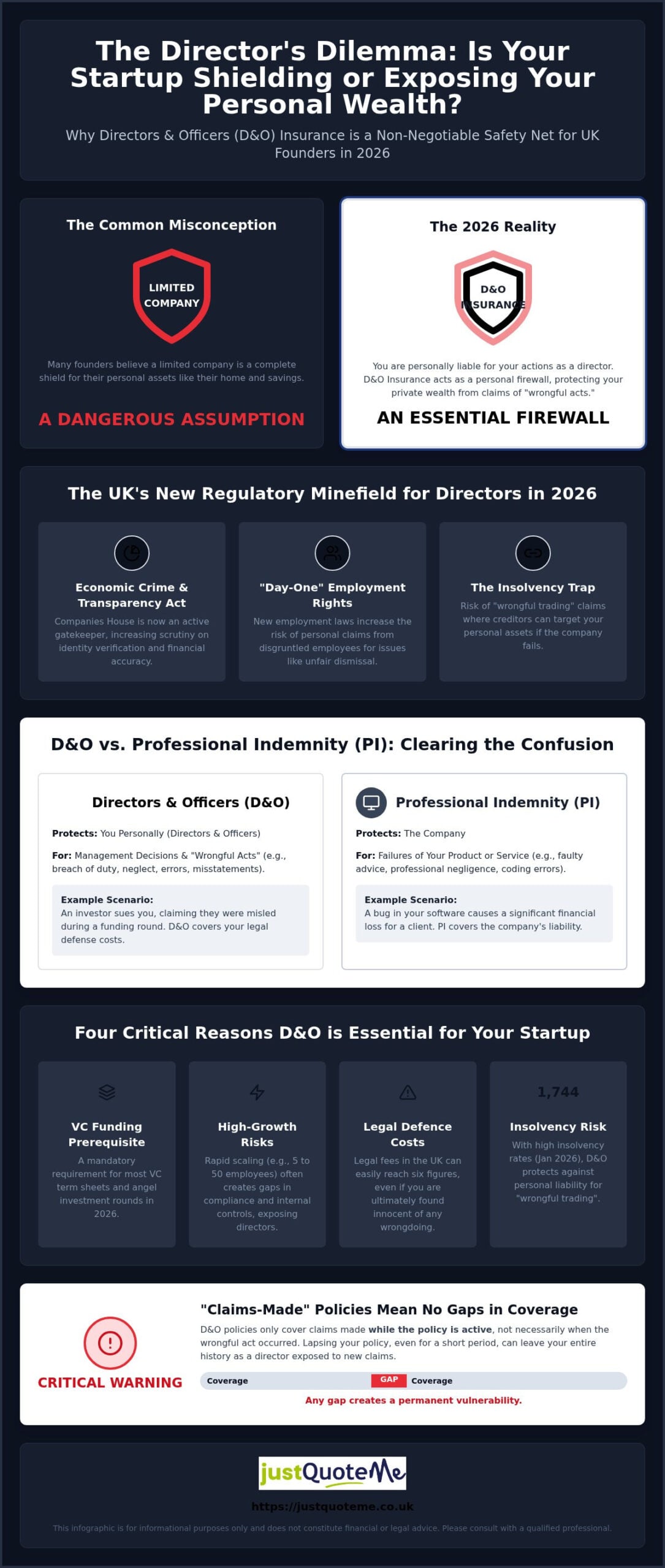
A common misconception among founders is that the “limited” in a limited company protects their personal bank accounts. While the company is responsible for its own debts, you remain personally liable for your actions as a director under the Companies Act 2006. Directors and Officers (D&O) liability insurance is designed to shield your private wealth from claims of “wrongful acts.” In a startup environment, these acts often involve breach of duty, neglect, or errors in judgement during rapid scaling. It’s not just about fraud; it’s about the everyday mistakes made while moving fast and trying to hit aggressive milestones.
D&O vs Professional Indemnity: Clearing the Confusion
Many founders struggle to distinguish between management liability and service-related risks. Professional Indemnity Insurance covers the company if your product or service fails. For example, if a coding bug causes a client financial loss, PI steps in. In contrast, D&O covers you personally for management decisions. If a disgruntled employee sues for unfair dismissal following the 2026 employment law changes, or an investor claims they were misled during a seed round, D&O is what protects your personal assets. Tech startups often find that VCs require both D&O and Cyber Insurance before releasing Series A funds to ensure the leadership team is properly insulated.
The Personal Firewall for Founders
Without this protection, a single legal challenge can target your home, your savings, and your private investments. The cost of legal defence alone in the UK can easily reach six figures before a case even reaches court. Even if you’ve done nothing wrong, you still have to pay to prove it. D&O insurance acts as a personal firewall, ensuring that a professional mistake doesn’t escalate into a private catastrophe. It’s the essential personal safety net for any UK director.
Why UK Startups Face Unique Management Risks
Rapid growth is the primary goal for most founders, but it’s also a significant liability minefield. In 2026, UK startups operate in an environment where regulatory oversight is at an all-time high. Founders often focus on achieving product-market fit while neglecting the rigorous administrative compliance now required by the Economic Crime and Corporate Transparency Act. This specific gap in management focus is exactly why directors and officers liability for startups is so vital. When you scale from five to fifty employees in a single year, your internal systems for financial reporting and identity verification often lag behind, leaving you personally exposed to civil penalties.
The “insolvency trap” is a recurring danger for firms running on tight runways. With 1,744 company insolvencies recorded in England and Wales in January 2026 alone, the risk of business failure remains historically elevated. If you continue to incur debt while knowing the company has no reasonable prospect of avoiding liquidation, you risk being held personally liable for “wrongful trading.” Creditors can bypass the corporate veil to target your private bank accounts. Companies House suggests that founders should seriously consider investing in directors’ and officers’ cover to manage these high-stakes personal exposures.
The Companies Act 2006 and Your Duties
Your role as a leader is governed by strict statutory duties under the Companies Act 2006. You’re legally required to promote the success of the company for the benefit of its members and exercise reasonable care, skill, and diligence in every decision. These aren’t just suggestions; they’re legal mandates. While Professional Indemnity Insurance protects the company against errors in your professional services, it won’t shield you if a shareholder claims you breached your fiduciary duties during a strategic pivot or a botched funding round.
Employment Practices Liability (EPL)
Employment claims are the most frequent source of D&O litigation for firms with fewer than 100 employees. As of April 2026, new statutory sick pay rules and expanded “day-one” parental rights have significantly increased the complexity of HR management. If an employee feels they’ve been unfairly dismissed or discriminated against, they may name you personally in the legal action. Rapidly scaling teams often face “culture clashes” that lead to litigation. Ensuring your policy includes an EPL extension provides a critical layer of safety during these volatile growth phases. If you’re unsure about your current level of exposure, you can consult with an experienced broker to identify potential gaps in your protection.
D&O Insurance as a Prerequisite for Raising Venture Capital
Venture capital firms don’t just invest in your technology; they invest in the stability and integrity of your leadership team. In 2026, a term sheet without a mandatory D&O clause is almost unheard of in the UK market. Investors view directors and officers liability for startups as a fundamental component of their own risk management strategy. They know that high-growth environments are prone to “investor suits,” where shareholders claim they were misled by overly optimistic financial forecasts or aggressive growth projections during the funding round. Having this cover in place signals that your startup is “investment-ready” and takes corporate governance seriously.
Satisfying the Term Sheet
Most Series A and B funding rounds in the UK now stipulate a minimum of £1 million to £3 million in D&O coverage as a condition of closing. Investors specifically look for “Side C” or Entity Cover, which ensures the company itself is protected when it is named alongside directors in a lawsuit. It’s common for investors to also mandate Cyber Liability Insurance alongside D&O. This creates a comprehensive shield that satisfies the fund’s compliance requirements and demonstrates that you’ve accounted for both management and operational vulnerabilities.
D&O on Exit: IPOs and Acquisitions
Your liability doesn’t end when the business is sold or goes public. If your startup undergoes a “Delaware flip” for international expansion or prepares for an acquisition, your D&O policy becomes even more critical. During these transitions, “Run-off cover” is essential. This specific extension protects past directors for a set period, typically six years, after the company changes hands. It ensures that management decisions made today won’t lead to personal financial disaster years after you’ve exited the business. For those heading toward a public listing, D&O also forms the basis of Public Offering Securities Insurance (POSI), which is vital for managing the unique risks of an IPO.
Calculating the Real Cost and Level of Cover for Your Startup
Determining the right level of directors and officers liability for startups requires a clear understanding of your specific risk profile. Your policy must be active when a claim is filed, not just when the event occurred. This is known as “claims-made” coverage. If you cancel your policy or allow a gap to occur after a funding round, you lose protection for all management decisions made during that period. Maintaining continuous cover is the only way to ensure your personal assets remain shielded from historical decisions that might only come to light years later.
The limit of indemnity you choose should reflect the scale of your operations and the expectations of your board. While £1 million is often the entry-level baseline for seed-stage companies, Series A and B rounds frequently mandate limits of £2 million or £5 million. You must also distinguish between “Any One Claim” and “Aggregate” limits. An aggregate limit is the total amount the insurer will pay across the entire policy year, whereas an “Any One Claim” limit provides the full sum for every individual claim made. For startups in high-growth phases, the latter offers significantly more robust protection against multiple simultaneous legal challenges.
Factors That Drive Startup Premiums
Insurers look closely at your sector and financial stability when calculating your premium. High-risk industries like FinTech, MedTech, and DeepTech often face higher rates due to the complex regulatory environments they inhabit. Your management team’s previous experience also plays a vital role; a founder with a successful exit history is often viewed as a lower risk. Maintaining a clean claims history and transparent financial reporting are your best tools for securing more competitive rates during your annual renewal. If you want to ensure your broader coverage is equally robust, consult our Small Business Insurance Checklist for a complete overview of 2026 requirements.
Selecting Your Limit of Indemnity
Benchmarking is essential for making an informed choice. Startups in Staffordshire and the wider West Midlands should look at the typical settlement figures and legal defence costs in UK courts, which have risen alongside inflation to 2.6% in 2026. A £1 million limit can be exhausted surprisingly quickly by legal fees alone, even if the claim is eventually dismissed. You should account for the possibility of multiple directors being named in a single suit, which multiplies the defence costs. To find the right balance for your budget, you can get a tailored D&O quote that reflects your specific funding stage and industry risk.
Securing Bespoke D&O Protection with Just Quote Me
Automated quote engines often treat a high-growth AI startup the same as a traditional consultancy. This lack of nuance leaves you either underinsured or paying for coverage that doesn’t fit your specific risk profile. Just Quote Me provides a human-centric alternative to these impersonal systems. As an independent, FCA-authorised broker with over 30 years of experience, we understand that directors and officers liability for startups is too complex for a standard online form. We don’t just provide a policy; we provide a partnership that manages the administrative burden so you can focus on hitting your next milestone.
Our access to a broad network of top UK insurers allows us to find competitive pricing that matches your specific funding stage. We act as your steady hand in a volatile market, ensuring that every detail of your management protection is tailored to your unique risks. Whether you’re based in the West Midlands or scaling nationally, our regional expertise ensures you receive a level of service that larger, impersonal competitors simply cannot match. We handle the complex paperwork and negotiations with underwriters, providing you with a frictionless experience from the initial inquiry to the final policy issuance.
Why a Bespoke Approach Matters for Startups
Success in the startup world requires a holistic approach to risk. By customising your insurance portfolio, we can combine your D&O cover with Cyber Insurance and Professional Indemnity Insurance into one manageable package. This eliminates coverage gaps and ensures that your personal assets and company operations are shielded simultaneously. Founders in Newcastle-under-Lyme, Stafford, and Stone benefit from our local roots and straightforward communication. We avoid hyperbolic marketing speak, opting instead for plain, honest advice that helps you make informed choices with total confidence.
Your Next Steps to Secure Management Protection
Securing a quote is a straightforward process when you have the right information ready. You’ll need to provide clear financial forecasts and details about your senior leadership team’s professional background. Insurers value transparency and experience, so highlighting your board’s previous successes can help lower your premiums. We’ll guide you through the disclosure requirements, ensuring that your application presents your startup in the best possible light to our panel of insurers. Taking these steps today prevents a management error from becoming a personal financial disaster tomorrow.
Get Your Free Business Insurance Quote now
Request a Call back for free Expert advice
Future-Proof Your Leadership Strategy
Protecting your startup means more than just securing your intellectual property; it’s about safeguarding the people who build it. We’ve explored how limited liability doesn’t stop legal claims from reaching your personal bank account and why investors won’t move forward without seeing a policy in place. In the regulatory environment of 2026, directors and officers liability for startups is the most effective way to manage these high-stakes personal risks while maintaining your focus on scaling. By addressing these management vulnerabilities now, you ensure that a single professional error doesn’t escalate into a private financial disaster.
Just Quote Me brings 30+ years of industry experience as an FCA-authorised independent broker to help you navigate these complexities. We specialise in bespoke startup insurance packages that combine management liability with other essential covers into one streamlined portfolio. Instead of wrestling with automated forms that don’t understand your unique growth trajectory, you can rely on our expert team for a personalised approach that prioritises your security. We’re here to handle the administrative burden so you don’t have to.
Take the first step toward securing your personal assets today. Get Your Free Business Insurance Quote now or Request a Call back for free Expert advice to speak with our knowledgeable team. You’ve worked hard to build your vision; let’s ensure your personal future is just as secure as your company’s next big exit.
Frequently Asked Questions
Is D&O insurance legally required for startups in the UK?
No, D&O insurance is not a statutory requirement in the UK, unlike Employers Liability insurance. However, it’s almost always a contractual requirement if you’re raising venture capital or angel investment. While the law doesn’t force you to have it, the Companies Act 2006 places significant personal duties on you that make this cover a practical necessity for any founder.
Does D&O insurance cover criminal acts or fraud committed by directors?
D&O insurance doesn’t cover proven criminal acts, deliberate fraud, or “dishonest” behaviour. It’s designed to protect you against “wrongful acts” like negligence, errors, or breaches of duty. Most policies will pay for your legal defence costs until a final adjudication or a guilty plea is reached, at which point the insurer will usually stop payments and may seek to recover the costs already paid.
What is the difference between D&O and Management Liability insurance?
Management Liability is an umbrella term that usually includes three distinct covers: D&O, Employment Practices Liability (EPL), and Corporate Legal Liability. While D&O specifically protects the individual managers’ personal assets, a full Management Liability package provides a broader shield for the company entity itself. Many founders find that a comprehensive directors and officers liability for startups policy is best structured within this wider Management Liability framework.
Can a startup director be sued by an employee personally?
Yes, employees can name individual directors personally in legal actions, particularly in cases of alleged discrimination or harassment. Following the expansion of “day-one” employment rights in April 2026, the risk of these personal claims has increased. Without the right cover, you could be forced to pay for your own legal defence even if the company is also named in the suit.
How much does D&O insurance typically cost for a UK startup in 2026?
The cost of your premium depends on several factors, including your industry sector, the amount of funding you’ve raised, and your company’s financial stability. High-growth firms in regulated sectors like FinTech often see higher premiums than those in less regulated industries. To get an accurate figure that reflects your specific risk profile, it’s best to request a bespoke quote from an independent broker.
What happens to my D&O cover if the startup goes into insolvency?
Your D&O policy is specifically designed to stay active and protect you during insolvency proceedings, provided the policy was in place before the insolvency began. This is when the cover is most valuable, as it protects you from claims made by liquidators or creditors regarding “wrongful trading.” With 1,744 company insolvencies recorded in January 2026, having this protection ensures your personal savings aren’t used to settle company debts.
Do I need D&O insurance if I am a sole trader?
No, sole traders don’t need D&O insurance because there is no separate legal entity or board of directors to protect. As a sole trader, you already have unlimited personal liability for your business actions. You should instead focus on Public Liability or Professional Indemnity insurance to manage your risks. Directors and officers liability for startups is specifically for those operating as a limited company.
What is “run-off” cover and why do I need it after an exit?
Run-off cover provides protection for claims that are filed after your company has been sold, merged, or closed down. Because D&O insurance is “claims-made,” the policy must be active at the time the claim is made, not when the event happened. Run-off cover typically lasts for six years, ensuring that management decisions you make today don’t come back to haunt your personal finances years after you’ve exited the business.
