

If you sub-contract your design work to a qualified architect, why are you still the primary target when a structural error is discovered five years later? Many construction firms assume that by hiring external specialists, they have successfully offloaded the professional risk. However, under most modern contracts, the legal responsibility for both design and construction remains firmly with you. This makes professional indemnity for design and build contractors a tactical shield rather than just a box to tick for a tender. Even if you aren’t the one drawing the plans, you’re the one the client holds accountable when things go wrong.
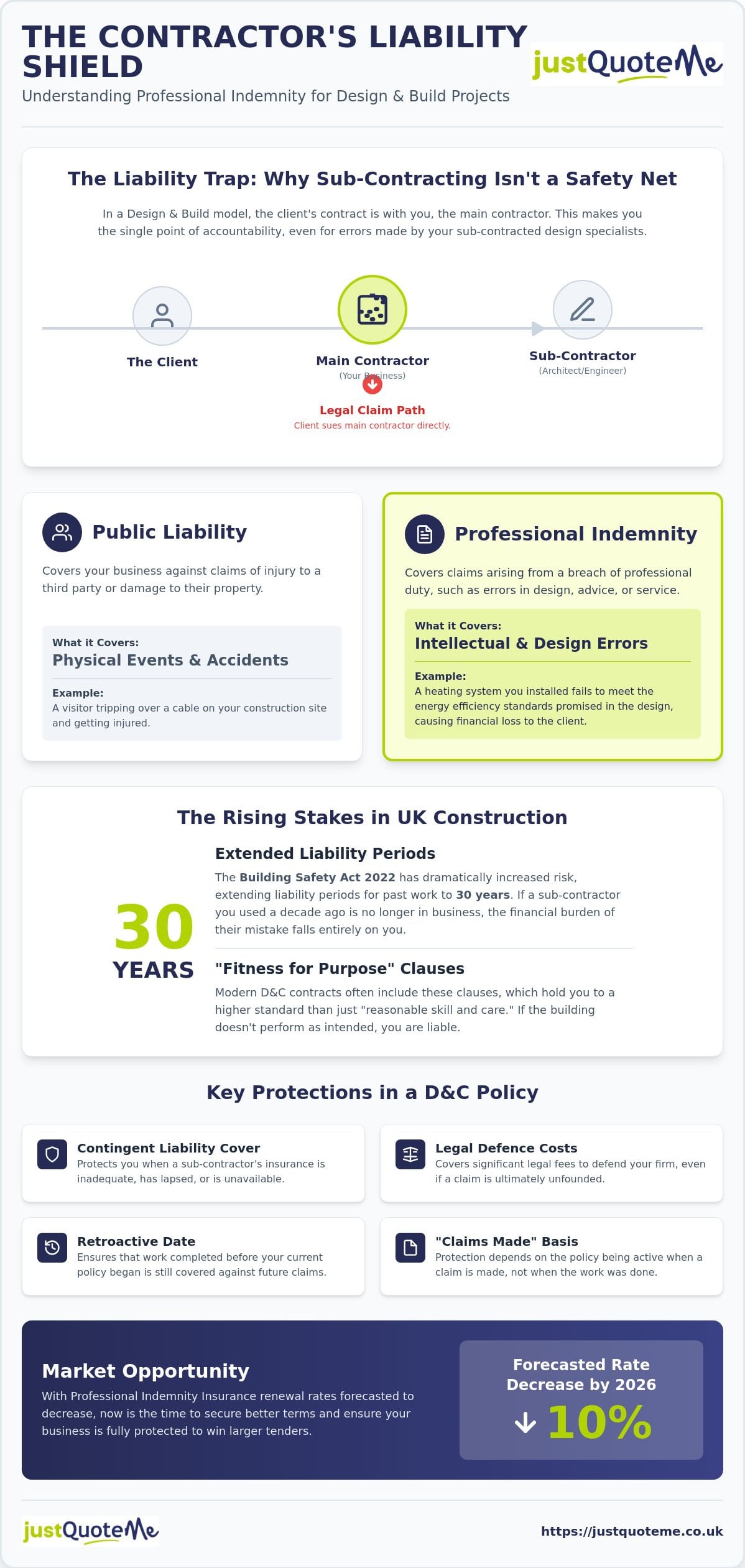
It’s frustrating to face high legal costs to defend claims when you weren’t at fault, especially with the Building Safety Act 2022 now extending liability periods to 30 years for older projects. Fortunately, the market is shifting in your favour. With PII renewal rates forecasted to decrease by up to 10% in 2026, there is a clear opportunity to secure better terms. This article explains how to protect your business from design-related liabilities and bridge the gap between execution and professional services. You’ll discover how to secure a policy that meets strict client requirements and ensures you aren’t left exposed by sub-contractor errors. Just Quote Me to simplify these technical requirements and win larger tenders with confidence.
Key Takeaways
- Understand why professional indemnity for design and build contractors is essential for protecting your firm against the contingent liabilities of sub-contracted designs.
- Learn why sub-contracting professional services does not absolve you of liability and how the main contractor remains the primary legal target in disputes.
- Identify the specific coverage features of a D&C policy, including the vital protection for legal defense costs during complex claims.
- Grasp the importance of the “claims made” basis and retroactive dates to ensure your business remains protected for past projects.
- Discover how a specialist broker can help you meet strict contractual requirements to secure larger, high-value construction tenders.
What is Professional Indemnity for Design and Build Contractors?
Professional indemnity for design and build contractors is the protection against financial loss arising from a breach of professional duty. Historically, the construction industry operated on a traditional procurement model where the client engaged architects and engineers directly. In that scenario, the contractor was only responsible for the physical build. The industry has shifted toward “Design & Build” (D&C) models, where the contractor takes full responsibility for the project from the initial sketch to the final handover. This transition means you aren’t just a builder; you’re the lead professional in the eyes of the law. Standard professional indemnity policies designed for architectural practices don’t always account for this dual role. They often miss the specific nuances of how a contractor manages sub-contracted design teams, leaving your business exposed to significant financial risks.
PI vs. Public Liability: Knowing the Difference
Many contractors mistakenly believe that their standard liability cover is sufficient for all project mishaps. It isn’t. Public Liability Insurance is designed to cover physical events, such as a visitor tripping over a cable or a crane damaging a roof. These are tangible, “bricks and mortar” accidents. In contrast, Professional liability insurance covers intangible, intellectual errors. If you install a heating system that is technically perfect but fails to meet the energy efficiency standards promised in the design, no physical damage has occurred. However, the client will still suffer a massive financial loss to rectify the error. Public liability won’t pay for that rectification, but a professional indemnity policy will.
The Rise of Design Liability in UK Construction
The move toward D&C contracts has significantly increased the legal burden on the main contractor. Modern clients and developers want a single point of accountability. This means they often include “fitness for purpose” clauses in contracts, which go beyond the standard duty to act with reasonable skill and care. If the building doesn’t perform as intended, the contractor is the first person the client will sue. This increased scrutiny is why professional indemnity for design and build contractors is now a non-negotiable requirement for most tenders. You’ll find that lenders, local authorities, and private developers won’t even allow you to sign a contract without a robust policy in place. Securing this cover isn’t just about protection; it’s a vital tool for winning larger, more complex projects—including specialist home extensions Buckinghamshire—in a competitive market.
The same logic applies to specialized technical services; for instance, those managing a boiler installation Moffat must ensure their professional advice is fully indemnified to meet the high standards expected by modern clients and insurers alike.
The Liability Trap: Why Sub-contracting Design Isn’t a Safety Net
Many contractors operate under the dangerous myth that hiring an external architect or engineer shifts all professional risk away from their business. They assume that if a drawing is wrong, the designer is the one who pays. However, in the eyes of the law and the client, you are the single point of accountability. The client doesn’t have a contract with your architect; they have one with you. When a design flaw emerges, the client will sue the main contractor first. This makes professional indemnity for design and build contractors a vital necessity rather than an optional extra.
Redirecting liability to a sub-contractor is rarely a quick or cheap process. Even if the fault clearly lies with the designer, you’ll likely spend significant sums on legal fees just to prove it. If your sub-contractor has gone out of business or allowed their insurance to lapse, you’re left holding the baby. This is a growing concern given that the Building Safety Act 2022 has extended limitation periods for claims to 30 years for work completed before June 28, 2022. If a firm you used twenty years ago no longer exists, the financial burden of their mistake falls entirely on your shoulders.
Contingent Professional Indemnity Explained
Contingent liability refers to your legal responsibility for work performed by others under your banner. A D&C policy provides a secondary layer of protection that steps in when a sub-contractor’s insurance is inadequate or unavailable. It’s essential to regularly audit your sub-contractors’ PI limits to ensure they match the scale of the project. For deeper insights into these risks, the IRMI provides excellent resources on Design Liability Professional Liability Insurance and how it functions for contractors.
The “Holding the Baby” Scenario
Imagine a scenario where a structural error is discovered in a completed residential block five years after handover. By this time, the original engineering firm has ceased trading. Without your own cover, you’d be responsible for both the rectification costs and the massive legal bill. PI insurance provides the legal muscle to defend your business against unfounded claims. It ensures that even if you’re caught in a dispute between a client and a defunct sub-contractor, your assets remain protected. You can get a specialist perspective on your specific risks to avoid these common pitfalls.
Key Coverage Features of a Design & Construct (D&C) Policy
A Design & Construct (D&C) policy is a specialized form of professional indemnity for design and build contractors that bridges the gap between manual labour and intellectual service. At its core, the policy covers professional negligence and breaches of your duty of care. This isn’t just about making a mistake; it’s about failing to meet the standards expected of a competent professional in your field. While a builder might be judged on the quality of their brickwork, a D&C contractor is judged on the integrity of the design they provide, even if that design was created by a sub-consultant. Your policy acts as the financial foundation that protects your business when these professional standards are called into question.
Perhaps the most valuable feature is the coverage for defence costs. Legal disputes in construction are notoriously long and expensive. Even if you’ve done nothing wrong, defending a complex claim can cost tens of thousands of pounds in expert witness fees and legal representation. Your policy ensures that these costs don’t drain your cash flow while the case is being resolved. Additionally, many modern policies include “rectification” or “mitigation” cover. This allows you to claim for the costs of fixing a design error before it results in a physical loss or a third-party claim. If you catch a structural design flaw during the build phase, your insurance can help cover the cost of the redesign and correction, preventing a much larger disaster later.
Collateral Warranties and Duty of Care
Clients, funders, and future tenants often demand collateral warranties. These legal agreements create a direct link between you and a third party who wasn’t part of the original contract. By signing these, you’re extending your duty of care significantly. PI insurance is essential here because it provides the financial backing required to honour these warranties. Without it, you might find yourself personally liable for claims from a building’s future owner decades after the project is finished. Most D&C policies include contractual liability extensions specifically to support these agreements, making it easier for you to sign off on tenders with confidence.
Additional Protections for Contractors
A comprehensive policy goes beyond basic design errors. For instance, design-related pollution or contamination can be a major risk if your plans fail to account for site-specific environmental factors. If you’re working on larger collaborative projects, joint venture protection ensures you’re covered for your share of the liability when working with other firms. While professional indemnity for design and build contractors covers the professional advice and design, you should also consider Contractors All Risk Insurance to protect the physical works and plant on-site. Combining these protections ensures there are no gaps in your business security, allowing you to focus on project delivery.
Navigating “Claims Made” Basis and Retroactive Dates
Professional indemnity insurance operates on a “claims made” basis, which is a fundamental shift from how most other business insurance works. In simple terms, the policy that pays out is the one active at the time the claim is made, not the one that was in place when the work was actually performed. If you designed a foundation in 2024 but a crack appears and a legal claim follows in 2026, it’s your 2026 policy that handles the dispute. This unique trigger is why professional indemnity for design and build contractors must be maintained without any gaps. even a 24-hour lapse in cover could leave you personally liable for projects completed years ago. If you aren’t insured on the day the letter arrives, you have no cover, regardless of how long you’ve paid premiums in the past.
This brings us to the importance of the retroactive date. This is a specific date in the past from which your insurer agrees to cover your professional activities. If your policy has a retroactive date of January 2022, any work done after that point is protected by your current insurer. In 2026, as the Building Safety Act 2022 continues to impact the industry with its 30-year liability window for older projects, ensuring your retroactive date goes back far enough is non-negotiable. With renewal rates for well-managed risks forecasted to decrease by 5% to 10% in 2026, now is an excellent time to review your retroactive protection and ensure your entire career history is fully secured.
How to Choose Your Indemnity Limit
Selecting the right limit isn’t about picking the cheapest option; it’s about evaluating the maximum possible financial loss on your largest project. While £1m is a common starting point, many commercial contracts now mandate £2m, £5m, or even £10m. You should also distinguish between “Any One Claim” and “In the Aggregate” limits. An “Any One Claim” policy is superior because it provides the full limit for every individual claim made during the year. Conversely, an aggregate policy has a single pot of money for all claims combined. If you face multiple disputes in one year, an aggregate limit can quickly vanish, leaving your business exposed.
The Danger of “Breaking the Chain”
Switching insurers can save money, but you must ensure the new provider picks up your existing retroactive date. If they don’t, you “break the chain,” and your previous years of work are suddenly uninsured. This is particularly dangerous if you’re closing a business or retiring. Because current UK law allows for claims decades after completion, you need “run-off” cover to protect your personal assets after you stop trading. Maintaining a continuous, clean insurance history is the only way to navigate the long-tail risks of the construction sector without risking everything you’ve built.
Securing Bespoke Protection with Just Quote Me
Finding the right professional indemnity for design and build contractors isn’t a task for an automated algorithm. D&C contracts are legally complex, and a “one size fits all” policy often leaves dangerous gaps in your protection. This is where an independent broker becomes essential. At Just Quote Me, we bring 30 years of experience in the UK construction sector to every consultation. We don’t just sell policies; we act as your trusted advisor, navigating the nuances of “claims made” triggers and retroactive dates so you don’t have to. Our goal is to ensure your business is shielded from the “liability trap” of sub-contracted design work mentioned earlier in this guide.
Our strength lies in our broad network of specialist UK insurers. Because we aren’t tied to a single provider, we can shop the market to find the most competitive terms for your specific risk profile. This access is vital in 2026, as insurers place increased scrutiny on fire safety and cladding compliance. We provide several key advantages for contractors:
- Access to A-rated UK insurers specializing in D&C risks.
- Expert analysis of contractual “fitness for purpose” clauses.
- Assistance in auditing sub-contractor insurance limits to protect your contingent liability.
- Personalized claims support if a dispute arises.
We know which underwriters have the appetite for your specific project types, whether you’re a small firm in Stafford or a large contractor managing multi-million pound developments across the West Midlands.
Tailored Solutions for Staffordshire Contractors
We pride ourselves on being a human-centric alternative to faceless national corporations. For businesses in Newcastle-under-Lyme, Stone, and Stafford, we offer regional expertise that larger competitors simply can’t match. We understand the local market and the specific contractual demands of West Midlands developers. By integrating Professional Indemnity Insurance into a wider business protection strategy, we simplify your administrative burden. You get a single point of contact for all your insurance needs, from public liability to fleet cover, ensuring your paperwork is always tender-ready.
Get Your Quote Today
Securing your business shouldn’t be a hurdle to winning work. We’ve streamlined our process to ensure you can transition from information gathering to expert protection quickly. When you use our “Get Your Free Business Insurance Quote” service, you aren’t just getting a number on a screen; you’re starting a conversation with a specialist who understands your industry. We provide the clarity and security you need to sign high-value contracts with peace of mind. Just Quote Me for straightforward, professional advice you can trust.
Build a Secure Future for Your Construction Business
Protecting your firm from design-related claims is about more than just checking a box for a contract; it’s about long-term survival. You now understand that the legal burden of design remains with you, even when you sub-contract the work to external specialists. By maintaining continuous cover and respecting the “claims made” nature of the market, you shield your personal and business assets from disputes that could emerge decades after a project is finished. Choosing the right professional indemnity for design and build contractors ensures you can pursue high-value tenders with total confidence in your liability profile.
Just Quote Me simplifies this complex process for you. As an FCA-authorised independent insurance broker with over 30 years of industry experience, we offer access to a broad network of top UK insurers to find the bespoke protection your business deserves. We’re ready to help you secure the straightforward, professional advice you can trust.
Get Your Free Business Insurance Quote now
Request a Call back for free Expert advice
Frequently Asked Questions
Is Professional Indemnity insurance a legal requirement for contractors in the UK?
Professional Indemnity isn’t a statutory legal requirement in the UK like motor insurance or Employers’ Liability. However, it’s a standard contractual demand for almost all construction projects. You’ll find that most tenders are impossible to win without proof of valid cover. It’s the professional benchmark that tells your clients you have the financial backing to stand by your work and handle potential design disputes.
How much does Professional Indemnity insurance cost for a design and build contractor?
The cost of professional indemnity for design and build contractors varies based on your annual turnover, project size, and claims history. Insurers also evaluate the percentage of design work you sub-contract to external firms. Businesses with documented risk management processes usually secure more favourable rates. It’s best to get a bespoke quote to understand the specific premiums for your business’s unique risk profile.
Does my Public Liability insurance cover design errors?
No, Public Liability strictly covers physical damage or bodily injury caused by your on-site activities. If a builder accidentally damages a neighbouring property, that’s Public Liability. If a building is structurally flawed due to an incorrect design specification, it’s a professional error. Only a PI policy covers the financial losses and legal costs associated with these intellectual mistakes and design failures.
What is a retroactive date on a Professional Indemnity policy?
A retroactive date is the specific point in time from which your insurer covers your professional activities. Since PI insurance is “claims made,” your current policy handles claims for past work, provided the work happened after this date. If you designed a project in 2023 and a claim arises in 2026, you’re covered. You must never move this date forward when switching providers.
What happens if a design claim is made against me after I retire?
Because PI insurance is “claims made,” you need an active policy at the moment a claim is filed. Run-off cover provides this protection after you retire or close your business. With limitation periods now extending up to 30 years under the Building Safety Act 2022, run-off cover is essential to protect your personal assets and retirement savings from delayed legal action.
Can I get PI insurance if I sub-contract all of my design work?
Yes, you can still secure professional indemnity for design and build contractors if you sub-contract all design work. As the main contractor, you’re the primary legal target for the client. This cover protects your contingent liability, ensuring you aren’t left paying for a sub-consultant’s error if their own insurance fails, their policy has lapsed, or if their firm has ceased trading.
What is the difference between “Any One Claim” and “Aggregate” limits?
An “Any One Claim” limit provides the full cover amount for every individual claim made during the policy year. Conversely, an “Aggregate” limit is a total pot for all claims combined. If you have a £2m aggregate limit and face two £1.5m claims, you’d be underinsured for the second claim. We always recommend “Any One Claim” cover for contractors to avoid this danger.
Will PI insurance cover the cost of rebuilding a defective structure?
Yes, if your policy includes rectification or mitigation cover. This feature pays for fixing a design defect before it causes a physical collapse or a third-party claim. If an error is spotted mid-build, your insurer can help pay for the necessary remedial works. This prevents a minor design flaw from escalating into a catastrophic financial loss or a lengthy legal dispute.
