
Why should a rigid computer script decide the value of your passion based on a single BHP figure? If you drive a high-performance vehicle in 2026, you’ve likely encountered the “algorithm penalty” where standard insurers overcharge for engine size or reject you for minor modifications. We agree that it’s frustrating to be treated like a generic risk, especially when vehicle thefts surged by 21% in the year ending March 2025 and the average value of a single theft claim has risen to over £12,000. Securing performance car insurance shouldn’t feel like a battle against a faceless machine that doesn’t understand your car’s true worth.
This guide promises to show you how to bypass these rigid systems to find specialist schemes that offer agreed value protection and cover for occasional track use. We’ll preview the essential 2026 updates, including the shift in the Expensive Car Supplement threshold to £50,000 for zero-emission vehicles and the impact of Euro 7 standards arriving on November 29, 2026. With group 50 supercar premiums often exceeding £5,145 in central London, it’s time to move beyond the automated “no” of the big insurers and find a policy that fits your specific needs.
Key Takeaways
- Understand how 2026 performance classifications for BHP and torque can push high-end family saloons into expensive insurance groups.
- Learn why standard automated systems often overcharge for performance car insurance and how specialist brokers avoid these algorithm penalties.
- Discover the benefits of specialist cover, such as the ability to choose your own marque-certified repairer and securing agreed value protection.
- Identify practical security upgrades, like Faraday pouches and Thatcham-approved trackers, that can significantly lower your annual premiums.
- Access exclusive, non-standard insurance schemes that aren’t available on comparison sites to ensure your vehicle is fully protected.
What is Classed as a Performance Car in 2026?
The definition of a performance vehicle has shifted significantly. In 2026, it’s no longer enough to look at engine displacement alone. While a 2.0-litre engine once suggested a standard saloon, modern turbocharging and hybrid assistance mean that same capacity can now produce upwards of 400 BHP. To understand what is a performance car in the eyes of a modern underwriter, we must look at a combination of power-to-weight ratios, insurance group ratings between 30 and 50, and the specific technology under the bonnet. Standard insurers often struggle to categorise a vehicle that looks like a family car but possesses the acceleration of a mid-90s supercar. This creates the “Super-Saloon” trap, where owners of cars like the BMW M5 or Audi RS6 are hit with massive premiums because an algorithm sees a four-door car with 600 BHP and defaults to the highest possible risk category.
The Performance Metrics That Matter to Insurers
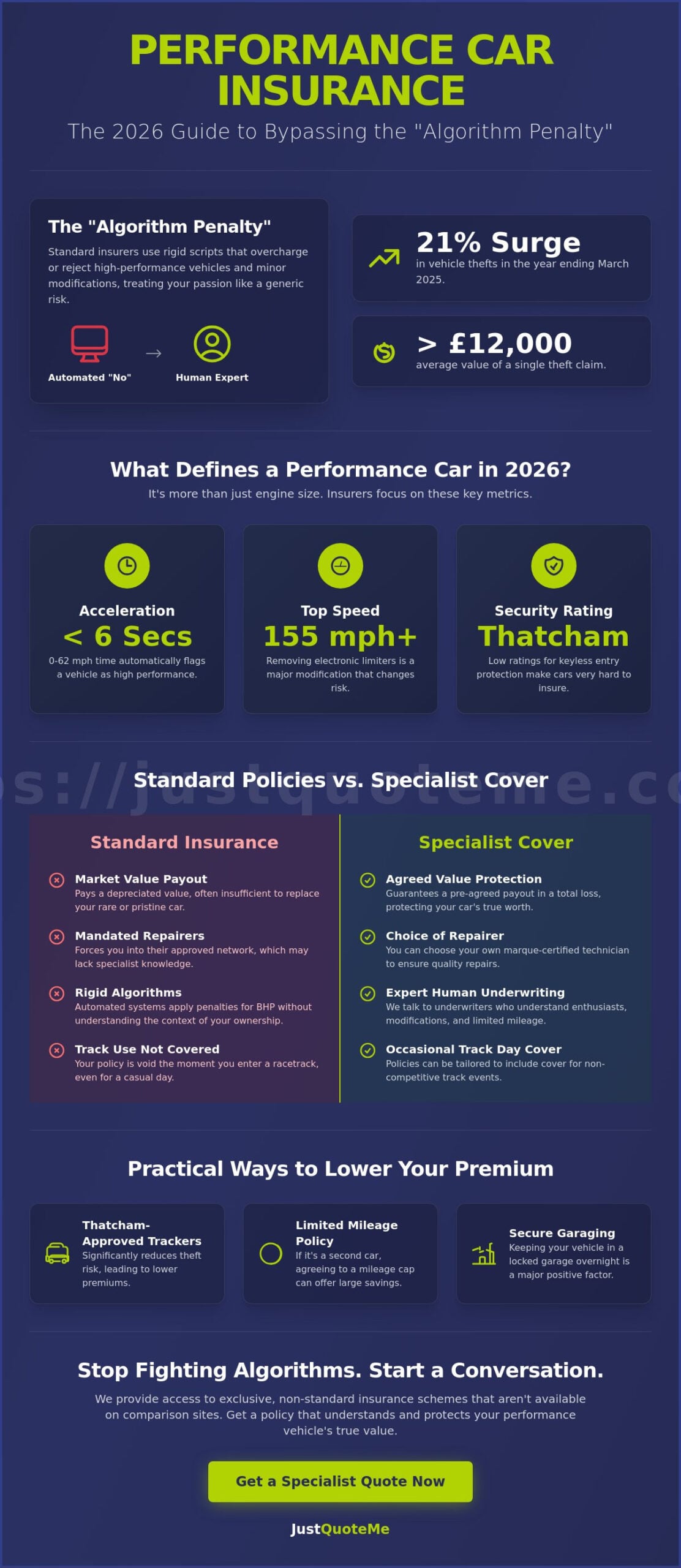
Insurers prioritising performance car insurance risk profiles focus on three core numbers. First is the 0-62 mph acceleration time. Any car hitting that mark in under 6 seconds is automatically flagged as high performance. Second is the top speed. While many German cars are electronically limited to 155 mph, insurers view the removal of this limiter as a major modification that changes the risk entirely. Finally, Thatcham security ratings are more critical than ever. With vehicle thefts in England and Wales having surged by 21% in the year ending March 2025, a car with a high BHP but a low Thatcham rating for keyless entry protection will be almost impossible to cover through standard channels.
High-Performance EVs and Hybrids
2026 marks a turning point for performance electric vehicles (EVs). With the Expensive Car Supplement threshold for zero-emission vehicles rising to £50,000 on April 1, 2026, many high-end EVs now sit in a complex tax and insurance bracket. Insurers are particularly wary of the instant torque provided by cars like the Porsche Taycan or Tesla Model S. The inclusion of “Ludicrous” or “Plaid” modes isn’t just a marketing feature; it’s a specific risk factor that specialists must underwrite manually. Furthermore, the high cost of battery replacement in a total-loss claim means that even a minor accident in a performance EV can lead to a write-off. This is why specialist performance car insurance is essential for EV owners who want to ensure their battery and specialist aerodynamic components are covered at their true replacement value.
If you’re finding that automated sites don’t understand your car’s true specification, it’s time to speak to a human expert. We don’t rely on rigid scripts to decide your premium.
Get Your Free Business Insurance Quote now.
Request a Call back for free Expert advice.
Why Standard Car Insurance Fails Performance Owners
Most mainstream insurers use broad-brush logic when calculating performance car insurance premiums. If your vehicle has a high-BHP engine, the automated systems often apply a significant penalty without considering the context of your ownership. They don’t account for whether you store the car in a climate-controlled garage or if you only drive it 2,000 miles a year. This rigid, binary approach is Why insuring performance cars is different; it requires a level of human nuance that a computer script simply cannot provide.
The financial risk for standard insurers is also driven by rising repair costs. Performance vehicles often feature specialist carbon-fibre bodywork or active aerodynamic components that require specific technicians and expensive parts. Because these models are highly desirable to organised criminal groups, generic companies often default to a flat refusal or an astronomical quote. At Just Quote Me, we bypass these scripts to negotiate bespoke terms directly with underwriters who understand the enthusiast market.
The Problem with Market Value Settlements
Standard policies usually pay out based on “Market Value” at the time of a claim. For a rare or pristine performance car, this figure is often insufficient to replace the vehicle. If your car is a future classic or has undergone significant restoration, you need an “Agreed Value” policy. This ensures that in the event of a total loss, you receive a pre-determined sum that reflects the car’s true worth, rather than a depreciated figure pulled from a generic trade guide. We work with you to verify the condition of your vehicle to secure these higher settlement figures.
Modification Rejection: The Mainstream Dealbreaker
Mainstream sites often cancel policies or refuse cover if they discover a simple ECU remap or an upgraded exhaust system. They view any change from factory specification as an unacceptable increase in risk. However, a specialist broker knows the difference between a performance upgrade and a dangerous modification. We ensure your changes are “accepted” rather than just “declared,” providing you with total peace of mind. If you are an enthusiast who spends time working on your own vehicles, you might also find value in our guide to Specialist Motor Trade Insurance. For those operating a business that buys, sells, or repairs performance vehicles, our comprehensive motor trade insurance guide for 2026 covers everything from MID obligations to protecting customers’ vehicles on your premises.
You can explore our range of tailored insurance products to see how we help drivers protect their high-value investments with a personal touch.
Get Your Free Business Insurance Quote now.
Request a Call back for free Expert advice.
Comparing Specialist Performance Cover vs. Standard Policies
Standard insurers usually promote “Comprehensive” cover as the ultimate protection. However, for a high-performance vehicle, this label often hides significant gaps. Standard policies default to market value settlements, whereas specialist performance car insurance prioritises “Agreed Value.” This distinction is vital because a market value calculation doesn’t reflect the true cost of replacing a pristine Porsche or a limited-edition Ferrari. If your car is damaged, a standard insurer might insist on using their “approved” repair network. These garages are often high-volume centres that lack the specialist jigs or diagnostic software required for high-performance marques. We ensure your policy includes a “Choice of Repairer” clause, allowing you to send your vehicle to a technician you trust.
Usage patterns also dictate your premium. If your car is a “weekend” vehicle, we can secure limited mileage discounts that reflect its reduced time on the road. Unlike standard policies that exclude any form of circuit use, specialist schemes can include occasional track day cover. This provides protection while you explore the car’s limits in a controlled environment. Understanding these ways to potentially lower your insurance costs is essential for managing the total cost of ownership in 2026. With the daily Congestion Charge in London rising to £18 as of January 2, 2026, and fuel duty set to rise on September 1, 2026, every saving on your premium counts.
Specialist Benefits You Won’t Find on Comparison Sites
One of the biggest advantages of a specialist policy is like-for-like replacement of modified parts. If your aftermarket carbon-fibre splitter is damaged, a specialist insurer replaces it with the same component, rather than a factory-standard plastic version. Additionally, many of our clients enjoy European road trips. Our policies often include full continental cover as standard, which is important for rallies or alpine tours. For those with a collection of high-performance vehicles, a bespoke Fleet Car Insurance policy often provides better value and less paperwork than individual covers.
The Multi-Car and Business Use Factor
It’s a common myth that performance cars can’t be used for business. If you use your vehicle for client visits or travelling between sites, we can arrange “Class 1” business use. This is a common requirement for consultants who also hold Professional Indemnity Insurance and want their vehicle to reflect their professional status. We can often bundle your daily driver and your performance car into a single multi-car policy, simplifying your admin while maintaining the high level of protection your performance vehicle requires.
Get Your Free Business Insurance Quote now.
Request a Call back for free Expert advice.
Practical Ways to Reduce Your Performance Car Insurance Premium
Reducing your performance car insurance premium requires a proactive approach to risk management. It isn’t just about finding the cheapest quote; it’s about proving to underwriters that you’re a lower-than-average risk. With vehicle thefts in England and Wales having surged by 21% in the year ending March 2025, security is the most significant lever you can pull. Modern 2026 security goes beyond a simple alarm. Insurers now look for AI-monitored trackers that can detect unauthorised movement in real-time. Since keyless theft accounted for 98% of stolen vehicles located by recovery companies in July 2023, simple steps like using Faraday pouches can have a direct impact on your quote.
- Thatcham-approved S5 or S7 trackers with 24/7 monitoring
- Ghost immobilisers or physical steering locks to deter relay attacks
- Professional-grade Faraday boxes for overnight key storage
Beyond hardware, your driving credentials matter. Completing an advanced driving qualification with the Institute of Advanced Motorists (IAM) or RoSPA demonstrates a level of competence that automated algorithms often ignore. Similarly, joining a marque-specific owner’s club can unlock specialist schemes. These clubs often have pre-negotiated rates with brokers because their members are statistically more likely to maintain their vehicles to a high standard. This human-centric approach to risk is why we prefer manual underwriting over rigid computer scripts.
The Impact of Storage and Location
Where you keep your car overnight is a critical factor. A locked, brick-built garage is the gold standard, but even a secure driveway with retractable bollards can lower your rate. We understand the specific risks in the West Midlands and Staffordshire. If you’re based in Stafford or Newcastle-under-Lyme, our local knowledge allows us to present your risk to underwriters more effectively than a national call centre could. We know which postcodes have higher recovery rates and which areas require extra physical security to satisfy specialist insurers.
Policy Structuring for Lower Costs
You can also lower costs by adjusting your policy structure. Increasing your voluntary excess is a direct way to reduce the annual premium for your performance car insurance, provided you can afford the upfront cost in the event of a claim. If you only drive your car during the summer months, a “laid-up” policy provides fire and theft cover while the vehicle is SORN, which is significantly cheaper than a full road policy. While telematics or “black box” insurance is often associated with young drivers, some performance specialists now offer “pay-per-mile” schemes for weekend cars. This allows you to maintain comprehensive cover while only paying for the exact distance you travel.
To find a policy that rewards your security efforts, you can get a tailored quote from our expert team today.
Get Your Free Business Insurance Quote now.
Request a Call back for free Expert advice.
Why Choose Just Quote Me for Your Performance Insurance?
Choosing the right partner for your performance car insurance is about more than just finding a policy; it’s about finding an advocate who understands the machine in your garage. With 30 years of expertise in the UK specialist motor market, Just Quote Me has built relationships with underwriters that the general public simply cannot access. While the average cost of comprehensive car insurance in the UK stands at approximately £726 as of January 2026, owners of high-performance vehicles face a much more volatile market. We specialise in placing risks that automated systems often reject, whether that’s due to a high-BHP engine or a specific modification list.
Our roots in Staffordshire and the West Midlands give us a unique perspective on local risk factors. We don’t just see a postcode; we see the secure garaging and proactive security measures you’ve taken to protect your investment. This local knowledge is vital as we move through 2026, especially with the temporary 5p reduction in fuel duty beginning to phase out from September 1, 2026. We help you manage the total cost of ownership by ensuring your premium reflects your actual risk, not a generic regional average calculated by a computer script.
The Personal Touch of an Independent Broker
Talking to a human expert is always more efficient than navigating a 50-page online form that doesn’t have a box for your specific turbocharger or carbon-fibre trim. Our “no-nonsense” approach means we get straight to the point, saving you time and frustration. We don’t hide behind corporate jargon. If you need to make a claim, we act as your advocate, not just a middleman. We handle the heavy lifting with the insurer so you don’t have to, ensuring that repairs are carried out to the highest standards by marque specialists who respect your vehicle’s integrity.
Get Your Bespoke Quote Today
Securing a tailored quote is a straightforward process. To help us find the best possible scheme for your vehicle, please have your V5 logbook, a full list of modifications, and your security specifications ready. Whether you’re preparing for the new Euro 7 emissions standards taking effect on November 29, 2026, or simply want better protection for your daily driver, we provide the steady hand you need. The Just Quote Me promise is built on reliability, efficiency, and expert protection that respects the true value of your performance car.
Get Your Free Business Insurance Quote now.
Request a Call back for free Expert advice.
Secure Your Vehicle’s Future Today
Navigating the 2026 insurance market doesn’t have to be a struggle against rigid computer scripts. You’ve seen how the Expensive Car Supplement threshold for zero-emission vehicles rose to £50,000 on April 1, 2026, and how Euro 7 standards arriving in November 2026 will further complicate vehicle values. It’s clear that a standard policy often falls short for a high-performance car. By focusing on agreed value protection and specialist repairer choice, you can ensure your investment is fully protected against the 21% surge in vehicle thefts recorded in the year ending March 2025.
Finding the right performance car insurance is about balancing comprehensive cover with a premium that reflects your actual driving habits. As an FCA Authorised Independent Broker, we pride ourselves on being a steady hand in a complex market. You can explore our bespoke insurance solutions to find a policy that fits your specific needs. We’re here to do the heavy lifting so you can get back to enjoying the drive with total peace of mind.
Get Your Free Business Insurance Quote now.
Request a Call back for free Expert advice.
Frequently Asked Questions
Is performance car insurance more expensive for young drivers?
Yes, premiums for younger drivers are significantly higher due to the increased risk of high-speed accidents. For a 20-year-old driver, annual quotes for a group 50 supercar can exceed £42,000. Specialist brokers can sometimes mitigate these costs by looking at advanced driving qualifications or restricted mileage, but the base risk remains high for inexperienced drivers in high-BHP vehicles.
What counts as a “modification” for insurance purposes?
Any change from the manufacturer’s original factory specification is a modification. This includes performance upgrades like ECU remapping and exhaust changes, as well as cosmetic alterations like aftermarket alloy wheels or body kits. You must declare every change to ensure your performance car insurance remains valid, as undeclared modifications are a leading cause of rejected claims.
Can I get performance car insurance with points on my licence?
You can still secure cover with points, but mainstream insurers often default to a rejection for drivers with multiple convictions. We work with specialist underwriters who look at the specific nature of your offences, such as SP30s or TS10s. By providing context to the risk, we can often find a bespoke scheme that accepts your licence history without an astronomical premium increase.
Does performance car insurance cover track days at Silverstone or Donington?
Standard policies almost always exclude circuit use, but specialist performance policies can include cover for specific track days. You usually need to notify your broker in advance to arrange a temporary extension for venues like Silverstone or Donington. This provides accidental damage protection while you are on the track, which is essential given the high speeds involved.
What is “Agreed Value” and why is it better for sports cars?
Agreed Value is a fixed settlement figure pre-determined by you and the insurer. This is superior to “Market Value” because it ignores generic trade guides that might undervalue a pristine or rare vehicle. If your car is a future classic or has a documented restoration history, an agreed value ensures you receive its true worth in the event of a total loss.
Will my premium go down if I only drive 3,000 miles a year?
Yes, limited mileage is one of the most effective ways to lower your costs. If you restrict your driving to 3,000 miles a year, you are statistically less likely to be involved in an accident. Specialist insurers offer significant discounts for “weekend” cars, provided you have a separate daily vehicle and can provide proof of your odometer readings during the policy term.
How does a performance EV like a Tesla compare to a petrol car for insurance?
Performance EVs often attract higher premiums due to their instant torque and the high cost of battery repairs. With the Expensive Car Supplement threshold for zero-emission vehicles rising to £50,000 on April 1, 2026, many high-end EVs now sit in complex insurance brackets. Specialist underwriting is required to account for unique features like “Plaid” mode and specialist aerodynamic bodywork.
Do I need a specific type of tracker for my high-performance vehicle?
Most specialist insurers now mandate a Thatcham-approved S5 or S7 tracker. With keyless theft accounting for 98% of stolen vehicles recovered in July 2023, a standard factory alarm is no longer sufficient. An S5 tracker includes driver identification tags, which provides the highest level of protection against the relay attacks that are common in high-value vehicle thefts.
Get Your Free Business Insurance Quote now.
Request a Call back for free Expert advice.
