

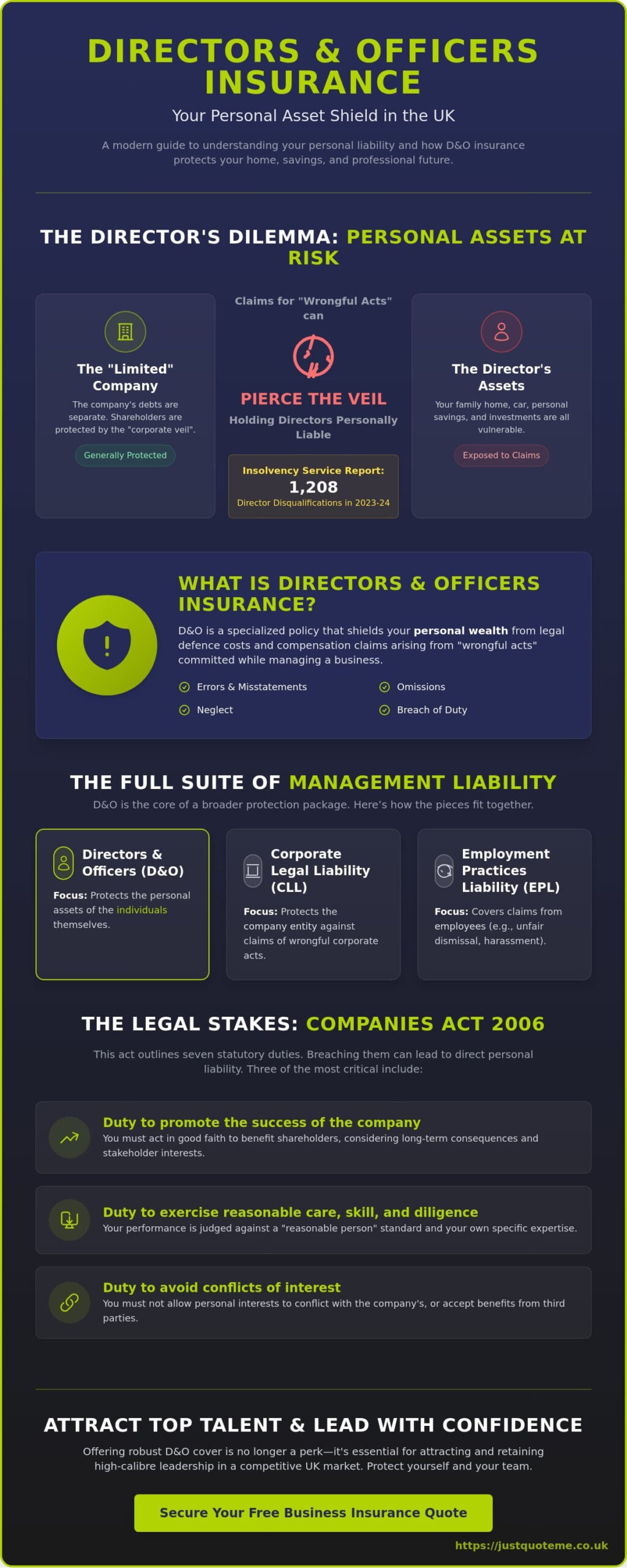
Did you know that your private bank account, your family home, and your personal savings are all at risk the moment you accept a seat at the boardroom table? It’s a sobering reality for UK leaders. You likely agree that the legal environment has become more hostile; for instance, the Insolvency Service reported 1,208 director disqualifications in the 2023-24 financial year, proving why directors and officers insurance is no longer optional. We understand the pressure you face to lead with confidence while managing the strict requirements of the Companies Act 2006.
This guide will show you how to shield your personal wealth and fulfill your legal duties with comprehensive cover. You’ll learn how to choose the right policy levels for 2026 and how to attract high-quality board members by offering them genuine security. We’ll break down the complex regulations and provide a clear path to securing your professional future.
Get Your Free Business Insurance Quote now.
Request a Call back for free Expert advice.
Key Takeaways
- Understand the critical distinction between corporate liability and your personal assets to ensure your private wealth remains protected.
- Learn how the UK Companies Act 2006 impacts your role and why statutory breaches can lead to personal bankruptcy without the right cover.
- Navigate the specific layers of protection—Side A, B, and C—to cover everything from legal defence fees to corporate reimbursement.
- Discover why directors and officers insurance is a vital tool for attracting and retaining high-calibre leadership in a competitive UK market.
- Gain practical advice on securing a bespoke policy through a specialist broker rather than relying on standard automated quotes.
What is Directors and Officers (D&O) Insurance?
Directors and officers insurance is a specialized policy that protects your personal wealth and assets from being used to pay for legal defense costs or compensation claims if you’re held personally responsible for mistakes made while running a business. It’s a common misconception that the “Limited” status of a UK company provides a total safety net for its leaders. While shareholders are protected from the business’s debts, directors have specific statutory duties under the Companies Act 2006. If you breach these duties, your personal assets, including your home and savings, are at risk.
The 2026 regulatory environment in the UK has made this protection more vital than ever. Since the full implementation of the Sustainability Disclosure Requirements (SDR) and the increased scrutiny on AI governance, management teams face a higher volume of personal litigation. Modern Directors and officers liability insurance provides the financial backing needed to defend against claims from shareholders, employees, or government bodies like the Health and Safety Executive (HSE).
The Core Concept: Protecting the Individual
At its heart, directors and officers insurance is about the individual, not the entity. If a claim is made against the company, other policies might trigger. However, if a claimant names you specifically in a lawsuit, D&O is often the only thing standing between your bank account and a legal bill. It covers the costs of legal representation and any settlements or awards granted to the claimant.
Coverage typically focuses on “wrongful acts.” In the insurance world, this includes errors, omissions, neglect, or a breach of duty. For example, if a director fails to disclose a conflict of interest or makes an ill-advised financial decision that leads to a loss for shareholders, they could be sued for negligence. This policy ensures that professional mistakes don’t lead to personal financial ruin.
Management Liability vs. D&O: What is the difference?
You’ll often hear D&O mentioned alongside “Management Liability.” It’s best to think of Management Liability as a bundle of protections, with D&O acting as the primary pillar. A full suite usually includes three distinct parts:
- Directors and Officers (D&O): Protects the individuals themselves.
- Corporate Legal Liability (CLL): Protects the company entity against claims of wrongful acts.
- Employment Practices Liability (EPL): Covers the business against claims from employees regarding unfair dismissal, harassment, or discrimination.
While a small firm might start with just D&O, most UK businesses now opt for the full suite to close the gaps between management errors and staff-related disputes. It’s also important to distinguish this from professional indemnity insurance, which covers the services you provide to clients, rather than how you manage the company. If your business has employees, you likely already have employers liability insurance, but that won’t protect you from a personal lawsuit alleging a breach of fiduciary duty.
Get Your Free Business Insurance Quote now.
Request a Call back for free Expert advice.
The Legal Stakes: Why UK Directors Need Protection
Leading a UK company brings significant responsibility and, more importantly, personal exposure. The Companies Act 2006 codified the conduct expected of every board member. These aren’t just suggestions; they’re statutory requirements that, if breached, pierce the corporate veil. While the company has limited liability, the directors do not. This means your personal assets, including your home and savings, are vulnerable if you’re accused of a “wrongful act.” This Forbes guide to D&O insurance explains how these risks affect management at every level.
Statutory Duties Under the Companies Act 2006
The Act outlines seven specific duties. Three of the most critical for management liability include:
- Duty to promote the success of the company: You must act in good faith to benefit the members (shareholders) as a whole, considering long-term consequences and employee interests.
- Duty to exercise reasonable care, skill, and diligence: You’re judged against both a “reasonable person” and your own specific knowledge or experience.
- Duty to avoid conflicts of interest: You must not put yourself in a position where your personal interests conflict with the company’s, and you cannot accept benefits from third parties.
Modern management also faces the rise of “adverse news events.” A data breach, a public environmental failure, or a social media scandal can tank a share price and trigger immediate directors and officers insurance claims from disgruntled stakeholders.
Common Claimants: Who can sue a Director?
Threats don’t just come from within. Shareholders and investors are the most common claimants, usually alleging that financial mismanagement led to losses. Regulators such as the Health and Safety Executive (HSE) or the Financial Conduct Authority (FCA) can also bring actions that carry heavy penalties. Employees frequently name individual directors in claims regarding unfair dismissal, harassment, or discrimination. While employers liability insurance is a legal requirement for the business, it doesn’t always protect the individual manager from personal litigation. Finally, during insolvency, liquidators or creditors can sue directors for “wrongful trading” if they didn’t stop trading when they knew the company couldn’t avoid liquidation.
The reality of an unsuccessful defence is grim. In the 2023/24 financial year, the Insolvency Service obtained 831 director disqualifications. Disqualification can last up to 15 years. Beyond being barred from the boardroom, you face unlimited fines and, in the most serious cases of negligence or fraud, prison sentences. Finding the right bespoke coverage ensures you have the financial muscle to fight these claims and protect your future.
Get Your Free Business Insurance Quote now.
Request a Call back for free Expert advice.
What Does D&O Insurance Actually Cover?
Directors and officers insurance acts as a financial safety net for the individuals making high-stakes decisions. It doesn’t just pay out for final judgements; it covers the heavy legal fees that mount up long before a case reaches court. In the UK, legal defence costs often outpace actual settlements. A complex regulatory investigation can easily reach six figures in legal fees alone before a single penny of compensation is paid. This policy ensures that personal wealth isn’t drained by the cost of proving your innocence.
Side A, B, and C: The Three Pillars of a Policy
Most policies are structured into three distinct layers of protection. This tiered approach ensures both the individual and the company stay financially stable during a claim.
- Side A: This is personal protection. It triggers when the company is legally unable or financially insolvent and cannot pay the director’s legal costs. It protects your personal home and savings from being used to satisfy a claim.
- Side B: This is the most common claim type. It reimburses the company after it has paid to defend or indemnify its directors, protecting the corporate balance sheet.
- Side C: Also known as entity cover, this protects the company itself when it is named as a co-defendant. This is particularly relevant for securities-related disputes or claims against the business entity.
D&O vs. Professional Indemnity vs. Cyber Insurance
A common mistake is assuming that Professional Indemnity is enough. It isn’t. PI covers mistakes in the professional services or advice you provide to clients. In contrast, directors and officers insurance covers management errors, such as breach of duty, neglect, or misleading statements. If a data breach occurs, cyber insurance handles the technical recovery and notification costs. However, D&O covers the directors if shareholders sue them for failing to implement proper security protocols.
According to the Association of British Insurers guide to D&O insurance, these policies also provide vital support for investigation costs. This includes responding to dawn raids by the Competition and Markets Authority or inquiries from the Financial Conduct Authority (FCA). Having an expert legal team ready to respond to a surprise regulatory visit is a major benefit for UK businesses.
What is Excluded?
Insurance isn’t a license to act recklessly. Policies won’t cover deliberate criminal acts, proven fraud, or claims involving personal profit gained dishonestly. Most policies also exclude “Prior Acts,” which are claims based on incidents that happened before the policy’s retroactive start date. Standard D&O policies don’t cover bodily injury or property damage. Those risks are managed through your Public Liability policy.
Get Your Free Business Insurance Quote now.
Request a Call back for free Expert advice.
Does Your Business Need D&O Cover?
Many UK business owners mistakenly believe that the “limited” in Private Limited Company protects their personal bank accounts from every legal threat. It doesn’t. If a claim is made against you personally for a “wrongful act,” your personal assets are on the line. In 2024, the Insolvency Service disqualified 2,827 directors for various misconduct issues, proving that regulatory oversight isn’t reserved for global corporations. Whether you’re a founder-led startup or an established firm, the risk is real.
Talent attraction is another critical factor for growing companies. High-calibre directors rarely accept a board position without seeing proof of directors and officers insurance. They understand that even a groundless accusation requires a costly legal defence. If you’re looking to scale or bring in outside expertise, having this policy in place is a basic requirement. It shows you’re a professional outfit that takes its governance and its people seriously.
D&O for Private Limited Companies (SMEs)
Small businesses often face higher risks because they lack the massive legal departments found in PLC environments. Common triggers for SME claims include health and safety breaches, tax disputes with HMRC, and creditor claims following insolvency. While you might already have Shop Insurance to protect your physical premises and stock, it won’t cover your personal liability as a director. One mistake in financial reporting or a single health and safety oversight can end a small business and the director’s livelihood simultaneously. You need a policy that steps in when the company’s structure isn’t enough to shield you. To ensure you have every essential cover in place alongside your D&O policy, review our small business insurance UK checklist for 2026. If your team works from a physical location, it’s equally important to ensure your workspace is fully protected with the right office insurance for UK businesses in 2026, covering your equipment and premises against fire, theft, and accidental damage.
Protection for Charities and Trustees
Trustees of UK charities hold significant legal responsibility. They can be held personally liable for a “breach of trust,” even if they’re unpaid volunteers. The Charity Commission for England and Wales makes it clear that trustees must act with reasonable care and skill. If a charity loses funds due to a perceived lack of oversight, the trustees might have to repay those funds from their own pockets. Charity Trustee Indemnity insurance provides the necessary safety net. It ensures that dedicated people can continue to volunteer their time without the constant fear of risking their family homes. We provide professional insurance solutions that cater to these specific needs.
Get Your Free Business Insurance Quote now.
Request a Call back for free Expert advice.
How to Secure the Right D&O Policy in the UK
Securing robust directors and officers insurance requires a clear understanding of your business’s specific risk profile. You can’t rely on a generic policy to protect your personal assets when legal challenges arise. The process involves more than just picking a number; it requires a strategic look at your company’s governance and financial stability. By focusing on the right metrics, you ensure that your coverage is both cost-effective and comprehensive.
What Determines Your Premium?
Insurance providers don’t use a single fixed rate for management protection. Instead, they evaluate several risk factors to calculate your annual cost. Your company turnover is a primary driver. A firm with a £20 million turnover presents a different liability scale than a local startup. Insurers also scrutinize your industry sector. High-regulation environments, such as financial services or healthcare, often see higher premiums due to the increased frequency of regulatory investigations.
Your financial health is equally critical. Since many claims against directors stem from insolvency or financial mismanagement, insurers will review your latest balance sheets. A strong balance sheet often leads to more competitive rates. Consider these key factors that influence the final price:
- Level of indemnity: Most UK SMEs start with £1 million in coverage, but firms with external investors or larger boards often opt for £2 million or £5 million limits.
- Claims history: A clean record over the last five years helps keep costs down, while previous notifications can lead to higher excesses.
- Number of directors: The more individuals covered under the policy, the higher the potential for a claim notification.
Getting Your Bespoke Quote
Relying on a generic algorithm to protect your personal livelihood is a significant risk. Automated systems often miss the nuances of your specific trade, leading to gaps in coverage or inflated premiums. An independent broker provides a human touch that software cannot replicate. With 30 years of experience in the Staffordshire insurance market, we understand the local business landscape and the pressures facing UK directors.
Working with an independent expert gives you access to a wider panel of top UK insurers, including names like Aviva, AXA, and Allianz. We negotiate on your behalf to find the most favourable terms. Just Quote Me simplifies the complex D&O application process by stripping away jargon and matching your specific risk profile with the right underwriter. This tailored approach ensures your directors and officers insurance provides the safety net you expect without paying for unnecessary extras. For a broader view of all the covers your business should have in place, see our ultimate small business insurance UK guide for 2026.
Get Your Free Business Insurance Quote now: https://justquoteme.co.uk/online-business-or-personal-insurance-quote/
Request a Call back for free Expert advice: https://justquoteme.co.uk/contact/
Protecting Your Leadership in 2026 and Beyond
Running a UK company carries significant personal risk. Under the Companies Act 2006, directors face over 200 statutory duties; a single oversight can lead to personal liability. You shouldn’t leave your personal assets exposed to legal claims or regulatory investigations. Securing robust directors and officers insurance ensures you can lead with confidence, knowing your defense costs and settlements are covered.
JustQuoteMe makes this process straightforward. As an FCA Authorised independent broker with over 30 years of industry experience, we provide direct access to top UK insurance underwriters. We understand the nuances of the local market and help you navigate complex policy terms without the corporate jargon. Whether you’re a small startup or an established firm, we’ll find the right fit for your specific needs. Don’t wait for a legal claim to arrive before checking your level of protection. Take a proactive step today to secure your professional future.
Get Your Free Business Insurance Quote now
Request a Call back for free Expert advice
Frequently Asked Questions
Is Directors and Officers insurance a legal requirement in the UK?
No, directors and officers insurance isn’t a legal requirement in the UK. Unlike Employers’ Liability insurance, which is mandated by the Employers’ Liability (Compulsory Insurance) Act 1969, D&O is optional. However, most UK directors won’t accept a board position without it because they face personal financial liability under the Companies Act 2006. It’s a vital tool for protecting your personal assets from claims made by shareholders, employees, or regulators.
Does D&O insurance cover the company or just the individuals?
It primarily protects the individuals, but it can extend to the company. Standard policies include Side A cover for directors’ personal assets and Side B to reimburse the company if it indemnifies those directors. Some policies also include Side C, also known as Entity Cover, which protects the business itself against specific legal claims. This structure ensures that both the leadership team and the business finances remain secure during a dispute.
What is the difference between D&O and Professional Indemnity insurance?
Professional Indemnity covers errors in your work or advice, while directors and officers insurance covers your management decisions. If a client sues you for a technical mistake in a project, that’s a PI claim. If a shareholder or regulator sues you for how you run the business or a breach of fiduciary duty, that falls under your D&O policy. Both are essential for comprehensive protection but they address very different risks.
Can a director be sued even after they have left the company?
Yes, you can be sued for actions taken while you were a director, even years after you’ve resigned. The Limitation Act 1980 generally allows for claims to be brought within six years of the incident. This is why many retiring directors purchase run-off cover, which provides protection for a set period after they leave the business. It ensures that a past management decision doesn’t come back to haunt your retirement years later.
How much D&O insurance does a small UK business typically need?
Most small UK businesses start with a limit of £250,000, though £1 million is a common benchmark for companies with several employees or external investors. Your required level of cover depends on your industry, turnover, and the complexity of your contracts. A specialist broker can help you determine the right amount to ensure your personal assets aren’t at risk. We provide tailored advice to help you find a limit that fits your specific business profile.
Does D&O insurance cover claims relating to COVID-19 or future pandemics?
Yes, D&O insurance generally covers claims related to management decisions made during a pandemic, such as health and safety failures or financial mismanagement. Since the 2020 lockdowns, some insurers have added specific exclusions or stricter terms for new policies. It’s vital to check your policy wording to see how it handles large-scale business disruptions. Our team can review your documents to ensure you have the protection you need for future public health crises.
What happens if our company becomes insolvent?
If your company becomes insolvent, the D&O policy becomes your most critical line of defence. Liquidators can sue directors personally for wrongful trading or misfeasance under the Insolvency Act 1986. Your policy provides the legal representation needed to defend these claims, which is essential when the company no longer has the funds to protect you. Without this cover, you might have to pay for expensive legal battles out of your own pocket.
Is D&O insurance tax-deductible for the business?
Yes, D&O insurance is typically a tax-deductible business expense for UK limited companies. HMRC usually views these premiums as a legitimate business cost rather than a benefit in kind for the individual directors. This means the company can deduct the cost from its annual turnover before calculating Corporation Tax. It’s a cost-effective way to manage management risks while ensuring the leadership team feels confident in their roles.
Get Your Free Business Insurance Quote now.
Request a Call back for free Expert advice.
