
The cheapest shop insurance policy you find online today could be the most expensive mistake your business makes in 2026. With commercial premiums across the UK projected to rise by 8.4% this year based on recent industry forecasts, many retailers feel pressured to prioritize price over actual protection. You likely feel that the line between mandatory legal requirements and optional extras has become frustratingly blurred. It’s a common concern that a single overlooked sentence in the fine print might lead to a rejected claim when you need help the most.
Securing your livelihood shouldn’t be a source of constant stress. Our guide helps you master the complexities of retail coverage so you can secure bespoke, cost-effective protection tailored to your specific shop type. We will explain exactly what you need to stay compliant with UK law, how to avoid common pitfalls that invalidate policies, and provide a clear path to a quick, no-nonsense quote. By the end of this article, you’ll have the expert validation needed to choose a policy that fits your budget without compromising on security, proving that getting the right cover can be as simple as saying “Just Quote Me”.
Key Takeaways
- Identify why a bundled policy is essential for protecting your physical assets and financial continuity in the 2026 UK economic landscape.
- Master the four pillars of retail protection to ensure your business has a 360-degree safety net covering liabilities, assets, earnings, and people.
- Learn how to secure bespoke shop insurance tailored to your specific trade, avoiding the dangerous gaps created by generic, one-size-fits-all policies.
- Discover how to accurately calculate your coverage levels and understand the “Condition of Average” to prevent the risk of underinsurance.
- Understand the value of expert, broker-led advice over faceless aggregators for accessing a panel of top UK underwriters and more reliable coverage.
What is Shop Insurance and Why is it Essential in 2026?
In 2026, the UK retail landscape remains as competitive as ever, but the financial stakes have risen. Shop insurance isn’t just a generic policy; it’s a bundled safeguard that protects your physical assets, legal liabilities, and financial continuity. It combines various covers into one manageable package, ensuring that your stock, premises, and reputation remain intact if things go wrong. With business operational costs rising by an average of 14% since 2024, an uninsured loss could be the difference between staying open or closing your doors for good.
We take a no-nonsense approach to retail protection. Our goal is to strip away the complex jargon and provide you with a clear, robust shop insurance policy that fits your specific trade. Whether you run a high-street boutique or a local convenience store, you need a partner who understands that every square foot of your shop represents your hard work and investment. We focus on getting you covered quickly so you can focus on your customers.
The Legal Reality: What You Must Have
The Employers’ Liability (Compulsory Insurance) Act 1969 isn’t a suggestion; it’s a legal mandate. If you employ anyone, you must hold employers’ liability insurance. This requirement applies to full-time staff, part-time workers, and even temporary seasonal help. The Health and Safety Executive (HSE) enforces this strictly. If you’re found trading without it, you can face heavy fines of up to £2,500 for every single day you’re uninsured. Additionally, you can be fined £1,000 just for failing to display your insurance certificate when asked. There are exemptions for family-only businesses where all employees are close relatives, but this exemption often doesn’t apply if the business is incorporated as a limited company.
The Commercial Reality: What You Should Have
While the law focuses on your staff, your commercial survival often depends on how you handle the public. Public Liability Insurance is the backbone of retail safety. It protects you if a customer or delivery driver suffers an injury or property damage while on your premises. The impact of a single “slip and trip” claim can be devastating for a small business. In 2025, the average payout for a minor leg injury claim reached approximately £12,500, excluding legal fees. Without cover, your business would have to find those funds immediately. Shop insurance serves as a strategic shield against unforeseen operational halts. It allows you to trade with the confidence that a spilled drink or a loose carpet tile won’t lead to financial ruin.
The Core Components of a Comprehensive Shop Insurance Policy
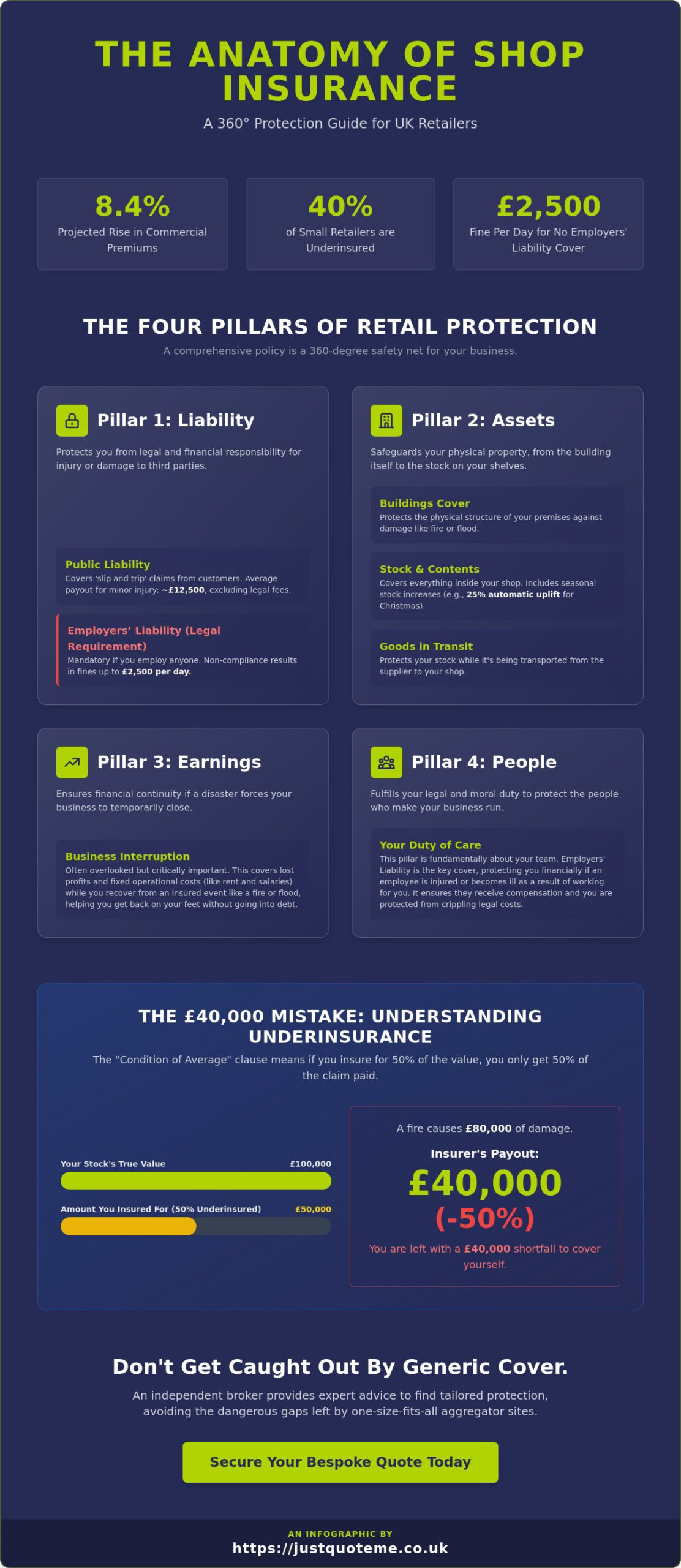
A robust shop insurance policy functions like a 360-degree safety net. It rests on four pillars: Assets, Earnings, Liability, and People. While basic covers protect against obvious threats, “all-risks” cover provides the highest level of security. It protects against any accident or event not specifically excluded in the policy wording. This comprehensive approach ensures your business stays resilient against the unexpected, allowing you to focus on daily operations rather than potential disasters.
Protecting Your Assets: Buildings, Stock, and Contents
Buildings cover protects the physical structure of your premises. In contrast, commercial property insurance often includes broader protections for landlords or complex retail units. You must value stock accurately to avoid being under-insured. Statistics from 2024 suggest that 40% of small retailers are under-insured because they fail to update their valuations. Many policies allow for a 25% automatic increase in stock sum insured during peak periods like November and December. Don’t forget goods in transit. Your items are at risk from the moment they leave the wholesaler until they reach your shelves. Items stored off-site in warehouses also require specific mention in your shop insurance schedule.
Safeguarding Your Revenue: Business Interruption
Business Interruption (BI) is frequently overlooked by new business owners. It covers lost profit and fixed costs if a disaster like a fire or flood forces you to close. The Association of British Insurers (ABI) provides a helpful guide to business insurance that explains how BI keeps a business solvent during lengthy repairs. In 2026, choosing a 24-month or 36-month indemnity period is often wiser than the standard 12 months. Construction lead times for retail fit-outs increased by 15% between 2023 and 2025, making short recovery windows increasingly risky for modern retailers.
Liability and Legal Expenses
Every customer-facing business needs public liability insurance. This covers claims if a visitor slips on a wet floor or is injured by a falling display. You also need product liability. Even if you didn’t manufacture a faulty item, the Consumer Protection Act 1987 can hold you liable as the seller. Legal expenses cover is another vital add-on. It handles the costs of employment tribunals or unexpected tax investigations. These legal battles can be financially draining, so having a professional legal team behind you is a pragmatic choice for any shop owner. If your retail business operates as a limited company, it’s also worth considering directors and officers insurance to protect the personal assets of your board members against claims arising from their management decisions.
Tailoring Your Coverage: Specialist Protection for Different Retail Sectors
A “one size fits all” policy is a dangerous trap for UK retailers. A high street newsagent faces entirely different threats than a boutique in a city centre shopping mall or a local independent florist. If you rely on generic cover, you’ll likely find gaps when you need to claim. High street shops often deal with higher footfall and increased theft risks, while independent businesses might struggle more with supply chain disruptions that halt their trade. Every shop insurance policy needs to be as unique as the inventory on your shelves.
Modern retail is also evolving into a hybrid model. Since roughly 26% of UK retail sales now involve an online component, your protection must bridge the gap between the physical and digital worlds. Your point-of-sale (POS) systems are essential for daily trade, but they’re also targets for data breaches. It’s vital to include cyber liability insurance to protect against system hacks and the loss of sensitive customer information. Under the Employers’ Liability (Compulsory Insurance) Act 1969, you’re legally required to cover your staff for at least £5 million, but a tailored package ensures your specific trade risks don’t leave your finances vulnerable. If your retail operation also includes an administrative or back-office function, reviewing a dedicated office insurance guide for 2026 can help ensure those spaces and the equipment within them are equally well protected.
Hospitality and Food Services
Businesses like restaurants and takeaways manage high-heat environments and perishable stock. Fire risks from commercial kitchens and claims regarding food poisoning are your primary concerns. If you serve alcohol, you need specific liability cover for incidents related to your license. Don’t forget outdoor seating. If you’ve secured a pavement license for tables and chairs, your public liability must extend to the street to cover trips or spills.
Service-Based Retail: Salons and Barbers
For hair and beauty businesses, standard public liability isn’t enough. You need professional indemnity insurance to cover “treatment risks,” such as a client having an adverse reaction to a chemical peel or hair dye. These “close contact” services carry unique liabilities that generic retail policies ignore. You also need to ensure your specialist equipment and chemical storage are covered against accidental damage, leaks, or theft.
Niche and High-Value Retailers
High-value retailers like jewellers or high-end fashion boutiques require enhanced security protocols to remain insurable. Insurers often mandate specific alarm grades or reinforced shutters for these premises. In these high-risk environments, security company insurance ensures your protection measures meet the rigorous standards required by the industry. Bespoke shop insurance policies account for unique inventory like antiques or electronics by using agreed-value assessments rather than simple market replacement rates.
How to Calculate Your Coverage Needs and Avoid Underinsurance
Underinsurance occurs when your policy limit is lower than the actual cost of replacing your assets. It remains the most common reason for insurers to only pay a fraction of a claim in the UK. If you estimate your contents at £50,000 but the true replacement value is £100,000, you are 50% underinsured. This triggers the “Condition of Average” clause. Under this rule, the insurer reduces your payout by the same percentage you are underinsured. In this example, a £10,000 fire claim would only result in a £5,000 payout; this leaves you to find the remaining £5,000 yourself. For a broader view of every coverage gap your business might face, our small business insurance UK checklist for 2026 walks you through each essential policy type in detail.
Valuing Your Stock and Equipment
Always calculate your shop insurance totals based on “replacement cost” rather than “market value.” Market value accounts for depreciation, but you need enough funds to buy brand-new equipment if yours is destroyed. Don’t forget to include “hidden” assets like bespoke signage, professional window displays, and any permanent improvements you’ve made to a rented unit. For stock, check your records for peak periods. Retailers often see stock levels rise by 30% or more during the final quarter of the year. You should ensure your policy includes a seasonal increase clause so you aren’t paying for high cover levels in quiet months like January. Retailers who also manage office-based operations should be aware that equipment such as computers and printers may require separate office insurance to be fully covered under their commercial arrangements.
- Electronic Point of Sale (EPOS) systems and card machines.
- Shelving, racking, and specialized lighting.
- Current stock at its highest anticipated volume.
- Tenant improvements such as flooring, partitions, and decor.
Setting Your Liability Limits
Public liability cover typically starts at £2 million, but this isn’t always enough for modern retail environments. Many UK local authorities and commercial landlords now require a minimum of £5 million or even £10 million as a condition of your lease. Assess your “worst-case scenario” carefully. If your shop is in a high-footfall area, a single trip-and-fall accident involving multiple people could quickly exceed a lower limit. We recommend reviewing these figures at every renewal. High inflation rates throughout 2024 and 2025 mean that the cost of materials and legal fees has risen sharply, making older limits potentially obsolete. A quick review every six months helps you stay protected in a fluctuating economy. For incorporated retail businesses, personal exposure doesn’t end with liability limits; reviewing directors and officers insurance alongside your shop policy ensures your leadership team’s personal finances are equally well protected.
Why an Independent Broker Beats the Aggregators for Shop Insurance
Price comparison websites offer a faceless, automated experience that often prioritises the lowest headline figure over actual business security. These aggregators rely on rigid algorithms to categorise your retail business; they don’t understand the nuances of a high-street boutique or a specialist hardware store. An independent broker provides a human alternative. We don’t just process data; we provide professional advice backed by access to a panel of more than 20 of the UK’s leading underwriters. The “Just Quote Me” philosophy is built on being professional, efficient, and straightforward. We do the heavy lifting so you don’t have to spend your day filling out repetitive forms.
The Advantage of Expert Advice
Brokers are trained to identify hidden risks that standard online forms usually overlook. A generic form might miss the fact that your stock value increases by 30% during the peak seasonal months of November and December. It might also fail to specify the correct cover for high-value glass frontages or outdoor signage. If you ever need to make a claim, having an advocate in your corner makes a massive difference. We manage the dialogue with insurers and handle the paperwork; this ensures you receive a fair settlement without the stress of dealing with a call centre. This personal touch is particularly valuable for businesses in Staffordshire and the West Midlands. We understand the local economic climate and provide a level of service that faceless national platforms simply cannot match.
Saving Time and Money Without Cutting Corners
Efficiency shouldn’t mean compromising on quality. We compare the market on your behalf, which saves you hours of manual data entry and research. Because we have access to specialist schemes not available on consumer comparison sites, we can often secure more robust protection for a more competitive price. Choosing a broker means you get a policy that is built for your specific needs rather than a “one size fits all” product. This ensures your shop insurance performs exactly as expected when you need it most. Don’t leave your livelihood to chance with a generic algorithm. Just Quote Me for your bespoke shop insurance today and secure a quote that actually fits your business.
Future-Proof Your UK Retail Business
Navigating the retail landscape in 2026 requires more than just a great product range. It demands a robust safety net that evolves with your business. You’ve seen why tailored coverage is vital and how avoiding underinsurance protects your bottom line from unexpected claims. Relying on an independent broker ensures you get specialist advice that generic comparison sites often overlook. It’s about finding a policy that fits your specific trade, whether you’re a high-street boutique or a local convenience store.
JustQuoteMe brings over 30 years of industry experience to your corner. As an FCA-authorised independent UK broker, we tap into a broad network of top UK insurers to secure the right shop insurance for your needs. We handle the heavy lifting and technical jargon so you can get back to serving your customers. Our team focuses on providing a personal touch that automated algorithms can’t replicate. Don’t leave your livelihood to chance when expert protection is straightforward to arrange.
Just Quote Me for your tailored shop insurance today and start trading with complete peace of mind. We look forward to helping your business thrive.
Frequently Asked Questions
Is shop insurance a legal requirement for my UK business?
Shop insurance isn’t a single legal requirement, but employers’ liability insurance is compulsory under the Employers’ Liability (Compulsory Insurance) Act 1969 if you employ any staff. Failure to hold a valid policy can result in Health and Safety Executive (HSE) fines of up to £2,500 per day. While other covers like public liability aren’t mandated by law, most UK commercial landlords require them as a condition of your lease agreement.
How much does shop insurance typically cost in 2026?
The cost of your premium depends on your specific risk profile, location, and the level of cover you choose. Factors such as your annual turnover, the number of employees, and the total value of your stock will influence the final price. According to 2024 industry data from the British Insurance Brokers’ Association (BIBA), premiums are calculated based on individual business needs rather than a flat rate. We recommend getting a tailored quote to see your exact costs.
Does shop insurance cover me if I sell online through a website or Etsy?
Standard shop insurance policies can be extended to cover online sales made through your own website or third party platforms like Etsy. This protection is vital if you store stock at your retail premises that is destined for digital orders. You’ll need to ensure your policy includes product liability to protect against claims arising from items you’ve sold and shipped. It’s a straightforward addition that bridges the gap between your physical and digital storefronts.
What is the difference between public liability and employers’ liability?
Public liability covers claims made by members of the public, whereas employers’ liability protects you against claims from your staff. If a customer slips on a wet floor in your shop, public liability handles the legal costs and compensation. If an employee suffers an injury while stocking shelves, employers’ liability is the relevant cover. Most UK retailers combine these into a single shop insurance package to ensure they have comprehensive protection against all common workplace accidents.
Can I get shop insurance if my business is located in a high-flood-risk area?
You can still obtain cover in high-flood-risk areas, though you might face higher excesses or specific security requirements. The Flood Re scheme, established in 2016, helps keep premiums affordable for many, though it primarily targets residential properties. For commercial shops, we work with specialist underwriters who assess individual flood defences. Providing evidence of flood-resistant measures can often help in securing a more competitive rate for your business despite its geographical location.
Does my policy cover seasonal increases in stock during Christmas?
Most retail policies include an automatic seasonal increase clause that boosts your stock cover by 25% during peak periods like Christmas. This typically applies for a set window, such as 30 days before and 30 days after a public holiday. Check your policy schedule to confirm the exact percentage and the specific dates covered. It’s an efficient way to ensure you’re not under-insured when your inventory levels are at their highest during the year.
What happens if I under-declare the value of my shop contents?
Under-declaring the value of your contents triggers the “Condition of Average” clause, which reduces your claim payout proportionally. If you insure your contents for £50,000 but the true replacement value is £100,000, you’ve only covered 50% of the risk. In the event of a claim, the insurer may only pay half of the loss, even for smaller incidents. Accurate valuations are essential to ensure your shop insurance provides the full financial protection you expect.
Are shop-fronts and glass covered under a standard retail policy?
Glass and shop-front cover is a standard feature in most retail insurance packages, covering windows, doors, and even fixed signage. This protection typically includes the cost of boarding up the premises immediately after a break-in or accident. Since a broken window can halt your trading, this cover ensures your business remains secure while permanent repairs are arranged. Always verify if there are specific limits for specialist glass or bespoke window displays in your policy.
