
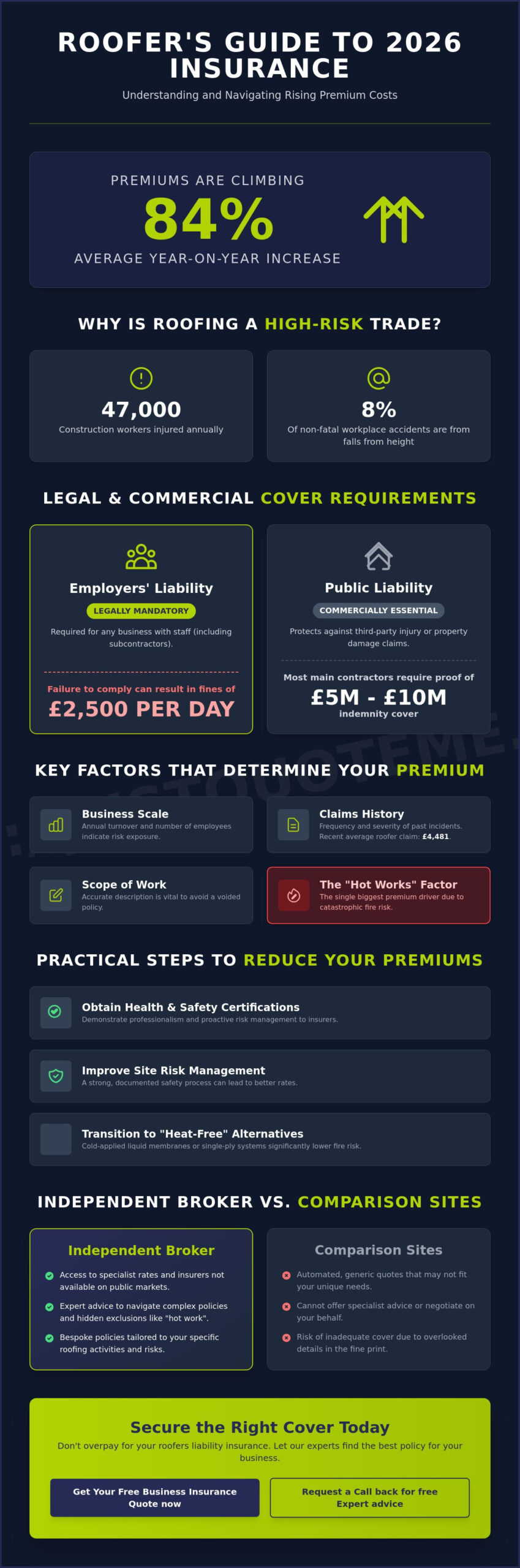
Did you know that UK roofers are currently seeing premiums rise by an average of 84% year on year? If you feel like your roofers liability insurance cost is climbing faster than you can keep up with, you aren’t alone. Between the high-risk nature of working at height and the complex “hot work” exclusions that often hide in the small print, finding affordable, comprehensive cover has become a genuine challenge for the trade.
We understand that you’d rather be on a roof than buried in paperwork. This guide breaks down the specific factors driving your 2026 premiums. Just Quote Me to simplify this process and secure the protection you need without overpaying for it. You’ll learn how to navigate legal requirements like Employers Liability, manage the risks of specialized roofing types, and ensure you’re protected against the types of accidents that injure 47,000 construction workers annually. It’s time to simplify your administrative burden and get back to business with confidence.
Get Your Free Business Insurance Quote now
Request a Call back for free Expert advice
Key Takeaways
- Understand the shifting 2026 UK insurance landscape and how current market trends directly impact your business’s bottom line.
- Identify the specific risk factors that dictate your roofers liability insurance cost, including turnover, staff count, and the use of heat.
- Learn how to build a bespoke policy by balancing essential public liability with optional protections like professional indemnity for design-led projects.
- Discover practical methods to lower your premiums through industry-recognised health and safety certifications and improved site risk management.
- Explore why working with an independent broker provides access to specialist rates and expert advice that automated comparison tools cannot offer.
Understanding Roofers Liability Insurance Cost in 2026
The 2026 UK insurance market presents a challenging environment for tradesmen. Recent industry data shows that roofers are paying an average of 84% more for public liability insurance year on year. This surge makes understanding your roofers liability insurance cost more critical than ever. While it is tempting to scan for the lowest number on a screen, the distinction between a cheap policy and adequate protection is often found in the exclusions. In a sector where risk is calculated by the metre, your premium reflects the complex nature of your specific projects.
At its core, public liability is the cornerstone of your business’s risk management strategy. To understand the basics, you might ask What is Liability Insurance? and how it applies to your trade. For roofers, this cover addresses the financial fallout if your work causes injury to a third party or damages their property. Insurers use risk-based pricing models that heavily weight factors like the height of the building and the tools you use. This means a domestic tiler will face a different cost profile than a commercial contractor working on high-rise structures.
Why Roofing is Classified as a High-Risk Trade
Insurers view roofing through the lens of strict statistics. Falling from a height accounted for 8% of all non-fatal workplace accidents in the 2023/2024 financial year, and an average of 47,000 construction workers are injured annually. These figures, combined with stringent Working at Height regulations, influence how insurers set their appetite for risk. If a tile slips or a tool falls, the resulting third-party property damage claims can reach tens of thousands of pounds, driving industry-wide premiums upward.
The Legal and Commercial Necessity of Cover
You need to distinguish between what is recommended and what is required. While public liability isn’t a legal obligation in the UK, Employers Liability Insurance is mandatory for any business with staff. Failing to hold EL cover can lead to fines of up to £2,500 for every single day you remain uninsured. Beyond the law, commercial reality dictates your coverage levels. Most main contractors and local councils now demand proof of £5 million or even £10 million in indemnity before you can even step onto a site. Liability insurance acts as a robust financial safety net that ensures a single accident or property damage claim doesn’t result in the total collapse of your roofing firm.
Get Your Free Business Insurance Quote now
Request a Call back for free Expert advice
Key Factors That Determine Your Roofing Insurance Premium
Insurance companies don’t calculate your premium based on guesswork. They use specific data points to evaluate the likelihood of a claim. Your annual turnover and the number of people you employ are the primary indicators of your business’s scale. A firm with a £500,000 turnover naturally has more exposure to risk than a sole trader. Each additional employee or subcontractor increases the statistical chance of a workplace accident, which directly influences your roofers liability insurance cost.
Your claims history is another critical driver for 2026 renewal rates. Insurers analyze both the frequency and the severity of your past incidents. Between April 2025 and March 2026, the average insurance claim for a roofer was £4,481. If your business has a pattern of small, frequent claims, underwriters may view this as a sign of poor site management. Maintaining a “clean” record is your best bargaining chip when looking to secure competitive roofing insurance. Accuracy in your trade description is equally vital. If you fail to disclose the full scope of your work, you risk a voided policy when you need it most.
The National Federation of Roofing Contractors highlights that professional standards and risk assessment are the foundation of a sustainable business. Aligning your operations with these standards helps demonstrate to insurers that you’re a lower-risk prospect.
The “Hot Works” Premium Hike
The use of heat is the single biggest factor that can cause your premium to skyrocket. Hot works involve blow torches, bitumen boilers, or any tool that produces a flame or spark. Insurers treat these activities with extreme caution because the resulting fire damage is often catastrophic. If you can transition to “heat-free” roofing alternatives, such as cold-applied liquid membranes or single-ply systems, you’ll find insurers are far more receptive. Reducing or eliminating heat-related risks is one of the most effective ways to lower your roofers liability insurance cost without compromising on your level of protection.
Height Limits and Location Risks
Standard policies often include a height limit, typically set at 10 or 15 metres. If your projects involve church spires, high-rise flats, or industrial warehouses, you’ll need specialized cover that accounts for these heights. Location also plays a role. Working in high-density urban areas like London often carries a higher premium due to the increased risk of third-party property damage and higher local claim costs. Specialized projects, such as thatched properties or hospitals, require bespoke terms because the cost of a mistake in these environments is significantly higher than on a standard domestic dwelling.
If you’re unsure how your current projects are affecting your rates, it’s worth speaking to a specialist at Just Quote Me to ensure your policy matches your actual workload.
Get Your Free Business Insurance Quote now
Request a Call back for free Expert advice
Comparing Essential vs. Optional Roofing Covers
While Public Liability is the foundation of your protection, it is rarely the only cover a professional firm requires. Just Quote Me to build a bespoke policy at Just Quote Me that aligns perfectly with your project scale. For design-and-build roofers, professional indemnity is a critical addition. If you specify a roofing system or drainage layout that later fails due to a design flaw, public liability won’t cover the professional error. Adding this protection increases your roofers liability insurance cost slightly, but the cost-to-benefit ratio is clear when compared to the price of a total roof replacement or a legal battle over professional negligence.
For larger contracts, Contractors All Risk Insurance becomes a necessity. This cover protects the work in progress, materials on site, and temporary structures from perils like fire, flood, or vandalism. If a severe storm destroys a partially completed roof, this insurance covers the cost of the materials and labour to redo the work. Bundling these covers into a single package is often more efficient than managing separate policies and can lead to overall premium discounts that make high-level protection more affordable.
Protecting Your Assets: Tools and Plant Insurance
The rising cost of tool theft is a major concern for the trade. In London alone, there was a 60% increase in tool theft from vans between 2020 and 2023. This trend makes tool cover an essential business expense rather than an optional extra. You need to distinguish between your owned tools and hired-in plant. If you use heavy equipment, Plant and Machinery Insurance provides the specific protection needed for excavators or cherry pickers that you don’t own but are responsible for while they are on your site. Protecting these assets ensures that a single theft doesn’t halt your operations for weeks.
Personal Accident and Income Protection
Sole traders often overlook personal accident cover, yet injury-related downtime can be financially devastating. With 47,000 construction workers injured annually, the risk of being unable to work is statistically high. Falling from height accounts for 8% of non-fatal workplace accidents, and the resulting loss of income often far exceeds the annual roofers liability insurance cost. Legal expenses cover is another valuable option, providing the financial backing needed to handle contract disputes or late payment issues without draining your business reserves. These optional covers transform a basic policy into a robust safety net for your livelihood.
Get Your Free Business Insurance Quote now
Request a Call back for free Expert advice
How to Reduce Your Roofers Liability Insurance Cost
Lowering your roofers liability insurance cost isn’t about cutting corners on cover; it’s about presenting your business as a lower risk to underwriters. By demonstrating a commitment to safety through recognised health and safety certifications like CHAS or SafeContractor, you provide underwriters with tangible evidence that your business operates above industry standard. These accreditations often trigger premium discounts because they suggest a lower likelihood of the types of workplace accidents that lead to expensive claims.
A strategic way to manage your annual spend is through the use of voluntary excess. While every policy has a mandatory excess, choosing to increase your voluntary contribution can significantly lower your monthly or annual payments. This signals to the insurer that you’re confident in your site management and safety protocols. It’s a calculated trade-off that helps manage cash flow, provided you keep the excess amount accessible in your business account. You should also avoid the “last-minute” trap by starting your renewal process at least 21 days before your current policy expires. Insurers often reserve their most competitive rates for proactive businesses rather than those seeking emergency cover at the eleventh hour.
Investing in Risk Management
Documented safety protocols are a powerful negotiation tool. When you can show an underwriter evidence of regular staff training and consistent PPE usage, you separate your firm from higher-risk competitors. For those involved in flat roofing or repairs, the implementation of “Hot Work Permits” is essential. These permits ensure that a formal fire safety check is conducted before and after any heat application, which can directly lower the fire-risk loading on your premium. A clean safety record is the most powerful tool for long-term cost reduction.
Choosing the Right Indemnity Limit
Determining whether you need £1 million, £5 million, or £10 million in cover depends entirely on your contract requirements. While £1 million used to be the standard, many commercial clients and local authorities now insist on £5 million as a minimum. Before you buy, assess your largest potential contract for the year. Interestingly, the cost difference between these tiers is often smaller than you might expect. Paying a slightly higher premium for a £5 million limit is frequently more cost-effective than having to upgrade your policy mid-year to secure a specific job. To find a balance that fits your budget, you can compare tailored roofing policies that grow with your business.
Get Your Free Business Insurance Quote now
Request a Call back for free Expert advice
Why an Independent Broker Beats Comparison Sites for Roofers
While automated comparison sites promise speed, they often fail to capture the nuances that dictate your actual roofers liability insurance cost. Algorithms are designed for standard, low-risk businesses; they frequently struggle with the specific complexities of high-altitude work or the use of bitumen boilers. Just Quote Me to access “broker-only” rates that are never published on public aggregators. These exclusive markets often provide more competitive pricing because they trust the professional risk assessment of an established broker over a generic online form.
Our deep roots in Staffordshire and the West Midlands mean we understand the local commercial landscape. Whether you’re a firm in Stafford or a contractor in the wider West Midlands, regional expertise ensures your policy reflects the specific risks of your area. We don’t just provide a document; we offer a steady hand in a complex market. By choosing a specialist over an algorithm, you ensure that your roofers liability insurance cost is a true reflection of your business’s safety standards rather than a generic industry average.
Bespoke Policies vs. Off-the-Shelf Templates
Off-the-shelf templates frequently contain hidden exclusions for specific roofing activities, such as working on thatch or exceeding standard height limits. These gaps only become apparent when a claim is rejected. With over 30 years of industry experience in Stone and Stafford, we tailor the policy wording to your daily operations. This precision ensures you aren’t paying for unnecessary cover while guaranteeing you’re protected for the work you actually do. We take the time to understand your specific trade description, which is the most effective way to secure reliable tradesman insurance.
Expert Support When Things Go Wrong
The real value of an insurance partner is revealed when things go wrong. A call centre operative follows a script, but a dedicated broker acts as your trusted advisor. Just Quote Me to manage the administrative burden of a claim so you can focus on your projects. We handle the complex communication with underwriters and ensure that the process is as frictionless as possible. Having a human-centric alternative to automated systems means you have an expert in your corner who understands the nuances of the roofing sector. This support is vital for protecting your business’s reputation and financial stability.
Get Your Free Business Insurance Quote now
Request a Call back for free Expert advice
Protect Your Business and Your Bottom Line
Managing your roofers liability insurance cost effectively requires a balance of proactive risk management and expert advice. By securing the right certifications and choosing indemnity limits that reflect your actual contract needs, you position your firm as a lower risk in a challenging market. Moving away from generic, off-the-shelf policies to bespoke cover ensures that your daily operations are fully protected without paying for unnecessary extras.
Just Quote Me acts as your steady hand in this complex landscape. As an FCA-authorised independent broker with over 30 years of industry expertise, we provide access to a broad network of top UK insurers that comparison sites simply cannot reach. We handle the administrative heavy lifting so you can focus on delivering high-quality roofing projects. Find the right cover for your firm today and build a more secure future for your trade. We’re ready to provide the reliable, straightforward protection your business deserves.
Get Your Free Business Insurance Quote now
Request a Call back for free Expert advice
Frequently Asked Questions
How much does roofers public liability insurance cost on average?
The cost varies significantly based on your specific activities, particularly whether you use heat application. Businesses that avoid hot works generally pay a lower baseline premium compared to those using blow torches or bitumen boilers. Your final roofers liability insurance cost is also determined by your annual turnover, the number of employees you have, and the indemnity limits required by your clients.
Is employers’ liability insurance compulsory for roofing sub-contractors?
Yes, employers’ liability is a legal requirement if you hire any staff, including labour-only sub-contractors. If you supervise their work and provide their tools, the law treats them as employees. Failing to hold this cover can result in fines of up to £2,500 for every day you are uninsured, making it an essential part of your business’s legal compliance.
Does standard roofers insurance cover “Hot Works”?
Standard policies often exclude heat application unless you specifically declare it and pay the associated premium. Hot works, such as using torches for felt roofing, carry a much higher fire risk, which insurers must account for. You must ensure your policy schedule explicitly mentions heat use to avoid having a claim rejected due to a “hot work” exclusion clause.
What happens if I work above my policy’s height limit?
Working even one metre above your specified height limit will typically void your insurance cover for that entire project. Most policies include a strict 10m or 15m cap as standard. If an accident occurs while working at a height not disclosed to your insurer, they won’t pay out for any resulting injury or property damage claims.
Can I get temporary liability insurance for a single roofing project?
While most specialist brokers focus on annual policies to provide continuous protection, short-term cover is sometimes available for specific, one-off contracts. However, for most active tradespeople, an annual policy is more cost-effective. It ensures you’re always ready to start a new job without the administrative delay of arranging separate cover for every site you visit.
How does my claims history affect my roofing insurance premium?
A history of frequent claims suggests to underwriters that your site safety protocols may be insufficient, which leads to higher premiums. Insurers typically review your last five years of activity. Maintaining a clean record is the most effective way to keep your roofers liability insurance cost low, as it demonstrates that your business is a lower risk to the insurer.
What is the difference between public liability and contractors all risk?
Public liability protects you against claims from third parties for injury or property damage, while contractors all risk covers the physical work and materials on site. If a storm destroys a partially completed roof, public liability won’t pay for the materials to fix it, but a contractors all risk policy will. Both are vital for comprehensive business protection.
Do I need professional indemnity insurance as a roofer?
You need professional indemnity insurance if your business provides design specifications or technical advice as part of your service. If you recommend a specific roofing system or drainage layout that later fails due to a design error, this cover handles the legal costs and rectification. It’s especially important for contractors involved in design-and-build projects where professional errors aren’t covered by public liability.
Get Your Free Business Insurance Quote now
Request a Call back for free Expert advice
