

Refusing a tenant simply because they receive benefits isn’t just a missed opportunity; it could lead to a legal battle following the landmark 2020 court ruling against “No DSS” policies. We understand that finding reliable landlord insurance for dss tenants often feels like an uphill struggle against outdated systems. It’s frustrating when standard providers turn you away, especially when you’re trying to manage your risks while providing essential housing.
You deserve a straightforward way to protect your investment without the corporate jargon. This guide will help you secure specialist cover that guards against rent arrears and malicious damage while keeping you on the right side of UK law. We’ll break down the final shift from legacy benefits to Universal Credit by 2026, explain your legal requirements, and show you how to get a competitive quote from a broker who actually understands your needs. Let’s simplify the process so you can focus on your property portfolio with total peace of mind.
Key Takeaways
- Understand why “No DSS” advertisements are legally discriminatory and how to navigate the 2026 regulatory landscape to remain fully compliant.
- Learn how specialist landlord insurance for dss tenants fills the gaps left by standard policies, ensuring you have robust buildings and liability protection.
- Discover the advantage of using a specialist broker to access “non-standard” insurance markets that are typically unavailable on generic comparison websites.
- Identify the essential coverage components you need to protect your property and furnishings when letting to individuals on Universal Credit or Housing Benefit.
- See how a tailored approach to risk management can simplify the process of securing affordable, high-quality cover for complex rental scenarios.
The Evolution of Landlord Insurance for DSS Tenants in 2026
The term “DSS” remains a common shorthand in the UK rental market, even though the Department of Social Security was replaced decades ago. In 2026, this label covers tenants receiving Universal Credit or legacy Housing Benefits. Many standard home insurance providers still view these tenants as higher risk, often excluding them by default to simplify their own underwriting processes. This legacy bias means a standard policy might not protect you if your tenant isn’t in full-time professional employment.
The 2026 rental market shows a distinct shift in landlord priorities. With private sector rents rising and economic fluctuations continuing, landlords are prioritizing long-term stability over high-turnover lets. Benefit-backed tenants often provide this consistency, staying in properties for longer durations than the average professional renter. To tap into this market safely, you need landlord insurance for dss tenants that acknowledges the reality of modern renting.
DSS landlord insurance is a specialist policy that removes the restrictive “professional only” clauses found in standard contracts.
Universal Credit vs. Legacy DSS: What Landlords Need to Know
The Department for Work and Pensions (DWP) now manages the vast majority of claims through Universal Credit. For landlords, the most critical development is the streamlined use of Alternative Payment Arrangements (APAs). These allow rent to be paid directly to the landlord if a tenant falls into arrears or has specific vulnerabilities. Insurers look favorably on APAs because they provide a more reliable revenue stream. When you secure residential letting insurance, specifying the payment method can directly impact your risk profile and lead to more accurate premium costs.
Why Standard Landlord Insurance Is Not Enough
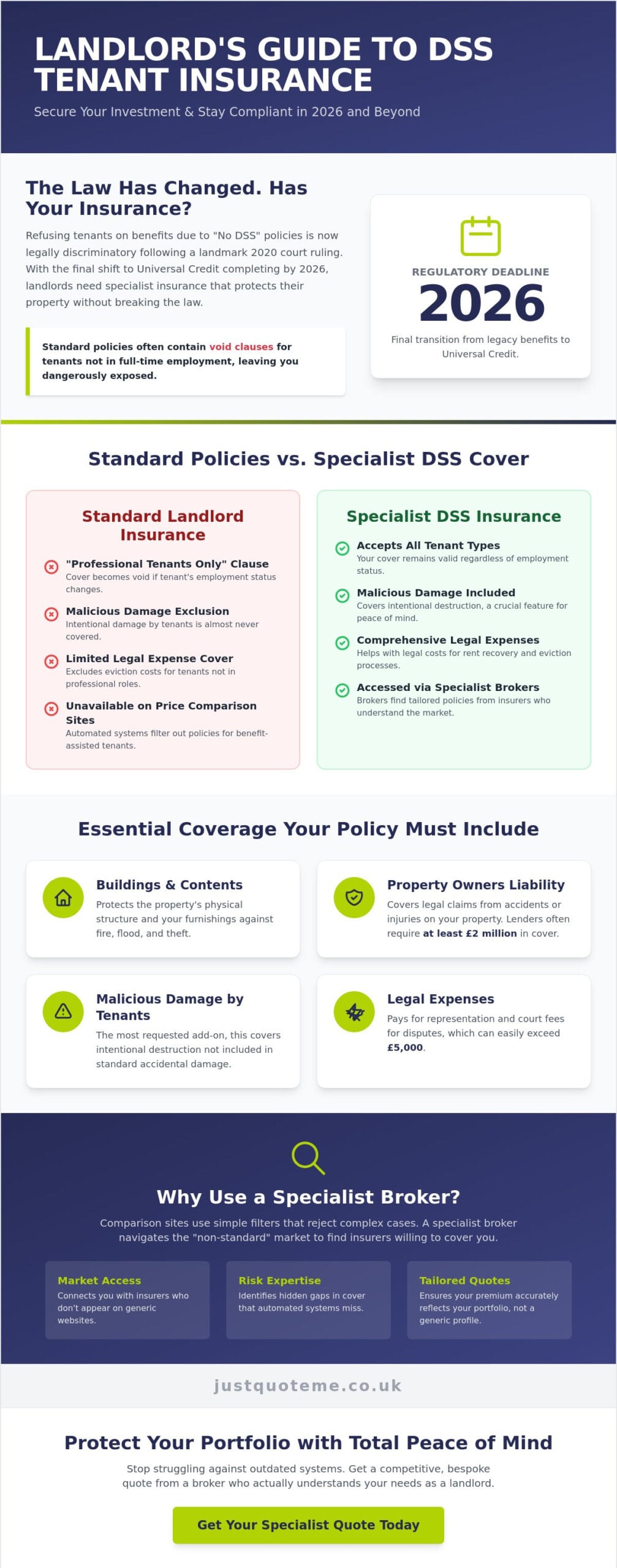
Standard policies often contain a “Professional Tenants Only” trap. If your tenant’s status changes from employed to benefit-reliant, your cover could become void instantly. These generic policies frequently exclude malicious damage or legal expenses cover for anyone not in a traditional 9-to-5 role. Managing these risks involves more than just insurance; it requires following legal requirements like tenancy deposit schemes to protect the financial interests of both parties.
Generic policies leave you vulnerable to specific exclusions that only become apparent during a crisis. An independent broker plays a vital role here, identifying hidden gaps that automated quote engines often miss. Using landlord insurance for dss tenants ensures that your buildings, contents, and loss of rent are protected regardless of the tenant’s employment status. We focus on providing a steady hand, helping you secure bespoke coverage that fits the actual profile of your rental portfolio without the corporate jargon.
Essential Coverage: What Your Specialist Policy Must Include
Specialist landlord insurance for dss tenants isn’t a luxury; it’s a structural necessity for your portfolio. Standard buy-to-let policies often exclude tenants receiving Universal Credit or Housing Benefit, which can leave you completely exposed if you don’t disclose the tenant type. A robust policy for 2026 must provide a foundation of several core covers to ensure your investment remains viable.
- Buildings and Contents: This covers the physical structure against fire, flood, and subsidence. If you let the property furnished, ensure your contents cover includes white goods and carpets, as these are frequently damaged in high-turnover tenancies.
- Property Owners Liability: This is essential for protecting you against injury claims. Most 2026 lenders require at least £2 million in liability cover to handle potential legal claims from tenants or visitors who might suffer an accident on your property.
- Malicious Damage by Tenants: This is the most requested feature for landlords working with benefit claimants. It covers intentional destruction, which is typically excluded from standard “accidental damage” clauses.
- Legal Expenses: With the 2026 regulatory environment placing stricter requirements on evictions and property standards, legal costs for disputes can easily exceed £5,000. This cover pays for professional representation and court fees.
If you’re unsure which level of cover fits your specific rental situation, you can get a tailored quote from our UK-based team today.
Rent Guarantee Insurance for Benefit Claimants
Rent guarantee cover ensures your income remains stable if a tenant’s benefit payments are delayed or stopped. For dss applicants, insurers in 2026 typically require a UK-based guarantor or a successful credit check from a recognised provider. Most policies feature a 30-day waiting period and will cover rent for up to 12 months or until you obtain vacant possession. You should check the fine print for claim limits, as some providers cap monthly payouts at £2,500.
Accidental and Malicious Damage Protection
You must distinguish between “fair wear and tear” and claimable damage to avoid rejected claims. Faded paintwork or worn carpets are maintenance issues, while a smashed internal door or a hole in the wall qualifies as damage. Specialist residential letting insurance offers higher limits for malicious acts, often up to the full sum insured. This provides a much safer safety net than standard policies, which frequently cap malicious damage at a few thousand pounds, leaving you to foot the bill for major repairs.
Evaluating Risk: Why Specialist Brokerage Beats Standard Policies
Standard comparison sites often fail landlords who accept benefits. Their algorithms are built for “standard” risks, meaning a single mention of Department for Work and Pensions (DWP) payments can trigger an instant rejection. This “Computer Says No” culture forces many property owners into expensive, generic products that might not actually provide the protection they need. Specialist brokers bypass these automated gatekeepers to access non-standard markets that are not available to the general public. These insurers understand that landlord insurance for dss tenants requires a nuanced approach rather than a blanket refusal.
The annual premium you pay is heavily influenced by factors that automated systems struggle to quantify. Tenant history and the specific property location play a massive role in how an underwriter views your risk. Your broker acts as an advocate, presenting your risk to underwriters in the best possible light to ensure they see the professional management behind the paperwork. This human intervention often results in lower premiums and more flexible terms than any algorithm could offer.
The Importance of Tailored Risk Assessment
Location and property type dictate your risk profile. A three-bedroom HMO in Stafford faces different logistical and regulatory challenges than a single-let house in Stone. Underwriters look at local crime statistics and property density when calculating costs. Providing concrete evidence of good management, such as documented quarterly inspections or a five-year history of zero claims, can significantly lower your insurance costs. For landlords with diverse portfolios, aligning your landlord insurance for dss tenants with commercial property insurance ensures that every asset is protected under a cohesive strategy.
Comparing Quotes: Price vs. Comprehensive Protection
Searching for the lowest price can be a dangerous strategy in the non-standard market. Cheap policies frequently include hidden “stingers” like a £2,500 excess for malicious damage or escape of water claims involving DSS-related tenancies. When comparing quotes, it is vital to check the financial strength of the underwriter. Look for insurers with high ratings from agencies like A.M. Best to ensure they have the capital to settle large claims quickly. Working with a dedicated broker also simplifies the administrative side of landlording. Mid-term adjustments, such as changing a tenant’s status or updating property details, are handled with a single phone call rather than through a frustrating automated portal.
Navigating the ‘No DSS’ Legal Landscape & Discrimination Laws
The UK rental market shifted permanently following landmark court rulings in 2020, which confirmed that “No DSS” advertisements are unlawfully discriminatory. These rulings established that blanket bans breach the Equality Act 2010 because they disproportionately impact women and individuals with disabilities. By 2026, the Renters’ Rights Act has further formalised these protections, making it illegal for landlords or letting agents to apply blanket policies against tenants who receive benefits. Securing the right landlord insurance for dss tenants isn’t just a matter of financial protection; it’s about staying on the right side of the law while opening your property to a wider pool of reliable renters.
A common misconception persists that insurance companies force landlords to reject benefit claimants. While some standard, “off-the-shelf” policies previously included restrictive clauses, modern specialist cover is built to be inclusive. We help you find policies that focus on the tenant’s individual risk profile rather than the source of their income. Having professional cover in place means you can assess every application on its merits, ensuring you don’t miss out on quality tenants due to outdated administrative hurdles.
Staying Legally Compliant as a Landlord
Compliance is a major priority under the 2026 regulations. Including Legal Expenses cover in your policy provides a vital safety net if you face a discrimination claim or a dispute over tenant selection. You should document your selection process clearly, using objective criteria like affordability ratios and previous landlord references. Don’t rely on outdated advice from internet forums. Reliable landlord insurance for dss tenants is often contingent on following a fair, documented process that proves you haven’t discriminated based on income source.
Mitigating the Risk of Arrears
Managing financial risk is straightforward when you follow your insurer’s guidelines. Most providers require a comprehensive credit reference or a UK-based guarantor as a condition of the policy. These steps don’t just protect the insurer; they safeguard your rental income. If you’re currently renovating a property to meet social housing standards, you might also need builders insurance to cover the structure during the works. Regular property inspections, typically every six months, are also essential to validate your coverage and catch maintenance issues early. This proactive approach keeps your investment secure and your tenants’ living standards high.
Securing Bespoke Landlord Insurance with Just Quote Me
Finding reliable landlord insurance for dss tenants shouldn’t feel like a full-time job. Our philosophy at Just Quote Me is simple: we strip away the complexity so you can focus on managing your properties. We’ve spent over 30 years building relationships with a broad panel of UK insurers who specialize in Universal Credit and DSS risks. This access allows us to find coverage options that standard price comparison sites often miss or automatically decline.
We pride ourselves on being a human-centric alternative to the faceless, automated algorithms that dominate the modern insurance market. When you call us, you speak to a specialist who understands that every tenancy is different. We don’t believe in “one size fits all” policies. Instead, we use our expertise to tailor your protection, ensuring you aren’t paying for unnecessary extras while keeping your core liabilities covered. It’s about providing a steady hand in a market that is often seen as high-risk.
- Access to specialist insurers who accept DSS and Universal Credit tenants.
- Direct access to UK-based experts, not automated chatbots.
- Proactive renewal management to keep your premiums competitive year after year.
- Bespoke policy structures for single lets or multi-property portfolios.
The Broker Advantage in the West Midlands
Geography plays a significant role in insurance risk profiling. We provide localized support for landlords in Newcastle-under-Lyme, Stone, and Stafford, offering a level of insight that national brokers often lack. Since we opened our doors in 1989, we’ve helped thousands of property owners navigate shifting government benefit schemes. This deep-rooted experience in the West Midlands means we understand the local rental market dynamics and how they impact your premiums. If you manage properties for others, we also provide professional indemnity insurance to safeguard your business against professional errors or omissions.
Getting Started: Your No-Nonsense Quote
We’ve streamlined our process to be as fast as possible. To secure a quote for landlord insurance for dss tenants, you’ll need your property’s rebuild value, the tenancy agreement type, and any claims history from the last five years. Our team handles the technical jargon and the negotiations with underwriters on your behalf. We also manage mid-term changes, such as when a tenant moves out or if you decide to renovate the property. Accuracy is vital, so we ensure every detail is captured correctly from the start. Just Quote Me for your specialist landlord insurance today and get the protection your investment deserves.
Future-Proof Your Rental Portfolio for 2026
The UK rental market in 2026 requires a proactive approach to risk management. Relying on standard policies often leads to rejected claims or legal complications, especially as discrimination laws become more stringent. Specialist landlord insurance for dss tenants provides the necessary safety net, covering specific risks that generic providers frequently exclude. By choosing a bespoke policy, you ensure your property remains a viable, protected asset regardless of tenant status.
Just Quote Me leverages 30+ years of insurance brokerage experience to find the right fit for your portfolio. We’re FCA-authorised UK specialists with direct access to non-standard insurance markets not found on comparison sites. Our team simplifies the process, moving you from inquiry to protection without the corporate jargon. We’re here to act as your trusted advisor, ensuring you get the comprehensive coverage your business deserves.
Get a Tailored Landlord Insurance Quote from Just Quote Me
Let’s take the stress out of your insurance renewals so you can focus on managing your properties with confidence.
Frequently Asked Questions
Is it illegal to refuse DSS tenants in 2026?
It’s illegal to implement blanket bans on tenants who receive benefits. Following the landmark 2020 ruling at York County Court, refusing applicants simply because they claim Universal Credit is considered indirect discrimination under the Equality Act 2010. You must treat every applicant fairly by assessing their individual ability to pay the rent rather than dismissing them based on their income source.
Do I have to tell my insurer if my tenant starts claiming benefits?
You must inform your insurance provider immediately if your tenant’s financial circumstances change. This is a material fact that can affect your policy’s risk profile and premium. If you don’t disclose that you’re using landlord insurance for dss tenants, your insurer might refuse to pay out when you try to make a claim for property damage or loss of rent.
What is the average cost of landlord insurance for DSS tenants?
While prices fluctuate, industry data from NimbleFins indicates that standard landlord insurance averages around £170 per year. When you house tenants on benefits, you can expect a premium increase of 10% to 25% depending on the provider. Your final quote depends on specific factors like the property’s postcode, the rebuild cost, and whether you’ve made claims in the last five years.
Can I get rent guarantee insurance for tenants on Universal Credit?
You can secure rent guarantee insurance for tenants on Universal Credit, but you’ll need to meet strict referencing criteria. Most insurers insist the tenant passes a professional credit check or provides a UK-based guarantor who earns at least 30 times the monthly rent. This protection is vital for maintaining your cash flow if the tenant’s benefit payments are delayed or reduced.
Does DSS landlord insurance cover malicious damage?
Malicious damage by tenants is typically an optional add-on rather than a standard feature. This cover protects your investment if a tenant intentionally destroys parts of the property, which is different from accidental damage or general wear and tear. You should check your policy wording carefully to ensure this extension is active, as it provides peace of mind when managing high-turnover rentals.
What happens if my DSS tenant falls into arrears?
If your tenant misses a payment, you should notify your insurer within the timeframe stated in your policy, which is usually 30 days. You’ll need to follow the legal eviction process, starting with a Section 8 notice under the Housing Act 1988, to remain eligible for a rent guarantee claim. Always keep a written record of all payment requests and correspondence to support your case.
Will my insurance be valid if the council pays the rent directly to me?
Your insurance stays valid if you receive direct payments through an Alternative Payment Arrangement from the DWP or local council. Many specialist providers actually prefer this setup because it lowers the risk of rent arrears. Just make sure your broker knows about this arrangement so they can tailor your landlord insurance for dss tenants to reflect the correct payment method.
Do I need a guarantor for a DSS tenant to be insured?
While a guarantor isn’t always mandatory for basic buildings cover, most insurers require one for rent guarantee and legal expenses policies. A UK-based homeowner guarantor provides a secondary layer of financial security, making the risk more acceptable to underwriters. Having a guarantor in place often gives you access to a wider range of competitive insurance products and lower excesses.
