

Imagine arriving at a job site only to find your van empty or facing a claim for accidental damage that could cost you thousands. For many, the average insurance claim for a carpenter reached £3,804 in the past year, a figure that can easily wipe out months of hard work. You’ve spent years perfecting your craftsmanship, and it’s frustrating when complex paperwork or high tool replacement costs stand in your way. Securing the right insurance for a carpenter self-employed isn’t just about ticking a box for site access; it’s about protecting your livelihood and your reputation with a policy that actually fits your day to day reality.
We understand that your time is best spent at the bench, not deciphering legal jargon. This 2026 guide will help you master the complexities of self-employed carpentry insurance so you can ensure full legal compliance and peace of mind. We’ll break down exactly how to protect your tools overnight and how to secure bespoke cover that meets the specific demands of the UK’s £390 billion construction market. By the end of this article, you’ll know how to simplify your administration and get back to work with total confidence. When you want to protect your future without the stress, Just Quote Me.
Get Your Free Business Insurance Quote now
Request a Call back for free Expert advice
Key Takeaways
- Understand the critical differences between standard business policies and specialist cover designed for both structural timber work and delicate finishing.
- Ensure you meet all 2026 legal requirements, including why even short-term apprentices make Employers Liability Insurance a mandatory necessity.
- Learn how to accurately inventory your machinery and assess your workspace to secure the most precise insurance for a carpenter self-employed.
- Navigate the contractual obligations of your business structure to understand how being a sole trader or a limited company shifts your legal liability.
- Discover the advantage of using an independent broker to move beyond generic algorithms and build a bespoke policy tailored to your specific trade.
Understanding Your Risks: Why Self-Employed Carpenters Need Specialist Insurance
Carpentry is a trade defined by its diversity. One week you might be installing structural timber frames for a new build; the next, you’re fitting delicate, hand-finished joinery in a high-end domestic property. This range of work carries a unique risk profile that generic small business policies often struggle to cover. Standard insurance packages frequently use broad categories that might exclude specific high-risk activities, such as working at height or using certain heat-application tools. Securing specialized insurance for a carpenter self-employed ensures that your specific daily tasks are actually protected, rather than just mentioned in a vague policy summary.
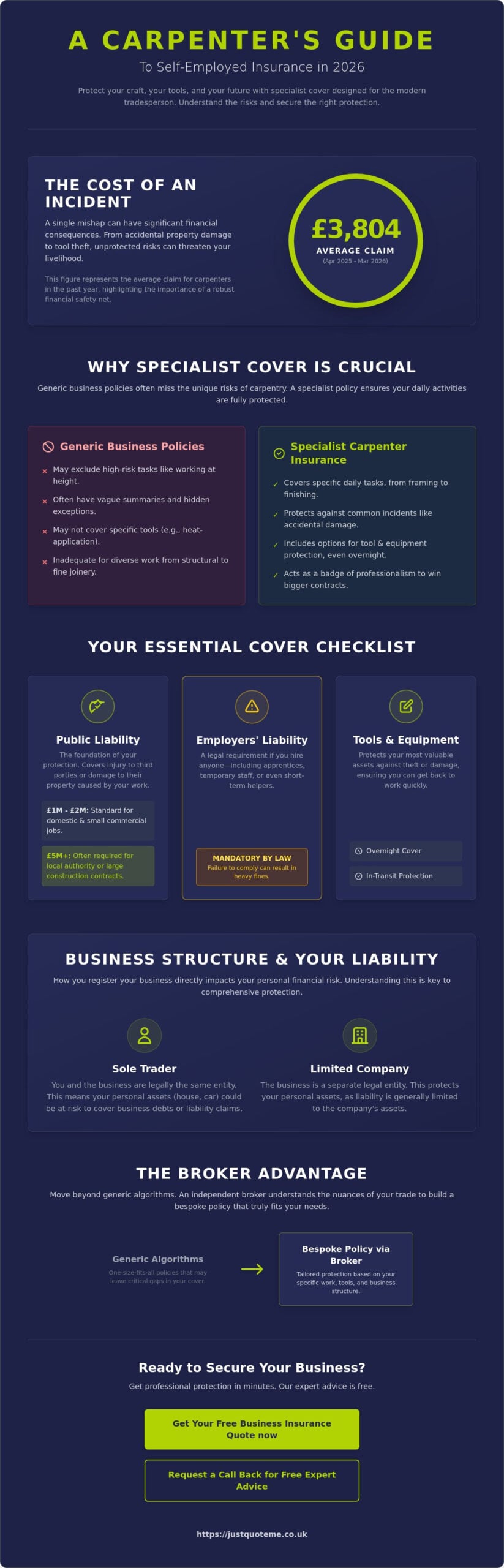
The financial reality of working without professional backing is sobering. Data shows that the average claim for carpenters was £3,804 between April 2025 and March 2026. While that figure represents a typical incident, a major structural error or a significant fire could result in costs reaching tens of thousands of pounds. Beyond the financial safety net, robust cover serves as a vital tool for business growth. Most major contractors and savvy homeowners now demand proof of Public Liability Insurance before you’re even allowed to unload your tools. It’s a badge of professionalism that validates your craftsmanship and gives your clients the confidence to hire you over an uninsured competitor.
The High Cost of Small Mistakes
In the world of carpentry, even a minor oversight can lead to a massive bill. Consider a common scenario: you’re fitting a bespoke kitchen and a hidden pipe is accidentally nicked behind a cabinet. By the time the leak is discovered, water has warped the floorboards and damaged the ceiling of the room below. Without a tailored tradesman insurance policy, you’d be personally liable for the repairs. Similarly, fine sawdust from sanding can settle into expensive electronics or high-value soft furnishings. Specialist cover accounts for these domestic hazards, ensuring that accidental damage to a client’s property doesn’t end your career.
Protecting Your Reputation in Staffordshire
Building a reputation as a reliable tradesman in areas like Stafford, Stone, and across the West Midlands takes years of hard work. Being fully insured is a cornerstone of achieving “trusted trader” status within the local community. Local knowledge is essential here; risk levels can vary depending on whether you’re working on historic timber-framed buildings in rural Staffordshire or modern commercial sites in the city. By choosing insurance for a carpenter self-employed that recognizes these regional nuances, you position yourself as a steady hand in the local market. This professional transparency is often the deciding factor when bidding for larger local authority contracts or high-profile commercial projects.
Get Your Free Business Insurance Quote now
Request a Call back for free Expert advice
The Essential Cover Checklist: Public Liability, Tools, and Beyond
Building a robust safety net requires a clear understanding of which covers are mandatory and which are simply sensible. Choosing the right insurance for a carpenter self-employed involves more than just picking the cheapest option; it’s about matching your policy to the specific scale of your projects. While Public Liability is the foundation of most tradesman policies, your business structure and the presence of any helpers will dictate your legal obligations. It’s vital to get these details right from the start to avoid expensive gaps in your protection.
Public Liability for Carpenters
This is the bedrock of your protection. Public Liability Insurance covers you if a third party is injured or their property is damaged because of your work. In the UK, most joiners opt for limits of £1 million, £2 million, or £5 million. The higher limits are often required when working as a subcontractor for local authorities or larger construction firms. You must check your policy for specific exclusions. Many standard documents exclude claims related to working at heights above a certain limit or the use of heat equipment like blowtorches. Ensure your broker knows exactly what tools you use so these activities are explicitly covered.
If you take on an apprentice or even a casual laborer for a single afternoon, Employers Liability Insurance becomes a legal requirement. In the UK, you must have at least £5 million of cover if you employ anyone. The penalties for non-compliance are severe, with fines of up to £2,500 for every day you are uninsured. This isn’t just about full-time staff; it applies to subcontractors and students on work experience too. For those pursuing high-level contracts, reviewing standards like the Federal Contractor Insurance Requirements provides a useful benchmark for the rigorous liability expectations often found in government-level sub-contracting.
Tools and Van Insurance: Guarding Your Livelihood
Tool theft is a significant pain point for tradesmen, yet many are surprised when their claim is rejected. The “overnight in van” clause is a common sticking point. To ensure a payout, most insurers require your van to be fitted with specific security measures, such as deadlocks or a Thatcham-approved alarm. They may also stipulate that the vehicle must be parked in a locked garage or a secure driveway after a certain hour. When setting up your Van and Tools Insurance, you’ll need to choose between “new-for-old” cover, which replaces stolen items with brand-new equivalents, or “indemnity value,” which only pays out the current market value of your used tools. Given how quickly the cost of power tools adds up, new-for-old is often the more pragmatic choice for a busy professional.
For carpenters who provide design work or specialized advice, Professional Indemnity Insurance is essential. This protects you if a client suffers a financial loss due to a mistake in your plans or technical recommendations. If you manage larger residential projects from start to finish, Contractors All Risk Insurance provides comprehensive protection for the work in progress, including materials on-site before they are installed. Balancing these various covers can feel complex, but a quick conversation with a specialist can simplify the entire process. You can find out more about tailoring these options by visiting our tradesman insurance page.
Get Your Free Business Insurance Quote now
Request a Call back for free Expert advice
Sole Trader or Limited Company: Navigating Legal and Contractual Obligations
Your choice of business structure significantly impacts how the law views your personal financial exposure. For sole traders, there’s no legal distinction between personal assets and business debts. If a claim exceeds your cover limits, your personal savings or property could be at risk. Conversely, a limited company provides a protective barrier, but it also introduces more complex administrative requirements. Understanding these differences is a fundamental step in launching any trade business. For those still in the planning stages, the SBA guide to business insurance provides a helpful overview of how these structures interact with liability protection.
When you’re bidding for contracts with local councils or large-scale developers, they’ll prioritize your compliance over your business size. These organizations often set strict minimums for insurance for a carpenter self-employed, frequently demanding at least £5 million in public liability. Failing to meet these contractual obligations won’t just lose you the job; it can lead to legal disputes if a project is delayed because your cover was inadequate. To stay competitive and legally sound, you need to ensure your policy levels align with the specific demands of the 2026 construction market. If the paperwork feels overwhelming, Just Quote Me.
The Legal Requirement for Employers Liability
Many sole traders fall into the “apprentice trap” by assuming they don’t need Employers Liability Insurance because they don’t have full-time staff. However, the law is very clear: if you hire a casual laborer, a student on work placement, or even a part-time apprentice for a single day, you must have this cover. Non-compliance is a serious offense that can result in a fine of up to £2,500 for every single day you operate without it. If your project requires extra hands for just a few weeks, you can often add temporary staff to your policy to ensure you’re protected without paying for a full year of unnecessary cover.
Contractual Compliance for Site Work
Working on new builds or large extensions often involves Joint Contracts Tribunal (JCT) agreements. These contracts frequently mandate Contractors All Risk Insurance to protect the works in progress and the materials on-site. This cover is vital because it protects the structure you’re building before it’s officially handed over to the client. Without it, a fire or flood on a half-finished site could leave you financially responsible for the entire rebuild. Ensuring your insurance for a carpenter self-employed includes these site-specific protections is essential for anyone moving beyond small domestic repairs into larger residential or commercial developments.
Get Your Free Business Insurance Quote now
Request a Call back for free Expert advice
Assessing Your Risk: How to Calculate Your Ideal Coverage Levels
Determining the right amount of cover doesn’t have to be a guessing game. To secure effective insurance for a carpenter self-employed, you need a clear-eyed assessment of your daily exposure that goes beyond basic compliance. This process involves looking at the physical and legal environment where you work to ensure your policy limits match the reality of your contracts. By following a structured approach, you can avoid the twin traps of paying for unnecessary extras or leaving yourself dangerously exposed to high-value claims that your current policy cannot handle.
Valuing Your Kit Correctly
Most tradespeople start by listing their expensive power tools, but a truly accurate inventory must go much deeper. Clamps, specialized blades, and even high-end consumables like premium adhesives and fixings add up to a significant sum over time. If you operate a workshop with heavy equipment, you should consider Plant and Machinery Insurance to cover fixed assets that stay off-site. Accuracy is vital here because of the “average” rule used by insurers. If you under-insure your equipment, insurers may apply this rule, resulting in a pro-rata claim rejection where you only receive a fraction of the replacement cost.
Setting Your Liability Limits
While £1 million in cover might seem substantial, £5 million is rapidly becoming the new standard for commercial site access across the UK. If you’re working on-site for a major contractor, they’ll likely mandate this higher limit as a condition of your contract. Comparing the cost difference between £1 million and £2 million of Public Liability Insurance often reveals a negligible price increase, making the higher limit a pragmatic choice for those looking to grow their business. Your largest ever contract value should serve as your benchmark; if you’re working on a high-value extension, your limit must account for the total potential rebuild cost.
Your workspace also dictates your risk level. Industrial settings carry different hazards than domestic living rooms, and you must declare these specifically to your broker. You should check for “working at height” or “hot work” requirements, especially if you use heat guns for stripping or blowtorches for specific treatments. Many standard policies have height restrictions, typically around 10 to 15 meters. If your projects take you onto scaffolding for roof timber work, you need to ensure these activities are declared under a working at height provision. Consulting a specialist helps identify these trade-specific gaps that generic algorithms often miss. For a personalized look at your specific needs, you can get a tradesman insurance quote tailored to your workshop or site work.
Get Your Free Business Insurance Quote now
Request a Call back for free Expert advice
Choosing the Right Partner: The Just Quote Me Broker Advantage
Algorithms are useful for basic insurance, but they often fail to grasp the nuanced risks of a skilled trade. When you’re searching for insurance for a carpenter self-employed, you need a partner who understands that your work is more than just a general construction category. Whether you’re focused on high-end bespoke furniture, heritage joinery, or structural site work, a generic policy can leave you with significant gaps. We’ve spent 30 years serving the Staffordshire and West Midlands market, providing the local expertise needed to navigate a complex industry with confidence. Our experience allows us to anticipate the challenges you face on-site before they become financial liabilities.
Choosing an independent broker gives you an advocate in a market that can often feel impersonal. We don’t just provide a document; we provide a relationship built on reliability and technical knowledge. This is especially important as the UK construction market continues to evolve in 2026, with new regulations and higher liability expectations from main contractors. We ensure your insurance for a carpenter self-employed stays current, protecting your reputation as much as your tools. By focusing on your specific specialism, we can build a policy that reflects the actual value of your craftsmanship.
Beyond the Comparison Site
Standard comparison websites frequently overlook the specific needs of joiners. They often miss hidden exclusions related to specialized machinery, working at height, or the use of heat equipment. These “off-the-shelf” policies might look cheaper, but they can be incredibly expensive if a claim is rejected due to a technicality. Our team identifies these pitfalls early, ensuring your policy is as precise as your woodwork. We leverage a broad network of top UK insurers to secure competitive pricing while maintaining high standards of cover. You can explore our dedicated Tradesman Insurance options to see how we tailor protection for your specific business goals.
Expert Advice When It Matters
Just Quote Me is an FCA-authorised firm based in Newcastle-under-Lyme. We prioritize the human touch over automated systems because we know that tradesmen value straightforward communication. If the time comes to make a claim, you won’t be left dealing with a faceless chatbot or a scripted call center. You’ll have a direct contact who understands the local landscape and the practical pressures of your trade. We manage the complex administrative tasks and paperwork, allowing you to stay on the tools and keep your projects moving. If you’re unsure about your current coverage or need guidance on a new contract, you can Request a Call back for free Expert advice here. We take the stress out of the “back office” so you can focus on the bench.
Get Your Free Business Insurance Quote now
Request a Call back for free Expert advice
Protect Your Craftsmanship and Your Future
Navigating the construction market in 2026 requires more than just technical skill; it demands a proactive approach to risk management. By accurately valuing your tools and understanding your legal obligations regarding Employers Liability, you build a resilient business that can withstand unexpected setbacks. Securing the right insurance for a carpenter self-employed ensures that a single mistake doesn’t derail years of hard work or lead to a pro-rata claim rejection. Whether you are managing delicate domestic joinery or large-scale site contracts, having bespoke cover in place is the ultimate tool for long-term success.
With over 30 years of industry experience, Just Quote Me provides the FCA-authorised expert advice needed to simplify your administration. We specialize in bespoke cover for Staffordshire tradespeople, moving beyond automated systems to offer a human-centric service that truly understands your specific specialism. Don’t leave your reputation to chance when a tailored solution is just a few clicks away. We are here to manage the complex administrative burdens so you can focus on the quality of your finish. Take the next step today and secure your business with professional cover.
Get Your Free Business Insurance Quote now
Request a Call back for free Expert advice
Frequently Asked Questions
Is public liability insurance a legal requirement for self-employed carpenters?
Public liability insurance is not a legal requirement for self-employed carpenters in the UK, but it is almost always a contractual necessity. Most main contractors and local authorities won’t allow you on-site without proof of cover. It protects you against third-party claims for injury or property damage, which is essential given that the average claim for carpenters reached £3,804 in the last year. Without this protection, you’d be personally liable for legal fees and compensation costs.
Does carpenter insurance cover my tools if they are stolen from my van overnight?
Your tools can be covered overnight, provided your policy includes a specific “tools in transit” or “overnight in van” clause. Most insurers require the vehicle to have specific security features, such as deadlocks or a Thatcham-approved alarm. You must also adhere to parking requirements, which often specify that the van be parked in a locked garage or a secure driveway after a certain hour. Always check your policy wording to ensure your security measures meet the insurer’s standards.
Can I add an apprentice or sub-contractor to my self-employed insurance policy?
You can add helpers to your policy, but doing so makes Employers Liability Insurance a legal requirement. Even if you only hire a casual laborer for a single day, the law mandates at least £5 million of cover. Failing to have this in place can result in fines of up to £2,500 for every day you’re uninsured. It’s vital to update your policy before they start work to ensure you remain fully compliant with UK law.
What is the difference between public liability and professional indemnity for a joiner?
Public liability covers physical mishaps, like a tool falling and damaging a floor, while professional indemnity covers financial losses caused by your advice or designs. If a client sues because your staircase design didn’t meet building regulations, professional indemnity handles the legal costs. Both are key components of comprehensive insurance for a carpenter self-employed, especially if you provide bespoke plans or technical specifications to your clients.
Does my insurance cover me for working at height or on building sites?
Most tradesman policies cover building site work, but working at height often has specific limits, typically 10 or 15 meters. You must declare if you’re working on scaffolding or roofs to ensure your cover remains valid. Standard policies might exclude high-risk locations like airports or power stations. Always check the “territorial limits” and “excluded locations” sections of your document to ensure your specific workspace is included in the policy.
How much does insurance for a self-employed carpenter typically cost in 2026?
The cost of insurance for a carpenter self-employed depends on several factors, including your turnover, the number of staff, and the level of cover you choose. Factors such as your claims history and the specific joinery tasks you perform also influence the premium. While basic public liability is often affordable, adding comprehensive tool cover and employers liability will increase the total investment. The most effective way to manage costs is to tailor the policy to your specific business risks.
What information do I need to provide for a bespoke carpentry insurance quote?
To get a professional quote, you’ll need to provide your estimated annual turnover, the number of employees or subcontractors you use, and the total replacement value of your tools. You should also specify the types of work you do, such as domestic kitchen fitting or structural timber framing. Providing accurate details ensures your bespoke cover doesn’t have hidden gaps that could lead to a claim rejection. Accurate information is the foundation of a reliable policy.
Does self-employed insurance cover me if I am working from a home workshop?
Self-employed insurance can cover you in a home workshop, but you must explicitly declare this to your insurer. Standard home insurance rarely covers business activities or industrial machinery, so you’ll need a policy that accounts for fixed workshop equipment. This ensures your craftsmanship is protected whether you’re working on-site or preparing materials in your own space. Declaring your workshop ensures that both your liability and your machinery are correctly insured under one professional policy.
Get Your Free Business Insurance Quote now
Request a Call back for free Expert advice
